Sarthak Sharadh Patel, Dhananjay Kumar, Samrat Dev (2024). Transforming Multi-Layered Plastic Waste into Upcycled Functional Art: A Sustainable Approach to Plastic Recycling. In: Design for Inclusion. AHFE Open Access, vol. 128, pp. 58–66. https://doi.org/10.54941/ahfe1004791
Today, the environment is threatened by different sources, and the environmental impact of plastic trash has become increasingly critical day by day, with the use of multi-layered plastic presenting particular difficulties because of its slow breakdown and enduring nature. Therefore, the study aims to predesign some useful art, lifestyle, and industrial products made from upcycled materials and address the problem of multi-layered plastic trash in an inventive way.For this study, a detailed survey was conducted among 106 randomly selected people aged 18 to 55 years. A comprehensive questionnaire was developed and performed to determine their opinion about the use of plastics, their impact on the environment, and sustainable products. They may buy or use any product made of upcycled plastics, and the answers to these questions helped to shape the environmental carelessness of multi-layered plastic. Further information about the possible market for these products was obtained from end-sellers. To collect the multi-layered plastic packets like Maggie, chips, biscuits, etc., we appointed a few people and took the help of a small restaurant or food stall to store the packets. By involving local communities, this collection technique attempts to lessen the negative effects of multi-layered plastic on the environment. Finally, based on user feedback and market research, we try to develop a few products after following the design process. After the analysis of the questionnaire, it was found that most users were aware of the side effects of multi-layered plastics and their adverse effects on the ecosystem. From the research, one interesting point came out: people are interested in buying products made of recycled plastic. So after brainstorming and based on the users and market trends, developing useful products by using design-thinking ideas was the focus of the research. Plastic packets that were collected were turned into yarn and weaved into textiles to make a variety of items, including laptop bags, pouches, totes, book covers, and bags. Through the development of handicraft skills, this method not only promoted employment prospects but also addressed environmental issues. According to the study's findings, implementing such a strategy can successfully increase public knowledge of inventive plastic recycling and help to lower environmental pollution. Additionally, the approach offers a viable way to create jobs while encouraging the incorporation of environmentally beneficial behaviors into daily life. This study promotes a change in approach towards creative, neighborhood-focused solutions to address the expanding issue of plastic trash.Finally, we can conclude that awareness related to multi-layered plastics is required and simultaneously increases the utilization of the used plastics for art, lifestyle products, and any industrial products that not only give an alternative to the users but also bring new sources of employment.
Plastic, a material we use daily and which produces 79% of the world’s waste annually, has developed into a necessary good. India is a major manufac- turer, producing 9.4 million tonnes of plastic annually, of which only 5.4 million are recycled (Ministry of Housing & Urban Affairs, 2019). The unor- ganized sector, which includes ragpickers and kabadiwalas, recycles 60% of plastic garbage, while the rest plastic pollutes the environment (Alhazmi, Almansour and Aldhafeeri, 2021). Plastics are separated into recyclable and non-recyclable categories using the BIS Classification, which splits plastics into seven groups. The largest group of non-recyclable plastics, group 7, is primarily composed of single-use plastic (Tsuchimoto & Kajikawa, 2022).
Transforming Multi-Layered Plastic Waste Into Upcycled Functional Art 59
Multi-layered plastic (MLP) packaging, which makes up 43% of plastic waste that is not typically recyclable, is a serious issue. Because of its com- position of several elements, including PE, PET, metal, and ink, fused and made to endure forever, making them lightweight and waterproof, MLPs are popular for packaging but are almost impossible to recycle in present setups. Because of the multiple layers of different materials that make up their composition, physical and chemical separation is difficult and expen- sive (Kaiser, Schmid and Schlummer, 2018). Due to their disregard for the environment, MLPs are becoming a bigger issue. MLP & PE loose packag- ing waste has increased following the COVID-19 pandemic. Despite their environmental difficulties, MLPs are preferred by enterprises due to their practical advantages (Anderson, Chandralingam and PraveenKumar, 2021). Until a sustainable packaging alternative is found, upcycling-based design ideas offer a potential means of recycling and making use of MLP waste.
This leads to pondering upon the concept of circular economy. The def- inition of the circular economy is a regenerative system that minimizes the input of resources and waste, while simultaneously lowering emissions and energy leakage. The slowing, closing, and narrowing of material and energy loops are some of the key practices used to accomplish this. Durable design, repair, reuse, remanufacturing, refurbishment, and recycling are integral components of the Circular Economy (Geissdoerfer et al., 2017). For the Circular Economy to function effectively true recycling methods are neces- sary in contrast to Recycled materials that lose quality, purity, and value during downcycling. Much like manufacturing using recovered materials, recycling procedures require a significant amount of energy for processing and transportation, despite the circular economy’s goal of separating pro- duction from material inputs. Most recent efforts to shift towards a circular economy have been “top-down,” emphasizing the influence and education of waste management firms, manufacturers, and designers (Bridgens et al., 2018). Determining how a product will affect the environment is mostly dependent on its design. Reducing waste and encouraging resource reuse are two benefits of incorporating circular economy ideas into design processes. As the people in charge of the design process, designers may help create a more circular economy by implementing sustainable practices (Geissdoerfer et al., 2017).
Contrary to the top-down approach, explorations based on upcycling take another way around. A common definition of upcycling is the process of transforming discarded materials into something useful in their second life. It is being recognized more and more as a potential way to cut down on energy and material consumption (Sung, 2015). Since designers are rarely involved directly in the industrial recycling of bulk materials such as rubber, plastics, and cellulose, their contribution is typically restricted to actively repurposing goods that have already reached the end of their useful lives or creating new uses for them. Professional designers can employ upcycling to increase the value of the marketed product beyond that of the original donor product, as profit is both a cause and a potential solution to the issue of sustainable production (Crabbe, 2012). Through functional art, the creative process can extend beyond established exchanges and surpass conventional limitations.
Usable items like dishes, lighting fixtures, and furniture have historically been incorporated into functional art. Nowadays, functional art can take on both digital and physical forms and serves a purpose in understanding, research, and useful design projects (Marrin, 2014).
To bring attention to the issue of plastic pollution, several modern artists have recognized the potential of plastics to be transformed into exquisite art- work and accessories (donkor, 2022) but the quantity of plastics upcycled in this manner is limited. Therefore, the effort to revitalize these used products through new design while also attempting to increase their aesthetic appeal can be interpreted as evidence of a design strategy with the functional goal of using modernist art techniques to bring value to waste products in any way that fosters a mutually beneficial commercial relationship between designer and consumer (Crabbe, 2012). Therefore, this study aimed to explore the potential of upcycled functional art as a design approach to tackling the growing menace of multi-layered plastic waste.
METHODOLOGY
Structured Questionnaire and Data Collection This study utilizes a structured questionnaire to gauge public awareness and attitudes towards single-use plastics and upcycled products made from plas- tic waste. The questionnaire involves asking respondents various questions regarding their awareness of the environmental impact of single-use plas- tics, their usage patterns, disposal habits, familiarity with upcycled products, willingness to purchase and spend on such products, as well as their design preferences. Questionnaires were administered to 108 participants through social media platforms like Instagram, Facebook & LinkedIn. The partici- pants filled up the questionnaire willingly by clicking on the link posted on the social media platforms.
Design Thinking Design thinking principles were focused on generating innovative ideas for upcycled functional art products and employed to guide the iterative process of product development, with a focus on creativity and sustainability.
Prototype Development Plastic packets were collected from various sources and transformed into yarn through a series of upcycling techniques. Subsequently, the yarn was woven into textiles using traditional handicraft methods, yielding a diverse range of products spanning different categories and design themes.
Exhibition and Feedback Collection Created products were Exhibited to environmentally aware users and Feed- back was analysed. The products were showcased to a target audience within a sustainability fair exhibition setting on a university campus, audience being aware of sustainability and gathering feedback to assess their preferences, perceptions, and willingness to purchase.
Transforming Multi-Layered Plastic Waste Into Upcycled Functional Art 61
RESULTS AND DISCUSSION
The demographic profile of the survey respondents in this study is provided by the questionnaire survey findings. Of the 108 respondents in the study, 63.8% were male (n = 69) and 36.2% were female (n = 39). 29.6% (n = 32) of the respondents were between 18–24 years old, 50.9% (n = 55) were between 25–30 years, 15.7 % (n = 17) were between 31–36 years, and 3.7% (n = 4) were between 37–42 years.
From the responses gathered from the survey, we can derive several insights regarding awareness, usage patterns, preferences, and willingness to engage with upcycled products made from plastic waste. Most respondents (75.9%) indicated they were “very familiar” with the impact of increasing single-use plastic waste on the environment and human life. This suggests a widespread awareness of the issue, which is consistent with growing public conscious- ness about environmental issues related to plastic pollution (Liobikien˙e, Grinceviˇcien˙e and Bernatonien˙e, 2017). Despite being aware of the environ- mental impact, a significant portion of respondents reported using single-use plastics frequently or sometimes in their daily lives (73.6%). A considerable proportion of respondents reported encountering multi-layered plastics often or sometimes (81.9%) because it is deeply embedded in current lifestyles. This highlights a gap between awareness and behavior change, indicating that while people acknowledge the problem, they may not be fully committed to reducing their plastic consumption (Wijekoon and Sabri, 2021). However, responses regarding the disposal and handling of single-use plastics varied, with a significant portion (50%) indicating they try to limit usage or dis- pose of plastics in designated recycling bins. However, a notable percentage (17%) admitted to not always being mindful of proper disposal methods, potentially leading to improper waste management practices which suggests a need for improved waste management education and infrastructure (Min- istry of Housing & Urban Affairs, 2019) to raise awareness about the pressing problem of plastic waste.
Efforts are being taken in the direction of waste management education and it is noteworthy that a substantial proportion of respondents were aware of products made from upcycled plastic waste (79.2%), additionally (76.0%) of respondents expressed a willingness to purchase upcycled lifestyle products made from plastic waste, reconfirming there is demand for sustainable alter- natives in the consumer market (Evans and Münster, 2022). The results are in line with a study that young Indian customers are generally rather con- cerned about environmental problems and have positive attitudes towards eco-friendly products for their consumption in the future (Yadav and Pathak, 2016). Such customers who purchase ecologically friendly products with these kinds of attitudes and actions are often called “green customers.” Green customers are aware of the advantages for the environment, the economy, the dependability of eco-friendly products, and their aesthetic appeal based on which green customers make decisions. The results of the research point to a significant relationship between customers’ awareness of environmental issues and their understanding of the financial effects of buying green items. This means that, when choosing green products, buyers generally consider
environmental and product pricing together, according to the same study (Maniatis, 2016).
It is critical to recognize the “attitude-behavior gap” or “values-action gap.” For example, according to a study, 30% of UK consumers expressed high levels of care about environmental issues; nevertheless, many of them had difficulties when trying to convert their concerns into green purchases (Young et al., 2010). Similar gap is found in the questionnaire analysis as most respondents opted for the option to spend less than 1000rs on upcy- cled lifestyle products per item (58.3%) which was the lowest price range option available, suggesting that price plays a significant role in consumer decisions regarding sustainable products (Hekkert & Leder, 2008). But it is extremely difficult to find expertly designed upcycled products that are as cost-effective as standard mass-produced designs while efficiently utilizing consumer waste as well as industrial recycling. This approach of minimizing waste by inventively upcycling materials while satisfying the cost expectations linked to mass production is impractical (Crabbe, 2012) as processing plastic waste to craft products out of it needs manual work and is time-consuming.
A study highlighted that some people think that recycled goods are less durable, have poor quality, and aren’t very affordable. Furthermore, there’s a prevalent public view that upcycled things aren’t worth the money or of high quality (Sung and Cooper, 2015). It is widely acknowledged that a product’s success is mostly determined by its functionality and appearance. A product’s functionality is defined by the range of actions it allows users to engage in and interact with, which in turn defines its performance. Conversely, aesthet- ics comprises two primary notions: the sensory experiences, especially visual ones, that a product evokes and the particular mental responses that are trig- gered in response to it. A product’s objective design components, such as its shape, and colour, are referred to as aesthetics in this context (Han, Forbes and Schaefer, 2021).
According to the responses, a significant majority (74.1%) prioritize func- tionality over aesthetic appeal when it comes to upcycled products made from plastic waste. This indicates that consumers primarily value the utility and practicality of the products. However, it’s important to note that a sizable minority (25.9%) still consider aesthetic appeal to be important. While func- tionality remains a key factor, there’s also a segment of the audience that appreciates visually appealing designs. The method to test the designs in an exibition is inspired from Sarah Turner (an eco-artist who has expertise in decorative home interior products through craft-based upcycling) who said until someone showed a desire to buy at an exhibition, the upcycled func- tional art from plastic waste had no clear market worth (Sung and Cooper, 2015). Based on the survey responses, the design brief for upcycled prod- ucts emphasizes creating products for exhibition that are practical and meet consumers’ everyday needs.
The method of weaving the plastic waste into a fabric was chosen to be suitable for the brief. The ability to apply innovative ideas and provide weav- ing with a variety of purposes and meanings has allowed weaving to develop into a sustainable product development technique. Using weaving design, designers may create products that are practical, aesthetically pleasing, and
Transforming Multi-Layered Plastic Waste Into Upcycled Functional Art 63
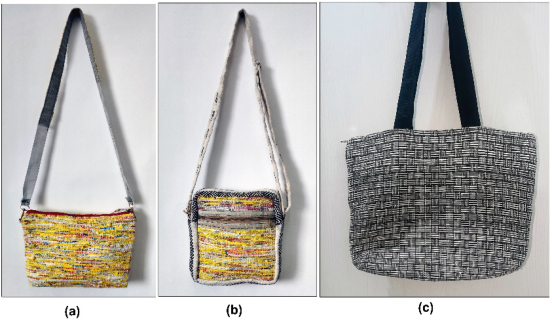
environmentally sustainable while still meeting their goals. They can effec- tively use the weaving surface as an instrument for expression by using this medium to communicate their intended messages either directly or indirectly (Metlio˘glu and Sürmelio˘glu, 2023). To create the fabric, collected plastic packets were cut into 1/2-inch thin strips and woven on a handloom in differ- ent levels of intricacies. Products like sling bags and laptop bags were chosen for development from the crated fabrics. To analyze preferences regarding green purchasing and aesthetics, three categories of products were made and exhibited: high functionality with low aesthetics, functional aesthetics, and high aesthetic products with intricate patterns. The first range of product (a) was made directly from this fabric, including sling bags, laptop bags, and travel pouches were priced between Rs 400–1000. The second range of prod- uct (b) combined this fabric with trending hemp fabric to create products with catchy patterns priced between 600–1400. The third range of product (c) focused on craftsmanship, sorting plastic by color and weaving it into intricate patterns priced between 1000–2000 (Figure 1).
Figure 1: Diverse product ranges: (a) high functionality with low aesthetics, (b) func- tional aesthetics, (c) high aesthetic appeal.
The third range of products got the highest sales, indicating that users were willing to pay a premium for high-aesthetic products with the same functionality. This highlights a disparity in user behavior, where aesthetics can subconsciously influence purchasing decisions alongside functionality for upcycled functional art products. Customers’ first impression of a product is usually formed by its aesthetics, which are strongly related to visual cues and greatly influence how they view the product in general. For products that don’t differ much from competitors in terms of price and usefulness, this visual appeal becomes very important. As a result, clients’ satisfaction levels and purchase decisions are greatly influenced by aesthetics. Further- more, aesthetics emphasizes the wider significance of emerging technologies beyond only their aesthetic appeal by helping to ensure their successful adop- tion and uptake in society (Han, Forbes and Schaefer, 2021). This suggests that Designers or Businesses working with Upcycled products have to keep in
mind that While functionality remains crucial, incorporating visually appeal- ing elements into sustainable designs is essential to cater to consumers for the widescale desirability of such products.
CONCLUSION
In conclusion, this research offers valuable insights into the efficacy of upcy- cled functional art being used as lifestyle products as a means of addressing the environmental challenges posed by multi-layered plastic pollution. The positive feedback and interest expressed by participants indicate a grow- ing recognition of the environmental impact of single-use plastics and a willingness to support innovative solutions. The developed products gath- ered positive feedback from environmentally aware users, highlighting the potential market demand for such sustainable alternatives. Such readiness offers manufacturers and marketers the chance to create and promote a wide range of environmentally friendly products without having to worry about their costs going up (5–40%) because of re-engineering the production pro- cess, using recyclable materials, or using sustainable packaging (Chekima et al., 2016). This allows marketers to concentrate on improving the design, performance, quality, and value of green products.
The study brings out the design considerations of upcycled functional art products made from plastic waste that can increase their likelihood of being purchased by consumers. By harnessing creativity, innovation, and commer- ciality, this approach demonstrates a viable pathway toward waste reduction, environmental awareness, and design opportunities. Although it is believed that this study’s experimental approach to MLP upcycling can somewhat lessen the pollution the packaging produces, it is hoped that a more intensive upcycling approach would raise awareness of environmental issues in soci- ety as highlighted by a similar study of weaving single-use plastic carry bags (Metlio˘glu and Sürmelio˘glu, 2023).
Further research should invest efforts in taking steps in the design direction of industrializing such approaches to make more functional, more aesthetic products at appropriate costs out of plastic waste. This shall create more demand for such products in people’s daily lives leading to more demand for segregated single-use plastic waste which can trigger a meaningful behaviour change in society. Ultimately, it can be stated that by embracing the approach of upcycling and design thinking, it is possible to reduce environmental plastic pollution and cultivate a culture of environmental responsibility.
ACKNOWLEDGMENT
The author sincerely appreciates all the users who participated in this study. Your invaluable contributions and feedback were crucial in shaping the research and enhancing the quality of our findings. This work would not have been possible without your active involvement and cooperation.
Transforming Multi-Layered Plastic Waste Into Upcycled Functional Art 65
REFERENCES
Alhazmi, H., Almansour, F. H. and Aldhafeeri, Z. (2021) ‘Plastic waste management: A review of existing life cycle assessment studies’, Sustainability (Switzerland). MDPI AG. Available at: https://doi.org/10.3390/su13105340. Anderson, A., Chandralingam, R. and PraveenKumar, T. R. (2021) ‘Impact of
COVID-19 pandemic on plastic surge and environmental effects’, Energy Sources, Part A: Recovery, Utilization and Environmental Effects [Preprint]. Available at: https://doi.org/10.1080/15567036.2021.1900456. Bridgens, B. et al. (2018) ‘Creative upcycling: Reconnecting people, materials and place through making’, Journal of Cleaner Production, 189, pp. 145–154. Available at: https://doi.org/10.1016/j.jclepro.2018.03.317. Chekima, B. C. et al. (2016) ‘Examining green consumerism motivational drivers:
Does premium price and demographics matter to green purchasing?’, Journal of Cleaner Production, 112, pp. 3436–3450. Available at: https://doi.org/10.1016/j. jclepro.2015.09.102. Crabbe, A. (2012) Upcycling: Where function follows form. evans kwadwo donkor (2022) ‘Garbage In, Garbage Out’ Disposal of Waste: A Concept for Reviving Plastic Waste into Art Objects. Evans, S. and Münster, M. B. (2022) Designing for a Circular Economy. Available at:
https://www.researchgate.net/publication/359992233. Geissdoerfer, M. et al. (2017) ‘The Circular Economy – A new sustainability paradigm?’, Journal of Cleaner Production. Elsevier Ltd, pp. 757–768. Available at: https://doi.org/10.1016/j.jclepro.2016.12.048. Han, J., Forbes, H. and Schaefer, D. (2021) ‘An exploration of how creativity, func-
tionality, and aesthetics are related in design’, Research in Engineering Design, 32(3), pp. 289–307. Available at: https://doi.org/10.1007/s00163-021-00366-9. Kaiser, K., Schmid, M. and Schlummer, M. (2018) ‘Recycling of polymer-based multilayer packaging: A review’, Recycling. MDPI AG. Available at: https://doi.org/ 10.3390/recycling3010001. Liobikien˙e, G., Grinceviˇcien˙e, Š. and Bernatonien˙e, J. (2017) ‘Environmentally
friendly behaviour and green purchase in Austria and Lithuania’, Journal of Cleaner Production, 142, pp. 3789–3797. Available at: https://doi.org/10.1016/ j.jclepro.2016.10.084. Maniatis, P. (2016) ‘Investigating factors influencing consumer decision-making while choosing green products’, Journal of Cleaner Production, 132, pp. 215–228. Available at: https://doi.org/10.1016/j.jclepro.2015.02.067. Marrin, D. L. (2014) Functional Art and Water Science. Available at: https://www.re
searchgate.net/publication/270050466. Metlio˘glu, H. H. and Sürmelio˘glu, L. ¸S. (2023) ‘An Experimental Research on Upcycling of Waste Plastic Bags in Weaving Design’, Tekstil ve Muhendis, 30(129), pp. 52–60. Available at: https://doi.org/10.7216/teksmuh.1272279. Ministry of Housing & Urban Affairs, G. of I. (2019) Plastic Waste ManageMent
issues, solutions & case studies. Available at: www.mohua.gov.in. Sung, K. (2015) A Review on Upcycling: Current Body of Literature, Knowledge Gaps and a Way Forward. Available at: https://www.researchgate.net/publication /299559229. Sung, K. and Cooper, T. (2015) ‘Sarah Turner – Eco-artist and designer through craft-
based upcycling’, Craft Research, 6(1), pp. 113–122. Available at: https://doi.org/ 10.1386/crre.6.1.113_1. Wijekoon, R. and Sabri, M. F. (2021) ‘Determinants that influence green product purchase intention and behavior: A literature review and guiding framework’, Sustainability (Switzerland). MDPI AG. Available at: https://doi.org/10.3390/su 13116219.
Yadav, R. and Pathak, G. S. (2016) ‘Young consumers’ intention towards buying green products in a developing nation: Extending the theory of planned behavior’, Journal of Cleaner Production, 135, pp. 732–739. Available at: https://doi.org/10. 1016/j.jclepro.2016.06.120. Young, W. et al. (2010) ‘Sustainable consumption: Green consumer behaviour when
purchasing products’, Sustainable Development, 18(1), pp. 20–31. Available at: https://doi.org/10.1002/sd.394.
LISTED IN THE AHFE DIGITAL BOOKSTORE CATALOGUE
Explore the complete digital volume
Design for Inclusion
Read this individual research paper free through the original publisher, or explore the full digital proceedings book.
ISBN 978-1-964867-04-5
Explore this ISBN in the AHFE Bookstore ↗Listed in the July 2026 bookstore catalogue; search by ISBN to confirm current availability · Digital book purchase optional