Giles Balbinottia, Grazielle Coutinhob, Leandro Vieirac, Leandro Wiemesd (2022). The Inter-Relationship Between Socio- Technical Systems and the Principles of Environmental Sustainability in the Pursuit of Quality of Work Life, Productivity and Pollution Prevention. In: Advances in Ergonomics In Design, Usability & Special Populations: Part III. AHFE Open Access, vol. 20. https://doi.org/10.54941/ahfe1001328
Publisher statistics will load when you open Metrics.
AHFE OPEN ACCESS OPEN ACCESS CONFERENCE PROCEEDINGS PAPER
The Inter-Relationship Between Socio- Technical Systems and the Principles of Environmental Sustainability in the Pursuit of Quality of Work Life, Productivity and Pollution Prevention
For Du Roy (1992), joint development or socio-technical design is a term coined in the United States to designate the joint development of social and technical systems. So it was intended to implement the joint design as an alternative to a challenge to the dominance or sovereignty of the technical design that refuses or neglects to take into account the question of "how the technology will be used." According to Capra's vision, sustainable not only refers to the type of human interaction with the world that preserves or conserves the environment to avoid compromising the natural resources of future generations, but a complex function, which combines a special way the state variables related to the aforementioned characteristics. Therefore, this paper aims: to present a theoretical discussion about the correlation between socio-technical principles and principles of environmental sustainability. The research will be done by means of qualitative analysis and exploratory study based on direct and indirect documentation. This is expected to show no correlation between the existing standards, and if it is possible to provide benefits, break paradigms and encourage developments in the topics under study, in order to verify the technical feasibility to correlate Quality of Working Life and Environmental Sustainability.
Socio-Technical School The history of Socio-Technical School starts next to the coal mines of Durham, in northern England in 1949, when some researchers from newly created Tavistock Institute of Human Relations were called to analyze the problems of mechanization of mining processes. (Biazzi, 1994).
The concept of socio-technical systems was established to emphasize the inter-relationship between humans and machines in order to promote the program to adapt the technical and social conditions of the working environment, so that efficiency and humanization do not contradict the throughout the process (Ropohl, 1999).
The work of extracting coal was then carefully examined by Eric L. Trist and Kenneth W. Bamforth. Given the multidisciplinary nature of Tavistock, mainly based on psychology and sociology, this analysis sought to describe and inter-relate the technical, organizational, social and psychological work performed under the extraction method of long walls aspects. Thus was coined for the first time, the term which can call "socio-technical analysis", published in 1951 (Biazzi , 1994).
Thus, the concept of organizational choice arises. A given organization of work is not only due to the technology used, but depends, in addition to our technical expertise, our assumptions about individuals and all our goals, whether explicit or not. Coal mines, the same technology could be supported by different organizational forms, with different economic results and humans. Moreover, the method consists of long walls was against another of the most important fundamentals of Scientific Management, which principles have actually sustained mode of production enterprises, despite the apparent existence of different forms of organization. Rather than preach the Scientific Directors, the project did not fit the job only to specialists. Although no changes in the design of the machines, the design of the organization of work fell to Chopwell miners themselves, the workers, the design was then partitioned (Biazzi , 1994) .
Thus, the models and structures that motivate the work are unique. However, the Socio-Technical School believes that the behavior of people towards work depends on the mode of organization and content of work tasks to be performed, since the duties and feelings related to them - responsibility, achievement, recognition, among others - are essential for the individual to remove pride and satisfaction in their work.
For Du Roy (1992), socio-technical design, is a term used to describe the joint development of social and technical systems. Thus it was intended to implement the joint design as an alternative to a challenge to the predominance or supremacy of technique conception that refuses or neglects to take into account the question of "how technology will be used." This is an important issue that cannot be ignored. Especially technical professionals, who take care of facilities, machines and devices manufacturing, begin to consider the variability in people and their conceptions of industrial organizations, and also the issue of environmental sustainability in the workplace. The technical system (devices, equipment, buildings, civil works) and the social system (workers' characteristics in terms of age, sex, education and training, cultural training, expectations, etc.) should be considered together in the design and improvement of manufacturing processes. For this, the goal of socio-technical design is the joint optimization of social and technical (Mumford, 2006) systems. The meeting point of these two systems is the organization, as illustrated in Figure 1.
This approach seeks to jointly develop the technical investment and organizational structures. The social and organizational problems described above are to be generated while the technical modifications. Companies need to include from the project activities, job enrichment through a participatory model. Industrial projects are early designs "poor", it means that are purely technical. Enhance a project is also dealing more particularly the areas of social and technical interface, and that if not taken into account, tend to be set only from the technical approach (DU ROY, 1992).
Company's objectives
Figure 1 - Interaction between social and technical system (From: Du Roy 1992) The socio-technical approach is an application field of study design situations where complexity is inherent and involves technical and social aspects (Erickson, 2009).
The enrichment of a project operates in all stages of the project, both at the time of the definitions of goals and the lifting of overloads on existing work situation of reference, as in the studies for the establishment of specifications. This enrichment involves a multiplicity of actors unaccustomed to participate in a process of conducting the project.
Environmental Sustainability Understand the concept of sustainability is far beyond what can be converted into practical actions for the maintenance of natural systems to provide the human species and other existing living species on the planet, the capacity and the possibility of subsistence. In this context, it is possible to say that the term Sustainable Development refers to a basic condition of survival for hundreds of years was not considered human beings: "Exist without degrading". Remove the inputs necessary for survival and turn them into goods and return them to their origins, considering the capacity of the biome in receiving and processing such large changes, is key to the sustainability of humanity.
The first international meeting on theme environment and development was held in Stockholm, Sweden, in 1972. According to Rattner (2009), the concept of sustainability was coined in the Brundtland Commission report, published in 1987, entitled "Our Common Future". The representatives of the countries agreed on the preparation of Agenda 21 in which goals and strategies were related for the main obstacles to development, from local, regional, national and even international. Although, there were many critical during this process, the principle encouraged the general positivism for achieving a sustainable world.
Given the literature survey and taking into account the approach that Du Roy (1992) cited in Figure 1, it is possible to extrapolate the concept to expand the approach adopted by then covered items and consider the environment as the system participating effectively in the conceptualization given by the article. Thus, as suggested by the authors of this work, from Figure 2, the environmental approach consists of a system that involves suffering and implications of technical and social systems and to the same degree, contributes to the strategic orientation of the company and is effectively part of the objectives established by the organization.
Assessing sustainability as a strategy to enable the development, comprehensively presented in the Brundtland Report, Cavalcanti (1994) confirms the explanation of the concept of sustainability arguing that the passage of the current world disintegrated into a world where development is sustained (with its implicit improved quality of life) requires radical migration of this reality of global unsustainability to another civilizational model. Similar transition depends in large part on profound changes in the theory of knowledge and science in general. Furthermore, the principles, assumptions and basic presuppositions of science, its paradigms, finally signs have very important in terms of direction of approach of a sustained economic society. Broadly suggests that existing practices are not effective from the point of view of environmental and new systems work procedures that culminate in new features and patterns to minimize and even eliminate the effect of existing degradation are developed. So, you can get processes with sustainable configurations with beneficial implications for society
Company's Objectives
Organization
Technical Environmental System System
Social System
Figure 2 Interaction between social and technical system (From: Du Roy 1992).
From an environmental perspective, and taking into account the new precepts increasingly widespread in business context, it is necessary to establish a culture change in order to establish a new system of thought, as it is supposed environmental sustainability organizations. According to the definition established by Capra (2006) sustainability is consolidated through a complex organizational pattern that is divided into five key characteristics, namely: inter- dependency, recycling, partnership, flexibility and diversity.
The increasing development of goods and services has provided society with an odd moment with regard to its evolution. New technologies, electronics and modern manufacturing techniques are great allies of industries and service providers to come up with increasingly accurate levels of production and quality. Associated with this development is the increasing exploitation of natural resources and non-recovery and / or reuse of the waste generated in many different steps of the manufacturing processes.
According to Alves, 2008, the first issue to be considered is "what it is and how Corporate Social Responsibility arose "? It can be said that the expression consists of a continuous and progressive process of involvement and the development of citizenship skills and enterprise, with the assumption of responsibility for all related stakeholders with whom it interacts environmental and social issues: body direct employees (workforce), partners and shareholders, suppliers, customers and consumers, market and competitors, government, media, community and the environment itself.
Can be defined as socio-environmental alliances forms of relationships between firms involving exchange, sharing or co-development of products, technology or services, with the objective of implementing policies and activities that include at least one partner nonprofit and non-economic goals, ie, goals focused on improving the welfare and preservation of the environment.
As shown Coutinho et al. (2009), understand and act on environmental issues goes beyond just dictate. You need a balance of forces that must interact in sync to establish the maintenance of natural resources. This timing is through the performance and application of appropriate and environmentally conscious acts. One must be aware of the impact of human actions on the environment, which will occur from the time when accurate information mechanisms and characteristics of environmental impacts are well identified, quantified and justified.
METHODOLOGY
The study presented is characterized as a bibliographical survey, structured consultations in articles and books. Formula for exploratory hypothesis of correlation between systems to gain new insight or relationship between component elements, and may be used subsequently to develop new research. Descriptive as it presents facts in order to identify the relationship and connection between phenomena. Qualitative exploratory and observational, it aims to exploring materials for proposing new situations (HART et al, 2007).
The mapping, description and classification of phenomena and events are conducted through the case study method (Yin, 2010) and focuses on the research on the application of socio-technical principles and environmental sustainability in an automobile industry. It also seeks to answer the specific questions in addition to worrying about a level of reality that cannot be quantified, MINAYO (cited Lakatos and Marconi, 2004).
By applying the technique of deduction is intended to build a logical structure, so as to make explicit truths taken private. By the inference technical, conclusions are drawn up by a mental operation leads to the conclusion that something known from the premises, thereby establishing a logical continuity.
The main features of this study are the bibliographic queries, developing hypotheses with the interpolation of structural elements of socio-technical principles with environmental sustainability character, in order to identify their correlation with the improvement of the quality of work life, improved productivity with the prevention of pollution.
The section certainly could be used as input in the reasoning, structuring and discussion of future work, contributing significantly in the dissemination of knowledge.
RESULTS
The development of the literature search was not successful in identifying studies that did analogy to the topic discussed here. Analyzing the terms separately there is relative amount of material, but a huge shortage in terms of the topic, subject of this study.
The structure of the paper is the analysis of actual elements of the automotive industry, among which can be cited:
Environmental Training - DOJO (in Japanese - definition which designates the location where the training takes place) - achieved through dissemination of theoretical and practical activity;
Ergonomics and waste disposal - use of appropriate personal protective type of work equipment, but with a focus on proper disposal of them after use;
Environmental Liability Partner - operational training taking into account the proper disposal of waste, strengthening the relationship between man and environment;
Implementation of new chemicals - development methodology taking into account aspects related to individual and collective protection, as well as advice from experts in the field of medicine and safety.
The lack of visibility when identifying the interface between the theme and you get as results outas research demonstrates difficulty in establishing elements that may constitute significant contributions to promote analysis and/or discussions about this approach.
Therefore, it can be seen that it is of significant importance the study presented here.
Considering the practical part of the whole approach set out above, a methodology that allows unifying the concepts presented consists in performing kaizen (continuous improvement) in jobs. The application of this systematic preserves the specifications recommended by the organization, while encompassing social and environmental approaches. Also contributes to the development of an action with a holistic process in which performs the analysis and fosters discussion to constantly promote continuous improvement. The initial analysis considers the situation of the job analysis in making a comprehensive assessment of the slopes of gain that can contribute in order to develop new opportunities or new concepts within the systems discussed in Figure 2. The comparison to the initial situation is presented and the gains are measured.
In the context of the production environment, review of a specific part of the application of sealants sector masses, which performed manual operations of application of sealant based on PVC (polyvinyl chloride), responsible for ensuring the tightness of the vehicle was taken. In this process the applications were sprayed and performed by two operators. However, operational monitoring was performed and identified that the product consumption was very high for the type of application envisaged. Faced with this observation, it was suggested by the methodology of kaizen, modify how the application performs the product. The operation was then modified to extruded, it consumes less product, but it requires greater skill by the operator.
Thus, for the deployment of new applications were considered necessarily the individual skills of each operator, in order to organize the workforce so that all operators were able to develop the modified operation, ensuring the quality of the operation. With the implementation of this modification, it was possible to obtain an increase in technical capacity of each operator who performed the operation, because besides the ability to perform the operation, there was also need for specific attention regarding the investments made, because if there misapplication, that would imply a non- tightness of the vehicle, favoring a possible claim by the end user of the product (car). Whereas under the main focus of the article , this modification the following elements were taken into consideration: 1 ) social aspect - the same operational and ability to perform the proposed modification, 2) technical aspect - changes the type of operation and capabilities needed for conducting the new operation , requiring changes in operating methods, 3) environmental aspect - reduced consumption of chemicals (PVC ), also contributing to less waste because the previous process generated significant amount of waste and greater consumption of sealant .
The modification in question required a strong implication on the part of operators, assigning an important socio- environmental responsibility. The fact reduce the material consumption is extremely important from an ecological point of view condition because it is characterized as an attitude of preservation of natural resources. Importantly, the DOJO training was extremely implication for ecological awareness, favoring environmental training.
Under the ergonomic aspect, there was a change in working conditions, the fact of the previous operation occur in powdered form, favored with the operator to develop the application using only one hand throughout the workday. From the proposed amendment, it was necessary to perform the operation with both hands, which favored a better ergonomic balancing of the upper limbs (arms and hands), because the operation is performed on critical job because the operator's hand always be above his head. However, the result obtained at the end of the implementation of the modification consisted of zero complaints with muscle pain in the upper limbs.
In this case there was no modification of the chemical (based on PVC). However, in certain situations, there is need for modifying chemicals as they may be elements that can impact the health of operators. For these specific cases, there is the need to register the new product with the environmental team of the company. Moreover, it is necessary to inform the relevant data in a meaningful product that you want to deploy. Among them is the Product Datasheet (data sheet), its use and location of use, storage, handling, chemical reactivity, among others. The document stating the proposed amendment is sent to the Department of Environment, which is responsible for obtaining the advice of the doctors and technicians work for approval or not the product in question. This is an activity that occurs systematically and favors the management of chemicals and industrial waste (generators possible environmental aspects), but it contributes greatly in the social aspect, because the company has extensive knowledge about what a given chemical can cause, and how should be spared to ensure that it is not harmful to the health of operators.
Besides the factors mentioned above, here are some points that can be considered significant for the company:
Consider all elements of the production system to balance the equation for money.
Reduced consumption of the product must take into account the operation, product features and individual, and the process.
The addition of two jobs may represent a reduction of one tenth of chemical consumption (sealant based on PVC) and an improvement in the quality of work due to distribution, ergonomically critical to operations (hand above head).
A very important element in this process becomes the Law No 9795, of April 27th 1999, which in Article 1 on environmental education versa the individual and the collectivity build social values, attitudes, knowledge, skills and competencies for the conservation of the environment and its sustainability. The Act sets out the factors to consider in the coming project:
Kaizen - improving the workplace, focusing on ergonomics and the environment, it is possible to unify the elements of the job, reduce waste of raw materials chemicals, energy and water.
ISO 14001 - Promotes continuous improvement of processes to encourage pollution prevention.
Figure 2 presents the main points that an analysis of the environmental and socio-technical interpellation can show the viewpoint of prioritizing elements. It is noticed that this analysis aspects of human competence is a priority and that the use of chemical substances and the presence of noise in industrial activity are key elements for the identification of environmental risks and the priority actions for maintaining balance between work conditions and productivity.
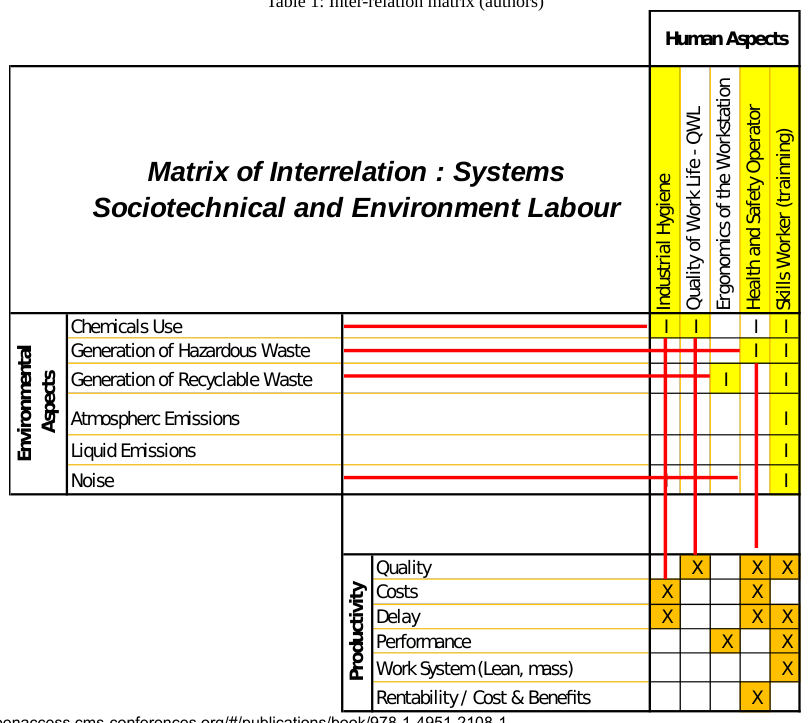
Making an analogy to a chemical modification of PVC by the example), the interrelationship matrix should be considered as described below, in Table 1.
The inclusion/modification of a chemical have a direct effect on an environmental aspect and by itself makes the following human aspects must be identified: industrial hygiene, quality of work life, health and safety of the operator. In turn, each of the Human Aspects generate impact on productivity, directly affecting the cost and time of industrial hygiene (which may be the cleaning operation, for example), the quality for the QWL (quality of work life) quality, cost, schedule and profitability/cost & benefit for the health and safety of the operator and the quality, maturity, and performance work system (lean, mass).
Besides the aforementioned interrelations may be other aspects that generate impacts with the use of chemicals, such as the generation of hazardous waste, and each must be evaluated.
Therefore, the purpose of the matrix is to provide a working tool to promote inter-relationship with many aspects that can be generated in a work environment. Moreover, the matrix contributes significantly to establish a correlation between socio-technical systems with the environment, providing advantages for all involved in the organization.
Table 1: Inter-relation matrix (authors)
An important component of the human systems integration plan should be a verification and validation process that provides a clear way to evaluate the success of human systems integration. The human systems integration team should develop a test plan that can easily be incorporated into the systems engineering test plan. The effectiveness and performance of the human in the system needs to be validated as part of the overall system. It may seem more attractive to have stand-alone testing for human systems integration to show how the user interacts with controls or displays, how the user performs on a specific task. This methodology can address the performance of the human operator or maintainer with respect to the overall system. The most important thing is to develop a close relationship between human systems integration and systems engineering.
CONCLUSIONS
It is possible to identify the interrelating socio-technical aspects of environmental elements within the production context. The analysis identifies the main elements of productivity affected by the direct relationship of human and environmental aspects, such as: Quality, Cost and Timing. Furthermore, a quantitative weighting allow the possibility of prioritizing actions and investments to improve the quality of life in the workplace thus avoiding losses and wastage balancing the results of company performance conditions in the workplace .
The study also allows for processes to list elements and Environmental Condition accreditation work simultaneously, indicating the possibility of implementation of integrated management systems, aiming to optimize the allocation of human and financial resources, in addition to better prioritization of actions and minimizing risks.
A comprehensive overview of elements commonly treated in isolation companies may reflect the change in critical thinking and openness for large corporations to affect a broader awareness of their management processes and encourage a holistic view of the business as a common good for society and the planet.
It is recommended for future work detailed testing of the integrated certification and application in product design and industrial design process.
REFERENCES
Alves, E. Dimensões da responsabilidade social da empresa: uma abordagem desenvolvida a partir da visão de Bowen, R.Adm., São Paulo, v.38, n.1, p.37-45, jan./fev./mar. 2003 Biazzi, Fábio - O Trabalho e as organizações na perspectiva sociotécnica, 1994. Capra, Fritjof. O Ponto de Mutação: A Ciência, a. Sociedade e a Cultura Emergente. 25. ed. São Paulo: Cultrix, 2006. Cervo, Amado Luiz, et al., Metodologia científica, 6ª edição, São Paulo, Pearson Prentice Hall, 2007. Clóvis Cavalcanti (Org.) et al, DESENVOLVIMENTO E NATUREZA: Estudos para uma sociedade sustentável.
INPSO/FUNDAJ, Instituto de Pesquisas Sociais, Fundação Joaquim Nabuco, Ministério de Educação, Governo Federal, Recife, Brasil. Octubre 1994. p. 262. Disponível na internet em: http://168.96.200.17/ar/libros/brasil/pesqui/cavalcanti.rtf Coutinho, Grazielle A. et al., Educação ambiental aplicada na indústria automobilística, VI Congresso de Meio Ambiente da AUGM, Universidade Federal de São Carlos, São Carlos, 5 a 8 de outubro de 2009. Du Roy, Olivier. L´Usine de L´Avenir – Gestão Sociotécnica do Investimento – Métoos Europeus; 1992. Erickson, T. Sócio-Technical Design. In: WHITTHORTH, B; MOOR, A. de. Handbook of Research on Socio-Technical Design
and Social Networking Systems. P. 334-335. New York: Information Science Reference, 2009. Guérin, F. et al. Comprendre le Travail Pour Le Transformer. La Pratique en Ergonomie. Paris, Ed. ANACT, 1991. Gontijo, Leila. A.; Souza, R. J. Macoergonomia e análise do trabalho. In: Anais... II Congresso Latino Americano e VI Seminário Brasileiro de Ergonomia, Florianópolis, 1993. Hendrick H. W. Human factors in ODAM: the future. Humam factors in organizational design and management. [s.l], 1994. p.6-
9. Hendrick, H. W; Kleiner, B. M. Macroergonomics: introduction to work system design. Santa Monica, CA: Human Factors and Ergonomics Society, 2000. Lakatos, E.M. e Marconi, M.A., Metodologia Científica, 4 ed. São Paulo, Editora Altas, 2004. Mumford, E. The story of socio-technical design: reflections on its successes, failures and potential. Information System Journal,
v. 16, n. 4, p.317-342, 2006. Rattner H. Revista Espaço Acadêmico, nº 95, abril de 2009. Ropohl, G. Philosophy of Socio-technical systems. Society for Philosophy and Technology, v. 4, n. 3, 1999.
LISTED IN THE AHFE DIGITAL BOOKSTORE CATALOGUE
Explore the complete digital volume
Advances in Ergonomics In Design, Usability & Special Populations: Part III
Read this individual research paper free through the original publisher, or explore the full digital proceedings book.
ISBN 978-1-4951-2108-1
Explore this ISBN in the AHFE Bookstore ↗Listed in the July 2026 bookstore catalogue; search by ISBN to confirm current availability · Digital book purchase optional