Rosângela Míriam Lemos Oliveira Mendonçaab (2022). Ergonomics’ Valorization through the Systemic Design – Innovation for an Active Society. In: Advances in Ergonomics In Design, Usability & Special Populations: Part III. AHFE Open Access, vol. 20. https://doi.org/10.54941/ahfe1001319
Ergonomics is a discipline concerned with human well being and in making resources adequate to human activities. Nevertheless we witness that the pressure of the market, regarding economy of time and resources make activities that involve optimization, such as ergonomic planning, design and evaluation, be penalized by the cuts performed by the industry. On the other hand, customers do not make a firm demand for ergonomic qualities which are not easily recognizable and can be complex to be designed and evaluated. Therefore the resource to protect human well-being regarding the resources available for them to develop their activities exists but is not well known or even recognized.This work proposes the valorization of Ergonomic activities by means of joining forces with the Systemic Design methodology in the development of strategies for increasing the awareness of customers. It also presents an instrument, the model of Systemic Network of Integral Endeavors, to be used to create strong network of businesses that are fully sustainable and that understand the importance of the respect for the customer.
Ergonomics is a discipline concerned with human well being and in making resources adequate to human activities. We can refer to a Product Design, where the focus of attention is on the user and the referred activities are related to the use of the product or a Process Design, where focus is on the worker that has to build the product and therefore the concern is related to the production activities.
Regarding Process Design, Ergonomic methods are used to assess health and safety of work. They consider risks of postures, manual material handling, hand intensive repetitive tasks, unfavorable conditions such as working on moving objects, vibration, counter shocks, impulses, extreme joint postures (especially the wrist), time distribution of repetitive tasks, etc. In most countries this assessment is part of labor laws, and therefore the industries are constrained to adopt workplace safety measures and processes. Their reasons are either to abide the law or to keep the worker productive, even because if the worker proves to have a health problem as a consequence of his work he can ask for a leave, what would, in some way, disrupt the work. Ergonomic methods can be used for risk assessment in all phases of production – in the design phase when the geometry of the product, its components and assemblies are roughly defined; in the product design and development phase, when the product is detailed and the manufacturing process is defined; in the layout design and planning, when assembly process, logistics and supply chain are defined; or during process time management, when it is being effectively produced. The later a problem is detected, the more costly is its solution. If involved early in the design phase, based on the results of ergonomic screening methods, designers may identify and eliminate the bottlenecks or even unviable details; if problems are detected in the production phase, planned procedures are already set and the possibilities to change the process are limited.
Concerning the Product Design, ergonomics is related to the development of the product so that it suits best the needs of its user. It consists of improving the characteristics of the systems in term of operability, maintainability, usability, comfort, security and health aiming at increasing the efficiency of the interaction between the people and the systems and reducing the probability of incidents, damages and faults. (San Jose State University, 2014). This is a work of optimization, which means the employment of further resources.
Nevertheless we witness that the pressure of the market, the need to cut costs and to produce ever more in a shorter time, make activities that involve optimization, such as ergonomic planning, design and evaluation, be an important subject of the cuts performed by the industry.
COSTUMER, ERGONOMICS AND THE INDUSTRY – OPPOSITE SIDES?
Traditionally the main objective of a business is to maximize its profit. Increasing sales and reducing costs are the most straightforward strategies. Tests in general, are reduced to the mandatory minimum (or, if possible, even totally suppressed) since they mean more production time and expenses. The deployment to the market of new versions of products has an ever shorter time cadence.
Consumers are treated as targets to be hit by the industry and in order to do so, not rarely, the market promotes products consumers do not need, maximizing on the advertisement of their benefits and effectively offering the minimum quality possible. Users not even have enough time to learn and fully profit from the product. The production of waste has increased in an exponential rate and the level of quality required to the products has significantly lowered – (after all, they are “disposable” and will soon be substituted by the next generation).
This is part of a linear approach of production where primary resources are used to generate a product that will be consumed by the society and, what exceeds either from the production process or the use of the product, becomes waste. The more the society consumes the better for the industry; the shorter the production cycle, the better.
The Systemic Design Principles The Systemic Design is a methodology that stimulates a new way of seeing production, different from the usual linear approach. The linear productive model is focused on the objective of each single business, aiming at the increase of its production as means of maximization of its profit.
The Systemic Design, instead, is a methodology for the planning of a network of activities and products focusing on the environmental and cultural protection.
From the observation of the needs of our society for a healthier environment, it has been foreseen the need for an instrument to trigger, fertilize, systematize and encourage the development by seeing relations differently from the usual linear approach.
Currently, the production centers its value on the product. Based on the main product of an organization, the production is planned considering the linear sequence: acquisition of resources, their transformation into product and the commercialization of the product. Some industries, at most, include in their process: the opportunity of doing other businesses, considering the possibility of the selling or the donation of scraps of production; the planning about the recycling of packaging; and, eventually, the indication of the destination of the product when it reaches its end-of-life, that is, how it should be disposed. Most industries are focused on the maximization of production as means of maximization of profit. The production of waste is also considered a means of profiting – the earlier a product is dismissed the more products of a new production will be acquired. The intentional design and manufacturing of products with a limited lifespan to assure repeated purchases is called “Planned (or Programmed) Obsolescence” (Dannoritzer, 2010).
The Systemic Design instead, is a methodology for planning activities and production based on 5 fundamental principles (Bistagnino, 2011):
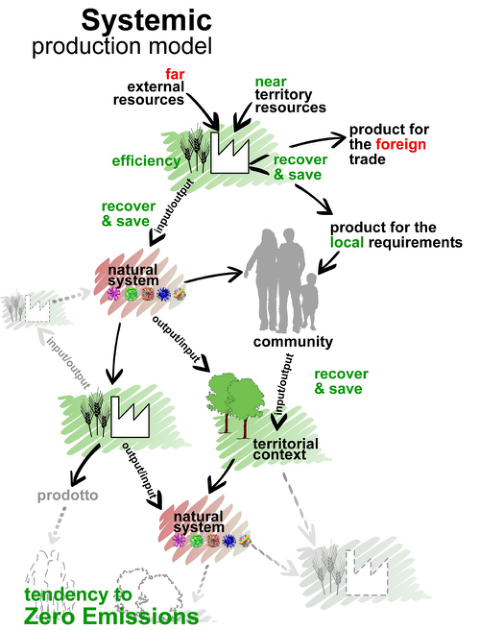
1. “OUTPUT/ INPUT: The output (waste) of a system becomes the input (resource) for another one, creating: an increase of cash flow; new job opportunities. 2. RELATIONSHIPS: The relationships generate the system: each one contributes to the system; the relationships can be within the system or outside of it. 3. AUTO-GENERATION: Self-producing systems sustain themselves by reproducing automatically, thus allowing them to define their own paths of action and jointly coevolve. 4. ACT LOCALLY: The local context is fundamental because it values local resources: humans, culture and materials; it helps resolve local problems by creating new opportunities. 5. MAN AT THE CENTER OF THE PROJECT: Man connected to own environmental, social, cultural and ethical context.”
Figure 1: Systemic Production Model - (Bistagnino, 2011)
The output/input cycle means the optimization of the use of resources. The systemic design process analyzes resources, processes and the whole products’ lifecycle. It is based on the principles of nature that uses the output of a system as a resource of another system. This creates a continuous flow of matter and energy minimizing waste. The full unfolding of the use of resources, using as resource of a business what remains from the process of production of another business (and nowadays is considered as waste) makes possible the creation of new equally important businesses. Here business is intended as any productive activity be it performed by the industry, a household, an individual or the nature. The network involves everyone, even from different biological kingdoms, who is in the position of extracting the best benefits of the resources. These new businesses open the possibilities for the elaboration of new products and for new entrepreneurs to emerge and also for new working relations to be established. Changing working and production environments brings changes to economy and social relations. The focus is the development, not of just one business, but that of the whole community.
The valorization of relationships, internal and external, is very important since no one element can be taken in isolation. This applies to products, considering its composing parts, or to a set of products, whose functionality is completed and improved by other product’s functionality. It is also relevant to peoples’ relationships since we depend on one another be it in psychological terms or in order to perform activities.
Within the context in which operations happen, although relationships can be internal or involve elements external to the system, local resources and culture are a priority and the globalization and monocultures, where products and activities are disconnected from the territory, should be avoided.
Interrelations of living systems with its environment trigger structural changes within the system. These changes alter the interrelations, what generates continuous structural change (autopoiesis). Living things adapt themselves, learn and develop continuously (Capra, 2008). It is then a continuous auto-generation cycle: living things change the system, that in its turn changes the living things.
Human well-being as a priority means that the understanding of the user and its culture must be a starting point for the definition of activities and products. The user is considered not as a target to market actions but as an active and aware member of the society, to whom information and choice should be given.
The New Role of Users There are various ways of involvement of the user in the development of a product, in different phases of a product creation and development; every time in earlier stages and in a more complete way.
Users can be involved in the eliciting of products requirements, in tests during the development of the product or tests to validate the “almost final” version of the product. Regarding tests, it is considered, and economically proved, that, in the development process of a product, the earlier a problem is found, the less expensive it is to solve it. And clients are valuable testers.
The role of the user can range from a living reference to be consulted whenever designers feel they require additional information, to the creator and constructor of a whole new product.
The User Centered Design, for instance, is a philosophy of design process that consists in involving the users, by talking directly to them, in various phases of the development of a product trying to understand their actual needs, requirements and comprehension of a product and its components. The ISO 13407 standard defines the essential activities of a user-centered design project, which may be characterized by a number of methods:
Requirements gathering: Understanding and specifying the context of use – Focus groups; Questionnaires; Interviews
Requirements specification: Specifying the user and organizational requirements
Evaluation: Carrying out user-based assessment – Usability testing; Questionnaires; Interviews.
The participants in these methods must accurately reflect the profile of your actual users. (Webcredible, 2006).
Nevertheless there are authors that question this methodology defending that a product improved for specific users may present problem to the others. The more adapted to the taste, abilities and needs of the ideal user the less adequate will be to the others.
“The individual is a moving target. Design for the individual of today, and the design will be wrong tomorrow. Indeed, the more successful the product, the more that it will no longer be appropriate. This is because as individuals gain proficiency in usage, they need different interfaces than were required when they were beginners. In addition, the successful product often leads to unanticipated new uses which are very apt not to be well supported by the original design.
But there are more serious concerns: first, the focus upon humans detracts from support for the activities themselves; second, too much attention to the needs of the users can lead to a lack of cohesion and added complexity in the design.” (Norman, 2005)
User-driven innovation differs from user centered design by the observation of the users rather than the use of questionnaires and focus groups in order to gain insights from them to be used in the innovation process.
Moving the role of the user from reference to creator, crowdsourcing is a distributed problem-solving and production model. In the classic use of the term, problems are broadcast to an unknown group of solvers in the form of an open call for solutions. Users – also known as the crowd – typically form into online communities, and the crowd submits solutions. The crowd also sorts through the solutions, finding the best ones. These best solutions are then owned by the entity that broadcast the problem in the first place – the crowdsourcer – and the winning individuals in the crowd are sometimes rewarded. In some cases, this labor is well compensated, either monetarily, with prizes, or with recognition. In other cases, the only rewards may be kudos or intellectual satisfaction. Crowdsourcing may produce solutions from amateurs or volunteers working in their spare time, or from experts or small businesses which were unknown to the initiating organization (Wikipedia, 2011).
Crowdsourcing can be used as a source of: online labour force, either by identifying and selecting workers or by posting the work to be accessed and performed by the community; solution to a problem; available knowledge search and organization; ideas, opinions and feedback. This can be used to: collect and organize information (Distributed Knowledge); raise money from many people that believe in your venture or cause (Crowdfunding); access on demand scalable workforce to perform large range of tasks (Crowd Labor); reach a diversity of creative people for idea generation and problem solving (Open Innovation); access the worlds’ creative communities to design and develop orignal art, media or content (Crowd Creativity) (Esposti, 2012).
Current Innovation Strategies Innovation is considered nowadays as an important “competitive advantage”.
“In many sectors, the technologic innovation has become the determining sector of competitive success: for the most part of the companies, to innovate is, at this point, an strategic imperative, fundamental to maintain and get a leadership position at the market, as well as to recover from a condition of competitive disadvantage.” (Schilling, 2009).
The innovation process, depending on the business strategy, can be started from a new invention that is pushed through R&D (“Technology Push”) or from the identification of a market need (“Market Pull” also called “Demand Pull”). The “Technology Push” strategy consists on developing a product (usually a radical innovation) starting from an idea or discovery from a scientific basic or applied research, which will then go under the design and development processes to be then produced and commercialized. In contrast, an innovation based upon market pull, the stimulus for innovation (generally an incremental innovation) starts from the needs of the society or of a specific market sector, being then developed by the R&D.
Design Driven innovations, according to Verganti, would be yet a third strategy that “do not come from the market; they create new markets. They don't push new technologies; they push new meanings. (...). It's about having a vision, and taking that vision to (...) customers. But where does the vision come from? (... from)"interpreters" - the experts who deeply understand and shape the markets they work in.” (Verganti, 2009).
Figure 2: Main focus and relationships between design and innovation methodologies and strategies
Figure available in the original PDF paper.
(based on Verganti, 2012)
That is to say that a group composed by experts such as designers, firms in other industries, suppliers, schools, artists, psychologists and the media analyse socio-cultural aspects in order to be able to create a product that explores the emotional, psychological and socio-cultural values of the customers. Their aim is to create products that customers don’t expect and that conquer them through passion. They work to develop global companies with “an unbeatable and sustainable competitive advantage through innovations” (Verganti, 2009b).
Product innovation is then seen as not “just a way to acquire competitive advantage, but (also ...) a question of survival, mainly for the enterprises that cannot exploit other sources such as the low cost of labour or privileged access to raw materials.” (Verganti, 2009b).
Innovation is undoubtedly a need, recognized by Design Driven Innovation and also by the Systemic Design. But while for Design Driven innovation is an instrument required for competition in market disputes for the Systemic Design it is the essence of a promising lifelong welfare.
But what is the problem with competition? After all, if we are to get inspiration from nature there is not only cooperation but also competitive relationships. The difference between market posture and that of nature is that, mostly, competition in nature is mainly a matter of defence, of self preservation; in the market instead the driving force is the attack in order to, ideally, be not only the dominant but the only one. In nature the need for resources, which are limited what makes competition a necessity, is defined by the requirements of living. In the market there is no limit to the ambition for resources and wealth – the more, the better.
The creation of products, of innovative products, is seen by the Systemic Design as a means of increasing society’s well-being. As it happens with Design Driven Innovation, it goes beyond the human centered approach of getting from clients the definition of what they need. Since it is impossible for one person to know everything that exists or will exist in every area of knowledge, it is fair that we have specialists that are focused in studying, learning and understanding specific subjects. Therefore these persons could foresee what could be created that could make a difference in our lives. Even because, when we talk about the knowledge of things, there can be defined 4 categories: things that we know that we know; things that we know that we don’t know; things that we don’t know that we know; and things that we don’t know that we don’t know. So sometimes we cannot even dream of something because we do not even have the awareness of its possible existence. Here comes the role of these design specialists that coordinate the invention of new things to improve our quality of life.
Figure 3: Innovation from the Systemic Design and Design Driven points of view
Figure available in the original PDF paper.
Although we talk about specialist knowledge, Systemic Design is inclusive, which means that it considers that everyone may be a protagonist and that knowledge must be shared. As in Design Driven Innovation, it believes in the strength of networks, but not only networks of expert interpreters. For the Systemic Design it is important to stimulate the conscious consumer. It is of its interest the evolution of loving witting customers, of users that have a participative role, acting in the conscious choice of their acquisitions, having the awareness that:
they buy what they need (not what the market imposes, be it in quality or in quantity);
they can also make part of the network being producers;
their culture and territory are very valuable, either as consumers or as producers.
Customers, Ergonomics and the Systemic Network of Integral Endeavors Ergonomic qualities are complex to be designed and evaluated. They are not easily recognizable and the human part is usually the one to be blamed if system does not work properly. Human difficulties (especially for the elderly) are considered as their fault, as lack of agility, strength or mental capacity.
Therefore the resource to protect human well-being in this situation exists but is not well known or even recognized. Ergonomists work for clients that do not know about the benefits of their work or think that there isn’t a good cost- benefit ratio. Besides they do not make a firm demand for ergonomic qualities nor fight for their right of having products and services with the quality of a good ergonomic development.
On the other hand, if the responsibility of creators is already being entrusted to customers, as happens in crowdsourcing, they should also be instrumented to do it properly. They should know about and recognize the value of ergonomic principles being able to use them in their creations and have access to advices from specialists that could take care of the attributes of the product that would guarantee its adequacy to the use.
All Systemic Design principles are important then to ergonomics. Specially the strategies that, not only put humans at the center of the project but explore two essential elements for them to gain respect as a market stakeholder – the knowledge and awareness of its culture, resources and needs, and the capability of taking active role in the network of relations.
On its turn, Systemic Design actions need multidisciplinary knowledge. Physics, chemistry, biology supply principles for the development of solutions for the optimization of energy and matter. Economic analysis gives feedback related to the feasibility of the business balance. Ergonomics supplies with the knowledge necessary to develop products that suit human physical, cognitive and organizational needs.
An important concept for a more positive relationship between enterprises is that, every business is essentially both a CUSTOMER and a PRODUCER. Therefore, in order to build the trust that is necessary for a collaborative network the attitude required for a supplier towards its customers should be the same as it would wish to be treated when in the position of a customer.
Besides, when planning the activities of a business it should be foreseen the hole network of business that should be created. Taking the Systemic Design principle that the output of a productive activity should become the input of another one leads to the necessity of the creation of this network in order to optimize the use of the resources. This optimization would mean extracting the most benefit possible from a resource. It would lead to the opportunity of new productive activities and the best use of a supply for the generation of means for good life standards, as well as the minimization of the production of garbage and its negative impacts to the environment.
Here we name “Business” every type of productive activity, be it performed by an industry, a household, an individual or the nature. This creates two new concepts: the Integral Endeavor, that refers to the business created by analyzing its holistic relations, and the Systemic Network of Integral Endeavors that refers to the network of such businesses. The network is then formed by every business that can extract the best benefits possible from the resources available. This leads even to different biological kingdoms, as it can be considered the productions of Fungi and the many processing of Bacteria, for instance.
The types of relationship regarding this flux of energy and resources can be either of SUPPLIER, COLLABORATOR, PARTNER or CUSTOMER, depending on what is exchanged and on the terms of agreement.
The products treated, from the point of view of one business can be main resources, semi-finished products, scraps, or waste. From the point of view of the recipient, it will be always a main resource, that shall be considered as “primary” as the main resource of the first company.
BUSINESS 3
BUSINESS 2
ACTION RESOURCE PRODUCT CUSTOMER
SUPPLIER
BUSINESS 4
ACTION RESOURCE PRODUCT CUSTOMER
BUSINESS1
COLLABORATOR/
CO-CREATOR
BUSINESS 7
PARTNER
CUSTOMER
BUSINESS 5
PRODUCT3 (scrap 2)
BUSINESS 6
Figure 4: The model that represents a Systemic Network of Integral Endeavors When looking internally in a business in more detail, in the role of a CUSTOMER it can be 1) a SOURCE OF INFORMATION (INFO) for the businesses that have supplied him with resources for his activity, giving feedback about the product or service, or participating in surveys that aims at understanding customers and their needs; 2) a PRODUCTION RESOURCE (RESOURCE), when it acts as one element of the Crowdsourcing by organizing information, volunteering for a task, generating ideas to solve problems, designing and developing original art, media or content and/ or 3) a SOURCE OF REVENUE ($), when it pays for its acquisitions or even participates in Crowdfunding actions.
Figure available in the original PDF paper.
Analysing the typical role of the business as a PRODUCER, there is this flux where there is an input of RESOURCES, that can be HUMAN or MATERIAL, (supplied by collaborators, partners, internal and external suppliers), that are transformed through activities/ ACTIONS, that become PRODUCTS to be supplied to customers or partners.
Sometimes, when planning a business, the reasoning begins from the product point of view, identifying the resources and actions that are necessary to produce it. From the point of view of the Systemic Design, it should begin from identifying the customer and his needs. In fact, though, it is not about a linear reasoning. It involves loops of back and forth adjustments since products, customers, resources and activities interfere with each other and they must be worked up to the point when they reach a good balance.
ACTIONS can be the actual activity of PRODUCTION, and also activities regarding COMMUNICATION, DISTRIBUTION or RECEPTION (including revenues). For each described ACTION, it must also be identified its CHANNEL, that is, its means of displacement to arrive to destination, and COSTS.
It is important to notice that, actions made in the role of a CUSTOMER, shall be treated as any other productive activity performed by the company, reasoned in terms of production, distribution and reception, and elaborating its DESCRIPTION, CHANNELS and COSTS.
Another important point is that, within the business itself there are many relationships of the CUSTOMER type, that is, there are activities that are performed for the internal supply – products that become resources for the business itself.
The Integral Endeavors are businesses that are sustainable in their very essence, since the origin of their conception and evolution is the optimization of resources, aiming at “zero waste” and giving priority to the use of local resources. This regards the depth and breadth of the measures as well as their longevity considering the business lifespan. If a business is born without this bias, sustainable measures become artificial, superficial and of difficult maintenance.
The Systemic Network of Integral Endeavors is the network formed by these Integral Businesses, that, in its turn, are planned by the identification of what is needed for the establishment and maintenance of a business. The elements that composes Osterwalder’s Business Model (Osterwalder, 2004) that is, Partners, Resources, Activities, Value Proposition, Customers Relationships, Customer Segments, Channels, Cost structures and Revenue Streams, are all present in the planning of an Integral Business. Nevertheless, the roles and relationships are more holistically understood. Instead of modelling a business in isolation, in an egocentric attitude, the planning includes the whole network. The desirable context is modeled encompassing businesses opportunities and possibilities of relationships to be created and maintained to favor sustainable development and quality of life.
This model, that embodies the Systemic Design principles, can be used to plan a network of businesses that have Ergonomics as a resource, be it as the main asset or as a complementary resource. It will be then a strategic instrument for ergonomists to identify the products and services that they can offer as well as collaborators, partners and the category of customers that will benefit from the solution delivered.
CONCLUSIONS
Ergonomics and the Systemic Design are complementary. Therefore they should join forces for the education of this new conscious citizen that is proud of his culture, aware of his own values and active through the dynamics of real activity networks.
In the Systemic Network of Integral Endeavors each business reasons not only about itself but also about how it can relate to the whole network, establishing a plan of action for new activities and a common language for the stakeholders. This model considers not only the economic aspects of businesses but also stresses the importance of relationships, of the optimization of resources (since an application should be found for each scrap or disposal) and the fair relation with customers. It allows every productive activity to be natively economic, social and environmentally sustainable.
The Systemic Network of Integral Endeavors model would be then an instrument for designers and ergonomists in the planning of their activities and in their mission as agents of transformation of consumers which are educated to demand the level of product needed for their quality of life.
It is a mistake to think that the Industry and Customers are in opposite sides. Every business has the role of a supplier when providing its product to its clients, but also it has the role of customer when acquiring the resources necessary to its production. So, each business, be it intended an industry, a house, an individual or the nature, has both roles of a customer and a supplier, and therefore the culture for the respect for the customer is also a benefit for itself.
Planning and implementing a strong network composed by designers, ergonomists and the industry is essential for their recognition as important allies for all citizens’ quality of life. This unfolds new values, meanings and priorities to innovation which is so important for the economic and social development of our society.
ACKNOWLEDGEMENTS
I would like to thank FAPEMIG – Fundação de Amparo à Pesquisa do Estado de Minas Gerais – for the support for the participation in this event.
REFERENCES
Bistagnino, L. (2011), “Systemic Design: Designing the Productive and Environmental Sustainability”, Slow Food Editore srl, 2nd Edition. Capra, Fritjoj (2008), “La Scienza della Vita Le connessioni nascoste fra la natura e gli esseri viventi.” P. BUR Scienza,
3ª edizione. pp.70-71 Dannoritzer, C. (2010), “Planned Obsolescence Documentary” – Internet Archive Website: http://archive.org/details/PlannedObsolescenceDocumentary - Consulted on September/ 2013. Esposti, C. (2012) “Crowdsourcing and Crowdfunding Explained.” Youtube Website: http://www.youtube.com/watch?v=- 38uPkyH9vI – Consulted in October/2013. Norman, D. (2005) “Human-Centered Design Considered Harmful.” Website: http://www.jnd.org/dn.mss/human-centered.html.
August, 2005. Consulted in October 2011. Osterwalder, A. (2004) “The Business Model Ontology – A proposition in a Design Science Approach.” PhD Thesis. École des Hautes Etudes Commerciales de l’Université de Lausanne. San Jose State University (2014), “A Definition of Human Factors”, Human Factors and Ergonomics Website:
http://www.engr.sjsu.edu/hfe/ - Consulted on Feb./ 2014. Schilling, M. (2009), “Gestione dell’innovazione.” Seconda Edizione. Italy: Mc-Graw Hill. Verganti, R. (2009), “Design Driven Innovation: Changing the Rules of Competition by Radically Innovating What Things Mean”. Harward Business School Publishing Corporation – USA Verganti, R. (2009b), “Design Driven Innovation” Website: http://www.designdriveninnovation.com/ - Consulted in Sep./2013 Verganti, R. (2012), “Design, meanings and radical innovation: A meta-model and a research agenda.” Università degli Studi
di Roma "Tor Vergata" Website: http://www.uniroma2.it/didattica/direzioneestrategie/deposito/Verganti.pdf - Consulted in Sep./2013. Webcredible, 2006 “User-centered design (UCD) - 6 methods”. Website http://www.webcredible.co.uk/user-friendly-resources/web-usability/user-centered-design.shtml. – Consulted in October 2011. Wikipedia. (2011). “Crowdsourcing.” Wikipedia Website: http://en.wikipedia.org/wiki/Crowdsourcing. Last modified on 27 October 2011 - Consulted in October 2011
LISTED IN THE AHFE DIGITAL BOOKSTORE CATALOGUE
Explore the complete digital volume
Advances in Ergonomics In Design, Usability & Special Populations: Part III
Read this individual research paper free through the original publisher, or explore the full digital proceedings book.
ISBN 978-1-4951-2108-1
Explore this ISBN in the AHFE Bookstore ↗Listed in the July 2026 bookstore catalogue; search by ISBN to confirm current availability · Digital book purchase optional