Hua Min, Liu Long (2018). Systemic Design Research for Hospital Laundry. In: Advances in Human Factors, Software, and Systems Engineering. AHFE Open Access, vol. 4. https://doi.org/10.54941/ahfe100140
Most of the existing design research on medical and healthcare is base on the current medical services and products system which work in a linear way. But this linear system often causes a huge waste of resources and energy, and pollutes the environment at the same time. To improve this situation, we chose the hospital laundry as the research object, studied and redesigned its working system from a Systemic Design perspective. Aiming to change the medical system from a linear system to a systemic one, we redesigned the material and energy flows of the system and optimized the relationships between the elements. This new approach will help identify new design opportunities and change the system to a more efficient one.
China’s healthcare industry faces a huge challenge. By 2020, the government plans to ensure that each of its 1.3 billion citizens has access to certified health services. With a rising standard of living and one of the world’s largest elderly populations, the domestic demand for care will only increase.
Since 2009, the Chinese central government has dedicated hundreds of billions of dollars to reforming its healthcare system, with the goal of providing affordable and accessible care to its citizens. This will be achieved by strengthening community health centers and rural health clinics, thus shifting the burden of care from top-tier, specialized hospitals to general care medical centers.
Although more and more patients are seeking care in community healthcare centers and rural hospitals, access remains unequal and dissatisfaction runs high. The number of healthcare professionals and hospital beds is three times lower in rural centers than in their urban counterparts.
-The uneven regional distribution of health care resources -The relative shortage of medical resources
-The low efficiency of current medical resources utilization Just this situation motivated us to conduct my research in the most remote town in the west of China. And then, based on the pilot study about the territory, we finally chose the hospital laundry as our research object.
Problem
To solve the medical problems faced by China, the design has already become one of the main driving forces. Many of the designers in China have made their own attempts to improve this situation from different perspectives. Unfortunately, these design practices and theories more or less covered parts of gaps but missed other parts at the same time, because none of them tried to solve their design problems from a holistic and systemic way.
So I use the Systemic Design theory as the theoretical basis of this study. This Systemic Design approach is a discipline which designs material and energy flows, investigating the positive changes in productive processes and activating a new economic model based on open industrial cycles. The quantities of what enters the system were analyzed, together with what happens inside it the quantities of what comes out of it, their destination and possible uses. In addition, the players involved in the system, their nature, their know-how and the available technologies were studied. Furthermore, the relationship occurring between the parties and the context, as well as their communication were taken in consideration. With this method, I can understand the situation in a better way, and find some suitable solution for it.
Aim The aim of this research project can be briefly summarized as follows: bring the theory back to China and test it in this project; design a real complex system that can be show as a good practice; through this project to sum up the general structure and guidelines for later designers.
I hope this project can show the potentialities of health care field if the whole system is re-designed, and introduce new products/services and reducing the environmental impacts. Through this process, by analyzing the relationships between the system elements, we can find out the real design opportunities and workflows for later developers.
Report disposition The report is structured to follow the development process of the redesigned hospital laundry system in a clear and structured way. The content of each chapter is described below.
Chapter 2 – Theory and Methods: The selected methods, tools and theories used in this project are summarized.
Chapter 3 – Territory research: In This chapter the study of the local climate, resources, population and stakeholders will be addressed, the players involved in the system are also studied at the same time.
Chapter 4 – Current system study: The second activity of this project consists of an investigation of the current systems that clearly outlines all the steps and the actions undertaken or undergone in it, data on incoming and outgoing flows of materials and energy are also studied.
Chapter 5 –System Redesign: Though SYSTEMIC DESIGN approach, current hospital laundry system was changed from a linear one to a systemic one with higher efficiency.
Chapter 6 – Discussion: The discussion is divided into five sections that handle the topics: results, methods, sustainability aspects and future research.
Chapter 7 – Conclusion: Finally, the conclusion summarizes the author’s thoughts concerning the project as a whole.
THEORY AND METHODS The selected theory and methods used in this project are summarized in the following chapter.
Theory This research is based on the theory of the Systemic Design method. Systemic design is a discipline that has its roots in cybernetics and the complexity of systems and it regards the study of industrial and agricultural processes with an eye to transforming the output of a process in a chain mechanism whose goal is the total elimination of manufacturing waste (Bistagnino, 2011)
Production systems become efficient and sustainable when they imitate nature, and the following are the guidelines of System Design:
- The output (waste) of a system becomes input (resource) for another, creating an increase in cash flow and new job opportunities;
- Relationships generate the system itself: each relationship contributes to the system and it can be within the system or outside of it;
- self-producing systems support and reproduce themselves, thus allowing them to define their own paths of action and jointly coevolved;
- Act locally: the local context is fundamental. Acting locally values local resources (human, culture and material) and helps to solve local problems by creating new opportunities;
- People at the center of the project (Germak, 2008) to be connected to their own environmental, social and cultural context.
Methods
The methods used throughout this project are briefly described in this section. How they were applied in the project is described further in the research and development chapters of the report.
Literature study: This is the most basic method of research work, but it always gives researcher the most in return. By studying the existing data and development within my research field, we found the research direction and our starting point. Specific to this project, the range of literature study focused on two areas, one is the system design theory itself, and the other one is the data and other related information about our study subject, which together formed the basis of this case.
Interviews: Interviews can be used to e.g. investigate how a system is running and the basic knowledge of it, also the people involved in the system, their feeling and know-how were studied. An interview can be structured with a formal script to follow, semi-structured to allow for probing, or in the form of a discussion. The most common form are semi-structured interviews as it allows for asking further questions if the interviewee has much to say on the topic.
Observations: In order to acquire an overall understanding of the operation of the system and the attitudes towards it, observations can be performed as a complement to interviews. One can observe the everyday running of the system to see how different system elements be composed and how mater and energy flow in it. Observation is also a very good way to figure out the hidden connections between those system elements which will be helpful for us to carry the research to a deeper level.
Flux board: Flux board is a kind of tool that commonly used in Systemic Design research. By using this flux board, the operation of complex systems can be easily simulated. And then we can successfully figure out the complex relationships between the elements in the system, and finally the relationships will tell us where the design opportunity is.
TERRITORY RESEARCH System design theory is always based on the local context. This project starts with a holistic survey of the local territory. This includes information about the local culture, climate, resources, etc. In this way, we can get the basic knowledge of the local context. So here are some preliminary studies, which mainly in the following aspects:
Climate Remote from the ocean and enclosed by high mountains, Xinjiang is cut off from marine climatic influences. Generally, a semi-arid or desert climate prevails in Xinjiang. It therefore has a continental, dry climate. Furthermore, the precipitation there not only is scanty but also fluctuates widely from year to year. On the average, the annual rainfall is about 6.5 inches (165 mm).
The entire region is marked by great seasonal differences in temperature and cold winters. During the summer, theTurpan Depression usually records the hottest temperatures nationwide, with air temperatures easily exceeding 40 C. In the far north, however, winter temperatures regularly drop below −20 C.
Resource Xinjiang has an annual runoff of some 88 billion cubic meters of surface water together with 25 billion cubic meters of exploitable groundwater. Glaciers covering 24,000 square kilometers lock away over 2,580 billion cubic meters of water.
Generous annual sunshine is in the range 2,600 to 3,400 hours. Estimates put Xinxiang’s coal reserves at about 38 percent of the national total. Petroleum and natural gas reserves estimated at 30 billion tons, account for more than 25 percent of the national total.
CURRENT SYSTEM STUDY Current System Analysis
The second step of this project is the investigation of the current systems. To formulate concrete study on this topic, I worked with one of the largest hospital in Hutubi (A small city in Xinjiang China) Work Process
Like other production and service systems of medical area, the hospital laundry also works and provides their service in a linear way. The core workflow of this system can be basically decomposed into several steps as below:
Water Washing Drying
Ironing Withdraw Delivery
Day Cleaning
Figure 1. The main process of laundry service.
Figure available in the original PDF paper.
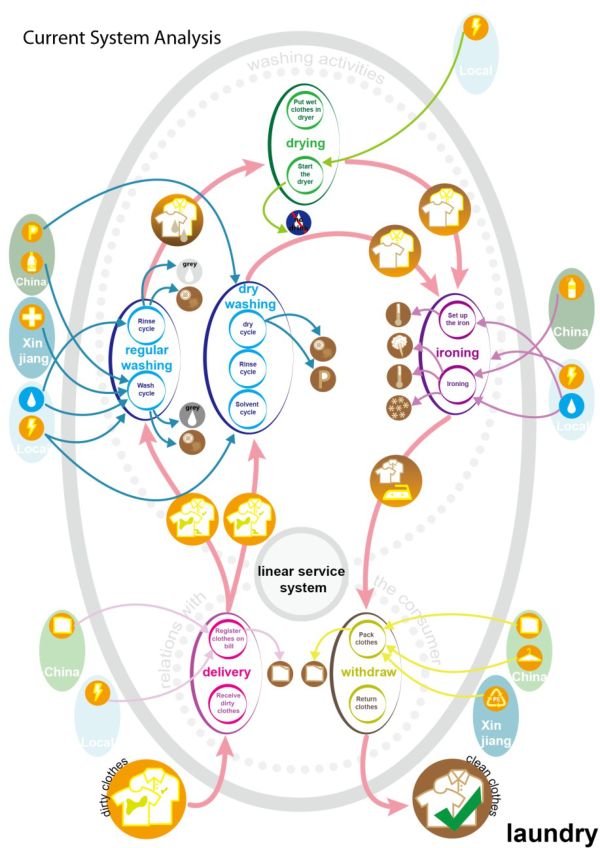
Qualitative & Quantitative Analysis Data on incoming and outgoing flows of materials and energy are provided. This includes information about their nature, their current origin and their use or destination. The quantities of what enters the system were also analyzed, together with what happens inside it the quantities of what comes out of it, their destination and possible uses (see figure 3).
Relationship After a clear understanding of the existing workflow and a sound data collection of the current system elements, we can finally begin to analysis how all of these system components are organized together. (I linked them together with arrows as you can see from the system diagram, which we called it relationship.) Systemic designers always attach great importance to the relationship between system elements, because just the discordant relationships will tell them what the real problem is.
Summary From a macro perspective, like all other industries, healthcare industry also arises from the relations that are created between resources, production and society. Most of these relations are now according to a linear one-way perspective. The linear view provides an overview of all the processes included in the process of creating the good or service. According to a linear perspective, only resources, and products related to individual processes are mapped (see figure 2).
Figure 2. Flux Board Analysis of Current System.
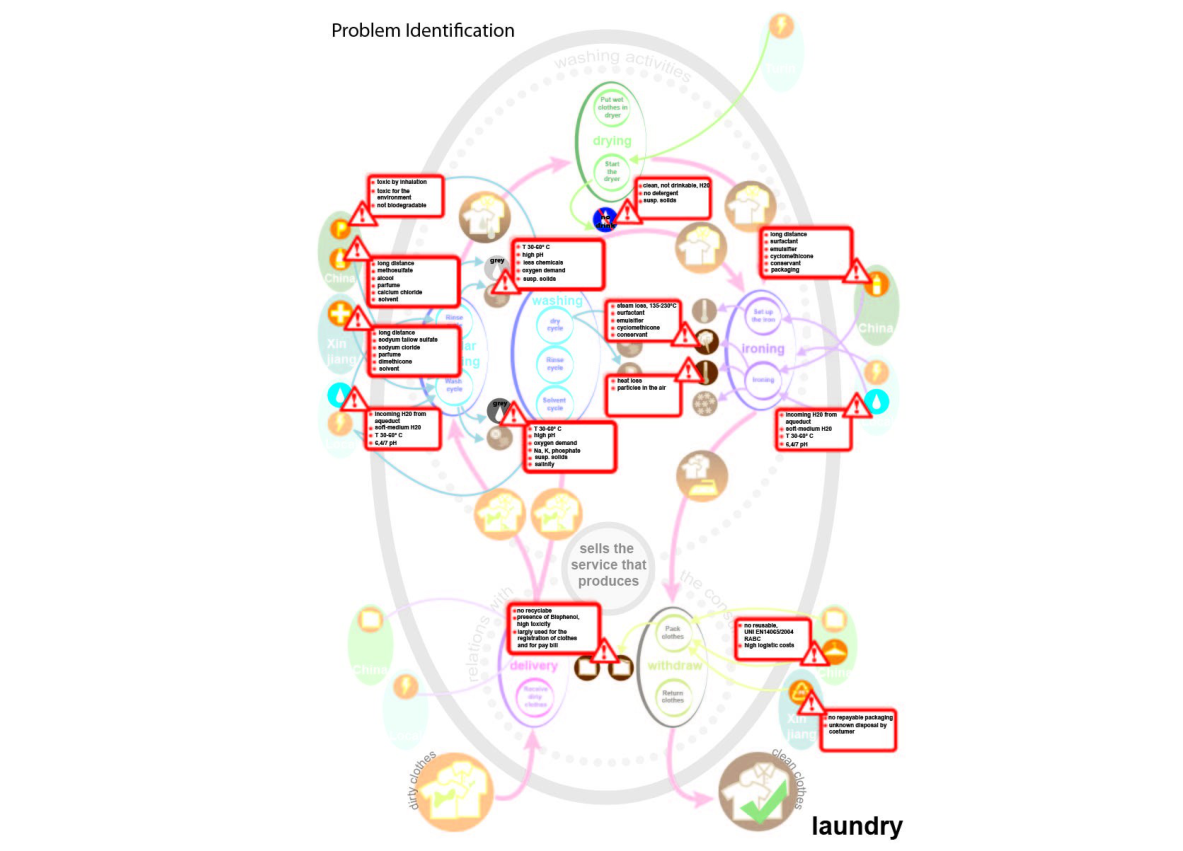
Problem Identification Linear system generates wastes in each step of its production process. In this project, besides those cleaned clothes, almost all of the rest outputs will be deemed to be trash and abandoned. For instance, just in the hospital we studied, this laundry discharges 960 tons of sewage each year.
Currently, packaging is considered as wastes which have no value. Disposing them in garbage dumps involves both economic costs (for collection, transportation, and treatment) and environmental costs that fall directly on the community.
While they are disposed of as undifferentiated rubbish, some other outputs even just disappeared in the air with nobody notice that. For example, the temperature of the steam which generates from the ironing process can be up to 200 , but this amount considerable heat normally disappeared at the same time with the steam itself, while which ℃ could be used as a kind of energy.
The specific situation of problem and waste you can find from the figure below:
Figure 3. Problem Identification of Current System.
HOSPITAL LAUNDRY SYSTEM REDESIGN Improved System
Based on the critical issues highlighted by the analysis discussed earlier, my research project focused on developing a new hypothesis premised on the idea that wastes from linear processes can be treated as inputs to other activities, thereby generating complex and branched productive systems.
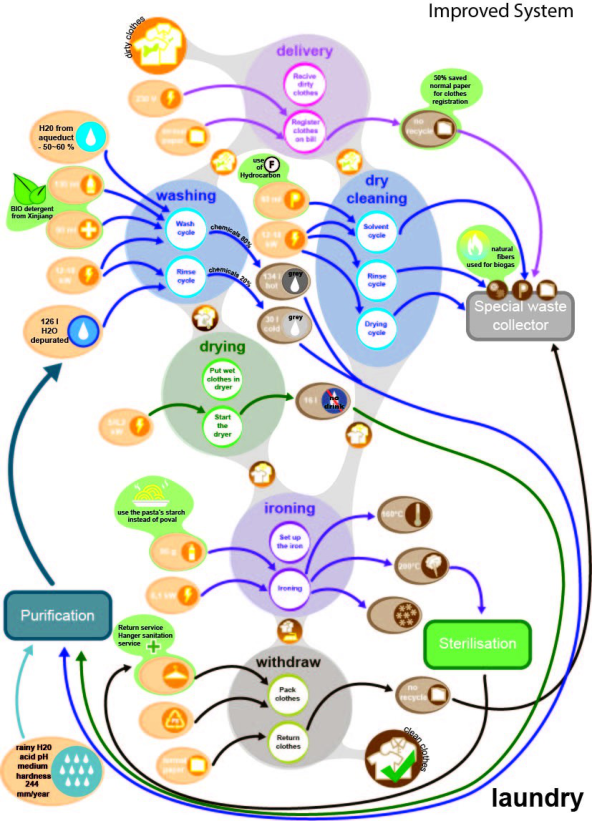
My proposal involved not only collecting wastewater from laundry but also taking the natural precipitation into consideration. Both artificial and biological means will be used to purify that sewage, and then this purified water can be reused in the laundry system for rinsing. In addition, other systems may also take advantage of this purified water, which can be used for Irrigation or even toilet use.
SYSTEMIC DESIGN designers always based their work on a local context. For example, biogas is an important energy source for local farmers, so we can collect all kinds of waste generated in the whole process, like fabric pieces, buttons and terminal paper, and use them to make biogas. Besides, noodle is the most popular food here so that we can get starch easily from restaurant nearby and use it in the ironing process.
Ironing process generates a lot of hot steam, to achieve zero emission, which I suggest could be used for hanger sterilization. Furthermore, to reduce the impact on the natural environment, we should use the organic detergents instead of the chemical one and purchase local products to reduce the logistic cost.
The detailed analysis is showed in the figure 4 as below:
Figure 4. Flux Board Analysis of Improved System.
Identifying Key Issues The most critical issues that emerge from analysis of the current situation are the following:
Wastewater are considered to be discharged, and is not seen as a feasibly potential resource, and water is processed in a linear way from cradle to grave, rather than as part of a system that could capture value; the potentially usable materials found in grey water, such as nitrogen compound and phosphorus compound, are simply discharge away.
Our analysis also reveals policy lapses with respect to packaging recycle or reuse. There currently is no organization or consortium in Hutubi that deals with collecting and recycling such wastes, making it even more critical to recover these materials for reuse.
Although our preliminary analysis underscored the importance of addressing the packaging issue, our research study focused specifically on water, because water is a fundamental resource for the conduct of the business activities of the laundry.
Improved Water Recycle System Computing, Software, and Systems Engineering (2018)
Based on the critical issues highlighted by the analysis discussed earlier, our research project focused on developing a new hypothesis premised on the idea that wastes from linear processes can be treated as inputs to other activities, thereby generating complex and branched productive systems.
In this case, the improved water recycle system can be mainly divided into two parts. The first one is the water purification system which also is the core part of the whole system. It is responsible for receiving and purifying the sewage. The second part is consisted of a lot of pipes which I called it water management system, their job is to send the water with different quality and quantity to where they are supposed to go. The water runs in this system can be divided into several different levels: drinkable water, black water, grey water, rain water and purified water, and they will be re-defined as follows: -Drinkable Water: Because the different kinds of water here are classified according to their different qualities, so I called the tap water as drinkable water.
-Black Water: Black water is the kind of water which contains those urban wastes, recognized harmful to public health or nuisance to the public (such as those from the toilet).
-Grey Water: In the laundry room, a large percentage of waste water are considered grey, they contaminated by the use of chemicals not highly harmful, but which make the water unusable without a purification process.
-Rain Water: Rainwater mentioned here actually represents the natural precipitation, which includes both rain and snow, especially in places like Xinjiang, snow is the main form of precipitation, but here for the sake of convenience, I put them collectively as the rain water.
-Purified Water: Purified water is water that is mechanically filtered or processed to be cleaned for consumption, but not necessarily remove all of the contaminants in it. Because this purified water will never be used for drinking but for irrigation, sanitary dwelling or clothes rinsing.
In this project, the primary aim of which was to create a web of relationships within the water recycle system. And we chose the purification and re-use section to form the main part as they consume the most of the water. But on the other hand, we could also generate the maximum value here in return.
The grey water mainly comes from three different parts: washing cycle, rinse cycle and drying cycle. They share different temperature, quality and proportion as you can see in figure 3. But in this case, I collectively called them grey water.
Each year, the laundry I studied will consume 1753 tons of drinkable water; around 50% of them will become the grey. Also, rain water will first go through two layers of filtration of biological and artificial, and then will be temporarily stored in the tank. Thus, depending on the specific needs, the grey water and rain water together become the main source of purification. The purified water will be used in three different places, which including irrigation, toilet use and rinsing clothes.
We carried out this research with one of the local hospital which has a large garden. This inspired me to generate the idea that we can use the purified water for irrigation. On the other hand, together with flushing toilets, the way we reuse the waste water not only make the hospital a better place for patients to stay but also will reduce the use of tap water. At this level, we are applying the principles of Systemic Design approach that change the output of one system to become the input for another one!
The rest of the purified water will be used for rinsing. By conducting this project, according to our estimate, it will save 960tons of fresh water per year for this laundry which equals 50%~60% of its water consumption.
Because of this water recycle system, tap water will be just used for drinking, hand and clothes washing, which means the water consumption in this laundry will meet a dramatic decrease. Furthermore, while the grey water become reusable, only the black water will be discharged as a kind of waste. But possible future research may also focus on this area, hoping to improve this project to a new level by absorbing this part of knowledge.
Figure 5. Improved Water Recycle System
Figure available in the original PDF paper.
DISCUSSION
The discussion is divided into five sections that handle the topics: results, process, methods, sustainability aspects and future research. The result part comments on the outcome, while the methods parts focus on the implementation and the usefulness of the chosen methods. Due to the nature of the project, the sustainability aspects are mainly on a theoretical level. Suggestions for future development concerns better solutions to improve the current design.
Results
This project will have a strong impact on: –Healthcare Innovation: Introduce Systemic Design method into the field of healthcare innovation in China. Most of the existing design research on healthcare is base on the current medical services and products system which works in a linear way. This project is based on the theory of the Systemic Design method. By focusing on the material and energy flux of the system and taking care of the relationships between the elements, this new approach helped us to identify new design opportunities and change the system to a systemic one.
-Environment: Reducing resource consumption and pollutant emissions. From the perspective of systemic design, we propose to use renewable resources, replace those chemical detergents with organic ones, and buy local products to reduce the consumption of logistics. All these measures together would improve the resource utilization and reduce the impact on the environment.
-Economy: Generating value from an eco-friendly system. As mentioned earlier, we can save money by using renewable resources. But beyond that, by changing the output of one system becomes an input for another one, we can get more production system involved which can bring extra value from a much bigger scale and create a lot of job opportunities.
-Society: Increasing local work opportunities. The activation of different economies of scale generates an increase in revenues, sales, and jobs available in the area; Promote social equity. The lack of medical resources makes a lot people have difficulties in going to hospital. By changing the hospital system into a more efficient one, our research may be helpful to improve this situation.
Methods
The methods used were chosen from the Systemic Design method library to suit for this project which concerns the completion of the main part of the system optimization. And we thought they had worked well overall. The relevant information was quickly identified during the territory research phase and the systemic problems identified in the system study.
The methods perceived as most useful was flux board analysis performed throughout the project. These provided extensive results on the overall system from different perspective and situation. Take figure3 as an example, it mainly shows where the systemic problems were and how serious they were. These results could easily be used, especially during the new system formulation.
Interview and literature study were also used during the research. Through interview, we got the first-hand research data and figured out the basic situation of our study subject. It really helped me a lot at the beginning of this project.
However, considering the limit length of the article, I can’t show it in detail here. On the other hand, literature study established the basic framework for our research, and also provided us the specific methods and related data at the same time.
In general, further evaluations on the re-planed system are desired to confirm the expected results.
Sustainability aspects The sustainability aspects of this project mostly concerns hypothetical effects of the establishment of the new system. A sustainable economy will employ a “win-win principle” in one form or another. That means economic and social systems must reverse their trends, so that can support the health of ecosystems and get economic benefits at the same time.
We Chinese people believe that human beings should live in harmony with nature, and Systemic Design theory can be a new way to conduct this philosophy. We hope this project can play the role as a high reference system model for future designers or even become a motive power of the long-term ecological civilization.
To some extent, our project is like some kind of first-attempt in China, because the SYSTEMIC DESIGN Theory applied in this project is absolutely new for us Chinese students. But we hope through this project can achieve these three goals: save money for the hospital to make it profitable; reuse waste water to save precious water resources for local; reduce pollution emissions and protect the natural environment will not be affected. This means that the result of this project can be transformed into a merged social, economic and environmental welfare, values at the base of sustainable development.
Future Research Depending on the different activities, the grey water can be divided into two types. One is from the garments washing and the other one is from the rinsing. They both have a temperature of 30-60 ° C, contain residues like fabrics or other particles solid and have a high standard of pH value. Unlike the water from the rinsing process, the first type has a greater presence of chemical components such as sodium, potassium and phosphates, which make therefore more polluted and harmful. Based on this situation, we should purify these two kinds of sewage separately and according to their nature to use them in different occasions.
To improve this system once again, we should find a better solution for those black water. When we designers begin to learn from the local culture almost everything will become easier. Actually, there is a tradition lasts for thousands of years in China, that the black water from the toilets can be used as the raw material for fertilizer. In this way, we can change this black water into an input for agricultural system and generate extra value from it.
CONCLUSION
Systemic Design is a design method which designs material and energy flows, investigating the positive changes in productive processes and activating a new economic model based on open industrial cycles. It reveals that this newborn theory goes far beyond the linear production process and will show us how production can be viewed from a wider perspective.
In our research, we developed a fully redesigned system for the local hospital laundry on a theoretical level. We fixed each highlighted problem occurs in the current linear system with a feasible solution and successfully transformed it into a more systemic and efficient one. But considering the limit length of this article, only the water recycle system would be discussed here in a detail way.
This project has just validated the systems approach by using a perspective that considers “waste” to be an input for other productive processes, in the same way that natural processes use materials. This innovative approach creates economic benefits -by reducing disposal costs and generating income from new activities; environmental benefits - by reusing organic substances in the bio-cycle and other substances in the techno-cycle; and social benefits -by creating new jobs and reducing the amount of waste that must be disposed or discharged.
The project described here also suggests that further research in this area would be valuable. Furthermore, the knowledge gained through it could be also transferred to other sections in health care design field.
REFERENCES
Alexander, C. (1964). Notes on the Synthesis of Form (Vol. 5). Harvard University Press. Bistagnino L. (2011), Systemic Design: Designing the productive and environmental sustainability, Bra, CN, Italia: Slow Food Editore. Bistagnino, L. (2008), The outside shell seen from the inside, Casa Editrice Ambrosiana Bertalanffy, L. V. (1968). General system theory: Foundations, development, applications (p. 141). New York: Braziller.. Brown, L. R. (2003). Plan B: Rescuing a planet under stress and a civilization in trouble. WW Norton & Company. Brown, L. R. (2008). Plan B 3.0: Mobilizing to save civilization (Vol. 384). New York: WW Norton. Barbero, S., & Toso, D. (2010). Systemic Design of a Productive Chain: reusing coffee waste as an input to agricultural
production. Environmental Quality Management, 19(3), 67-77. Brand, S., & Portola Institute. (1971). The Last Whole Earth Catalog: Access to Tools. Portola Institute. Barbero, S., & Tamborrini, P. M. (2012). Systemic Design in AgroFood Sector: EN. FA. SI project. Capra, F. (1983).The turning point: Science, society, and the rising culture. Random House LLC. Capra, F. (1996).The web of life: A new scientific understanding of living systems. Random House LLC. Capra, F. (2004).The hidden connections: A science for sustainable living. Random House LLC. Ceppa, C. (2009). Create new local sustainable networks by using the" Systemic Software input/output". Ceppa, C., & Marino, G. P. (2012). Food-pack Waste Systemic Management. Alternative Ways to Reuse Materials and to Develop New Business, Products and Local Markets. Procedia Environmental Sciences, 16, 616-623. Cozzo, B., & Bistagnino, L. (2010, April). An Holistic Approach to Production Systems. In Junior Scientist Conference 2010 (p.
337). Goldsmith, E., & Meadow, P. (1972). The limits to growth (Vol. 381). D. H. Meadows (Ed.). New York: Universe books. Hawken, P., Lovins, A. B., & Lovins, L. H. (2010). Natural capitalism: the next industrial revolution. Earthscan. Papanek, V., & Fuller, R. B. (1972). Design for the real world. London: Thames and Hudson. Pauli, G. (1996). Breakthroughs: what business can offer society. Epsilon Press limited. Pauli, G. A. (2010). The blue economy: 10 years, 100 innovations, 100 million jobs. Paradigm Publications. Paulesich, R. (2008). Sustainable consumption: a crucial aspect of research in economics. Progress in Industrial Ecology, an International Journal, 5(1), 149-159. Simon, H. A. (1996). The sciences of the artificial. MIT press.
LISTED IN THE AHFE DIGITAL BOOKSTORE CATALOGUE
Explore the complete digital volume
Advances in Human Factors, Software, and Systems Engineering
Read this individual research paper free through the original publisher, or explore the full digital proceedings book.
ISBN 978-1-4951-2096-1
Explore this ISBN in the AHFE Bookstore ↗Listed in the July 2026 bookstore catalogue; search by ISBN to confirm current availability · Digital book purchase optional