Yang Zhao, Wen Tang (2023). Analysis of home hospice from a systemic design perspective. In: The Human Side of Service Engineering. AHFE Open Access, vol. 108, pp. 358–366. https://doi.org/10.54941/ahfe1003138
This paper reframes the hospice service system from a systemic design perspective and considers it as an extreme case of the wicked problem in the healthcare field. Through literature review, we first derive the feasibility of using systemic design thinking to analyze and intervene in hospice services from a theoretical level. Then, a multi-case comparative analysis was conducted to identify the commonalities in existing service system models. Next, we further explore the correspondence between these commonalities and system design features to confirm the presence of systemic design in hospice service systems. Also, the highlights and omissions of the existing cases are analyzed under the lens of systemic design, providing a reference for subsequent related research and system construction.
With an aging society and the growing concept of “death well”, hospice care is becoming more and more vigorous. Literature shows that increased demand for hospice care makes a large number of hospital deaths neither pos- sible nor sustainable. In addition, the outbreak of Covid-19 has increased the pressure on the healthcare system. In this context, how to mobilize commu- nity resources and rely on networks of acquaintances for home hospice has become an important option to relieve the pressure on the healthcare system.
Unlike the personalized implementation of specific programs, there are cer- tain commonalities in the structure of the overall home hospice care systems, such as, participants, concerns, and programs in the service delivery pro- cess. The diversities of existing home hospice service models are caused by the complexity and unclear conditions among the stakeholders, which is an actual wicked problem. However, these commonalities also show that there are some universal principles behind the design thinking, an implicit systemic design thinking.
Inspired by the premise that system thinking is an appropriate approach to address the wicked problem, in this paper, we hence reveal the commonali- ties of the care systems and analyze home hospice by a system thinking view. In terms of correlating the phenomena, commonalities and systemic design features among our multiple case study, we discover and show the empirical
Analysis of Home Hospice From a Systemic Design Perspective 359
evidence of the common systemic design thinking and deficiencies in the exi- sting service delivery process. Then analyzed the highlights and omissions of the existing cases under the lens of systemic design, providing a reference for subsequent related research and system construction.
RELATED WORK
Home Hospice Hospice care can be divided into two categories based on where they are recei- ved: facility-based hospice care and community-based home hospice (Davis, 1988; Zhao & Liu, 2020). The former hospice care is provided in a hospice facility(care centers) or hospital, and the latter it is provided in the patient’s own home. The hospital setting (Hockley, 1999) with its professional staff and facilities, has the advantage of being the preferred location for hospice care because of more specialized needs such as symptom control. However, due to the limited number of hospital beds, the high workload of nursing staff, and the lack of personalized care, the number of people who choose hospice care in hospitals has declined over the years. Specialized hospices (care cen- ters) are in the middle of the transition from hospital to home, combining some of the advantages of both. Research (Chung & Burke, 2013; McGinley & Marsack-Topolewski, 2022) has shown that the primary concern about the choice of a specialized facility for the hospice is financial considerations especially for rural and marginalized populations. Thus, more patients turn to the community-based home hospice. Receiving hospice services at home may include a variety of service delivery models, such as professional care- givers visiting the home, family members taking responsibility for care, and professional and non-professional collaboration.
Studies (Kalseth & Halvorsen; Hawkins et al. 2020) show that with the development of technology, medical facilities, especially the telemedi- cine equipment, have provided favorable conditions for the development of hospice care in a non-professional setting. The data (Kellehear, 2005; Smith, 2016) also shows that the subjective wishes of most dying people and their families are to complete their life journey in a familiar environment. In addi- tion, from a more macro perspective, in order to relieve the huge pressure on the medical system caused by the huge nursing needs of the aging society, non-curative nursing tasks are gradually being dispersed to the community level, and the distributed medical care system is gradually becoming the dire- ction of development with the most sustainable potential (Jones, 2013). This also further promotes the return of hospice care to the community and family.
Home Hospice Is a Wicked Problem A wicked problem (Buchanan, 1992; Van Poeck & Lönngren, 2019) refers to the complex, ill-defined problem that lacks a clear solution and is often the result of interconnected and conflicting stakeholder interests. Wicked problems can arise in many different fields and disciplines, which include: environment and sustainability, public policy, urban design and planning, social justice and inequality, healthcare.
360 Zhao and Tang
By the common interconnections and the conflicting interests among the stakeholders, such as the family and the dying people, etc., home hospice can also be considered an extreme case of a wicked problem in the field of healthcare due to its complexity and interrelated nature. The specific reasons(Kellehear, 2005; Jones, 2013; Zhao & Liu, 2020) that why home hospice can be regarded as a wicked problem are listed as follows:
Intense emotional and ethical considerations: Home hospice often invo- lves intense emotional and ethical considerations, such as end-of-life decisions and the allocation of limited resources, making it a particularly challenging issue to address.
Lack of a clear solution: There is no single, clear solution to the challenges faced in providing home hospice care, making it difficult to develop a comprehensive approach to the problem.
Multiple stakeholders with differing perspectives: Home hospice care involves multiple stakeholders with differing perspectives, including pati- ents, family members, healthcare professionals, and policymakers, which can make it challenging to reach a consensus on the best approach to care.
Dynamic and rapidly changing context: The context in which home hospice care is provided can change rapidly, requiring flexible and ada- ptive solutions that can respond to new challenges as they arise.
Limited resources: Providing home hospice care often requires a signifi- cant investment of resources, including trained healthcare professionals, equipment, and medications, which can be limited in many communities, making it difficult to provide care to all those who need it.
Overall, the complex and interrelated nature of the challenges faced in providing home hospice care, combined with the lack of a clear solution and the involvement of multiple stakeholders with differing perspectives, make it an extreme case of a wicked problem in the field of healthcare. The above characteristics not only highlight the reason why home hospice is a wicked problem, but also serve as an entry point for research and analysis.
Systemic Design Systemic design is a “strong systemic view of complex system problems addressable by intuitive and abductive approaches implicit in design thin- king” (Jones, 2014; Sevaldson, 2018; Battistoni, et al. 2019). It emphasizes that designers should consider all the elements that make up a system as a whole, rather than considering them independently. Different from the com- monly referred system design, which is a design field (system is a modifier of design), systemic design is the design of systems as objects, a practice develo- ped through systems engineering (Jones, 2020). Thus, systemic design recei- ves more attention in recent years. As the combination of human-centered design and systems design can co-create the complex and multi-stakeholder services (Zivkovic, 2018), more examples of systemic design for services have been applied in the medicine and healthcare areas. As early as 2010, Hinrichs has attempted to apply the systemic design to the real cases to improve patient satisfaction and the efficiency of healthcare delivery (Hinrichs, 2010), which
Analysis of Home Hospice From a Systemic Design Perspective 361
is later improved by Barbero, et al. in 2017. In addition, Peter Jones introdu- ced systems thinking in design to holistically understand patient needs and journey and interactive process with care providers in 2013, and published “Design for Care” to propose that system design, as new design disciplines, are enabling to create a new mindset of professional care in designing for people, practitioners, and societies and to promote a comprehensive appro- ach to the healthcare systems. Not simply replicating the business as usual, but examining various innovations in moving care from academic health centers to communities and homes. In 2018, the authors in (Pennefather et al., 2018) also used systemic design to optimize the interactive experience and processes of healthcare delivery, which improved users’ well-being and promoted a virtuous cycle and prosperity of the system. In order to better mobilize multi-stakeholder collaboration for the developing sustainable heal- thcare, the systemic design is also introduced in (Pereno & Eriksson, 2020) in 2020. These all show that systemic design has a useful impact to improve the complex healthcare issue.
As home hospice is a wicked problem in the healthcare field, then the syste- mic design approach is also naturally applicable to it. This paper is to explore the systemic design thinking existing in the existing home hospice service delivery models.
METHODOLOGY
Systemic design adapts design practices to the complexity of social technolo- gies. By integrating systems thinking and its methods, systems design employs human-centered design to co-create complex, multi-stakeholder services. In the literature, the adapted systemic design methods for solving such wicked problems have some distinguishing features (Zivkovic, 2018):
Take a place-based approach: Take a neighborhood, a region, or even an ecosystem as a scope and engage stakeholders in a collaborative process to solve the problems they experience in the same space.
Adopt a transitional approach: Recognize the developing process, guide and help stakeholders find their most appropriate roles.
Engage diverse actors: Different expertise is needed to ensure that the com- plexity of the wicked problem is understood so that a diversity of actors are needed for joint insight and action.
Involve users as co-creators: The participation of users as co-creators is especially important during the innovation phase of the system.
Support networked approaches: Establish an interdependent self- organizing environment to ensure interaction and achieve shared goals.
Recognize the need for governments to create enabling conditions:Inspire government to empower complex systems.
Since home hospice is an extreme case of the wicked problem in the heal- thcare field, the systemic design approach is also a naive and good way to address home hospice design. Meanwhile, the existing home hospice service delivery models also implicitly follow the features of the aforementioned systemic design thinking. Therefore, to prove the existence of systemic design
362 Zhao and Tang
in the implementation and response process of home hospice as a wicked problem through, we use a multiple case study approach (Yin, 2009) to show how current existing home hospice services follow the aforementioned features. The detail steps of our multiple case study are listed as follows:
Select case studies: Choose eight typical case studies of home hospice pro- grams that have been implemented in different settings and with different populations from 50 literatures on related topics and published during 2000 to 2023, to provide a diverse and representative sample of the issue.
Gather data: Collect data on the implementation and response process of each case study, including information on the stakeholders involved, the design of the program, the outcomes achieved, and any challenges or barriers encountered.
Analyze data: Analyze the data collected from the case studies to iden- tify common themes and patterns related to the delivery process of home hospice. Pay particular attention to any systemic design features that may have been employed in the programs.
Draw conclusions: Correlate common themes and patterns with systemic design features to draw conclusions about the role of systemic design in home hospice delivery processes based on the analysis of the case studies.
In next section, we provide the empirical evidence of the effectiveness of systemic design features in addressing the challenges and opportunities of home hospice and demonstrate the current highlights and omissions of home hospice delivered by the systemic design view.
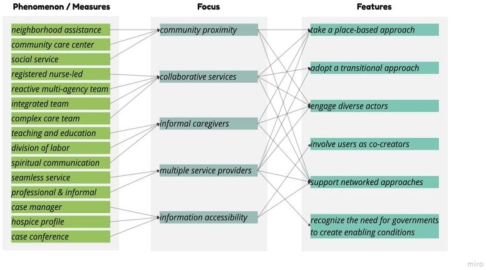
CASE ANALYSIS In our multiple case study, we summarize the specific phenomena and mea- sures in the implementation process of existing cases by team building, interpersonal relationships, introducing a third party, and information acqui- sition. Team building includes the integrated team, reactive multi-agency team. Measures in interpersonal relationships include neighborhood assista- nce, community care centers, and social services. The introduction of third parties such as registered nurses and case managers can provide efficient coor- dination. There are also measures to facilitate access to information, such as hospice profile and case conference.
Through the induction of various phenomena and measures we identify most common themes and patterns related to the delivery process of home hospice in five focus aspects, namely: community proximity, collaborative services, informal caregivers, multiple service providers and information accessibility, which are connected by the arrows in Fig. 1.
According to the features displayed by the systemic design approach we introduced in Section 3, the correlation between common themes and pat- terns in the delivery process of home hospice in the typical cases are also shown as the connections between the right two columns in Fig. 1. The cor- relations shown in Fig. 1 demonstrate that home hospice does follow the systemic design approaches.
Analysis of Home Hospice From a Systemic Design Perspective 363
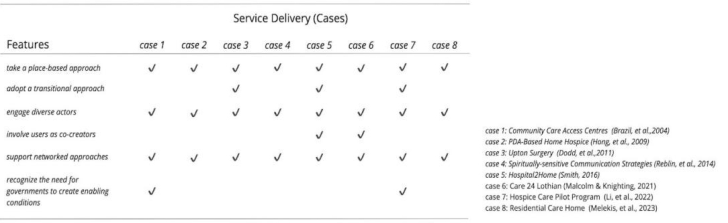
Figure 1: Relation between home hospice model and systemic design (drawn by author).Figure 2: Highlights of current home hospice models (drawn by author).
To show how much systemic thinking is implicitly currently used in the home hospice service, in Fig. 2, eight typical cases are analyzed based on the six features of systemic design in dealing with such wicked problems. We mark the systemic design features that appear in each case. As shown in Fig. 2, all cases have at least 3 systemic design features, when 5 cases include more than 4 systemic design features. Only 2 cases involve 5 systemic design fea- tures, while there is no cases that fully consider all 6 systemic design features in their design process.
The solutions involved in the service delivery process of each case are detai- led listed in Fig. 2, combining with Fig. 1 the the following points can be drawn:
- The three features of take a place-based approach, engage diverse actors, and support networked approaches are present in all cases.
The core of these three features is the active mobilization of the human element to reallocate resources and realize more possibilities through the reconstruction of relationships and interactions. The specific response in the hospice case is to mobilize stakeholders to shape different service rela- tionships and service systems by stimulating and adjusting collaborative relationships between them to achieve systematic progress. The fact that programs coincidentally choose to develop a system architecture based on
364 Zhao and Tang
a community context is proof that community proximity brings conveni- ence to care delivery. Moving away from the old doctor-patient binary, a systems perspective is used to understand the hospice process and mobilize more participants (not limited to patients and their families) to engage in it. New interpersonal relationships of care are being shaped along with new support networks, thus spreading the stress of traditional care and achieving system sustainability.
- The feature of adopt a transitional approach is also shown in some cases(case 3, 5, 7), especially in programs that focus on collaborative services and multiple service providers.
As a complex, multidisciplinary care process involving multiple parti- cipants, hospice patients often face relocation of care sites, changes in caregivers, and inevitable task overlaps and vacuums in multiple cross-service processes brought about by multiple service providers. A key focus of service system development is to construct new models to coordinate collaboration among multiple service providers to achieve “seamless” service delivery in the hospice care process while avoiding wasted resources.
- Analysis revealed that in all cases, the features of involve users as co- creators(case 5, 6), and recognize the need for governments to create enabling conditions(case 1, 7) are the most lacking.
The lack of involvement of the dying and their families in the design of the hospice system, and the lack of engagement with the higher levels of the system, were the most serious findings. As important components of the care system, and even central to relationship building, the dying and their families need to be involved as co-creators in the process in order to achieve true system coherence. Only when they are motivated to participate in co-design can they be given the most direct and efficient feedback on their needs, such as in terms of information and trust. It is also important to get support from the community, from outside the health care system at the governmental level, and in this case there is a lack of exploration and innovation at the macro level of the system. In fact, the recognition of government as an agent of change and the promotion of this enabling role is also a macro-level pursuit of system design.
CONCLUSION
As a comprehensive care process involving multiple disciplines and parti- cipants, home hospice can be regarded as an extreme case of the wicked problem in the healthcare field. The particularity of the hospice service system is that it serves a special group of vulnerable people; at the same time, it is a livelihood issue that cannot be avoided in everyone’s life. The existing service system construction models have their own focus and have targeted soluti- ons to the existing pain points in different contexts. These solutions have commonalities in utilizing community proximity, promoting collaborative services, focusing on informal caregivers, coordinating multiple service provi- ders and emphasizing information accessibility. These also provide the basic principles for subsequent research and system construction. From the per- spective of systemic design, the current proposal has paid sufficient attention
Analysis of Home Hospice From a Systemic Design Perspective 365
to take a place-based approach, engage diverse actors, and support networ- ked approaches. However, the future system should still focus on improving the coordination of multiple service providers to achieve “seamless” servi- ces, promoting stakeholder participation in co-creation, and stimulating government empowerment.
ACKNOWLEDGMENT
This paper was sponsored by China Scholarship Council (CSC).
REFERENCES
Battistoni, C., Giraldo Nohra, C. and Barbero, S., 2019. A systemic design method to approach future complex scenarios and research towards sustainability: A holistic diagnosis tool. Sustainability, 11(16), p. 4458. Brazil, K., Whelan, T., O’Brien, M. A., Sussman, J., Pyette, N. and Bainbridge, D.,
2004. Towards improving the co-ordination of supportive cancer care services in the community. Health Policy, 70(1), pp. 125–131. Buchanan, R., 1992. Wicked problems in design thinking. Design issues, 8(2), pp. 5–21. Davis, F. A., 1988. Medicare hospice benefit: Early program experiences. Health
Care Financing Review, 9(4), p. 99. Dodd, J., Taylor, C. E., Bunyan, P., White, P. M., Thomas, S. M. and Upton, D., 2011.
A service model for delivering care closer to home. Primary health care research & development, 12(2), pp. 95–111. Hawkins, J. P., Gannon, C. and Palfrey, J., 2020. Virtual visits in palliative care: about time or against the grain?. BMJ Supportive & Palliative Care, 10(3), pp. 331–336. Hinrichs, S., 2010. A case study of design methods applied to researching medical
device purchasing processes. Australasian Medical Journal (Online), 3(8), p. 471. Hockley, J., 1999. Specialist palliative care within the acute hospital setting. Acta Oncologica, 38(4), pp. 491–494. Hong, H. S., Kim, I. K., Lee, S. H. and Kim, H. S., 2009. Adoption of a PDA-
based home hospice care system for cancer patients. CIN: Computers, Informatics, Nursing, 27(6), pp. 365–371. Jones, P., 2013. Design for care: Innovating healthcare experience. Rosenfeld Media. Jones, P. H., 2014. Systemic design principles for complex social systems. Social systems and design, pp. 91–128. Jones, P., 2020. Systemic design: Design for complex, social, and sociotechnical
systems. Handbook of systems sciences, pp. 1–25. Kalseth, J. and Halvorsen, T., 2020. Relationship of place of death with care capacity and accessibility: a multilevel population study of system effects on place of death in Norway. BMC health services research, 20, pp. 1–12. Kellehear, A., 2005. How Australia Cares For Its Dying Population: History, Health
Services and Hopes. アメリカ太平洋研究=Pacific and American studies, 5, pp. 41–51. Malcolm, C. and Knighting, K., 2021. What does effective end-of-life care at home for children look like? A qualitative interview study exploring the perspectives of bereaved parents. Palliative Medicine, 35(8), pp. 1602–1611. McGinley, J. M. and Marsack-Topolewski, C. N., 2022. A Comparative Case Study
of Hospice and Hospital End-of-Life Care for Aging Adults With Developmental Disabilities. Global Qualitative Nursing Research, 9, p. 23333936221087626.
366 Zhao and Tang
Melekis, K., Weisse, C. S., Alonzo, J. D. and Cheng, A., 2023. Social Model Hospice Residential Care Homes: Whom Do They Really Serve?. American Journal of Hospice and Palliative Medicine®, p. 10499091221150769. Pennefather, P., Seaborn, K. and Fels, D. I., 2018. Inclusive Systemic Design for Health
System Flourishment. Systemic Design: Theory, Methods, and Practice, pp. 69–85. Pereno, A. and Eriksson, D., 2020. A multi-stakeholder perspective on sustainable healthcare: From 2030 onwards. Futures, 122, p. 102605. Reblin, M., Otis-Green, S., Ellington, L. and Clayton, M. F., 2014. Strategies to sup-
port spirituality in health care communication: a home hospice cancer caregiver case study. Journal of Holistic Nursing, 32(4), pp. 269–277. Smith, C., 2016. The feasibility of research in cancer patients close to death and the impact on evaluating a complex intervention. Van Poeck, K. and Lönngren, J., 2019. Wicked problems: a systematic review of the
literature. In European Conference on Educational Research (ECER),’Education in an Era of Risk–the Role of Educational Research for the Future’. Xueying, L. I., Limei, J. I. N. G., Yifan, X. U., Tianshu, C. H. U., Yunjia, Z. H. A. O., Ruiyang, C. H. E. N., Xiaohan, T. E. N. G. and Shuijing, L. I., 2022. Hospice Care Pilot Program Independently Pioneered by Community Health Centers in Shanghai: a Cross-sectional Survey. Chinese General Practice, 25(13), p. 1624. Yin, R. K., 2009. Case study research: Design and methods (Vol. 5). sage. Zhao, Y. and Liu, C., 2020. The lean solution of hospice service design in the
“internet+” era. In Advances in Physical Ergonomics and Human Factors: Pro- ceedings of the AHFE 2019 International Conference on Physical Ergonomics and Human Factors, July 24-28, 2019, Washington DC, USA 10 (pp. 315–326). Springer International Publishing. Zivkovic, S., 2018. Systemic innovation labs: A lab for wicked problems. Social Enterprise Journal, 14(3), pp. 348–366.
LISTED IN THE AHFE DIGITAL BOOKSTORE CATALOGUE
Explore the complete digital volume
The Human Side of Service Engineering
Read this individual research paper free through the original publisher, or explore the full digital proceedings book.
ISBN 978-1-958651-84-1
Explore this ISBN in the AHFE Bookstore ↗Listed in the July 2026 bookstore catalogue; search by ISBN to confirm current availability · Digital book purchase optional