João Paulo Cabrala, Rosângela Míriam Lemos Oliveira Mendonçaab (2022). Synesthetic Metering for Speed. In: Advances in Ergonomics In Design, Usability & Special Populations: Part II. AHFE Open Access, vol. 19. https://doi.org/10.54941/ahfe1001233
As proven by some studies, the approach to estimate the speed of travel has significant levels of error. In addition, the meters usually used, such as the speedometer, are not sufficient for the drivers perception of risks. Often the driver’s perception of speed is based on a comparison with other drivers present on the road. In addition, cars tend to be acoustically isolated and the noise of the engine therefore tends to be minimized. In this way, the references are even fewer and so drivers lack for signals that trigger their self-awareness with regard to the level of danger of driving at high speed. This is true, specially, concerning the situation when the driver needs to arrive at a certain time at his destination. Devices such as GPS and on-board computers provide guidance on travel time and arrival and the maximum speed allowed on any road, but they still do not provide the information necessary for a more effective use of speed and more efficient travel in terms of saving time. For this reason, we propose a system that advises the driver on the best speed in every part of the route, giving a better performance without exceeding the speed limit. This system uses auditory icons that reproduce the sound of a natural event (e.g. the wind) present in some situations while driving. Since this adds on channels of reception with a natural signal this is an effective and non-intrusive way of informing the driver.
Every year millions of people lose their lives and millions more are injured around the world due to road accidents. The problem of speeding is one of the main causes of these statistics. The causes for this happening are the most diverse. Social and behavioral aspects such as the influence of age on the risk perception (Brown & Groeger, 1988;Deery, 1999) and the driving experience (Lucidi et al., 2010; Deery, 1999) are just a few.
The estimation of the driving speed is an important factor, influencing the speed perception on the road. According to Conchillo et al. (2006), the awareness of the speed is based on a balance between the objective control, based on the observation of the speedometer or GPS and a personal estimation based on subjectivity. Cognitive aspects are responsible for the traffic perception and attention to the large amount of information that reaches the driver. When some of this information is altered or withdrawn, the resulting distortion of information may create a wrong perception of speed. The subjective elements are connected to the perception of external events in the environment which act as a guide and can be activated by the senses of vision, hearing and touch which can be isolated or multisensorial.
The speed choice made by drivers through vision is the result of a process where their speed is compared to that of the other drivers. This causes the influence among drivers compared to their own personal speed choice (Aberg et. al., 1997;Connolly & Aberg, 1993) of generally overestimating other vehicles speed, thereby causing an avalanche effect, through speed contamination and making the cars go even faster (SWOV - Institute for road safety research, 2012).
The driver’s environment is also an influential factor to speed perception. The (SWOV - Institute for Road Safety Research, 2012) relates that speed perception takes place in the greatest majority of the cases in the peripheral visual field instead of the central visual field. The speed estimate is increased when there are elements in this visual field, as for example, trees and buildings. Some studies have shown that even the presence of parked cars can affect speed. According to Smith and Appleyard (1981) drivers tend to drive more slowly in streets with a larger number of parked cars. The drivers also tend to underestimate and overestimate speed under special conditions, such as driving at night or even in the presence of fog (Snowden et al., 1998;Cavallo et al., 2000).
The subjective speed perception through hearing is also affected by the reduction of external sounds inside the car due to the acoustic improvement, which on one hand contributes to the comfort, but in counterpart takes away the important signs that are essential external sound source information from the driver. One of these items of information is that of the engine sound, an important source of speed perception. According to Hellier et al. (2011), the decrease or lack of perception of the sound of the engine contributes to the underestimation of the driver speed, causing an increase in speed even in the presence of the speedometer. The decrease of the sound engine sensation is also influenced by technological surplus. Engineers and experts in automotive acoustics work continuously with the purpose of having more efficient and quiet engines, both electrical, but also combustion ones (Cerrato, 2009).
The result of the car moving together with the air resistance and the tire friction with the asphalt creates vibration at points such as the seat, pedals, steering wheel and shift lever, influencing the tactile perception (Genuit, 2008; Giacomin & Woo, 2004).
In addition to the subjective perception, the driving speed estimation has also to do with the speed objective and the use of control devices such as the satellite navigation system and speedometer. These provide data on speed and estimation of travel time, which are important to the choice of the speed while traveling.
From the point of view of consumer comfort it is important to use more efficient technologies and alternatives to the existing ones, also as a measure against noise pollution. However, in contradiction to this, these advances contribute to the decrease of subjective speed perception.
In their daily activities drivers need to be able to arrive at destination within a certain time, and, at the same time, to respect the maximum speed limit for each stretch of the road. There are devices that already provide objective information, such as distance and time required to arrive at a destination, and also advertence sounds based on a fixed preset speed. Nevertheless these devices are not designed to guide the optimal speed of the driver with respect to each part of the road and therefore to have a greater economy of time and, eventually, fuel, while still respecting the variable speed limits.
SUPPORTS THE SPEED PERCEPTION The research on the subject
In order to improve the speed driver perception, some researchers try to implement the most efficient ways of information in an objective manner. This occurs through new tools and display mode information, such as the introduction of speed information of traditional projecting onto the dashboard through the windshield Head-Up Display, HUD, which, according to Gish and Staplin (1995), demonstrated a small impact on the speed choice of drivers.
The change of perception based on the way that the speed information is shown to the driver was studied by Eriksson et al. (2013) on the basis that drivers make wrong calculations of saved time with speed increase. The experiment used the available information of the speed in minutes per kilometers (min/km), different to traditional speedometers in kilometers per hour (km/h), resulting an alteration in the judgment of speed on the part of drivers. Some studies that are already being used in some cars also seek to design systems that are able to identify the road signs as a mode of visually reinforcing the information to the driver (Lorsakul & Suthakorn, 2007). The use of intermittent abstract sound signals which vary with respect to the car speed have also been proposed (Shahab et al., 2010).
TRADITIONAL SUPPORT FOR EFFICIENT MOVEMENT Auxiliary driving devices now consolidated such as GPS and on-board computer provide information for navigation as for example, the time spent, the average speed of the route already covered and the estimated time to reach the destination. Although this information is shown to the driver, it does not take into account his actual need, which is of being able to cover the distance in the time available to him, or at the most efficient speed that allows him to cover the route in time, safely within comfortable speed references.
Without these considerations, the driver still has to make an estimate, by comparing the estimated travel time from the GPS with the real needs time available and thus determine how fast to go to get there in time, yet without forgetting the speed limits that must be respected. Mistakes in this estimation, mainly if accumulated during the trip, may induce exceeding desired speed references to compensate for previous delays.
Having a better management of this information will help the driver to decrease his cognitive load and maintain a consistent constant speed which are important for safety, performance, comfort and allowing him to arrive at the desired time and with a possible fuel saving.
THE WARNING HEARING ALERTS Alert means calling attention to something. When an alert is required, the adequate reaction time depends on the level of urgency of the situation. In a litigious society, more awareness of dangers and the role of warnings has become increasingly important (Edworthy & Hellier, 2000). The type of alarm to be applied must be coherent with the level of attention that the event requires, the amount of alarms present in the environment and the correlation between the alarm and the event or the risk of warnings not being accepted. An alarm can be not urgent enough, or be too urgent in a situation where it is not necessary (Edworthy, 1994). The improvement in the correspondence between the situation (known or unknown), and the acoustic urgency is called " urgency mapping ". Guidelines for an adequate mapping of urgency and abstract non-verbal warning signals were introduced by Patterson (1982). They were designed initially for the aircraft field, but they had a high acceptance and adaptation in several other areas, because they focus on psychoacoustics, rather than on specific environment variables (Edworthy, 1994).
Advantages and disadvantages in the use of auditory warnings Audible alerts may offer many advantages in comparison with other human sensorial modalities (visual and tactile). One of these is the omnidirectional perception, which aids localization. According to Edworthy and Hellier (2000) research shows that hearing is the primary sense of warning, that is, a sound is strong enough to be heard, and you cannot do anything about blocking it. On the other hand vision leads to looking in the right place at the right time and can be more easily ignored by the visual stimulus. For Stevens et al. (2006) acoustic warnings being omnidirectional in nature must be recognized as much faster than a visual signal in situations where the operator is required to expect more than one thing at a time. The use of sound can also improve the response time in comparison with the visual ones (Ho et al., 2013;Stevens et al., 2006).
Ineffective warnings are inappropriately intrusive, not easily detectable, difficult to interpret, or are not properly mapped to represent an appropriate level of urgency to the situation. In addition, ineffective warnings may require excessive attention or invoke an unnecessary state of physiological stress that may interfere with the decision making process and the corrective response (Baldwin, 2012).
Auditory icons Born in the computer field, auditory icons are defined as sounds of everyday events that have been integrated into the sounds that computers produce (Gaver, 1994). These are auditory icons such as natural everyday sounds or sounds that mimic those found in the nature. The auditory icons mimic the everyday unspoken sounds which could be familiar in the real world (Graham, 1999).
There are a number of advantages to using auditory icons as they can be learned and remembered more easily than the abstract sounds (Gaver, 1986;Graham, 1999;Campbell et al., 2004). The greater semantic link between auditory icons and the event improves reaction time and accuracy of response (Mckeown, 2005;Graham, 1999). The disadvantages are those linked to the familiarity and extreme obviousness that many objects have which could lead to an ambiguous interpretation of sounds (Graham, 1999).
Auditory icons offer interesting and important opportunities for the use of natural signals to warn the driver in a more effective and less invasive way. The events while driving on the road daily offer a good opportunity to use sound resources that are rich in meaning, as auditory warnings. Making use of these everyday sounds in the environment of the driver and "transforming them" into auditory icons is an interesting opportunity in the creation of auditory signals with wide semantic mapping. Combined with visual information about the road environment and the assistance of guiding devices make them compose an important system of multisensorial information.
USE OF THE AUDITORY ICONS INSIDE THE CAR The representation of the auditory icons to the driver
In-vehicle Information System (IVIS) devices and the Advance Driver Assistance Systems (ADAS), make use of auditory warnings in different ways, not only with the objective of warning in important situations directly related to driving, but also in less significant driving situations, such as alerting about an incoming call or message from his phone connected to the car. These make use of abstract non-verbal notifications, such as beeps or bells or verbal warnings like synthesized GPS voices (Baldwin, 2012), along with eventual visual reinforcement present in the on- board computer.
Auditory icons offer better opportunities for use inside the car compared to abstract signals. The semantic mapping and general previous experiences of the driver, make it unnecessary to learn auditory icons (Brazil & Fernström, 2011). The different events that can occur within the context of the road create the possibility of exploring the rich potential of communication of sounds mimicked through the auditory icons. One example of its application has been seen in the work of (Fagerlönn, 2011) applied to truck drivers, where auditory icons had a high acceptability, although varying with preferences with respect to the individual driving situations.
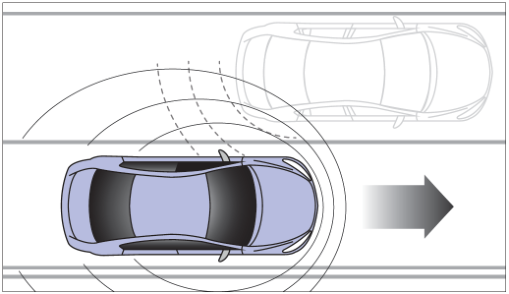
AUDITORY ICONS AS WARNING SIGNAL TO THE SPEED A situation that provides a characteristic sound that can be applied as auditory icons giving information of movement is that of the wind sound that is perceived when driving with the window open. This sound, generated by air resistance, tire friction, and engine sound is present in the environment around the vehicle, and when this encounters an obstacle, such as a lamp post, parked vehicles, etc. it reflects the sound to the driver (see Figure 1).
Each time the wind sound reflects back from the obstacles to the driver has an intermittent physical perception of how fast the vehicle is travelling. The strength of the wind noise is directly related to the resulting speed, which can also be used as a non-intrusive speed indicator to the driver (Bodden et. al., 2004).
Figure 1. Sound reflection scheme heard by the driver, when one passes near an obstacle.
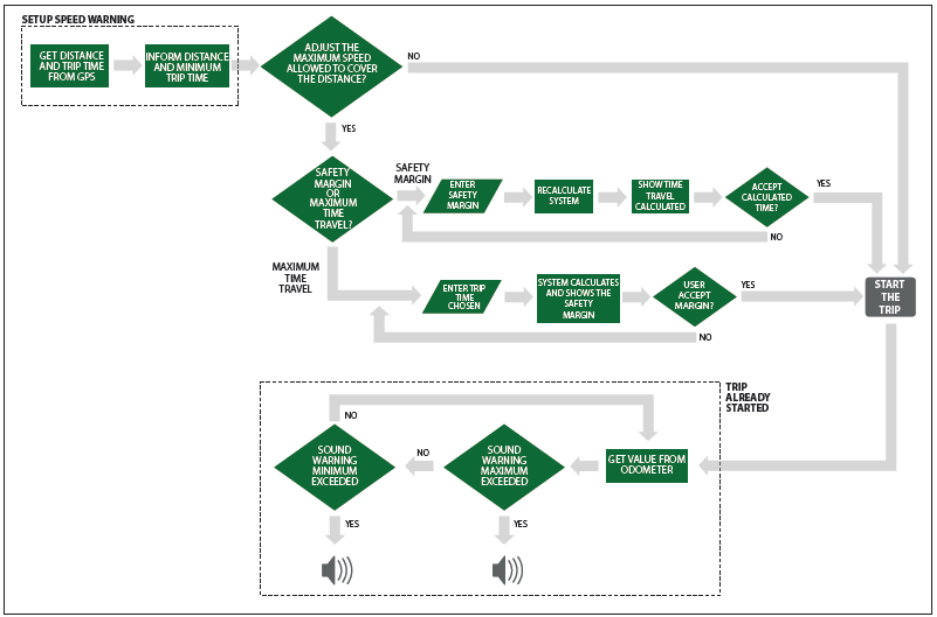
The relationship between driver and interface The concept that is proposed is to make use of a system that satisfies more efficiently the real needs of the driver while travelling. These needs are to arrive at his destination safely and efficiently, through better management of time and travel at a speed that is compatible with his demands. The system (see Figure 2) is explained in the sequence.
Figure 2. Set-up scheme and operation of the system.
The system will work according to the information on distance and trip time from the GPS, considering that the GPS has made this calculation on the basis of the speed limit for each part of the route. After this, the driver will have the possibility to choose to receive "advices" from the system through sound alerts of auditory icons. Considering the speed limits informed by the navigating system, the driver can, not only be warned when exceeding the limit but also on how much he is exceeding it. If desired, he can also set his minimum desired speed (lower speed limit) based in two modes. The first is called the safety margin, where the driver enters the safety margin (that is, the number of km/h to be deducted from the maximum speed permitted in each section of the route) and the system calculates the travel time. The second mode is called maximum travel time, where the driver inputs the time available to complete the trip. The travel time chosen must always be greater than the time stipulated by the first speed limit (which has been calculated considering the trip performed using the maximum allowed speed), and the system calculates the most convenient safety margin to cover the route.
The safety margin mode is aimed at drivers who want to define a tolerance within which he feels comfortable and safe not to exceed the allowed speed limits. The maximum travel time mode is intended for drivers who want to arrive at destination within a certain limit of time.
Defining the auditory icons perception in the relationship between its reproduction and the vehicle speed For the alerts that are used in the implementation of the system to be effective, as initially mentioned, they will be used auditory icons which mimic the sound of the wind heard while driving with the windows opened, passing by equally spaced objects (such as lamp poles).The auditory icons in different speed situations will provide the speed warning, indicating not only to be both above the maximum level allowed and below the level determined by the driver, but also and mainly informing how much the speed is not coherent with one of the two levels of alerts entered.
What is proposed is to establish the interval between the emission of one auditory icon and the next on the basis of the speed of the car in covering a particular distance. In the case in which the driver is above the maximum speed limit of the GPS, an alert will be as more frequent as the speed increases. As regards the lower speed limit chosen, the alert would be less frequent, i.e. the sound would recur at longer intervals as the car becomes slower.
As these alerts would be heard only if the driver is outside the target speed he determined before, it means that when the speed is within the chosen values, the system does not emit any warning. In other words, if the driver does not hear any warning along the way means that the trip is being done within the defined speed limits.
Factors to consider-masking Another important point that contributes to reducing the effectiveness of the acoustic signals is the use of radio and other systems of in-vehicle entertainment and information, which could mask any critical acoustic warning signals present in the vehicle (Slawinski & MacNeil, 2002). Often the signals can be confused with other similar signals when heard at different times but in particular when they occur simultaneously. Identifying different alerts simultaneously in a closed environment increases the mental workload, as well as the time necessary to adjust to the alerts (Wiese & Lee, 2004).
An effective way to reduce the possibility of masking auditory icons used in the proposed concept is to work with the positioning of the sound source of the alert. The solution proposed to avoid similarity between several other sounds and improve the sound perception is to position the sound source close to the driver. Green et al. (2008), made use of warning sound systems such as Lateral Drift Warning (LDW) and Lane Change-Merge (LCM), where he used loudspeakers positioned in the driver’s headrest. The use of the speakers in the headrest could be an effective solution not only against the risk of masking, but also as a way of making the signal be less intrusive to other passengers.
CONCLUSION AND FUTURE WORKS While satellite navigation and onboard computers currently exist in cars providing information support to the driver, they do not take into account the real need of the driver with respect to his available travel time or the speed that allows him to get to his goal in time, safely and comfortably.
This article proposes a system that "advises" the driver, based on the information previously entered by him, on the his preferences regarding the route, speed or available travel time to reach to his destination. The efficiency of the system is provided by the use auditory icons that imitate the sound of an event that is known intuitively by the driver. These warning signals, together with the way in which they are heard by the driver while driving (that is, the position of the source of sound and the change in its intermittence), become a more intuitive and rich source of information about the car speed and driving conditions.
The advantage of this system is to provide richer information to the driver, along all the way so that his real time and speed requirements are met, within a very balanced and consistent driving. This allows a more regular, efficient and safer trip.
Further work will be that of the practical application of this concept through tests in a driving simulator, to refine the initial proposal suggested in this article, indicating the optimal intervals for the emission of sounds. Another improvement will be considering also speed values suggested by the vehicle on-board computer specifically regarding efficiency of fuel consumption.
ACKNOWLEDGEMENTS
We would like to thank FAPEMIG – Fundação de Amparo à Pesquisa do Estado de Minas Gerais – for the support for the participation in this event.
REFERENCES
Aberg, L., Larsen, L., Glad, A., & Beilinson, L. (1997). Observed vehicle speed and drivers perceived speed of others. Applied Psychology: An International Review. 46(3), 287-302. Baldwin, C.L. (2012). Auditory Cognition And Human Performance. Research And Applications. CRC Press, 13-30. Bodden, M., Booz, G., & Heinrichs, R. (2004). Interior vehicle sound composition: Wind noise perception. Fortschritte der
Akustik - CFA-DAGA ‘04. Retrieved from http://www.product-sound.com/assets/images/cfadag04.pdf. Brazil, E., & Fernström, M. (2011). Auditory Icons. In Hermann, T., Hunt, A., & Neuhoff, J.G. (Eds.). (2011). The “Sonification Handbook”. Logos Verlag, Berlin, Germany. Brown, I.D., & Groeger, J.A. (1988). Risk perception and decision making during the transition between novice and experienced
driver status. Ergonomics. 31(4), 585–597. Campbell, J. L., Richman, J. B., Carney, C., & Lee, J. D. (2004). In-Vehicle Display Icons and Other Information Elements.
Volume I: Guidelines. (Report no. FHWA-RD-03-065). U.S. Department of Transportation. 6-5. Cavallo, V., Colomb, M., & Dore, J. (2000). The overestimation of headways in fog. Recherche Transports Securite. 66, 81-99. Cerrato, G. (2009). Automotive Sound Quality – Powertrain, Road and Wind Noise. Proceedings, NOISE CON 2009, Dearborn, Michigan, USA. Conchillo, A., Recarte, M.A., Nunes, L., & Ruiz, T. (2006). Comparing Speed Estimations from a Moving Vehicle in Different
Traffic Scenarios: Absence versus Presence of Traffic Flow. The Spanish Journal of Psychology. 9(1), 32-37. Connolly, T., & Aberg, L. (1993). Some contagion models of speeding. Accident Analysis and Prevention. 25, 57-66. Deery, H.A.(1999). Hazard and Risk Perception among Young Novice Drivers. Journal of Safety Research. 30(4), 225-236. Edworthy, J., & Hellier, E. (2000). Auditory warnings in noisy environments. Noise Health. (2). 27-39. Retrieved from http://www.noiseandhealth.org/text.asp?2000/2/6/27/32649. Edworthy, J. (1994). Urgency mapping in auditory warning signals. In Stanton, N. (Eds.), Human Factors in Alarm Design.
Taylor & Francis. Eriksson, G., Svenson, O., & Eriksson, L. (2013). Debiasing Time Saving Judgements by Manipulation of Speed Display, In: D.
de Waard (Eds.). Proceedings of the Human Factors and Ergonomics Society Europe Chapter Annual Conference. Turin. Italy. Fagerlönn, J. (2011). Making auditory warning signals informative: examining the acceptance of auditory icons as warning signals in trucks. Sixth International Driving Symposium on Human Factors in Driver Assessment, Training and Vehicle Design. Lake Tahoe, California, USA, 95-101. Gaver, W. W. (1994). Sound effects for computational worlds. Proceedings of the Ergonomics Society/IEE Conference
'Designing Future Interaction'. Loughborough, UK. Gaver, W. W. (1986). Auditory Icons: Using Sound in Computer Interfaces. Human–Computer Interaction. 2(2), 167-177. Genuit, K. (2008). Vehicle Interior Noise – Combination of Sound, Vibration and Interactivity. Proceedings, NOISE CON 2008, Dearborn, Michigan, USA. Giacomin, J., & Woo, Y.J. (2004). Beyond Comfort: information content and perception enhancement. Engineering Integrity. 16.
July 2004, 8-16. Gish, K.W., & Staplin, L. (1995). Human Factors Aspects of Using Head Up Displays in Automobiles: A Review of the Literature. Office of Crash Avoidance Research. National Highway Traffic Safety Administration. U.S. Department of Transportation. Washington, DC. USA, 27. Graham, Robert (1999). Use of auditory icons as emergency warnings: evaluation within a vehicle collision avoidance
(2008). Integrated Vehicle-Based Safety Systems (IVBSS): Human Factors And Driver-Vehicle Interface (DVI). (Report No. DOT HS 810 905) Summary Report. U.S. Department of transportation. National Highway Traffic Safety Administration.. Feb. 2008. Hellier, E., Naweed, A., Walker, A., Husband, P., & Edworthy, J. (2011) The influence of auditory feedback on speed choice, violations and comfort in a driving simulation game. Transportation Research Part F: Traffic Psychology and Behaviour. 14(6), 591-599. Ho, C., Spence, C., & Gray, R. (2013). Looming Auditory And Vibrotactile Collision Warnings For Safe Driving. Proceedings of
the Seventh International Driving Symposium on Human Factors in Driver Assessment, Training, and Vehicle Design, 551- 557. Lorsakul, A., & Suthakorn, J. (2007). Traffic Sign Recognition for Intelligent Vehicle/Driver Assistance System Using Neural Network on OpenCV. The 4th International Conference on Ubiquitous Robots and Ambient Intelligence (URAI 2007). Retrieved from http://www.bartlab.org/Dr.%20Jackrit's%20Papers/ney/3.KRS036_Final_Submission.pdf Lucidi, F., Giannini, A.M., Sgalla, R., Mallia, L., Devoto, A., & Reichmann, S. (2010). Young novice driver subtypes:
Relationship to driving violations, errors and lapses. Accident Analysis and Prevention. 42(6), 1689-1696. McKeown, D. (2005). Candidates for within-vehicle auditory displays. Proceedings if ICAD 05-Eleventh Meeting of the
International Conference on Auditory Display. Limerick, Ireland, 182-189. Patterson, R.D. (1982). Guidelines for auditory warning systems on civil aircraft. (CAA Paper No. 82017). Civil Aviation Authority, London. In Brewster, S.A. (1994). Providing a Structured Method for Integrating Non-Speech Audio into Human-Computer Interfaces. Unpublished PhD thesis. Human-Computer Interaction Group, Department of Computer Science. University of York. Shahab, Q., Terken, J., & Eggen, B. (2010). Auditory Messages for Speed Advice in Advanced Driver Assistance Systems.
Proceedings of the Second International Conference on Automotive User Interfaces and Interactive Vehicular Applications. (AutomotiveUI 2010). Pittsburgh, Pennsylvania, USA, 50-56. Slawinski, E. B., & MacNeil, J. F. (2002). Age, music, and driving performance: Detection of external warning sounds in vehicles. Psychomusicology, 18, 123-131. In Ho, C., & Spence, C., (2008). The Multisensory Driver Implications for Ergonomic Car Interface Design. Ashgate, 35-40. Smith, D. T., & Appleyard, D. (1981). Improving the Residential Street Environment. (Report FHWA/RD-81/031) Federal
Highway Administration, U.S. Department of Transportation, Washington, D.C. In Fildes, B.N. Fletcher, M.R. and Corrigan J.M. (1987). Speed Perception 1: Drivers, judgements of safety and speed on urban and rural straight roads. (Report No. CR54) Transport and communications. Federal Office of Road Safety. RACV Limited.. Melbourne. Australia, 27. Snowden, R.J., Stimpson, N., & Ruddle, R.A. (1998). Speed perception fogs up as visibility drop. Nature. 329 (6), 675. Stevens, C., Perry, N., Wiggins, M., & Howell, C. (2006). Design and Evaluation of Auditory Icons as Informative Warning Signals. Australian Transport Safety Bureau. August 2006. SWOV - Institute for road safety research. (2012). Speed choice: the influence of man, vehicle and road. SWOV Fact sheet.
Leidschendam, the Netherlands. June 2012, 1-6. Wiese, E.E. & Lee, J.D. (2004). Auditory alerts for in-vehicle information systems: The effects of temporal conflict and sound parameters on driver attitudes and performance. Ergonomics. 47(9), 965 – 986.
LISTED IN THE AHFE DIGITAL BOOKSTORE CATALOGUE
Explore the complete digital volume
Advances in Ergonomics In Design, Usability & Special Populations: Part II
Read this individual research paper free through the original publisher, or explore the full digital proceedings book.
ISBN 978-1-4951-2107-4
Explore this ISBN in the AHFE Bookstore ↗Listed in the July 2026 bookstore catalogue; search by ISBN to confirm current availability · Digital book purchase optional