Simon Saurbier, Sebastian Helmstetter, Susanne Sutschet, Andreas Lindenmann, Sven Matthiesen (2025). The Human-Machine Symbiosis Laboratory: A New Testing Environment for Developing Symbiotic Human-Machine Systems. In: Human Factors in Design, Engineering, and Computing. AHFE Open Access, vol. 199, pp. 777–786. https://doi.org/10.54941/ahfe1006890
Industry 5.0 envisions a shift in European manufacturing toward human-machine symbiosis, where humans and technical systems operate as adaptive partners. Realizing this vision poses challenges not only for work organization but also for product development of manufacturing machines and technical systems. To validate symbiotic interaction and to systematically generate development knowledge, suitable testing environments are lacking that focus on the interaction between humans and the technical system. To address this gap, the new Human-Machine Symbiosis Laboratory (HMS-Lab) is developed. It integrates three core aspects: simulation of technical systems, measurement of human physiology, and measurement of human perception. A mixed reality setup combines a six-axis industrial robot, a voice-coil shaker, modular handles, and a Unity-based VR environment. For the simulation of the technical system, this equipment enables immersive haptic, visual, and acoustic feedback and allows early evaluation of product behavior without physical prototypes. Human physiology is captured through motion capture for body posture, force plates, and a six-axis force/torque sensor for physical load, EMG sensors for muscle activation, and accelerometers for vibration dynamics. Human perception is assessed with standardized questionnaires and proxy variables such as eye-tracking via VR headsets. By synchronizing physical and virtual components in real time, the HMS-Lab establishes a closed-loop environment for investigating symbiosis. It enables systematic validation of product concepts and provides a scalable basis for building development knowledge, contributing directly to the realization of Industry 5.0.
Global economies are facing increasing challenges due to a rising shortage of skilled workers, especially in craft and industrial fields in North America and Europe (Brucker Juricic et al., 2021). This problem is worsened by demographic shifts and a decreasing influx of young workers
(Hardege. November 2023). To counteract this development, the European Commission has launched the flagship initiative “Industry 5.0.” It places people at the center of production processes and their interaction with machines (Tropschuh et al., 2021). In the future, humans and machines will not only interact with each other, but also work together symbiotically (Inga et al., 2023). This kind of interaction represents the most effective form of collaboration between humans and technical systems, as both partners respond to each other to optimize performance. However, product development for this kind of human-machine system raises the following research question: How can a testing environment be designed to validate technical products in the development of symbiotic human-machine systems and to generate development knowledge for their design?
In the current state of research, X-in-the-Loop concepts have become particularly well established for testing products. In these approaches, physical prototypes are examined in interaction with the partially simulated overall system (Albers et al., 2013). For systems with strong human involvement, the Human-in-the-Loop approach has also been established, enabling the study of human behavior in interaction with technical systems. Current research includes test environments in which the characteristics of humans or technical systems are analyzed (see examples in Table 1).
Table 1: Examples of testing environments from the current state of research and their metrics.
Table available in the original PDF paper.
Testing Environment
Objectives of Investigation
Independent Variables
Dependent Variables System behavior of individual components Load profiles/load from real-world applications
Mechatronic performance of technical systems
Hardware-in- Loop-test benches (e.g. (Dörr et al., 2021)
Human motion, reactions forces, and physical stress
Biomechanical performance of humans
Virtual environment and underground, Tasks
Biomechanical laboratories (e.g. (Motek Medical, 2025), (Delft University of Technology, 2025)
Tasks Perception and cognitive load
Psychological Laboratories (e.g. (Hommel, 2011))
Human experience, perception and fulfillment of tasks
Design of technical systems
Human perception, human behavior
Interaction between humans and tech. systems, the performance of mechatronic systems
User Centered Design Laboratories ((Kleer et al., 2014), (Rupp, 2010), (Robert Weidner, 2025))
The Human-Machine Symbiosis Laboratory: A New Testing Environment 779
Interactive testing environments such as RODOS® (RObot-based Driving and Operation Simulator) offer the opportunity to test new developments in technical driving systems directly, without the need to build complex prototypes (Emmerich et al., 2025). In this Human-in-the-Loop environment, the technical system can be adjusted and monitored, while human perception can also be recorded through surveys.
The overview of laboratories in Table 1 shows that there is currently no testing environment is known that specifically addresses the investigation of symbiotic human–machine systems. None of the laboratories mentioned enable the investigation of the multivariate perspective of Inga et al., which encompasses four dimensions: task, interaction, performance, and experience. However, according to Inga et al., this is necessary to study ’true collaboration’ and symbiosis (Inga et al., 2023).
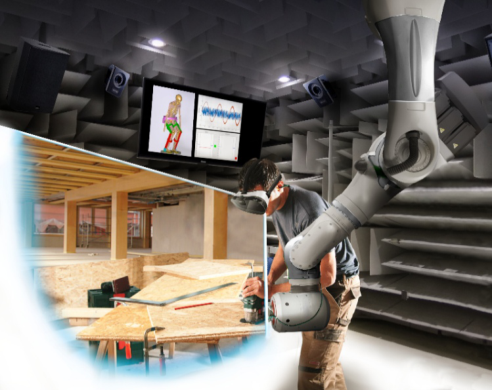
Based on the characteristics of the existing environments, this paper presents a concept for such a testing environment. As illustrated in Fig. 1, the vision combines the characteristics of existing testing environments and extends them with requirements specific to human-machine symbiosis.
Figure 1: Vision of a testing environment for developing technical, symbiotic human- machine systems. A human is working with a virtual technical system in a testing environment. A robot with a real handle and a VR-environment gives him the feeling of a real-world task.
Methods
In order to realize the vision of a testing environment for the development of symbiotic human-machine systems, a concept has been designed. This concept comprises the following elements:
A mixed reality environment that represents the characteristics of the technical system and task dimension (Inga et al., 2023).
The human interacting with the technical system, whose behavior is observed.
Measurement systems that enable data-driven analysis of the human’s physiological behavior and perception of human-machine interaction.
To generate development knowledge for designing symbiotic human- machine systems, three key requirements for the testing environment were derived from the literature. These three key requirements make it possible to examine the four-dimensional multivariate approach of symbiosis (Inga et al., 2023).
1. Mixed reality simulation of the technical system must model its haptic behavior reproducibly and to enable precise adjustments. In addition, the simulation must represent the application context of the product in an immersive way. 2. Measurement of human physiological behavior must enable ergonomic evaluation of the performed task. Minimizing human strain is a central criterion in symbiotic human-machine systems. At the same time, the measurement setup should interfere as little as possible with natural human behavior. 3. Capturing human perception must allow for the identification of human- machine symbiosis based on objective criteria. Established psychological questionnaires and physiological proxy variables, such as eye-tracking metrics or heart rate, should be used to identify sensor-driven indicators of symbiosis.
The following section presents the technical solutions implemented for the testing environment and their realization within the Human-Machine Symbiosis Lab at the Karlsruhe Institute of Technology.
Results
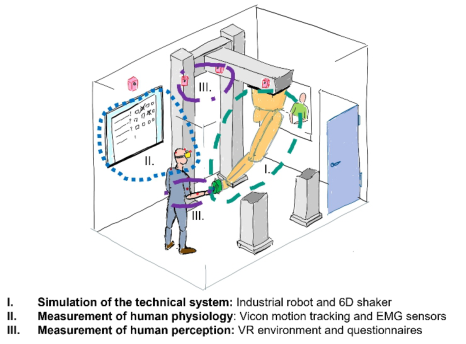
As shown in Figure 2, the technical implementation was divided into three tasks based on the defined requirements.
Figure 2: Concept for a testing environment for the development of symbiotic systems.
The Human-Machine Symbiosis Laboratory: A New Testing Environment 781
Simulation of the Technical System The simulation of the technical system is realized through four components: a six-axis industrial robot from Kuka (model KR 210 R3100-2C), a specialized six-axis shaker system (voice coil) from DT-Square (DTSquare GmbH, Stuttgart, Germany), a handle with interchangeable geometries, and a VR environment (Meta Quest 3, Unity environment).
Human and technical system are directly interacting via the handle. This interface is designed with a standardized flange, allowing a wide variety of handles to be attached. The 6-axis voice coil shaker, positioned between the handle and the robot (shown in green in Figure 2), models the vibration behavior and the small-scale movements of the technical system. The general movements dynamics of the technical system are modelled by the robot, which is mounted upside down to provide an optimal range of motion. A 6-axis force-torque sensor (Schunk SE & Co. KG, Lauffen, Germany) mounted between the robot end effector and the shaker enables participants to freely guide the robot through force-velocity control. Additional control parameters, such as the actual response variables from the application, allow the robot to reproduce the behavior of the technical system in real tasks. This functionality is achieved using the ADWIN Pro II real-time control system (Jaeger Computergesteuerte Messtechnik GmbH, Lorsch, Germany), a Beckhoff SPSS (Beckhoff Automation GmbH & Co. KG, Verl, Germany), and the robot’s internal control system. These control parameters are determined in preliminary studies by measuring real applications or comparable reference systems.
The simulation of the technical system is completed by the virtual environment, which enables immersion for the participant. In addition to haptic feedback via the handle, shaker, and robot, the VR environment delivers visual and acoustic feedback. Within the VR environment, the technical system and its behavior are displayed realistically. The environment was developed in Unity, which offers flexibility for the integration of new virtual worlds and application-specific scenarios.
Measurement of Human Physiology The following measurement systems are implemented in the Human-Machine Symbiosis Laboratory to accurately capture participants’ physiological behavior and their interaction with the technical system, with minimal influence on the natural human behavior. The evaluation parameters include:
Physical human behavior, characterized by executed movements and action forces applied to the technical system,
Physical load, quantified by body posture and reaction forces acting on participants,
Physical strain, determined through muscle activation measurement.
Body posture and participant motion are recorded using an optical motion capture system with infrared Vicon markers (Vicon Motion Systems Ltd, United Kingdom). Reaction forces effecting the participants’ physical load are measured using a floor-mounted force plate (Advanced Mechanical
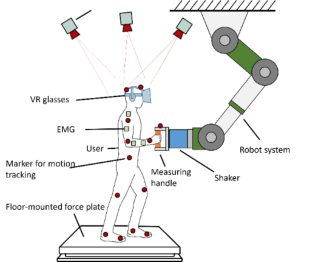
Technology, Inc. Watertown, USA) and the six-axis force/torque sensor integrated onto the robot arm. The same forces and torques measured by the force/torque sensor are used to analyze the interaction between the human and the technical system. Muscle activation is measured using wireless surface electromyography (EMG) sensors (Delsys, Natick, USA). In addition, the dynamic behavior of the technical system is assessed through accelerometers mounted on the robot handle, enabling analysis of the effect of human vibration impedance on system dynamics. An example setup of the measurement systems is shown in Figure 3. Neither the infrared markers of the motion capture system or the EMG sensors or the force sensors installed on the robot restrict participants’ natural behavior. The only limitation arises from the restricted surface area of the force plate, which confines the participant’s movements to a defined working position. However, for stationary tasks, this constraint can be accounted for in the task design, resulting in minimal impact on study outcomes.
Figure 3: Schematic test setup of the measurement technology in the human-machine symbiosis lab.
Measurement of Human Perception To measure human perception and behavior, the technical implementation is based on the current state of research. Studies show that aspects of human perception, such as cognitive load, play a central role in human-machine symbiosis due to their influence on human safety and performance (Zhang et al., 2023). Standardized questionnaires are used to measure these variables. They can be administrated via a screen installed in the laboratory, through a verbal interview conducted by the study supervisor or the VR environment. In addition to subjective questionnaires, objective proxy variables such as eye- tracking measurements can collected using the VR-headset. This combination enables the development of novel metrics to evaluate the state of symbiosis within the Human-Machine Symbiosis Laboratory.
Coupling VR Environment and Robot for Immersive Perception The evaluation of symbiotic human-machine systems requires precise alignment of the VR environment with the physical components to ensure a realistic sense of immersion for participants. A key element of the system’s
The Human-Machine Symbiosis Laboratory: A New Testing Environment 783
functionality is the real-time synchronization between the motion of the physical handle and virtual representation of the technical system in the VR environment. The Vicon motion capture system records both participant posture and the handle position. These data are transferred and visualized in the VR environment and complemented with positional information from the robot to correct tracking errors, for example those caused by occluded markers. Ultimately, symbiosis between human and machine can only be achieved and evaluated through the interaction of all subsystems.
Figure 4: Virtual environment of the human machine symbiose lab in a hammer drill application.
DISCUSSION
This paper aimed to answer the following research question: How can a testing environment be designed to validate technical products in the development of symbiotic human-machine systems and to generate development knowledge for their design?
This question is divided into two parts:
1. Designing a testing environment for validating symbiotic human-machine systems The Human-Machine Symbiosis Laboratory at the Karlsruhe Institute of Technology (KIT) provides a testing environment that meets the requirements of three task areas:
Simulation of the technical systems
Measurement of human perception
Measurement of human physiology The simulation of the technical system is implemented as a mixed reality environment, consisting of a robot as the physical component for haptic stimuli and a VR environment for representing the visual and acoustic application context. This setup is comparable to established simulators described in the literature (e.g., RODOS, Bengler), but currently shows certain limitations: the behavior of the technical system can only be
influenced to a limited extent by participant actions, which may reduce immersion. In the future, the fidelity of real-world behavior representation should be enhanced to improve the interaction experience. Existing interactive test environments, such as the RODOS system developed by the Fraunhofer Institute, may serve as a reference, particularly in regard to industrial robot control. In addition, the internal responses of the simulated system to human actions can be integrated into the control loop of the Human-Machine Symbiosis Laboratory, enabling more realistic system behavior. A key objective is to incorporate insights from dynamic test benches, such as the New Dynamical Test Bench for Multi-Axial Loading of Angle Grinders (see Table 1), into the control loop (Uhl et al. 2019).
The selected measurement systems for human physiology are state-of- the-art. The Vicon motion capture system and AMTI force plates are also used in modern biomechanical laboratories such as the GRAIL environment (see Table 1). There is, however, potential to extend the metrics used for perception analysis. Additional psychophysiological approaches, such as the evaluation of heart rate, blood pressure, or brain activity, could be integrated to obtain a more comprehensive understanding of human-machine interaction.
2. Building development knowledge for symbiotic systems The second part of the research question relates to the possibility of generating development knowledge from the measurements. This requires that the influence of various product parameters on human-machine interaction and their effect on humans can be precisely recorded. The selected measurement technology, combined with a fully adjustable technical configuration of the laboratory, make this possible.
This allows hypotheses about novel product development, pushing the boundaries of what can be investigated beyond what is currently possible in prototypes. The result is a practical, efficient basis for the stepwise accumulation of knowledge for the design of symbiotic human-machine systems.
CONCLUSION
In conclusion, the Human-Machine Symbiosis Lab at the Karlsruhe Institute of Technology provides a testing environment that allows technical products to be examined in the context of human-machine symbiosis. This is achieved by recording human behavior, physical load, and physical strain, while allowing the configuration of the simulated product to be flexibly adjusted. In this way, the laboratory enables the systematic accumulation of development knowledge for the design of symbiotic human–machine systems.
ACKNOWLEDGMENT
This research is funded within the proposals “Human-Machine-Interaction Laboratory” (528773253) by the German Research Foundation (DFG). The test equipment was partially supported through the funding of the DFG under
The Human-Machine Symbiosis Laboratory: A New Testing Environment 785
proposal 528773253. The research results are the sole responsibility of the authors and do not represent the official opinion of the DFG.
Declaration of Generative AI and AI-Assisted Technologies in the Writing Process During the preparation of this work, the authors used Deepl SE and ChatGPT5 to improve writing and language skills. After using this tool/service, the authors reviewed and edited the content as needed and assume full responsibility for the content of the publication.
REFERENCES
Albers, Albert/Behrendt, Matthias/Schroeter, Jens/Ott, Sascha/Klingler, Simon (2013). X-in-the-loop: A framework for supporting central engineering activities and contracting complexity in product engineering processes. Lindemann, Venkataraman et al. (Hg.) 2013 – Proceedings of ICED 13, 379–389. Brucker Juricic, Belinda/Galic, Mario/Marenjak, Sasa (2021). Review of the Construction Labour Demand and Shortages in the EU. Buildings 11 (1), 17. https://doi.org/10.3390/buildings11010017. Dörr, Matthias/Mertens, Joscha/Gwosch, Thomas/Matthiesen, Sven (2021). A New
Dynamical Test Bench for Multi-Axial Loading of Angle Grinders. https://doi.org/ 10.5445/IR/1000130022. Delft University of Technology (2025). Delft Haptic Lab. Available online at https:// delfthapticslab.nl/research/ (accessed 8/26/2025). Emmerich, S./Reinhard, R./Kleer, M./Steidel, S./Starck, R./El-Ratal, W./Lin, W.-T./
Ki, N./Tebbe, S./Boden, S. (2025). Simulatorgestützte Bewertung verschiedener Kabinenfederungskonzepte für Traktoren im frühen Prototypenstatus. In: Humanschwingungen 2025. VDI Verlag, 153–164. Hardege, Stefan (2023). Fachkräfteengpässe gefährden Transformation und Innovation. DIHK-Report Fachkräfte 2023/2024. Available online at https:// www.dihk.de/resource/blob/107882/f8e2f248f04aaf10e622d5a0fcb38df9/ fachkraefte-dihk-fachkraeftereport-2023-data.pdf (accessed 12/10/2024). Hommel, Bernhard (2011). The Simon effect as tool and heuristic. Acta psychologica 136 (2), 189–202. https://doi.org/10.1016/j.actpsy.2010.04.011. Inga, Jairo/Ruess, Miriam/Robens, Jan Heinrich/Nelius, Thomas/Rothfuß, Simon/
Kille, Sean/Dahlinger, Philipp/Lindenmann, Andreas/Thomaschke, Roland/ Neumann, Gerhard/Matthiesen, Sven/Hohmann, Sören/Kiesel, Andrea (2023). Human-machine symbiosis: A multivariate perspective for physically coupled human-machine systems. International Journal of Human-Computer Studies 170, 102926. https://doi.org/10.1016/j.ijhcs.2022.102926. Kleer, Michael/Gizatullin, Andrey/Dreßler, Klaus/Müller, Steffen (2014). Real-time human in the loop MBS simulation in the Fraunhofer RobotBased Driving Simulator. Archive of Mechanical Engineering (61(2)), 269–285. Motek Medical B. V. (2025). The Ultimate Gait-Lab Solution. A new standard
for clinical gait analysis, training and research. Available online at https:// www.motekmedical.com/solution/grail/ (accessed 8/15/2025). Robert Weidner (2025). EVO-MTI - Environment for the Development of Physical Support Systems. Available online at https://www.rob.cs.tu-bs.de/de/node/1443 (accessed 8/15/2025). Rupp, Gary L. (2010). Performance Metrics for Assessing Driver Distraction: The
Quest for Improved Road Safety. Warrendale, PA, SAE International.
Tropschuh, Barbara/Dillinger, Fabian/Korder, Svenja/Maier, Maria/Gärtner, Quirin/ Vernim, Susanne (2021). Industrie 5.0 – ein menschzentrierter Ansatz. Zeitschrift für wirtschaftlichen Fabrikbetrieb 116 (6), 387–392. https://doi.org/10.1515/zwf- 2021–0091. Uhl, Michael/Bruchmüller, Tim/Matthiesen, Sven (2019). Experimental analysis of
user forces by test bench and manual hammer drill experiments with regard to vibrations and productivity. International Journal of Industrial Ergonomics 72, 398–407. https://doi.org/10.1016/j.ergon.2019.06.016.
LISTED IN THE AHFE DIGITAL BOOKSTORE CATALOGUE
Explore the complete digital volume
Human Factors in Design, Engineering, and Computing
Read this individual research paper free through the original publisher, or explore the full digital proceedings book.
ISBN 978-1-964867-75-5
Explore this ISBN in the AHFE Bookstore ↗Listed in the July 2026 bookstore catalogue; search by ISBN to confirm current availability · Digital book purchase optional