Sebastian Zimprich, Benjamin Anstotz, Sven Matthiesen (2022). Hydro-mechanical Dampers for Testing high Cyclic Shock Loads in Preventive Health Protection. In: Human Interaction & Emerging Technologies (IHIET 2022): Artificial Intelligence & Future Applications. AHFE Open Access, vol. 68, pp. 683–689. https://doi.org/10.54941/ahfe1002793
Construction workers are exposed to harmful vibration emissions in the usage of power tools. For preventive health protection, the vibration emission is therefore regulated in the EN ISO 28927, as well as tested and optimized in the development of new power tools. The vibration emission of hammer drills and other impact driven power tools can be tested by using a steel ball energy absorber as a substitute workpiece, which reduces statistical variance and expenses in laboratory tests. The steel ball energy absorber, as the current used damper in EN ISO 28927, is not adjustable in its properties and has no variable influence to the power tools vibration emission. It is unknown, whether an adjustable damper could affect the power tools vibration emission. Therefore, a new adjustable hydro-mechanical damper for testing high cyclic shock loads was designed and tested in this study. The tests revealed that hammer drills vibration emissions can be influenced by an adjustable hydro-mechanical damper. In field tests, the used tool, tool wear or the machined workpiece influences the hammer drills vibration emissions. The new adjustable damper can improve the preventive health protection of workers, as these factors now can be taken into account in laboratory vibration testing.
Hand-arm vibrations increase the probability of vascular and neurologi- cal diseases. Vibration white finger is such a known long-term condition and acknowledged occupational disease (Nilsson et al., 2017). Construction workers are exposed to harmful vibration emissions in the usage of power tools. The maximum daily working time with power tools is therefore limi- ted by considering their vibration emission (EN ISO 5349-1:2001). Every power tools vibration emission is specified with the ahv value, which weights harmful frequency components (EN ISO 5349-1:2001). A smaller vibration emission results in a lower ahv value and allows a longer daily working time. Manufacturers optimize and test power tools in their development therefore to a low vibration emission.
Scattering concrete properties lead to a high statistical variance in these tests. For hammer drill tests, the concrete can therefore be replaced by the mechanical particle damper “Dynaload” as a substitute workpiece in labora- tory tests (EN ISO 28927-10:2011). With this particle damper, the hammer drills tool strikes in a container with more than 3000 bearing balls. These bearing balls convert impact energy into heat by friction. The consistent pro- perties reduce the statistical variance in the tests and leads to measurements that are more comparable. McDowell et al. compared the vibration emission in tests with this mechanical particle damper to field tests in working con- ditions. These tests revealed large differences in tests between the vibration measured with the particle damper and the field (Mc Dowell et al., 2012). This lowers the tests reliability, as test results derive from the real application (Hewitt et al., 2011). In the field, the vibration emission of hammer drills can depend on many different factors, such as bit diameter, bit wear or the concrete type (Antonucci et al., 2017; Coggins et al., 2010). These influe- ncing factors to the vibration emission are not yet considered in laboratory vibration tests.
Due to their nature, mechanical particle dampers are not adjustable in their properties (Sánchez et al., 2012). Hydro-mechanical dampers can provide variable stiffness and damping parameters (Jugulkar et al., 2016). However, it is unknown whether variable stiffness and damping parameters have an influence to the hammer drills vibration emission. With an adjustable damper for high cycle shock loads, these tests could be carried out with more vali- dity, as the influencing factors to the vibration emission could thus be taken into account. The research question in this paper is therefore formulated as follows: Have variable stiffness and damping parameters an influence to a hammer drills vibration emission?
MATERIALS AND METHODS
A new designed hydro-mechanical damper with variable stiffness and dam- ping parameters is presented in this chapter. This damper is used for vibration tests, according to EN ISO 28927, to answer the research question.
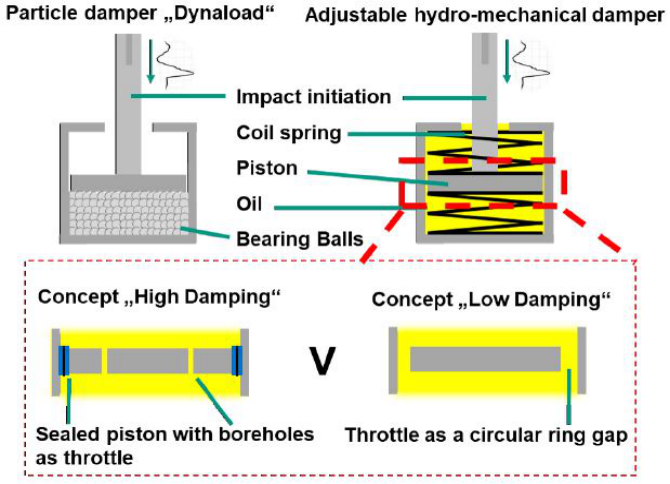
The Adjustable Hydro-Mechanical Damper In order to answer the research question, a new adjustable damper for high cycle shock loads was designed. As particle dampers are not adjustable due to their nature, a hydro-mechanical damper concept was selected. The scope of application is analogous to the particle damper used in the EN ISO 28927- 10: To be used as a substitute workpiece to replace concrete in laboratory hammer drilling tests. The new damper compared to the particle damper “Dynaload” is shown on the top in Figure 1.
The impacts of the hammer drill are transmitted into the piston via the rod, causing the piston to move. The piston is pivoted by coil springs. Different coil springs can be used to vary the stiffness. The piston is designed as a throttle. The movement of the piston causes oil to flow through the piston, which dissipates the energy introduced by the impacts.
Hydro-Mechanical Dampers for Testing High Cyclic Shock Loads 685
Figure 1: Sketches of the new adjustable hydro-mechanical damper in comparison to the particle damper and the two different damping principles.
The piston was designed as two throttle variants, one with a high damping and one with a low damping parameter. In the concept “high damping”, the piston is sealed to the cylindrical wall and the oil can flow through boreholes. In the concept “low damping”, the oil can flow through a circular ring gap. Both damping concepts are shown on the bottom of Figure 1.
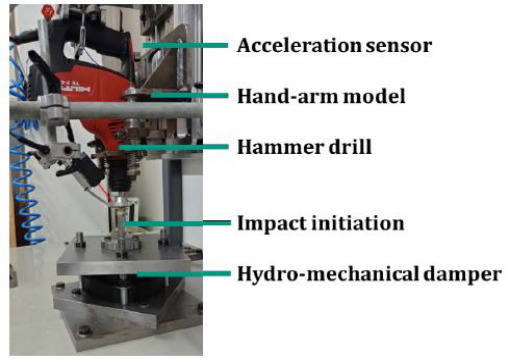
Experimental Setup To answer research question, whether adjustable stiffness and damping para- meters damper have an effect to hammer drills vibration emissions, the new hydro-mechanical damper was loaded with high cycle shock loads and the- refore tested as a substitute workpiece according to the test procedure in EN ISO 28927-10. A Hilti TE 7-C is used as a hammer drill, which has an impact frequency of 67 Hz at a single impact energy of 2.6 J. This requires a damping performance of 174 W.
To obtain stable und reproducible test conditions, the drilling tests are performed in a drilling test rig, replacing the human operator. A pneumatic cylinder provides a constant feed force of 300 N. For valid vibration emis- sions, the hammer drill is clamped in a hand-arm model (Jahn and Hesse, 1986). The vibration emission of the hammer drill is measured via acceleration sensors PCB 356A02 in drilling direction. The acceleration sensor is atta- ched to the hammer drill at the proposed location, according to EN ISO 28927. The vibration emission is evaluated in the drilling direction, as the used hand-arm model is designed and valid for this direction (Jahn and Hesse, 1986). The mean ahv value over a test run is calculated from the acceleration
Figure 2: Experimental setup to test the influence of variable stiffness and damping parameters to hammer drills vibration emission.Table 1. Factor levels for stiffness and damping.
Table available in the original PDF paper.
Factor Levels Stiffness Factor Levels Damping S1 535 N/mm High Sealed piston with boreholes throttles S2 1250 N/mm Low Throttle as a ring gap S3 1455 N/mm S4 3132 N/mm
signal according to EN ISO5349-1:2001. This method weights harmful fre- quency components higher than non-harmful ones. The higher the resulting value, the more harmful the frequency and the shorter the daily exposure time allowed. The experimental setup is shown in Figure 2.
Experimental Plan In the tests, the stiffness and damping parameters in the hydro-mechanical damper were varied. To vary the factor stiffness, four different coil springs were used as factor levels. The levels S2 and S3 were used, as the stiffness is near the theoretical concretes stiffness value 1670 N/mm in hammer drilling (Jahn and Hesse, 1986). S1 and S4 were selected as a yielding and stiffer factor level, compared to the theoretical concretes stiffness value.
To vary the damping principle, the two different pistons were used as quali- tative factors with a hydraulic oil of viscosity 22 cSt. Both damping principles had a theoretical damping, which is high enough to damp the previous impact at the time the next impact occurs. The factor level “low damping” had a piston with a ring gap to the cylindrical wall as a throttle, resulting in a lower damping coefficient, whereas the level “higher” had a piston which was sealed to the cylindrical wall and had four boreholes as throttles, resul- ting in a higher damping coefficient. The values for the factor levels are given in Table 1.
Hydro-Mechanical Dampers for Testing High Cyclic Shock Loads 687
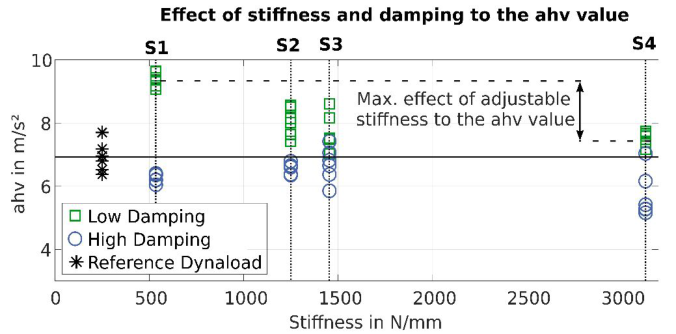
Figure 3: Ahv values for the stiffness and damping levels.
Each factor combination was tested for with the hammer drill for 30 seconds and was repeated for six times. The four factor levels for stif- fness, the two factor levels for damping principle and six test runs for each combination result in 48 test runs in total for the full factorial test design. The test runs were partially randomized to reduce trend effects.
To compare the vibration emission of tests with the new hydro-mechanical damper to tests according to EN ISO 28928, six test runs were performed with the particle damper “Dynaload” in the in the here presented test setup. These tests were carried out at the same feed force of 300 N and were evaluated regarding the ahv value analogous to the 48 tests runs.
RESULTS
The ahv values for the 48 test runs with the new hydro-mechanical damper and the six tests runs with the particle damper “Dynaload” are shown in Figure 3. The Mann-Whitney U-Test observed, that tests of the factor level “low damping” had a significant higher ahv value than tests with the factor level “high damping” (U = 8.000, Z = −5.774, p < 0.001, n = 48).
The six tests with the particle damper “Dynaload”had a mean ahv value of 6.9 m/s2. This mean value is marked as the black line in Figure 3. Compared to the tests with the hydro-mechanical damper, this value is higher than most tests with the factor level “low damping”, but higher than all ahv values of tests with the factor level “high damping”.
For tests with the factor level “high damping”, the ahv value decreased with an increasing stiffness value. For tests with the factor level “low dam- ping”, this decreasing trend with an increasing stiffness value is not that clear.
The highest effect for a decreasing ahv value with a higher stiffness at the same damping concept was observed for test with the stiffness “S1” compa- red to test runs with the stiffness “S4” (S1: 9.4 m/s2 vs. S4: 7.4 m/s2). The highest effect the ahv value was observed between for test with the factor
combination “S1/Low damping” to “S4/High damping” (S1/Low damping: 9.4 m/s2 vs. S4/High damping: 5.7 m/s2). The ahv values standard deviation for the six tests runs with the particle damper “Dynaload” was 0.48 m/s2. This standard deviation is bigger than the standard deviation for tests runs with the level “low damping” at the highest or lowest stiffness (S1: σ = 0.23 m/s2 vs. S4: σ = 0.22 m/s2).
DISCUSSION
It is possible to carry out vibration tests for preventive healthcare, according to EN ISO 28927, with the new adjustable hydro-mechanical damper. In the tests performed, the ahv values are comparable to tests with the existing par- ticle damper “Dynaload”. The tests revealed that the ahv value is depended by the dampers stiffness and damping parameters. Therefore, the research question “Have variable stiffness and damping parameters an influence to a hammer drills vibration emission?” can be answered with yes.
Although both damping principles provided valid ahv values, the adju- stability of the vibration emission via the varied stiffness is larger for the damping principle with the throttle as a ring gap than the sealed piston with boreholes. This indicates that the concept with the throttle as a ring gap is bet- ter suited for future tests, since a greater adjustability is reached. With this, a wider range of effects to the vibration emission can be mapped in laboratory vibration tests.
As only one hammer drill was used in this study, the effect of stiffness and damping parameters to the vibration emission should be tested with various hammer drills from different manufacturers to secure the findings. A specific mapping of influencing factors to the vibration emission, like the used tool, tool wear or the machined workpiece, in laboratory vibration tests is with the findings of this study not yet possible. One the one hand, the quantita- tive effect of these factors to the ahv value is unknown, on the other hand, the precise adjustment of the vibration emission by different stiffness and damping parameters is unknown. For this, the determination of stiffness and damping effects to the ahv value needs further research. This would enable to map the influencing factors in laboratory tests and would therefore lead to laboratory vibration tests with a higher degree of validity. With further resea- rch, it would be conceivable to integrate the hydro-mechanical damper to the standard EN ISO 28927 for laboratory vibration tests. With this, power tool manufacturers can estimate the ahv values more reliable. This protects the user in a preventive manner, as he has a better estimation and more precise information about the vibration emission affecting him.
CONCLUSION
A new adjustable hydro-mechanical damper for testing high cyclic shock loads was designed and tested as a substitute workpiece for hammer drills in laboratory vibration tests. The tests revealed, that a hammer drills vibration emission can be influenced by an adjustable stiffness and damping parame- ters. This can be used in future tests with hammer drills to map different use
Hydro-Mechanical Dampers for Testing High Cyclic Shock Loads 689
cases in laboratory vibration tests. The findings in this study help to consider relevant influencing factors to the ahv value in laboratory tests. Vibration tests with hammer drill can thus be carried out more reliable. This protects the user in a preventive manner, as he would have a better estimation and more precise information about the vibration emission affecting him.
REFERENCES
Antonucci, A., Barr, A., Martin, B. and Rempel, D. (2017) ‘Effect of bit wear on hammer drill handle vibration and productivity’, Journal of occupational and environmental hygiene, vol. 14, no. 8, pp. 642–651. Coggins, M. A., van Lente, E., McCallig, M., Paddan, G. and Moore, K. (2010)
‘Evaluation of hand-arm and whole-body vibrations in construction and property management’, The Annals of occupational hygiene, vol. 54, no. 8, pp. 904–914. EN ISO 28927-10:2011 Hand-held portable power tools – Test methods for evaluation of vibration emission – Part 10: Percussive drills, hammers and breakers: European committee for standardization (2011), Berlin: Beuth Verlag. EN ISO 5349-1:2001 Mechanical vibration – Measurement and evaluation of human
exposure to hand-transmitted vibration: European committee for standardization (2001), Berlin: Beuth Verlag GmbH. Hewitt, S., Shanks, E., Heaton, R. and Mole, M. (2011) Evaluation of EN 60745 test codes: BS EN 60745-2-6:2003+A2:2009 concerning the vibration of hand-held electric hammers. Jahn, R. and Hesse, M. (1986) ‘Applications of hand-arm models in the investiga-
tion of the interaction between man and machine’, Scandinavian journal of work, environment & health, vol. 12, 4 Spec No, pp. 343–346. Jugulkar, L. M., Singh, S. and Sawant, S. M. (2016) ‘Analysis of suspension with variable stiffness and variable damping force for automotive applications’, Advances in Mechanical Engineering, vol. 8, no. 5, 168781401664863. Mc Dowell, T. W., WARREN, C., WELCOME, D. E. and DONG, R. G.E.N. (2012)
‘Laboratory and field measurements and evaluations of vibration at the hand- les of riveting hammers’, The Annals of occupational hygiene, vol. 56, no. 8, pp. 911–924. Nilsson, T., Wahlström, J. and Burström, L. (2017) ‘Hand-arm vibration and the risk of vascular and neurological diseases—A systematic review and meta-analysis’, PLoS ONE, vol. 12, no. 7. Sánchez, M., Rosenthal, G. and Pugnaloni, L. A. (2012) ‘Universal response of opti-
mal granular damping devices’, Journal of Sound and Vibration, vol. 331, no. 20, pp. 4389–4394.
Read this individual research paper free through the original publisher, or explore the full digital proceedings book.
ISBN 978-1-958651-44-5
Explore this ISBN in the AHFE Bookstore ↗Listed in the July 2026 bookstore catalogue; search by ISBN to confirm current availability · Digital book purchase optional