Felix Leitenberger, Johannes Sänger, Jonas Hemmerich, Tobias Kretschmer, Patrick Haberkern, Niklas Frank, Albert Albers, Patric Grauberger, Markus Doellken, Sven Matthiesen (2025). Multibody Simulation Framework for Human-Machine Interaction in Impact Wrench Fastening: Enabling Reliability and Work-Related Health Risk Assessment. In: Human Interaction and Emerging Technologies (IHIET 2025). AHFE Open Access, vol. 197, pp. 57–66. https://doi.org/10.54941/ahfe1006699
Ensuring both work-related health protection and reliability in impact wrench operations requires an in-depth understanding of human-machine systems, specifically the interactions between the human operator, impact wrench, and bolt connection with the environment. However, existing studies typically focus on isolated aspects, neglecting the complex dynamics between these systems. The lack of a simulation framework hinders assessments of human load, hand-arm vibration syndrome (HAVS) risk, and the reliability of the fastening process. Without a holistic approach, it remains challenging to optimize tool design, refine tightening strategies, and mitigate risks associated with high-frequency impulsive forces.To address this gap, we present a multibody simulation framework for analyzing human-machine systems, integrating three models: a digital human model (DHM) based on a musculoskeletal human model for biomechanical and health risk assessment, a multibody impact wrench model with drivetrain dynamics to capture impulsive force transmission, and a multibody bolt connection model with fastening dynamics to assess reliability. The three models run as a co-simulation between OpenSim and MATLAB Simulink described by Molz et al. The multibody impact wrench model based on the presented workload model (ApOL) of Sänger et al. is extended by modelling the internal drivetrain dynamics of the impact wrench and the forces acting onto the human during the bolt tightening process. The bolt model integrates finite element (FE) simulations on the micro level with a multibody system (MBS) model on the macro level to capture tribological effects in tangential impact-driven bolt tightening. The micro-scale FE model incorporates real thread topographies to compute friction coefficients, which are then applied in the macro-scale MBS model that includes bolt inertia and the impact wrench’s drive system. This enables a more accurate prediction of fastening dynamics, thread deformation, and torque losses, improving the assessment of the final preload force while ensuring scalability across different bolt sizes. By leveraging these models, we establish a multibody simulation framework that links human biomechanics, tool dynamics, and the mechanics of the bolt connection. Our framework provides a structured way to assess how impulsive forces propagate through the different systems. Additionally, by integrating fastening mechanics, we can examine how variations in bolt preload, friction coefficients, and tightening sequences impact the reliability of the bolt connection. The framework can also be used to compare different impact wrench tool designs and configurations, offering insights into how to mitigate undesired tool-induced physical stresses on the human operator. It sets the stage for future developments in enabling reliability and work-related health risk assessment. The modular nature of the framework allows for extensions, such as incorporating sensor-based validation data, and adapting the approach to other fastening tools. Additionally, this framework can be applied to different industrial settings, where fastening precision and human stress are critical factors, such as construction industry. The DHM in OpenSim estimates muscle activity in response to external forces and motion; however, it is not validated for assessing vibration exposure. This remains an active research topic within the musculoskeletal modeling community. Future work will focus on validating the simulation results against experimental measurements and refining the dynamic models to capture interactions more accurately. Ultimately, this framework establishes a foundation for systematically analyzing and enhancing human-machine interaction in impact wrench fastening, effectively linking reliability with work-related health risk assessment.
Bolted joints are among the most widespread mechanical connections used in engineering and manufacturing. In fastening these bolted joints, tangential impact wrenches are preferred in industrial settings due to their high torque capacity and ergonomic advantages, as their mechanical decoupling between drive and output reduces the physical load on users.
Even though they significantly reduce load on their users, many power tools induce high-frequency vibrations into the user (Rimell et al., 2008). As users also influence the dynamic behavior, the interaction of user and power tool needs to be considered for two reasons in order to reduce health risks on the users: First, even though impact wrenches decouple the direct torque transmission, their dynamic behavior can lead to health risks for users
(Clemm et al., 2020). Their vibration characteristic differs from well-known vibration inducing power tools like hammer drills, nonetheless they affect the health of their users (Schulze et al., 2023). Assessment of health risks of impact wrenches cannot be done without insights into their interaction with the bolted joint connection as well as their user.
Second, the uncertainties and variabilities of preload forces lead to the necessity to overdimension bolted joint connections fastened by impact wrenches. These overdimensioned bolted joints require unnecessary high torques for fastening, increasing the health risk on the power tool users (McDowell et al., 2008). To lower the health risk, reduction of variability of preload force is a way to reduce the necessary bolt size.
Causes for this variability is the fact, that in bolted joints, up to 80% of the applied torque is consumed in overcoming friction in the thread and under- head contact surfaces. Even minor changes in the friction coefficient can lead to significant deviations in achieved preload, which is especially critical in dynamic tightening processes. Further, cumulative effects during the multiple impact events of tangential wrenches can result in preload force deviations of up to 60% from the nominal value (Niemann et al., 2019).
To integrate user influences in product development, co-simulation approaches have been used, e.g. in the research on exoskeletons (Molz et al., 2024). Simulation models for the individual instances of impact wrench tightened bolted joint connections already exist up to a certain degree, but their interaction is not investigated so far.
However, the dynamic nature of tangential impact tightening obstructs gain of knowledge about influencing factors of these bolted joints, as it presents unique modeling challenges. It is characterized by nonlinear friction interactions and repeated high-frequences torque impulses. The frictional behavior varies significantly over time during tightening, influenced by surface roughness, coatings, lubrication, and material properties. Dynamic changes in friction have been observed, for example, in the work of Wettstein and Matthiesen (2020), where both head and thread friction coefficients were found to decrease by approximately 80% over the course of a single tightening operation.
Even though the effect of thread surface topography has been well documented in tribological studies (e.g. Fehrenbacher et al. (2020); Schwarze et al. (2018)) its implementation into macro-scale bolt simulations is still to be done. Impact mechanisms and corresponding bolted joint behavior can be described using various modeling approaches. Sieling (1977) introduced an energy-based model of the impact mechanism, while Zhang and Tang (2016) developed a multibody system with eight rotational and one translational degree of freedom, tuned using experimental data and multi-objective optimization. For modeling joint dynamics, Japing et al. (2015) implemented a multibody simulation model incorporating the Stribeck friction model, which includes Coulomb, viscous, and static friction components. However, these models generally rely on generalized or empirical friction parameters and do not consider surface-specific microstructural effects.
Summarizing, the problem is, that investigation of health risks under consideration of reliability of bolted joints needs to consider many influences
Multibody Simulation Framework for Human-Machine Interaction 59
and interactions from the bolted joint connections, the power tool and also the user.
This leads to the following research question: How can a simulation framework be developed to systematically assess work-related health risks under consideration of fastening reliability of impact wrenches?
MATERIALS AND METHODS
The aim of this study is to develop a multibody simulation framework capable of modeling the dynamic interactions among an user, an impact wrench, and a bolted joint connection. This section describes the chosen sub-models for the simulation framework – the digital human model (DHM), impact wrench drivetrain model, and bolt connection model – and explains how they are combined. The goal is to provide a structured and adaptable framework that researchers can later deploy and validate in various fastening scenarios.
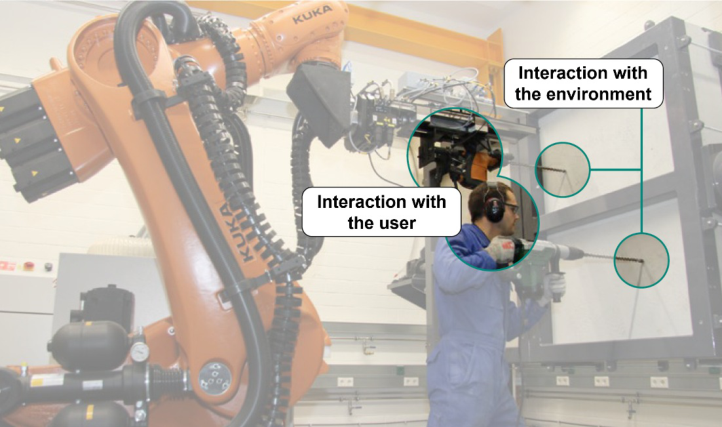
The framework is structured based on the X-in-the-loop (XiL) approach (Albers et al., 2016), where interactions of technical systems with their users and environment can be considered on a physical and/or virtual level. In Figure 1, the interaction of a power tool with a real user and a robot employing a hand-arm model is shown as an example of testing setups.
Figure 1: Interaction of a power tool with its user and environment in a testing setup following the XiL approach (Matthiesen et al., 2024).
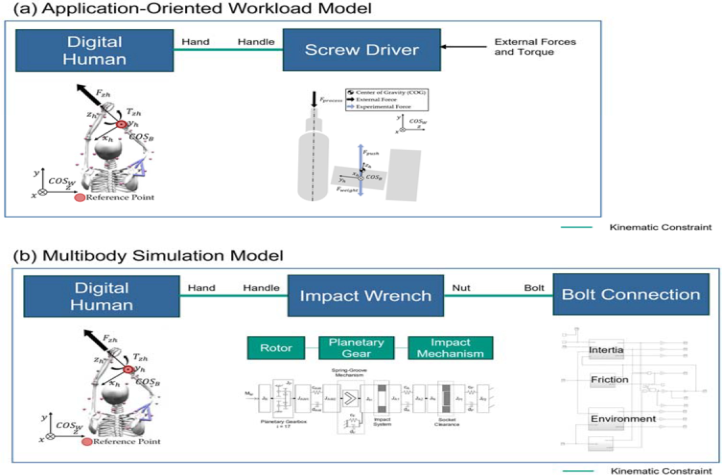
BASIS OF SIMULATION FRAMEWORK The proposed framework is based on the Application-Oriented Workload (ApOL) model (Sänger et al., 2023). In the ApOL model the primary goal was to establish an application-oriented load profile for overhead screw-in tasks using a cordless screwdriver. The structure of the ApOL model is shown in Figure 2a. The forces and torque acting on the interface between the power
tool and the environment were determined using a push-force-based virtual sensor and a torque estimation method based on battery current. Using an inertia mass model of the screwdriver, it was possible to transfer these forces and torque to the handle of the power tool as the interface to the human. By combining these components, ApOL successfully determined the forces and torques acting on a digital human model (DHM), thereby predicting the user’s musculoskeletal load. The authors demonstrated that their simulation outputs were sufficiently accurate to guide strain-based design approaches for handheld tools and user support systems such as exoskeletons.
However, a key limitation in the published ApOL approach lies in its reliance on external signals (e.g., battery current) and simplified representations of internal mechanics, effectively treating the cordless screwdriver as a “black box” whose impulses and torques are deduced from experimentally derived parameters. While this strategy has proven suitable for a range of applications involving static or quasi-static loading, it does not fully capture the complex transient behaviors of impact-driven or high- torque processes. In scenarios where impulsive forces dominate, external parameterization may overlook critical mechanical phenomena that occur within the tool before being transmitted to the user.
Our extended framework in Figure 2b therefore seeks to directly simulate the internal drivetrain dynamics of the power tool in interaction with the bolt connection as a “white box”, rather than estimating them solely through measurable signals such as battery current or ground reaction forces. When shifting to an impact wrench design, the periodic high-frequency impacts within the tool’s hammer mechanism make it imperative to simulate the mechanical chain that generates each torque impulse and how it is absorbed by the bolt connection. In doing so, the hammer-anvil mechanism, gear ratios, rotational inertias, friction coefficients and preload forces become explicit parts of the simulation. Similar to the original ApOL model, we still compute the net forces and torques that pass into the user’s hand at the power tool handle and evaluate them with the digital human model; however, the route by which these loads arise now contains a detailed depiction of the technical system and the bolt connection. This distinction is particularly relevant when analyzing impact wrenches, where impulsive loading is a defining characteristic. By contrast, a cordless screwdriver can often be approximated with simpler torque curves or battery current correlations.
Digital Human Model (DHM) The DHM employed is based on a musculoskeletal model implemented in OpenSim by Sänger et al. (2023) and Molz et al. (2024). The model provides biomechanical and health risk assessments by estimating muscular activity, joint forces, and torques resulting from forces and movements imposed by the external system. No custom modifications has to be made to this DHM. The data exchange between OpenSim and MATLAB Simulink, crucial for the co-simulation, follows their methodology, where kinematic and kinetic data are interfaced directly via Simulink co-simulation blocks.
Multibody Simulation Framework for Human-Machine Interaction 61
Figure 2: (a) Application-oriented Workload model based on Sänger et al. (2023) (b) proposed multibody simulation framework.
Multibody Simulation of Impact Wrench The internal dynamics of the impact wrench are modeled in MATLAB Simulink using the Simscape Multibody library, enabling a detailed MBS of the drivetrain components and impact mechanism. The hammer-anvil mechanism is modeled using a Hookean contact model with adjustable damping and stiffness parameters. Torsional stiffnesses and damping coefficients for key drivetrain elements—such as the hammer, anvil, drive shaft, and test bench—were obtained through FEM simulations and literature sources, and are implemented as single-mass oscillators. A 3
rotational clearance between socket and bolt head is represented using a damped rotational joint to capture torque losses during impulse transfer. Overall, the model includes six rotational and one translational degree of freedom. It shows a good approximation to the experimentally measured torque impulses (Brennenstuhl et al., 2025).
Multibody Simulation of Bolt Connection The bolt connection model is still being developed, whereby a multi-scale modeling approach is used to simulate bolted joints under impact-driven tightening. Real head and thread surfaces are measured and analyzed in micro-level FE simulations to determine friction coefficients, which are then integrated into a macro-level multibody model.
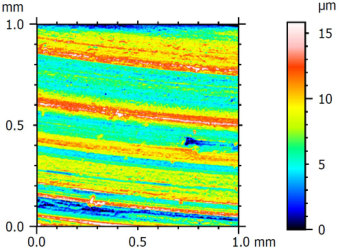
Step 1: Micro-Level Surface Analysis Initially, untreated bolt samples and nuts samples are thoroughly cleaned in an ultrasonic bath. The surfaces of the bolt head and threads are then analyzed at the micro-scale using high-resolution imaging tools such as white- light interferometry and digital microscopy (Figure 3). This analysis provides
precise topographical data which form the basis for developing realistic friction models on the micro-scale.
Figure 3: White light interferometric topography of the first flank of a M20 thread.
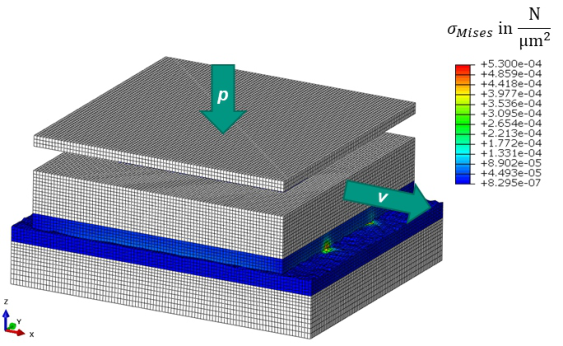
Step 2: Micro-Level Finite Element Simulation With the topographical data, a FE model based on Joerger et al. (2021) and Albers and Reichert (2017) is constructed at the micro-level using the software Abaqus. The FE simulation specifically investigates the frictional behavior under the bolt head and on the bolt threads considering realistic load conditions. The parameters for the tests are the pressure p and velocity v (Figure 4).
Figure 4: Micro-scale FE simulation in Abaqus using topography-based geometry.
Step 3: Macro-Level Multibody Simulation Model Development The condition-dependent friction coefficients derived from the micro-level FE simulations are integrated into a macro-level MBS model. This macro- level model considers not only frictional interactions but also bolt inertia and elasticities throughout the tightening process. The integration ensures accurate representation of tribological interactions on a practical scale and facilitates a dynamic assessment of the bolted connection’s reliability.
Multibody Simulation Framework for Human-Machine Interaction 63
Step 4: Experimental Validation and Analysis Physical tests using a tangential impact wrench are conducted on a dedicated tribological test bench based on Wettstein and Matthiesen (2020) to record friction behaviors in real-time under the bolt head and within the thread interfaces.
Step 5: Scalability Analysis Additionally, scalability tests are performed with different bolt sizes and strength classes (such as M10 class 12.9 and M16 class 8.8 bolts). The intent is to evaluate the developed model’s robustness and validity.
Step 6: Final Calibration and Adjustment Finally, any discrepancies between experimentally measured and numerically simulated preload forces are analyzed. Based on these findings, necessary adjustments and recalibrations are performed to refine and enhance the simulation accuracy and predictive capability of the multibody simulation model.
With the multibody simulation framework, analysis of causes of vibrations as well as interactions between bolted joint connection, impact wrench and user is possible in a more detailed way due to the white box models of the impact wrench, bolted joint connection as well as the coupling of existing models of up to now isolated research areas.
DISCUSSION
This research presents an integrated simulation framework capable of systematically evaluating the complex dynamics between user, impact wrench, and bolted joint connection within close-to-reality operational scenarios. By explicitly simulating internal drivetrain dynamics, musculoskeletal biomechanics, and tribological interactions in fastening processes, our simulation framework addresses significant gaps identified in prior research.
Compared to previous studies, such as the ApOL workload model described by Sänger et al., our framework’s explicit modeling of the internal drivetrain dynamics represents a significant conceptual advancement. By capturing gear interactions, hammer-anvil impacts, and transient torque events explicitly, the simulation provides more realistic representations of forces transmitted to the user.
Additionally, the multi-scale friction model of the bolted joint introduces a refined approach to fastening simulation. The inclusion of micro-scale FE- derived frictional properties based on measured topographies ensures that the macro-scale model accurately represents realistic tribological behavior. This allows for precise assessments of fastening dynamics under practical operational conditions, improving predictive reliability assessments crucial for industrial fastening applications.
The modularity and adaptability of our simulation framework facilitate broad applicability across various operational contexts and user
demographics. Its structured interface and scalability make it possible to swiftly adapt models to different user anthropometries, tool configurations, and bolt sizes or materials. This flexibility significantly enhances the framework’s utility in industrial contexts, providing manufacturers and occupational safety practitioners with a robust tool for pre-emptively evaluating and optimizing workplace conditions, tools, and fastening procedures.
While the framework represents significant advancement, several limitations should be acknowledged. The DHM employed, though effective in estimating muscular and joint loads, currently lacks validation for analyzing high-frequency vibration exposures such as those associated with hand-arm vibration syndrome (HAVS). Future research should focus on incorporating validated vibration modeling capabilities within the DHM, potentially integrating empirical data from sensor-based validation studies.
CONCLUSION AND OUTLOOK In this contribution, the topic of health risk assessment in impact wrenches under consideration of reliability of bolted joint connection is addressed through a multibody simulation framework based on the ApOL model for investigation of human machine interactions. In this framework, existing models of different fields of research are coupled as well as new white box model aspects regarding the impact wrench and the bolted joint connections are developed. With this framework, future research can be conducted into different power tools with health-related risks through vibration, e.g. hammer drills or angle grinders. The methodology behind the framework can be used to extend existing multibody simulation models through consideration of influences from user as well as environment.
ACKNOWLEDGMENT
This research was funded by the Deutsche Forschungsgemeinschaft (DFG, German Research Foundation) with the project ID 511570411.
During the preparation of this work the authors used AI tools such as deepl.com and grammarly.com in order to improve readability and language. After using these tools, the authors reviewed and edited the content as needed and take full responsibility for the content of the publication. All authors have read and agreed to the published version of the manuscript.
REFERENCES
Albers, A., Behrendt, M., Klingler, S. and Matros, K. (2016) ‘Verifikation und Validierung im Produktentstehungsprozess’, in Lindemann, U. (ed) Handbuch Produktentwicklung, München, Carl Hanser Verlag GmbH & Co. KG, pp. 541–569. Albers, A. and Reichert, S. (2017) ‘On the influence of surface roughness on the
wear behavior in the running-in phase in mixed-lubricated contacts with the finite element method’, Wear, 376–377, pp. 1185–1193.
Multibody Simulation Framework for Human-Machine Interaction 65
Brennenstuhl, F., Leitenberger, F., Kretschmer, T., Hemmerich, J., Doellken, M.
and Matthiesen, S. (2025) ‘Multibody Simulation of Impact Wrench for Reliability Analysis in Impact-Tightened Bolted Joints’, 2025 Annual Reliability and Maintainability Symposium (RAMS) Europe. Amsterdam, Netherlands, 08/06/2025–08/07/2025, IEEE. Clemm, T., Færden, K., Ulvestad, B., Lunde, L.-K. and Nordby, K.-C. (2020) ‘Doseresponse relationship between hand-arm vibration exposure and vibrotactile thresholds among roadworkers’, Occupational and environmental medicine, vol. 77, no. 3, pp. 188–193. Fehrenbacher, R., Joerger, A. and Ott, S. (2020) ‘Vorkonditionierung trockenlaufender Reibpaarungen für eine stabile Reibfunktion im Feld’, Reibung, Schmierung und Verschleiß Forschung praktische Anwendung: 61. Tribologie Fachtagung 2020. Virtuell, 28.-30.9.2020. Japing, A., Seibel, A. and Schlattmann, J. (2015) ‘Modellentwicklung zur Beschreibung von Reibschwingungen bei der Schraubenmontage’, in Reibung, Schmierung und Verschleiß: Forschung und praktische Anwendungen, Tribologie- Fachtagung, 56, Aachen, GfT, 63/1–63/10. Joerger, A., Spiropoulos, I., Dannecker, R. and Albers, A. (2021) ‘Multi Scale
Modelling of Friction Induced Vibrations at the Example of a Disc Brake System’, Applied Mechanics, vol. 2, no. 4, pp. 1037–1056. Matthiesen, S., Leitenberger, F., Hölz, K., Sänger, J., Lindenmann, A., Grauberger, P.
and Gwosch, T. (2024) ‘Die Testing-Umgebung’, in Matthiesen, S. and Grauberger, P. (eds) Konstruktionswissen für Ingenieure: Innovative Produkte zielgerichtet entwickeln, Berlin, Springer Vieweg, pp. 177–214. McDowell, T. W., Dong, R. G., Xu, X., Welcome, D. E. and Warren, C. (2008) ‘An evaluation of impact wrench vibration emissions and test methods’, The Annals of occupational hygiene, vol. 52, no. 2, pp. 125–138. Molz, C., Scherb, D., Löffelmann, C., Sänger, J., Yao, Z., Lindenmann, A.,
Matthiesen, S., Weidner, R., Wartzack, S. and Miehling, J. (2024) ‘A Co-Simulation Model Integrating a Musculoskeletal Human Model with Exoskeleton and Power Tool Model’. Niemann, G., Winter, H., Höhn, B.-R. and Stahl, K. (2019) Maschinenelemente 1, Berlin, Heidelberg, Springer Berlin Heidelberg. Rimell, A. N., Notini, L., Mansfield, N. J. and Edwards, D. J. (2008) ‘Variation
between manufacturers’ declared vibration emission values and those measured under simulated workplace conditions for a range of hand-held power tools typically found in the construction industry’, International Journal of Industrial Ergonomics, vol. 38, 9–10, pp. 661–675. Sänger, J., Wirth, L., Yao, Z., Scherb, D., Miehling, J., Wartzack, S., Weidner, R., Lindenmann, A. and Matthiesen, S. (2023) ‘ApOL-Application Oriented Workload Model for Digital Human Models for the Development of Human-Machine Systems’, Machines, vol. 11, no. 9, p. 869. Schulze, D. G., Nilsen, K. B., Clemm, T., Grotle, M., Zwart, J. A., Ulvestad, B. and Nordby, K. C. (2023) ‘Influence of ergonomic factors on peripheral neuropathy under HAV exposure’, Occupational medicine (Oxford, England), vol. 73, no. 1, pp. 13–18. Schwarze, H., Prölß, M., Hagemann, T., Zemella, P. and Winking, P. (2018)
‘Theoretical and Experimental Investigations on Transient Run-Up Procedures of Journal Bearings Including Mixed Friction Conditions’, Lubricants, vol. 6, no. 4, p. 105.
Sieling, P. (1977) Untersuchungen zum Drehschlagschrauben [Online], Wiesbaden, VS Verlag für Sozialwissenschaften. Available at http://dx.doi.org/10.1007/978-3- 322-88372-8. Wettstein, A. and Matthiesen, S. (2020) ‘Investigation of the thread coefficient of
friction when impact tightening bolted joints’, Forschung im Ingenieurwesen, vol. 84, no. 1, pp. 55–63. Zhang, S. and Tang, J. (2016) ‘System-Level Modeling and Parametric Identification of Electric Impact Wrench’, Journal of Manufacturing Science and Engineering, vol. 138, no. 11.
LISTED IN THE AHFE DIGITAL BOOKSTORE CATALOGUE
Explore the complete digital volume
Human Interaction and Emerging Technologies (IHIET 2025)
Read this individual research paper free through the original publisher, or explore the full digital proceedings book.
ISBN 978-1-964867-73-1
Explore this ISBN in the AHFE Bookstore ↗Listed in the July 2026 bookstore catalogue; search by ISBN to confirm current availability · Digital book purchase optional