Sebastian Helmstetter, Susanne Sutschet, Carina Spengler, Felix Möhler, Michael Herzog, Thorsten Stein, Sven Matthiesen (2022). Parametric Scaling of a Lower Limb Model According to Body Height in OpenSim. In: Human Interaction & Emerging Technologies (IHIET 2022): Artificial Intelligence & Future Applications. AHFE Open Access, vol. 68, pp. 45–53. https://doi.org/10.54941/ahfe1002711
The standard preprocessing for simulations in OpenSim requires experimentally acquired motion data of an individual. This paper presents an approach for scaling musculoskeletal OpenSim models using an estimation of body measures according to the body height from the MMM Reference Model, instead of a recorded static pose of a subject. In this way, the data acquisition effort should be reduced using data from existing motion databases. For a first validation of the approach, 1) a pre-study is carried out to evaluate the estimations of the body segment lengths from the MMM Reference Model and 2) a gait study to compare the kinematics of a scaled model using experimental data with a scaled model using our scaling approach. The errors between real and estimated body dimensions are around 10 % resulting in up to 10° differences between the joint angles of the differently scaled models. In general, the scaling approach shows the potential of reducing effort in the simulation preprocess.
Personalization is one of the main issues when developing exoskeletons and other assistive systems (Bleuler et al. 2019). For the personalized ergono- mic design of exoskeletons, individual musculoskeletal simulation models, e.g. in the software OpenSim (Delp et al. 2007), are common to study the influences of assistive systems before building prototypes (Ferrati et al. 2013; Seth et al. 2018). A central preprocessing element of the simulation in Open- Sim is capturing the human motion of each individual in an experimental study using a marker-based motion measurement system (Seth et al. 2018; Yu et al. 2020). With the state-of-the-art process, the subject-specific simu- lation based on the experimentally acquired motion data is only valid for the person whose motion was recorded. Therefore, an experimental motion analysis in a laboratory is conducted for each simulation in OpenSim which
makes it time-consuming and costly. Miehling (2019) shows the use of muscu- loskeletal models in OpenSim, valid for larger user groups and product development. However, they also point out that their approach can only be used if the movements for the simulation are known. Miehling (2019) refers to predicting movements from muscle activity in the musculoskeletal model. However, this method requires a very precise understanding of the relationsh- ips between muscle activity and movements, which is still being researched on single movements and can currently not be used yet in product development (Dorschky et al. 2019). On the other hand, there are several open databases including motion data from individual humans in multiple activities, such as the KIT Whole-Body Human Motion Database (Mandery et al. 2016).
These data can be used in musculoskeletal simulation models without fur- ther motion data acquisition. However, this motion data is specific to the recorded person from the database. So far, there is no procedure to transfer these data to new persons with e.g. different body size in order to use the data of the databases for personalized design via OpenSim. This leads to our research question: How can existing motion data from databases be used and transferred to an individual scaled model of any person to improve the efficiency of the pre- processing for simulation in OpenSim without experimental motion analysis for each person?
To solve this problem, we developed a scaling approach that allows the application of motion data from the KIT Whole-Body Human Motion Data- base to a generic musculoskeletal simulation model in OpenSim scaled to an individual body height. The KIT Whole-Body Human Motion Database uses the marker set and the body model of the Master Motor Map (MMM). Thus, the scaling approach also uses the MMM Reference Model – a relation between body height and segment relations – for scaling, instead of a recor- ded static pose of a subject. For a first validation of the new approach, the following two sub-questions are evaluated in a short experimental study:
1. How well can the segment lengths of an individual be estimated using only the body height of the individual and the algorithm of the MMM Reference Model? 2. How well does the scaled model match the real walking motion of a person acquired in an experimental study?
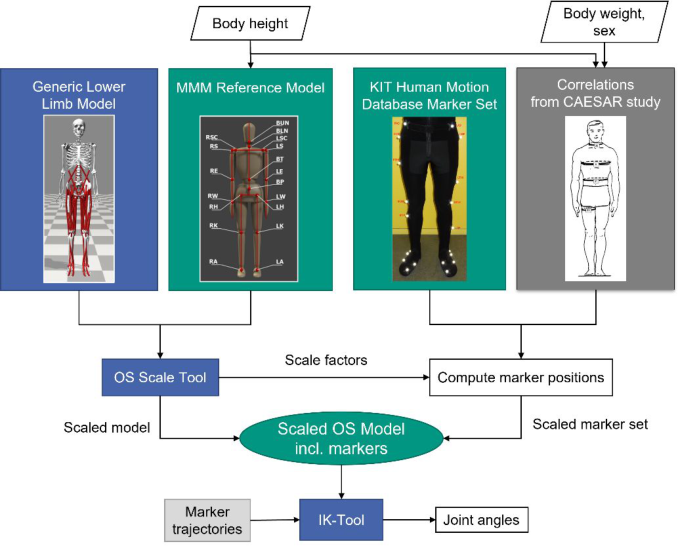
SCALING APPROACH The basic steps of the new scaling approach are described in the following section as shown in Figure 1. In this example, the approach is applied to the lower limb model ArnoldHamnerLegsTorsoArms v2.1 (Arnold et al. 2010) and the KIT Whole-Body Human Motion Database is used. These elements can be changed if needed.
First, a generic OpenSim model needs to be selected. We selected the lower limb model ArnoldHamnerLegsTorsoArms v2.1 (Arnold et al. 2010) as gene- ric model since designing an exoskeleton requires detailed modeling of the lower limb. Second, an input body height is used for computing body segment
Parametric Scaling of a Lower Limb Model According to Body Height in OpenSim 47
Figure 1: The workflow used to obtain the individually scaled human model and the joint angles during the motion. (OS scale tool = OpenSim scale tool; IK-tool = inverse kinematics tool).
lengths according to the Reference Model of the Master Motor Map (MMM) framework (Mandery et al. 2016). It includes statistically determined relati- onships between body size and body segment lengths adopted from Winter (2009). To determine scale factors, the initial segment lengths of the gene- ric model are measured using markers placed in the joints. Comparing the MMM segment length to the corresponding segment length of the generic model, the scale factor of each body segment can be obtained. Third, manual scaling is performed by the OpenSim Scale Tool using the determined scale factors. Fourth, the marker set of the KIT Whole-Body Human Motion Data- base (Mandery et al. 2016) is adopted, so that motion data from the database can be applied to the model. The marker positions are adjusted to the scaled model using the previously determined scale factors. In addition, the posi- tion of hip and thigh markers are adapted using correlations between body mass index (BMI), hip breadth, and thigh circumference from the CAESAR study (Blackwell et al., 2002; Harrison and Robinette, 2002; Lee, 2008). Height, weight, and sex are inputs for these correlations. In this way, the human body shape is estimated by empirical data. Experimental marker tra- jectories for the KIT Whole-Body Human Motion Database or other motion data can be applied to the model by running OpenSim’s Inverse Kinematics Tool (IK-Tool) to obtain the joint angles.
Table 1. Subject-specific data.
Table available in the original PDF paper.
Subject Sex Age Height [m] Weight [kg] BMI [kg m-2] 1 male 31 1.77 59.8 19.1 2 female 25 1.65 64.1 23.5
MATERIALS AND METHODS
To validate the scaling approach, we carried out 1) a pre-study to evaluate if the MMM Reference Model is good enough for estimating body dimensi- ons and 2) a gait study to acquire experimental data for motion analyses of models which were scaled using the developed approach.
Pre-Study In the pre-study, seven female and seven male subjects between 22 and 31 years old and between 1.60 and 1.93 m tall participated. Segment lengths were measured according to the MMM Reference Model. The definitions of the measured body lengths by Winter (2009) are foot height, shank length, thigh length, pelvis width, and torso length. The measured lengths were com- pared to the corresponding lengths from the MMM Reference Model. The error between both lengths was computed for 1) all subjects, 2) all male sub- jects, and 3) all female subjects. Median, first and third quantile of the error were evaluated.
Experimental Study The experimental gait study was carried out at the BioMotion Center at KIT. One male and one female subject participated. The subject-specific data are listed in Table 1. Both subjects walked at the same predefined speed of 1.5 ms-1 (±4%). Ten gait trials per subject were recorded. Stride length and frequency were individually adapted to the given walking speed by the sub- jects and aimed to keep constant over the ten trials. Marker trajectories and ground reaction forces were measured.
All markers of the marker set from the KIT Whole-Body Human Motion Database were positioned except for the hand markers. The positions of the 49 retro-reflective markers were captured using a VICON motion analysis system (Oxford Metrics Inc., UK) with 16 IR cameras and a 200 Hz recording frequency. Also, one static pose of each subject was recorded before the gait trials. Ground reaction forces (GRF) were measured using two in-ground force plates (BP600900, AMTI, USA), one per foot.
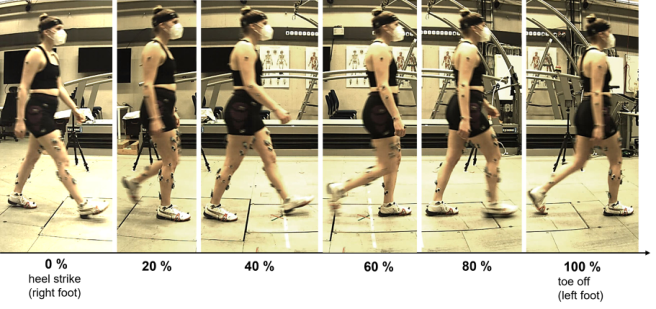
Data Post-Processing and Simulation A right-side gait cycle was segmented from the experimental data for each trial using the measured GRF. Heel-strike on the first force plate was defi- ned as start time, toe-off of the second force plate as end time (Figure 2). With the processed data, simulations were performed in OpenSim (Version 4.3, Stanford University, Stanford, California, USA). First, a subject-specific
Parametric Scaling of a Lower Limb Model According to Body Height in OpenSim 49
Figure 2: The analyzed gait cycle represented by one of the participants with heel-strike of the right foot as start time and toe-off of the left foot as end time.
model was generated using the recorded static pose of the subjects. The gene- ric lower limb model was scaled measurement-based using the experimentally captured static pose. Inverse Kinematics (IK) were performed for all ten gait cycles. The IK results were filtered (Butterworth 4th-order, 6Hz low pass filter) and averaged over all gait cycles. The joint angles of interest are hip flexion, knee flexion, and ankle plantarflexion. For each subject, the joint angles were compared to the ones of the model that was scaled according to our approach using the subject-specific data from Table 1 (MMM scaled model).
RESULTS
The results from the pre-study are first described to evaluate how good the MMM Reference Model is generally suitable for estimating the body dimen- sions. The simulated joint angles of the subject-specific and MMM scaled model are further compared to analyze the model kinematics to investigate the accuracy of the scaling approach.
Accuracy of MMM Reference Model
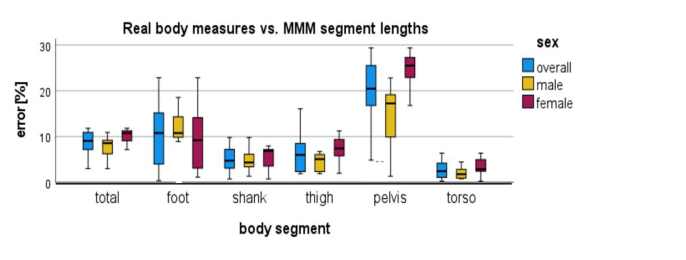
Figure 3 shows the percentual error between the body measures from the pre-study and the segment lengths from the MMM Reference Model. Com- paring the body segments, the shank, thigh, and torso show mainly errors below 10% which scatter less than for the other body parts. The error of the ankle height (foot) shows a wide value range between 0% and 23% with a median of 11%. The pelvis width deviates the most with errors of up to 30%. Overall, women are represented in mean 2% worse by the MMM Reference Model than men (Mann-Whitney U test: U = 9.000, p = .053). The pelvis shows a clear difference with a ca. 8% bigger median error for the female than for male subjects.
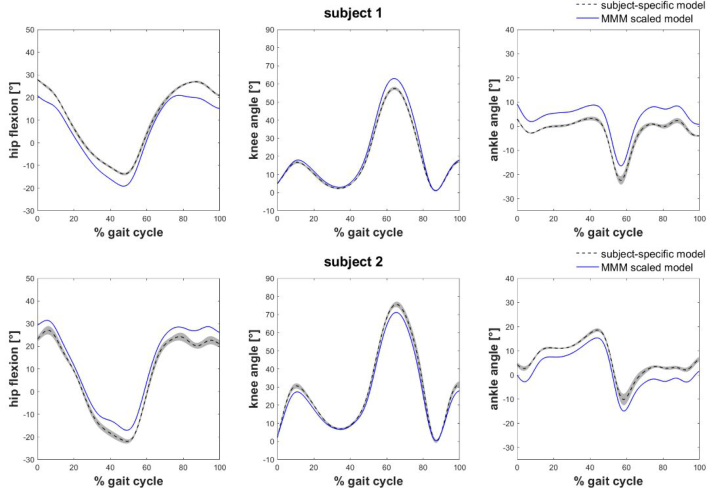
Figure 3: Percentual errors between the real body dimensions and the corresponding segment lengths from the MMM reference model from 14 subjects (blue): 7 males (green), 7 females (red).Figure 4: Joint angles of the right leg of subject 1 and 2 over one right-side gait cycle; compared are the mean joint angles over the 10 gait cycles of the subject-specific model (dashed line) with 1st and 3rd quartile (shaded area) and MMM scaled model (solid line).
Kinematics of MMM Scaled Model To validate the results of the parametric scaling in OpenSim, the kinema- tics of the subject-specific and MMM scaled model are compared for the same body height. Thus, differences between experimental and simulated data result from different scaling, not from different motions of the body heights. Figure 4 shows an overlay of joint angles of the right hip, right knee, and right ankle normalized to one gait cycle with the scattering of the motion in gray of the subject-specific model (median as dashed line). MMM scaled model (solid line) was scaled using the new approach. The comparison of the
Parametric Scaling of a Lower Limb Model According to Body Height in OpenSim 51
joint angles showed a very similar trend between experiment and simulation. The knee angles are overall in good agreement and deviate by max. 5°. The hip and ankle flexion angles show an offset of max. 10°.
When comparing the joint angles of both subjects, there are differences in progression and value range. In general, joint angles of subject 2 show a wider value range than those of subject 1. The ankle flexion of subject 1 shows a slightly different progression from subject 2.
DISCUSSIONS The paper presents an approach to using and transferring motion data from existing databases to obtain individual scaled models of any person to reduce the effort of the OpenSim preprocessing.
In a first pre-study, the correlations between body size and segment length from the MMM Reference Model used in the scaling approach were tested in a group of 14 subjects. The results generally show a good agreement between the MMM Reference Model and reality. Further, the results are more suitable for estimating body dimensions of men than of women. This might be because they are based on studies including mostly male subjects (Winter 2009). The Mann-Whitney U test showed a significant difference between the error in men and in women in selected sample. However, it must be considered that in addition to the median in both groups of men and women the variance of the error also differs and both samples were small with 7 participants each. Therefore, a non-significant difference between men and women should rather be assumed.
To validate parametric scaling, joint angles of a walking cycle from an experimental study were compared with data from a scaled model of the same motion. Compared to Arnold et al. (2011), the joint angles of subject 1 and 2 describe typical gaits. The joint angles of the subject-specific and the MMM scaled model showed a good agreement in the progression. However, we recognized discrepancies between both models that can be attributed to the following aspects: The placement of the virtual markers and the markers in the experimental study is important for the accuracy of the model scaling. According to Kainz et al. (2017), scaling with surface markers alone shows a smaller accuracy than including the joint centers in the scaling process. The MMM scaled models are scaled with scale factors computed using the distance between joints. Thus, this scaling process itself is probably more accurate. However, the key aspect of the discrepancies and offsets between the joint angles of both models are probably 1) the error between empirically determined segment lengths of the MMM Reference Model and the individual segment lengths and 2) errors of the marker positions.
From different joint angles between both subjects can be assumed that the motion should possibly be adapted to the body height, age, or sex as well. For walking, other factors influencing joint angles should also be considered, like walking speed, age, and specific motion from training of certain sports disciplines like running (Hamner und Delp 2013; Judge et al. 1996). It could further be investigated for which applications it is necessary to scale motions.
For instance, a motion could be scaled according to the body height by deter- mining different master motions for different body sizes using typical joint angles.
CONCLUSION
In this paper, we present an approach for scaling a generic model statistically to a body height to reduce data acquisition effort. We used the MMM Refe- rence Model to estimate the body segment lengths and correlations from the CAESAR study to adapt markers to the body shape. The marker set from the KIT Whole-Body Human Motion Database is adjusted to apply its motions to the model. The accuracy of the MMM Reference Model was investigated roughly with a small pre-study measuring the body lengths of 14 subjects. The experimental data from two subjects was obtained to analyze the kinematics of our MMM scaled model. Differences in the joint angles (max 1knee = 5°; max 1hip, ankle = 10°) could be recognized, mostly due to the marker place- ment and deviations between the real and the statistical body measures. Thus, the scaling still needs to be refined to perform further valid simulations, e.g., for studying joint loads and muscle forces in detail. A simulation model that can be easily personalized with the new scaling approach helps designing assi- stance systems adapted to individual users and, due to the reduced effort, it would allow more people to personalize assistance systems.
ACKNOWLEDGMENT
The authors would like to acknowledge that this research was developed in the project ‘JuBot - Jung bleiben mit Robotern’ (JuBot - Staying young with robots). A research program funded by the Carl-Zeiss-Stiftung, Stuttgart, Germany.
REFERENCES
Arnold, E. M. and Delp, S. L. (2011) ‘Fibre operating lengths of human lower limb muscles during walking’, Philosophical transactions of the Royal Society of London. Series B, Biological sciences, vol. 366, no. 1570, pp. 1530–1539. Arnold, E. M., Ward, S. R., Lieber, R. L. and Delp, S. L. (2010) ‘A model of the lower
limb for analysis of human movement’, Annals of biomedical engineering, vol. 38, no. 2, pp. 269–279. Blackwell, S., Robinette, K. M., Boehmer, M. and Fleming, S., Kelly, S., Brill, T., Höferlin, D. (2002) Civilian American and European Surface Anthropometry Resource (CAESAR), Final Report, Volume II: Descriptions. Bleuler, H., Vouga, T., Ortlieb, A., Baud, R., Fasola, J., Olivier, J., Shokur, S. and
Bouri, M. (2019) ‘Exoskeletons as Mechatronic Design Example’, in Carbone, G., Ceccarelli, M. and Pisla, D. (eds) New Trends in Medical and Service Robotics, Cham, Springer International Publishing, pp. 109–117. Delp, S. L., Anderson, F. C., Arnold, A. S., Loan, P., Habib, A., John, C. T., Guendelman, E. and Thelen, D. G. (2007) ‘OpenSim: open-source software to create and analyze dynamic simulations of movement’, IEEE transactions on bio-medical engineering, vol. 54, no. 11, pp. 1940–1950.
Parametric Scaling of a Lower Limb Model According to Body Height in OpenSim 53
Dorschky, E., Krüger, D., Kurfess, N., Schlarb, H., Wartzack, S., Eskofier, B. M.
and van den Bogert, A. J. (2019) ‘Optimal control simulation predicts effects of midsole materials on energy cost of running’, Computer methods in biomechanics and biomedical engineering, vol. 22, no. 8, pp. 869–879. Ferrati, F., Bortoletto, R. and Pagello, E. (2013) ‘Virtual Modelling of a Real Exoskeleton Constrained to a Human Musculoskeletal Model’, in Hutchison, D., Kanade, T., Kittler, J., Kleinberg, J. M., Mattern, F., Mitchell, J. C., Naor, M., Nierstrasz, O., Pandu Rangan, C., Steffen, B., Sudan, M., Terzopoulos, D., Tygar, D., Vardi, M. Y., Weikum, G., Lepora, N. F., Mura, A., Krapp, H. G., Verschure, P. F. M. J. and Prescott, T. J. (eds) Biomimetic and Biohybrid Systems, Berlin, Heidelberg, Springer Berlin Heidelberg, pp. 96–107. Hamner, S. R. and Delp, S. L. (2013) ‘Muscle contributions to fore-aft and verti-
cal body mass center accelerations over a range of running speeds’, Journal of biomechanics, vol. 46, no. 4, pp. 780–787. Harrison, C. R. and Robinette, K. M. (2002) CAESAR: Summary Statistics for the Adult Population (Ages 18-65) of the United States of America. Judge, J. O., Davis, R. B. and Ounpuu, S. (1996) ‘Step length reductions in advanced
age: the role of ankle and hip kinetics’, The journals of gerontology. Series A, Biological sciences and medical sciences, vol. 51, no. 6, M303-12. Kainz, H., Hoang, H. X., Stockton, C., Boyd, R. R., Lloyd, D. G. and Carty, C. P.
(2017) ‘Accuracy and Reliability of Marker-Based Approaches to Scale the Pelvis, Thigh, and Shank Segments in Musculoskeletal Models’, Journal of applied biomechanics, vol. 33, no. 5, pp. 354–360. Lee, S. (2008) ‘Comparative analyses of anthropometry associated with overweight and obesity: PCA and ICA approaches’, vol. 9, no. 5, pp. 441–475. Mandery, C., Terlemez, O., Do, M., Vahrenkamp, N. and Asfour, T. (2016) ‘Unifying
Representations and Large-Scale Whole-Body Motion Databases for Studying Human Motion’, IEEE Transactions on Robotics, vol. 32, no. 4, pp. 796–809. Miehling, J. (2019) ‘Musculoskeletal modeling of user groups for virtual product and process development’, Computer methods in biomechanics and biomedical engineering, vol. 22, no. 15, pp. 1209–1218. Seth, A., Hicks, J. L., Uchida, T. K., Habib, A., Dembia, C. L., Dunne, J. J., Ong, C. F.,
DeMers, M. S., Rajagopal, A., Millard, M., Hamner, S. R., Arnold, E. M., Yong, J. R., Lakshmikanth, S. K., Sherman, M. A., Ku, J. P. and Delp, S. L. (2018) ‘OpenSim: Simulating musculoskeletal dynamics and neuromuscular control to study human and animal movement’, PLoS computational biology, vol. 14, no. 7, e1006223. Winter, D. A. (ed) (2009) Biomechanics and motor control of human movement, 4th edn, Hoboken N.J., Wiley. Yu, J., Zhang, S., Wang, A. and Li, W. (2020) ‘Human gait analysis based on
OpenSim’, 2020 International Conference on Advanced Mechatronic Systems (ICAMechS). Hanoi, Vietnam, 12/10/2020 - 12/13/2020, IEEE, pp. 278–281.
Read this individual research paper free through the original publisher, or explore the full digital proceedings book.
ISBN 978-1-958651-44-5
Explore this ISBN in the AHFE Bookstore ↗Listed in the July 2026 bookstore catalogue; search by ISBN to confirm current availability · Digital book purchase optional