Anja Naumann, Birte Thomas-friedrich (2024). Automation in Railway: How tasks and roles of operational staff change. In: Advances in Human Factors of Transportation. AHFE Open Access, vol. 148, pp. 670–677. https://doi.org/10.54941/ahfe1005259
Tasks of railway operational staff are changing with increasing digitalization and automation of the railway system. Even lower grades of automation like Grade of Automation 2 (GoA2) result in a decrease of active tasks and the operators having to predominantly monitor the technical systems. Effects of the introduction of higher Grades of Automation like GoA3 and 4 on tasks and roles of operational staff are currently examined in our research. In both GoA3 and 4, the train drives automatically and there are no train drivers in the cabin anymore. Instead, the new role of remote train operators is introduced. Remote train operators can drive the train remotely in case of disruption, for example from a control room. In GoA4, there is no operational staff on board, while in GoA3, a train attendant is still on board and can support in case of disruption. An interaction between staff on the train and remote train operators could also be possible.In the present paper, we will introduce different research projects at the Institute of Transportation Systems of the German Aerospace Center (DLR). These projects deal with research questions like: Which tasks of railway operational staff can be automated and which remain with the human? What could be a task distribution between automation and human that optimally utilizes the strengths of both? Who is going to carry out the remaining human tasks? Which new roles for operational staff could emerge from this task distribution? How could workflows within these new roles look like? What interaction and communication processes are necessary for a smooth operational procedure of automated railway? Current results will be presented.
The increasing digitalization and automation of the railway system is also leading to a gradual and now clearly noticeable change in terms of jobs in rail transport. The Institute of Transportation Systems at the German Aerospace Center (DLR) is examining these changes and their consequences in the inter- play between people, technology and organization. One main finding is that even in a largely automated rail system, humans are indispensable, espe- cially with their strengths in complex problem-solving, decision-making and diagnostics (Brandenburger, 2022). Planning to include human operators in future highly automated railway systems opens up new opportunities and approaches as to how they can contribute to efficient and safe rail operations
Automation in Railway: How Tasks and Roles of Operational Staff Change 671
(Naumann and Brandenburger, 2021). Particularly in the context of higher levels of automation, new ways of task allocations between humans and tech- nology are possible, tasks can change for train and control center staff and completely new roles and job profiles for staff can emerge. In various research projects at the DLR, we are therefore analyzing current developments in the field of automation in the railway system from a human factors perspective. Design recommendations for a user-centered design of future workplaces in the railway system are derived. An important goal here is to utilize the respec- tive strengths of humans and technical systems and to achieve an optimal division of tasks between the two. In the following, current projects and first results of our research are presented.
NEW TASKS AND ROLES FOR TRAIN AND CONTROL CENTER STAFF From Train Drivers to Remote Operators
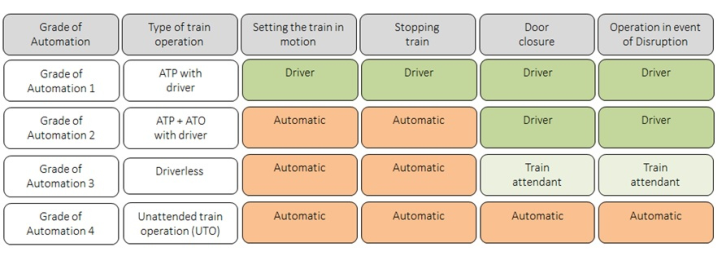
The various levels of automation in rail transportation (Grade of Automa- tion – GoA; VDE, 2015, see Figure 1) result in significant changes to the tasks for train drivers in particular. Therefore, there is a need to design the corresponding workplaces and work environments with the human in mind. At GoA1, driving is still manual, with the safety support of a train control system (e.g. the German intermittent train control system PZB, ‘Punktuelle Zugbeeinflussung’), so the drivers are continuously occupied with the driving task and route observation. This is a favorable, quite holistic activity from a perspective of occupational psychology, that consists of alternating obser- vational and manual actions. A risk of fatigue and monotony only occurs on longer, more uniform routes, for example in freight transport (Stein and Naumann, 2016).
Figure 1: Grades of automation (International Association of Public Transport, 2012).
In GoA2 (e.g. European Train Control System ETCS Level 2 without sig- nals), a large part of the driving task is already carried out automatically. In addition, there are no trackside signals. Thus, the need for permanent track- side observation by the train divers is also eliminated. As a result, the drivers’ work essentially becomes a monitoring task of a technical system. This is
672 Naumann and Thomas-Friedrich
reflected in results of eye tracking studies showing that when driving with ETCS, train drivers continuously observe the ETCS display on the control panel and only look at the tracks with a few glances (Brandenburger, Stamer and Naumann, 2016). Pure monitoring activities like this are regarded as rather unfavorable from the point of view of occupational psychology, as they lead to monotony and fatigue (Brandenburger, Wittkowski and Naumann, 2017). Therefore, when introducing GoA2, measures must be taken to ensure that the drivers can still act quickly and appropriately in a critical situa- tion. It is therefore recommended to create alternating phases of monitoring automation and manual driving during drivers’ shifts in order to maintain an optimum level of workload (neither under-nor overload; Brandenburger and Naumann, 2018a).
For GoA1 and 2, it is also important to provide the drivers with an opti- mum amount of information through assistance and information systems. Information should be displayed on as few display elements as possible in the drivers’ cab to avoid cognitive overload due to information distribution. However, it is important that enough information is displayed, as a lack of information could potentially lead to insufficient awareness of the situation at hand (so-called situational awareness; Endsley, 2000). Situational awareness is necessary for quick and appropriate action and thus has to be maintained. At DLR, design recommendations for displaying information to the drivers at GoA1 and 2 are being developed with a focus on the needs of the human drivers. One example is an assistance system developed in the FASaN (Driver Assistance Systems Adaptive Sustainability in Rail Operations) project (DLR, 2023a), that provides the train drivers with driving recommendations for energy-efficient driving. The assistance system is being developed with a user-centered approach (Schnücker, Naumann and Klencke, 2023). First, requirements for the system have been collected together with drivers, various design variants are going to be discussed with the drivers and finally a pro- totype is tested for comprehensibility, usefulness and usability in a field test with the East-German rail operator ODEG (Ostdeutsche Eisenbahn GmbH).
As automation increases further to GoA3, the train will run automatically and there will no longer be drivers in the driver’s cab. However, in GoA3 there is still operational staff on board who are responsible for, e.g., closing the doors. In the event of a disruption, staff on board could take over certain tasks to assist in the clearance of the disruption. If there are no train drivers on the train, the drivers’ role will potentially change to that of remote train operators (TO). TO would work, for example, from a control center together with dispatchers. In most scenarios, the goal is for the TO to be the fallback in case of a disruption of the automatic train operation. Thus, tasks of the TO will include remotely driving the train in case of a malfunction of the automation and providing operational staff on board with information or instructions for troubleshooting. However, if the TO are only responsible for carrying out active tasks in case of a disruption and otherwise passively mon- itor the system, the role of TO carries similar risks of monotony as working with GoA2. Such working conditions can lead to a loss of performance, dis- satisfaction with the work and negative effects on mental and physical health (Ahlstrom, 2016; DIN, 2000). Therefore, in the project Teleoperation ATO
Automation in Railway: How Tasks and Roles of Operational Staff Change 673
(DLR, 2023b), the German Centre for Rail Traffic Research (DZSF) tasked the DLR to develop a validated job profile for TO with a focus on the needs of the future operators. The goal of the project is to design a concept for an attractive, satisfying and user-friendly work environment and task descrip- tion for TO. This might include enriching the tasks of TO beyond the function as a fallback by, e.g. integrating tasks that have traditionally been carried out by the dispatcher alone. Further, adding back manual driving tasks out- side of disruptions might be necessary to achieve the sense of a holistic task (Baßin et al., 2023).
Needless to say, if the new role of TO is introduced, new workstations including the user interface have to be developed. Thus, in the internal projects of the DLR Next Generation Train (DLR, 2023c), Next Generation Railway Systems (DLR, 2023d), and Digitalization and Automation of Rail- way Operations, a prototypical work environment for TO was developed in a user-centered design process with several iterations and user tests.
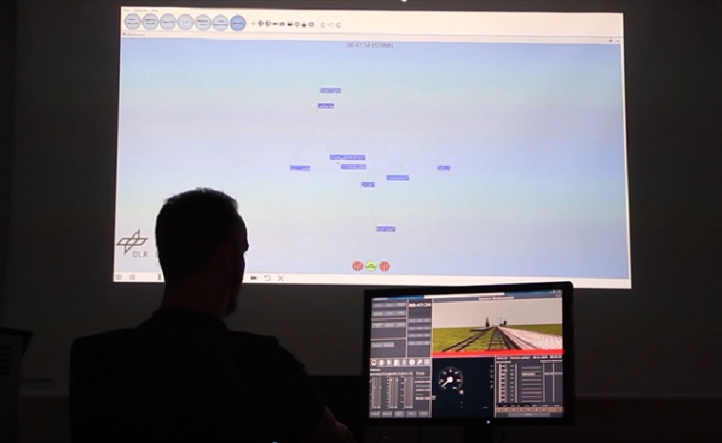
The goal was to create a work environment that is optimally designed for the new role of TO from an occupational psychology perspective. Meaning, the work environment should neither under- nor overload the TO and despite the distance to the actual position of the train, create sufficient situational awareness and the greatest possible immersion. The resulting prototypical work environment is shown in Figure 2.
Figure 2: Prototypical work environment for remote train operators (source: DLR).
The main idea for the work environment is that the TO is responsible for all trains in a specific area. A representation of the current situation in this area is projected onto a large wall, providing the TO, dispatcher and rail traffic controllers, who all work together in a shared environment, with the
674 Naumann and Thomas-Friedrich
same information. In case an automated train in this area stops due to a mal- function (e.g. a door malfunction) or a critical situation (e.g. animals on the track), the TO receives a request to take over the train manually. The TO then has the task of assessing the situation and remotely driving the train out of the critical situation (e.g. using a driving brake lever). The TO can monitor the situation on site via a real-time transmission of video images from a cam- era setup at the front of the train. As soon as the critical situation has been overcome, the TO can return the train to automatic operation (e.g. the ani- mals have moved away from the track). Detailed descriptions of the concept, the prototypical work environment and the previous human factors studies at DLR regarding the TO work environment can be found in Brandenburger and Naumann (2018b,c). We have recently been and are currently working in several projects with partners from both research and the rail industry on further development and investigation of the TO work environment, for example in the projects 5G Living Lab (Brandenburger et al., 2023; DLR, 2023e) and ATO Cargo (Schöne et al., 2023). In the project ARTE (Auto- mated Regional Trains in Lower Saxony; Specht et al., 2022; Bekehermes, Arslan and Naumann, 2023), a simplified remote train operation via tablet is investigated with a strong focus on human factors aspects and usability.
Finally, in GoA4, there is no longer any staff on the train during the fully automated journey. This means that there are neither drivers in the driver’s cab nor train attendants on board. In the event of a disruption, the TO will intervene, but there is no operational staff on board to support the clearance of the disruption. If the TO cannot deal with the disruption via remote con- trol, technical staff must be informed and travel to the location of the train. This could lead to considerable delays, if technical staff is not in the imme- diate vicinity of the disrupted train. DLR is investigating the effects of such circumstances, for example in the projects ARTE and Care4Rail, both from a human-factors perspective and from an operational and financial perspective.
Changes in the Control Center Control center work places will also change due to an increase in automa- tion. On the one hand, there might be the addition of the new workplace of the TO. On the other hand, the work of the dispatcher and rail traffic controller is also increasingly automated. This will result in new tasks and new forms of communication and interaction between dispatchers, rail traf- fic controllers and TO, and possibly also completely new combinations of tasks and roles. The investigation of these changes is subject of the projects TraCo (Train Control and Management; DLR, 2023f) and Care4Rail. Ini- tial design recommendations for control center workstations of the future have already been developed in a DLR cooperation project with the Erfurt University of Applied Sciences (Thomas-Friedrich et al., 2022).
New Tasks for Train Attendants?
The train attendant in GoA3 is the only staff on board the otherwise auto- mated train. Although the TO could perhaps rectify some disruptions from a control center, the train attendant might have to take on some additional
Automation in Railway: How Tasks and Roles of Operational Staff Change 675
tasks that can only be carried out on site. The ARTE project will there- fore first examine which tasks can generally be automated and which must ultimately remain as manual tasks (therefore defining the division of tasks between humans and automation). In a second step, it will be considered who will take over the remaining manual tasks. Tasks could be taken over by the TO, by the train attendant (resulting in a so-called ‘train attendant plus’ with additional tasks) or staff usually tasked with preparatory and stabling tasks, for example in the depot. Regarding the train attendant plus, one option could be to have the train attendant plus drive the train manually via tablet in case of a disruption, similar to a TO (Bekehermes, Arslan and Naumann, 2023). In addition, the train attendant plus could resolve disruptions with help from a remote TO. The goal of the ARTE project at DLR is to describe the resulting roles, tasks and activities of the operational staff. Together with the project partners, it will then be considered how these potential roles could be implemented through specific job descriptions in real rail operations and which (additional) training would be required for each role.
CONCLUSION
Rail transport will be particularly important in the coming decades as the backbone of a sustainable transportation system. However, several challenges have to be overcome in order to substantially increase the volume of goods and passengers transported by rail. It will be necessary to quickly implement operational and technical innovations, such as rolling out ETCS on more routes or even pursuing the implementation of automatic train operation with remote control solutions as a fallback. But all of these developments are not purely operational and technical. Above all, they entail changes for all people in the socio-technical system of railways. Tasks and roles of opera- tional staff will continue to change and evolve. When implementing changes in the railway system, the focus should therefore always be on the needs of the people in their various roles in rail operations to ensure user-friendliness, the satisfaction of operational staff, optimal division of tasks between automa- tion and human operators and thus optimal performance of the system as a whole.
REFERENCES
Ahlstrom, Vicki (2016). Human Factors Design Standard (DOT/FAA/HF-STD- 001B). Atlantic City International Airport, NJ: Federal Aviation Administration William J. Hughes Technical Center. Baßin, Nathalie Victoria, Brosch, Felix, Huber, Andreas, Lüer, Yasmin and Seumel,
Annika (2023). Project documentation: Konzepte gegen Unterbeanspruchung bei der Teleoperation im hochautomatisierten Bahnverkehr. Project work of FH Erfurt and DLR Braunschweig. Bekehermes, Tobias, Arslan, Bekir and Naumann, Anja (2023). ARTE - A technical solution for driverless trains on non-ETCS lines. SIGNAL + DRAHT (12/23), pp. 18–25. DVV Media Group. ISSN 0037–4997.
676 Naumann and Thomas-Friedrich
Brandenburger, Niels (2022). The Changing Role of Staff in Automated Railway Operation and why Human Cognition is Here to Stay. ERTMS 2022 Conference, April 26–28 2022, Valenciennes, France. Brandenburger, Niels, Bier, Igor, Busse, Martin, Gärtner, Jakob and Melzer, Tobias
(2023). A technical demonstration of remote train operations using 5G mobile communications. SIGNAL + DRAHT, 06, pp. 34–40. DVV Media Group. ISSN 0037–4997. Brandenburger, Niels and Naumann, Anja (2018a). The impact of railway automation on train drivers’ tasks and skills. European Rail Human and Organisational Factors Seminar, Nov. 14–15. 2018, Valenciennes, France. Brandenburger, Niels and Naumann, Anja (2018b). Enabling automatic train opera-
tion through human problem solving. In: SIGNAL + DRAHT 3/2018, pp. 6–13. Brandenburger, Niels and Naumann, Anja (2018c). Towards remote supervision and recovery of automated railway systems: The staff ’s changing contribution to system resilience. In: Proceedings of the 2018 IEEE International Conference on Intelligent Rail Transportation. Brandenburger, Niels, Thomas-Friedrich, Birte, Naumann, Anja and Grippenkoven,
Jan (2018). Automation in Railway Operations: Effects on Signaller and Train Driver Workload. In: B. Milius & A. Naumann (Eds.), Proceedings of the 3rd German Workshop on Rail Human Factors, 51–60. Braunschweig, Germany: ITS Mobility Nord. Brandenburger, Niels, Wittkowski, Martin and Naumann, Anja (2017). Countering Train Driver Fatigue in Automatic Train Operation. In: Sixth International Human Factors Rail Conference (pp. 57–65). London, UK. Brandenburger, Niels, Stamer, Mareike and Naumann, Anja (2016). Comparing dif-
ferent types of the track side view in high speed train driving. In: Human Factors and Ergonomics Society Annual Meeting Proceedings 2016. DIN (Deutsches Institut für Normung e. V.) (2000). DIN EN ISO 10075–2 Ergonomische Grundlagen bezüglich psychischer Arbeitsbelastung-Teil 2: Gestal- tungsgrundsätze (ISO 10075–2:1996); Deutsche Fassung EN ISO 10075–2:2000. DLR (2023a). Project website Driver Assistance Systems Adaptive Sustainability in
ung.dlr.de/en/projects/ngt-hst. Accessed 2023-01-23. DLR (2023d). Project website Next Generation Railway System (NGRS): https: //verkehrsforschung.dlr.de/de/projekte/next-generation-railway-system. Accessed 2023-01-23. DLR (2023e). Project website 5G Living Lab: https://verkehrsforschung.dlr.de/en/pr
ojekte/5g-reallabor. Accessed 2023-01-23. DLR (2023f). Project website TraCo (Train Control and Management): https://verk ehrsforschung.dlr.de/de/projekte/traco-train-control-and-management. Accessed 2023-01-23. Endsley, Mica R. (Ed.) (2000): Situation Awareness: Analysis and Measurement.
Erlbaum, Mahwah NJ. ISBN 0–8058–2133–3. International Association of Public Transport (2012). Metro Automation Facts, Figures and Trends: A global bid for automation: UITP Observatory of Automated Metros confirms sustained growth rates for the coming years. www.uitp.org/metro-automation-facts-figures-and trends. Accessed 28.11.2016.
Automation in Railway: How Tasks and Roles of Operational Staff Change 677
Naumann, Anja and Brandenburger, Niels (2021). From GoA2 to Remote Operation. Workplaces in highly automated rail. 7th International Human Factors Rail Conference, June 23–25, 2021, online. Schnücker, Gina N., Naumann, Anja and Klencke, Marius (2023). Requirements for
Advanced Driver Assistance Systems in Rail Operations. HFES Europe Chapter Annual Meeting, April 26–28, Liverpool. Schöne, Stefanie, Mönsters, Michael, Käthner, David and Brandenburger, Niels (2023). ATO-Cargo: Operating procedures for the fallback levels of highly auto- mated railway operation. SIGNAL + DRAHT, 115 (10), pp. 18–25. DVV Media Group. ISSN 0037–4997. Specht, Felix und Michels, Alexander und Adebahr, Frederik-Alexander und Meirich,
Christian und Hofstädter, Raphael und Milius, Birgit und Naumann, Anja (2022). Automated driving in Lower Saxony - ARTE. SIGNAL + DRAHT (114), Seiten 10–15. DVV Media Group. ISSN 0037–4997. Stein, Jenny and Naumann, Anja (2016). Monotony, Fatigue and Microsleeps - Train driver’ daily routine: a Simulator study. In: Rail Human Factors. Proceedings of the 2nd German Workshop on Rail Human Factors, pp. 96–102. ITS Automotive Nord. ISBN 978–3–937655–39–0. Thomas-Friedrich, Birte, Naumann, Anja, Baar, Marie-Luise, Haidari, Ahmad
Najim, Schmidt-Brücken, Andreas, Kroth, Daniel and Michaelsen, Raimo (2022). Gestaltungsempfehlungen für Leitstellenarbeitsplätze der Zukunft. EI - Der Eisen- bahningenieur (11/22), S. 11–14. Tetzlaff Verlag. ISSN 0013–2810. VDE (2015): Railway applications–Urban guided transport management and command/control systems–Part 1: System principles and fundamental concepts, IEC 62290–1:2014. 2015.
LISTED IN THE AHFE DIGITAL BOOKSTORE CATALOGUE
Explore the complete digital volume
Advances in Human Factors of Transportation
Read this individual research paper free through the original publisher, or explore the full digital proceedings book.
ISBN 978-1-964867-24-3
Explore this ISBN in the AHFE Bookstore ↗Listed in the July 2026 bookstore catalogue; search by ISBN to confirm current availability · Digital book purchase optional