Marcel Saager, Jörn Kruse, Anja Naumann (2024). Who is Responsible for What? Combining HTA and RACI for Modelling Cooperation in Remote Operation Center of Trains in Future Railway Sector. In: Human Factors and Systems Interaction. AHFE Open Access, vol. 154, pp. 236–246. https://doi.org/10.54941/ahfe1005371
Since 2020, the German national railway company (DB) has been working on the "Digital Rail" project, with aim to create a better environmental balance, higher travel capacities and smoother processes by 2030. The focus here is on the large-scale use of automation. In the future, trains will run autonomously and identify hazards themselves using sensor technology. Autonomous trains with AI will take over tasks from actors, which means that the scope of actor’s tasks will be transformed. Actors, such as train operators will move away from the train to Remote Operation Centers (ROC). This will require new processes for humans and machines and a fundamentally new digital infrastructure, as humans will now act as a fallback level for the autonomous train. This will lead to new organizational and technical structures (monitoring, intervention in autonomy) for control centers. These control centers can be seen as safety-critical systems with multiple actors depending on each other. Therefore, it is important to look at the cooperation between these actors and how they execute tasks. In our case, hierarchical task analysis (HTA) was chosen to identify the tasks of the actors. In order to conduct this HTA, some assumptions were made regarding the scenario and the actors involved. The scenario depicts an autonomous train running on a track section that has an insufficient infrastructure to support autonomous train operation. The actors are organized in a ROC. There is the remote train operator, who has the task of monitoring the autonomous train and intervenes if necessary, and the dispatcher, who handles the disruption at management level. In our context the AI that controls the train is also classified as actor.This information is now being used to create an HTA and to apply the RACI model (Responsible, Accountable, Consulted, and Informed). RACI assigns these responsibility-roles to the individual actors in a so-called responsibility assignment matrix in which all relevant actors are involved.In addition, each responsibility-role gets assigned a quantitative value that reflects the level of responsibility. This makes it possible to identify tasks that have a high concentration of responsibilities by different actors (depending on the sum of the values). The overall model was then validated and adjusted with the help of semi-structured expert interviews. The experts from the rail digitization sector suggested minor adjustments to the model. The response to applying the RACI model to HTA in the rail sector of the future (for stakeholders in the ROC sector) was received positively.This HTA-RACI-ROC model can be used in several ways. On the one hand, the model can be used to detect patterns between new tasks and roles in ROC in order to provide appropriate actions for the organizational structure. On the other hand, it can be used in design methods for control rooms that use HTAs as input. This would require the development of a formalism of the RACI model to the HTA.
Since 2020, the German national railway company (DB-Deutsche Bahn AG) has been working on the “Digital Rail” project, with aim to create a better environmental balance, higher travel capacities and smoother processes by 2030. The focus here is on the large-scale use of automation. In the future, trains will run autonomously and identify hazards themselves using sensor technology. Autonomous trains with AI will take over tasks from actors, which means that the scope of actor’s tasks will be transformed (Digital Rail Germany a, 2022 and Digital Rail Germany b, 2022).
Actors, such as train operators will move away from the train to Remote Operation Centers (ROC). This will require new processes for humans and machines and a fundamentally new digital infrastructure, as humans will now act as a fallback level for the autonomous train. This will lead to new organizational and technical structures (monitoring, intervention in auton- omy) for control centers. These control centers can be seen as safety-critical systems with multiple actors depending on each other. Therefore, it is impor- tant to look at the cooperation between these actors and how they execute tasks (European Maritime Safety Agency, 2023). For this purpose, hierar- chical task analysis (HTA) was chosen to identify the tasks of the actors.
Who is Responsible for What? Combining HTA and RACI for Modelling 237
In order to conduct this HTA, some assumptions were made regarding the scenario and the actors involved. The scenario depicts an autonomous train running on a track section that has an insufficient infrastructure to support autonomous train operation. The actors are organized in a ROC. There is the remote train operator, who has the task of monitoring the autonomous train and intervenes if necessary, and the dispatcher, who handles the disruption at management level. In this context the automation that controls the train is also classified as actor. This information is now being used to create an HTA and to apply the RACI model (Responsible, Accountable, Consulted, and Informed).
RACI assigns these responsibility-roles to the individual actors in a so- called responsibility assignment matrix in which all relevant actors are involved. In addition, each responsibility-role gets assigned a quantitative value that reflects the level of responsibility (Smith, Erwin and Diaferio, 2005). This makes it possible to identify tasks that have a high concentration of responsibilities by different actors (depending on the sum of the values). The overall model will then be validated and adjusted with the help of expert interviews.
This HTA-RACI-ROC model can be used in several ways. On the one hand, the model can be used to detect patterns between new tasks and roles in ROC in order to provide appropriate actions for the organizational structure. On the other hand, it can be used in design methods for control rooms that use HTAs as input. This would require the development of a formalism of the RACI model to the HTA.
THEORETICAL FOUNDATIONS As this work combines the HTA with the RACI model from a methodological point of view, both modelling techniques are presented briefly in this section.
HTA was developed to break down tasks into subtasks so that they can be processed in an abstract model. These subtasks can then be integrated into a complex or less complex computer system. Tasks could either be taken over completely by machines or performed with computer assistance. It is also possible to derive what information is required for the individual tasks (Annett, 2003; Stanton, 2006). Typically, the breakdown of the individual tasks follows a specific notation. Top-level tasks are always given a num- ber, while their associated subtasks (which are necessary for completing the top-level task) carry the number of the top-level task plus a new number (starting at 1). The numbers are separated by dots. In the present implemen- tation of the HTA, a graphical representation in the form of a task tree is also chosen.
The RACI matrix is a tool for clarifying tasks and responsibilities within a project team. It is used to identify responsibilities for individual tasks, milestones or project results. By applying the RACI method, clear respon- sibilities are defined and uncertainties are clarified. This is helpful when assigning tasks within a project to different stakeholders. If a project involves many decision-makers, RACI can help to avoid wrong decisions and ensure a smoother decision-making process.
“RACI” stands for “Responsible”, “Accountable”, “Consulted” and “Informed”. The definitions behind these terms are explained below: Responsible (R): The actor with the “R” label is directly assigned to the linked task. The individual assignment of the task to a primarily responsi- ble person is essential to ensure a clear work structure. This clear area of responsibility enables clear communication and defines a contact person for questions or updates. This person is also legally responsible for the project. Assigning this responsibility to several people for one task can affect trans- parency and potentially lead to confusion. This could be avoided by including additional team members in the other roles of the RACI method that are intended for the involvement of more than one person (Smith, Erwin and Diaferio, 2005; Martins, 2023).
Accountable (A): The assignment of the accountable actor extends to ensuring the complete completion of tasks, even if this person does not directly perform the activity. There are two primary approaches to assign- ing this responsibility. Firstly, a project manager can act as Accountable (and possibly also as Responsible, although it makes more sense to differentiate between the two roles due to mutual control). In such scenarios, the account- able person’s responsibility is to ensure that all essential tasks are completed. Alternatively, in other situations, a senior manager or leader takes on the role of Accountable by approving the work before it is considered complete. Anal- ogous to the function, individual accountability should always be ensured when assigning the accountable function.
Consulted (C): Is defined as any role that should carry out the review and acceptance of the work before the final acceptance. Several actors can be involved here. A classic example can be found in manufacturing companies, which often employ a separate department - Quality Assurance - to check initial drafts or final versions before they are sold.
Informed: Informed” (I) refers to those instances that are notified of the completion of a task. Here too, several persons or instances can be named at the same time. What is special here is that although these persons are not involved in the execution of the work step, they often follow it indirectly and should therefore also be kept informed of new findings and progress. progress should be kept up to date (Smith, Erwin and Diaferio, 2005; Martins, 2023).
STATE OF THE ART OF RAILWAY SYSTEMS AND RELATED WORK This section describes the state of the art in the future railway system.
The Sensors4Rail project, which was also part of Digital Rail Germany, tested the integration of state-of-the-art sensors and powerful computers in a test vehicle of the Hamburg S-Bahn. The aim was to test the combination of sensor-based environmental perception and train location with a digital map. The system is intended to provide real-time information about the train environment and the precise train position and enables the detection and evaluation of obstacles on and next to the tracks as well as the development of assistance systems for potential fully automated operation. After four years of development and a 15-month test phase, the project was completed. The findings and data collected will be used in the future development of the
Who is Responsible for What? Combining HTA and RACI for Modelling 239
next generation of sensor-based environment detection to create an important basis for fully automated driving on rails (Digital Rail Germany a, 2022).
Another project in the context of railroad digitization is the DB high-speed rail programme. DB’s “fast track programme” was intended to drastically modernize seven sections of German railroad lines within two years - also as part of the Digital Rail Germany. Improved standards and newly estab- lished processes ultimately ensured that parts of the infrastructure on the seven line sections, such as signal boxes and level crossings, could be replaced one-to-one with fully automated counterparts. The programme successfully demonstrated that steps towards digitalization can be taken quickly with the right resources and coordination (Digital Rail Germany b, 2022).
The idea of replacing the role of a train driver and by the new role of a remote operator has also already been developed in multiple studies at the Institute of Transportation Systems at the German Aerospace Center (DLR). One of the topics of this work was the theoretical creation of a so-called “shared knowledge space”, in which a train operator shares infor- mation with, for example, rail signallers and dispatchers and can monitor autonomous trains through close contact with them (Brandenburger and Naumann, 2018). This is fundamentally taken up and filled with a clearly structured procedure on the part of the train operator and stakeholders in the created use case explained later in this work.
In this related work section, work is presented in which the RACI model was also used systematically. A combination of RACI within a process flow chart was already presented by Kö and Francesconi (2014). The focus here is on linking the respective responsibilities from RACI with the stakeholder activities of a company. The aim is to make unstructured micro-information within a process convertible for technical systems and transform it into a sequence of activities using RACI. By drawing on information from various databases and documents, systems can create a simple representation of pro- cesses within large companies. In this example, the aim was to prepare data for machines, whereas this paper is more concerned with human-machine interaction.
That is why another study from the maritime sector is presented here. In the CMORCC study commissioned by EMSA, the authors looked at roles, tasks and ultimately competencies for employees in ROC in future shipping. They used a model-based approach, which partly inspired the approach used in this paper. The authors used an extended form of HTA and combined it with the RACI model to determine at what competence level the new roles in ROC might be (European Maritime Safety Agency, 2023).
DEFINITION OF GAP AND RESEARCH QUESTION From the state of the art and relevant work, a research gap can be identified. Many considerations are already being made as to what the train system of the future should look like. There is also an idea of which actors belong to this system, as well as the tasks that need to be performed. However, there is no assessment of which actor has what level of responsibility for certain tasks in specific critical phases. This could help to recognize high levels of responsibility among actors and tasks. This in turn could be used to create
co-operative human models of future railway systems, where this problem has already been considered. This has already been done to some detail in the maritime sector (European Maritime Safety Agency, 2023), but nowhere else. Therefore, this research question results: What does a cooperative human model in the future railway system look like, what are the tasks and responsibilities of the actors?
USE CASE DEFINITION The use case is inspired by literature (mainly from the German railway sys- tem) and current research, as one can see in the following explanations and is also used in the following expert interviews.
The use case chosen for this development is the scenario of an incomplete infrastructure. This includes scenarios in which the track is blocked by its own damage or by foreign objects. An autonomous train runs on this track, oper- ating between higher automation levels with no train driver on board, called GoA3 and GoA4 (Habib, Oukacha, Enjalbert, 2021). These levels of automa- tion include a completely autonomous sequence of the operating day. Within Unattended Train Operation, the automation of the train itself is responsi- ble for the most important tasks on board. As there is no longer a traditional train driver on board, this use case assumes that a train operator can intervene remotely in the event of a malfunction and therefore act as a human fallback level. A just as important player in this use case is still the rail signaller. It is also assumed that the role of the remote operator will be integrated into that of the rail signaller or dispatcher in the future. The dispatcher is listed here as a human actor, but may under certain circumstances be supported or replaced by autonomous systems in his area of activity. Finally, we look at the players who are essential to solving the problem of incomplete infras- tructure (Brandenburger et al., 2018; Thomas-Friedrich, Grippenkoven and Naumann, 2018). These include the staff in and around signaling control, crisis management within the operation center, maintenance on site, any line attendants, the safety center and timetable and network coordination. The following is a table of the actors (see Table 1).
Table 1. Possible actors in the future train system according GoA3/GoA4.
Table available in the original PDF paper.
Actor Function Rail signaller (of the future) The rail signaller assumes a key, liability-relevant role, which is supported by various intelligent systems. Train Operator (TO)/Remote Operator
Monitoring while regular Operation, intervene in autonomy, remote control, works in ROC Dispatcher Switch tracks, reroute trains, work together with ROC (especially GoA3, assumed as fallback in GoA4) Autonomous Train Takes over the tasks of the train driver, monitoring train systems (Autonomous) Time Table Coordination
Supervise Time table, manages time collisions, can suggest alternate routes (autonomously, especially GoA4) (Autonomous) Railway Network Coordination
Supervises the traffic in a defined region, can help localize malfunctions (autonomously, especially GoA4) Crisis Management Coordination of actions for solving problems, working together with ROC, make emergency plans Maintenance Physical repair of damages Track Attendant Human fall back, supervises tracks personally Safety Central Service, Safety Clearance, supervises Train stations
Who is Responsible for What? Combining HTA and RACI for Modelling 241
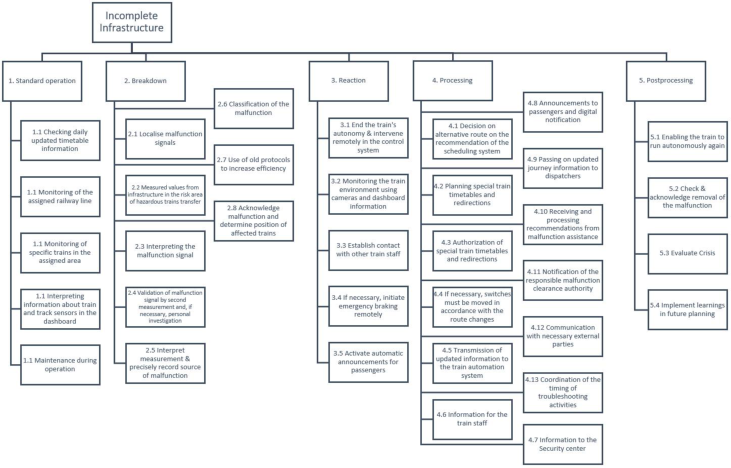
It cannot be excluded that there will be other relevant actors in the railway system of the future, but these have been identified as relevant for the present use case. The tasks in the use case can be systematised by HTA modelling. Figure 1 shows the hierarchical task model and then the tasks are described.
Figure 1: Hierarchical task model of an incomplete infrastructure from an operational view in GoA3/GoA4.
1. The smooth running of daily rail operations is essential in order to ensure stable, regular operations, a number of steps and technologies are required to be carried out by those involved in the operations cen- tre. Part of the standard operation are tasks which are being executed simultaneously and steadily (Hausmann and Enders, 2017). 2. Operational disruptions in railway operations, referred to here as “break- downs”, require a precise and rapid response in order to ensure the safety and efficiency of rail transport (Thomas-Friedrich, Grippenkoven and Naumann, 2018). 3. The reaction phase represents a key intersection in which various actions are taken to respond to the unforeseen event. Several processes are used here to ensure the safety of the passengers, the train and the surrounding area (Biembacher et al., 2023). 4. Within the processing task, there are structured work steps that are required to resolve the problem of the incomplete infrastructure step by step and restore normal operations. They usually follow on from the more rapid reactions from phase 3 reaction (Brandenburger, Hörmann and Stelling, 2017). 5. If all processing steps have been completed, regular operation can be authorised again. In the event of postprocessing, action is now taken to minimise or completely avoid similar malfunctions in the future.
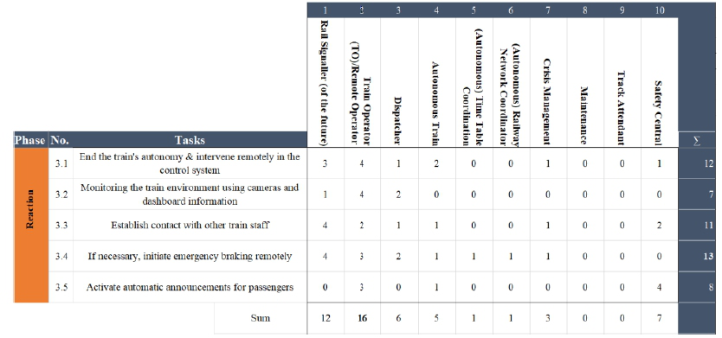
FIRST RACI-HTA ROC MODEL With the information about the actors and the tasks in the application case, an initial combination of the RACI model and the HTA was carried out before the interviews. A table form (see Figure 2) was chosen that looked as follows (showing the whole table would go beyond the scope of this paper).
Figure 2: HTA-RACI ROC model of reaction tasks in railway use case.
Here we can see a section of the Reaction Phase. As can be seen from this table in Figure 2, the decision was made to determine the degree of respon- sibility by numbers. Responsible 4, Accountable 3, Consulted 2, Informed 1 and Not Involved 0. This allows initial conclusions to be drawn about the extent to which a task, but also an actor, is burdened with responsibility. As an example, the principle can be explained using task 3.1 End the train’s autonomy & intervene remotely in the control system. The Rail Signaler will obviously be accountable for this, as he bears legal responsibility for the pro- cess. The train operator will be accountable because, as described, he has to perform the remote control himself. The autonomous train must be con- sulted, as the autonomous actor is stripped of a degree of responsibility (for operating itself). It was also decided that crisis management and safety con- trol must be informed about this. The assessment of the task can probably also be adjusted at this level. However, this is a first approximation of the method. When individual figures are summed up, they allow some conclu- sions to be made. When added vertically, the numbers give the sum of the responsibility of the individual actors. The train operator has the value 16, which means the highest load in the reaction phase. When added horizontally, the numbers represent the responsibilities of the actors in the individual tasks. It can be seen that the emergency brake task takes on the most responsibility, which is not surprising regarding its importance.
Who is Responsible for What? Combining HTA and RACI for Modelling 243
VALIDATION WITH EXPERT INTERVIEWS In order to provide an initial validation of this model, two experts from the field of rail digitization were interviewed on various aspects of the autonomous future of the railroads. In both cases, the “narrative interview” method was chosen. This method does not focus on questions. Instead, the interviewees are encouraged to give a coherent account in the form of a nar- rative (Roulston, 2014). Nevertheless, an interview template was prepared with the following questions:
1. How will rail travel change in the area of autonomy in the future? 2. Which new actors or roles could exist in the future, and which will disappear? 3. Which existing tasks could these new players take on? 4. Where will responsibilities and processes in rail operations shift to? 5. Which fundamentally new tasks could be added in the future?
The questions were followed roughly, but various discussions were held based on the respective expertise, and the relevant statements are summarized below.
Interview 1 - Expert in the Field of Civil and Traffic Engineering Due to his background, the expert had a lot to say on the topic of infrastruc- ture. He began by stating that if the automation runs smoothly, passengers generally do not notice any difference between a driver controlling the train and an autonomous system. Nevertheless, it is important to have a function- ing fallback level in emergencies during GoA 4 operation. He also highlighted problems with evacuations or personal injury when there are no more human actors on the train. With regard to the incomplete infrastructure, the expert stated that the processes (for GoA 3–4) must basically run as they do now. This raises the question of whether the train or the infrastructure should be made more intelligent. Nevertheless, he emphasized that there must be a central unit for controlling the processes and communication between the players. However, a uniform system for this is difficult to imagine, as the rail system (in Germany) is very diverse in its design. Regarding the actors, he said that the responsibilities between infrastructure and transport companies could shift, which would lead to a change in tasks and workload. If such a role is to be performed in a ROC, care must be taken to avoid empty running times if autonomy is to operate without problems. Monitoring tasks, for example, are suitable for this. With regard to responsibility, the expert pointed out that such a (highly automated) system may require double equipment in the tech- nology or other fallback levels in order to be operated resiliently. Otherwise, problems or malfunctions will bring the train to a stop (safe state) and thus have an impact on operations.
Interview 2 - Former Train Driver The second expert had gained first-hand practical information from his for- mer job as a train driver. The expert pointed out early that a functioning human fallback level would be essential in the future. He also said that the
challenge for autonomous trains lies not only in technology, but also in the trust of passengers. In particular, when there is no longer a driver on site, passengers must be given the same feeling of safety as they have today. In addition, the train driver is still very much involved in all processes relating to malfunction management. It was also possible to gather information about the nature of the workplace of a future train operator. This means that even in the future and via remote control, the most important sensory impressions of the original train driver cannot be dispensed with. Information and news such as the view to the front and sides, the weather, the rail condition and the basic parameters of the train itself would have to be made available in a dashboard. Although the two interview partners are thematically different, important insights were gained for future autonomy on the rails.
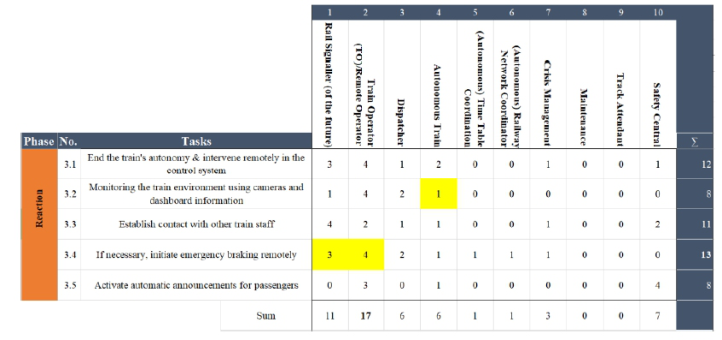
ADJUSTMENTS OF THE HTA-RACI ROC MODEL In response to the expert interviews held, the RACI model was adjusted in some important points with regard to the expert statements (see Figure 3). The following changes were included in the model. For example, two adjust- ments were made on the basis of the interviews in the reaction phase. It was decided to give the autonomous train an information point in Part 3.2, as it is indirectly involved in communicating information to the operator. In addi- tion, the responsibility for emergency braking was transferred to the operator, as he intervenes in the automation of the train. Nevertheless, the dispatcher must remain accountable.
Figure 3: Adjusted HTA-RACI ROC model of reaction tasks in railway use case.
Changes have been made at several points in the model, but these are beyond the bounds of this paper. However, it should be shown which general tasks involve the most responsibility and which actor has the most responsibility: With 18 points, task 2.4, validating interference signals, has the highest level of responsibility. In addition, the train operator has the most points with 111, followed by the dispatcher with 104 points.
Who is Responsible for What? Combining HTA and RACI for Modelling 245
CONCLUSION AND OUTLOOK In this work, a procedure was presented on how to develop a model that can show responsibilities in ROC of future rail transportation. Exist- ing knowledge was used and the findings validated through two expert interviews.
First, the literature was reviewed and a hierarchical task model was devel- oped on this basis. In addition, possible players in the rail journey of the future were identified. These were compared in a RACI matrix and provided with a rating system. Based on the individual evaluations, it was possible to make statements about which tasks bundle responsibility and which tasks do this. This made it possible to answer the research question “What does a cooperative human model in the future railway system look like, what are the tasks and responsibilities of the actors?”. However, it should be noted that the weighting of the values in RACI in particular could be validated, and more expert interviews should be conducted to help evaluate responsibility. It should also be noted that future rail transportation is a constantly changing area in which new findings can always lead to changes in actors and tasks.
ACKNOWLEDGMENT
Both interviews were possible with experts from the railroad sector from the DLR Institute of Transportation Systems.
REFERENCES
Annett, John (2003). Hierarchical task analysis. Handbook of cognitive task design. CRC Press. Biembacher, I., Hundertmark, A., Marsch, P., Fiack, A., Grell, A. Spiegel, D., Heimes,
M., Laux, T. (2023). A look into the future of the Railroad - Basics of the digital railroad system (Blick in die Zukunft der Eisenbahn – Grundlagen des digitalen Bahnsystems). Ausrüstung & Betrieb | Digitalisierung. Brandenburger, N., Nauman, A. (2018). Enabling automatic train operationthrough human problem solving. In Signalling + Datacommunication (110) 3 / 2018. Brandenburger, N., Hörmann, H.-J., Stelling, J. and Nauman, A. (2016). Tasks, skills,
and competencies of future high-speed train drivers. Journal of Rail and Rapid Transit. Digital Rail Germany a (2022). Sensors4Rail bringt mehr Kapazität auf die Schiene.
URL https://digitale-schiene-deutschland.de/Sensors4Rail, assessed 9. January 2024. Digital Rail Germany b (2022). Schnellläuferprogramm (SLP). URL https://digitaleschiene-deutschland.de/de/projekte/Schnelll%C3%A4uferprogramm, assessed 9. January 2024. European Maritime Safety Agency (2023). CMOROC Identification of Competences
for MASS Operators in Remote Operation Centres, EMSA, Lisbon. Habib, L., Oukacha, O. and Enjalbert, S. (2021) Towards Tramway Safety by Managing Advanced Driver Assistance Systems depending on Grades of Automation. IFAC PapersOnLine 54–2 (2021) 227–232. Hausmann, A. and Enders, D. H. (2017). Fundamentals of railroad operation
(Grundlagen des Bahnbetriebs). 3. Edition, Berlin, Bahn Fachverlag.
K˝o, Andrea und Francesconi, Enrico (2014). Combining Knowledge Management and Business Process Management. In: Electronic Government and the Informa- tion Systems Perspective: Third International Conference, EGOVIS 2014, Munich, Germany, September 1–3, 2014. Proceedings. Lecture Notes in Computer Science. Springer International Publishing, S. 112–115. Martins, Julia (2023). Raci-Matrix: Beispiele und Vorlage im Überblick! Asana,
Asana. URL https://asana.com/de/resources/raci-chart, assessed 23. May 2023. Roulston, Kathryn (2014): Analysing interviews. In: The SAGE Handbook of Qualitative Data Analysis. S. 297–312. Stanton, N. A (2006). Hierachical task analysis: Developments, applications, and
extensions. Applied ergonomics. Smith, ML., Erwin, J., Diaferio, S. (2005). Role Responsibility charting (RACI).
Project Management Forum (PMForum). Thomas-Friedrich, B., Grippenkoven, J. D. and Naumann, A. (2018). Development of a Situation Awareness Assessment Tool for Rail Signalers. In: AHFE International Conference on Human Factors in Transportation.
LISTED IN THE AHFE DIGITAL BOOKSTORE CATALOGUE
Explore the complete digital volume
Human Factors and Systems Interaction
Read this individual research paper free through the original publisher, or explore the full digital proceedings book.
ISBN 978-1-964867-30-4
Explore this ISBN in the AHFE Bookstore ↗Listed in the July 2026 bookstore catalogue; search by ISBN to confirm current availability · Digital book purchase optional