Marcus Behrendt, Daniela Johannmeyer, Bertram Wortelen, Marcel Saager, Jacqueline Klimmek, Alexander Steinmetz (2022). An Integrated Approach for More Efficiency in Maritime Investigations. In: Human Factors in Transportation. AHFE Open Access, vol. 60, pp. 707–713. https://doi.org/10.54941/ahfe1002508
Incidents such as pollution or smuggling occur regularly at sea. These incidents needto be investigated by the responsible authorities in order to minimise consequentialdamage and prosecute those responsible. However, the current procedures used byinvestigators are very ineffective. That is why we have developed a software toolcalled Smart Profiling Engine (SPE). This tool supports investigators in their workand should lead to greater efficiency. In this paper, we present both the tool and astudy design that we will use to evaluate its efficiency compared to the traditionalinvestigation method.
As maritime traffic increases, so does the risk of undesirable incidents. Such incidents include violations of national and international maritime law. On the one hand, these include water pollution caused by the negligent or inten- tional discharge of environmentally harmful substances into the sea, and on the other, violations of laws such as drug, weapons and human smuggling. Furthermore, such incidents can represent accidents, such as the cargo of a vessel in distress going overboard, which now represents a collision hazard for other vessels.
Such incidents need to be resolved as quickly as possible by the responsible security and investigative authorities. On the one hand, in order to hold those responsible accountable and thus ensure deterrence. On the other hand, to minimize consequential damage. However, it is often difficult for the authori- ties to resolve such incidents quickly, which leads to suspects no longer being in the area of responsibility, the burden of proof dwindling or consequential damage assuming major proportions.
In the run-up to this work, we have analysed the working methods and working circumstances of the authorities in interviews and have identified possible reasons why investigations get stuck. We see three main reasons: lack of integration, insufficient automation and a shortage of formal procedures.
The lack of integration manifests itself in the fact that some process steps rely on external information sources to solve an entire investigation task.
For example, all investigation tasks involving the tracing of a flotsam or a substance in the water, such as oil, rely on drift calculations performed by outside experts.
Insufficient automation is noticeable in that investigators have to perform many process steps manually, which are necessary to solve an investigative task. This is time-consuming and leads to errors. For example, a potentially large number of vessels must be manually intersected in time and space with the result of a drift calculation in order to narrow down the originator of an oil spill.
The lack of formal processes also acts as an inhibitor here: communication with external information sources such as the drift provider, for example, is not standardized. Thus, it can happen that drift calculations are delayed because an investigator requested the drift calculations outside the regular working hours or at times of high workload. Furthermore, the lack of formal processes makes it difficult for investigators to work collaboratively on an investigation case, as individual ways of working can conflict with each other.
To optimize investigation tasks at sea, we are currently developing a system that addresses these three main reasons for slow investigations: The system integrates all necessary process steps and automates the flow of information between them. It formalizes the work of investigators by mapping inve- stigation tasks as workflows. We call the system Smart Profiling Engine (SPE).
The SPE is designed to place the processing of an investigative task comple- tely in the hands of the investigators. This is done by the investigators setting all parameters of the individual nodes of a workflow. On the one hand, this newly gained autonomy leads to faster times until the result of an investiga- tion is available. But on the other hand, investigators may be overwhelmed by the need to set certain parameters that require domain-specific expert kno- wledge. These are, for example, the parameters of a node that performs a drift calculation. To counteract this effect, the system has an automatic sug- gestion function which, based on the current parameter constellation, shows the investigators the most probable parameter values.
In this paper, we aim to show how we plan to evaluate the SPE in terms of operator efficiency compared to the investigators’ existing workflows. To this end, we first present related workflow tools on which the SPE is based in Section 2. In Section 3, we give a detailed description of the SPE. Finally, in Section 4, we explain the ways in which we plan to evaluate the SPE. Finally, we give a conclusion in Section 5.
WORKFLOW TOOLS Data analysis tools such as Knime (Berthold et al. 2009), Orange (Demsar et al. 2013), and RTMaps (Goetzeler, 2021) serve as the basis for the SPE. These tools map workflows in directed acyclic graphs. Nodes in the graph represent reusable individual tasks that can be parameterized by the user. In order to use nodes in a workflow, they have input and output ports. The calculated results are available at the output ports of a node, which can be transmitted via edges to the input ports of other nodes for further processing.
An Integrated Approach for More Efficiency in Maritime Investigations 709
Users can build workflows in a graphical user interface by adding new nodes and edges and parameterizing the nodes.
However, we have further use case-related requirements for the SPE, which the previously mentioned tools do not support. On the one hand, this is the integration of a map for the presentation of the investigation results. As a rule, these results are always based on geodata. Furthermore, the focus is not on the creation of new workflows, but rather on the parameterization of existing workflows. Therefore, the SPE uses a fundamentally different inte- raction design than the tools mentioned above: the parameterization of a workflow is done in the SPE by means of a wizard approach instead of within a graph view. We hope that the wizard approach will improve usability for investigators who, in contrast to the target group of the workflow tools men- tioned above, are not data scientists. Last but not least, the SPE also offers parameter suggestions for the investigators based on historical data, which is not supported by the previously mentioned tools. Because of this, general purpose workflow tools are not well suited for maritime investigations. So, with the SPE we developed a special purpose maritime workflow system and integrated it in a (high performance) maritime surveillance software.
Parameter suggestions and statistics are obtained using a Bayesian netw- ork (Pearl, 1985). Bayesian networks are directed acyclic graphs where the nodes represent a set of random variables and the edges signify direct cau- sal dependencies. The variables’ conditional probability distributions may be learned from data or suggested by experts.
Using observed variables as evidence, the posterior distribution of unob- served variables can be inferred based on Bayes theorem. Thus, probabilistic queries can be answered, such as finding a variable’s most probable value given the evidence, and variable statistics evaluated.
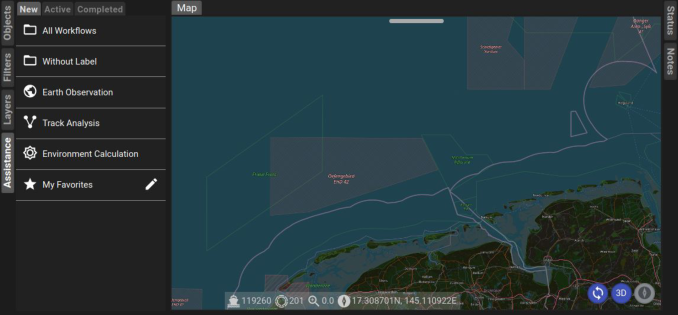
DESCRIPTION OF THE APPLICATION This section explains the basic functionality of the SPE. We created the inter- face with standard technologies of the World Wide Web in order to use it in every modern web browser. In Figure 1 we show a screenshot of the user interface. The central element is an interactive map on which the investigator can view the current traffic situation. On the left side of the user interface is the workflow view. Here, the investigators select suitable workflows for their investigation cases, configure them and interpret the results.
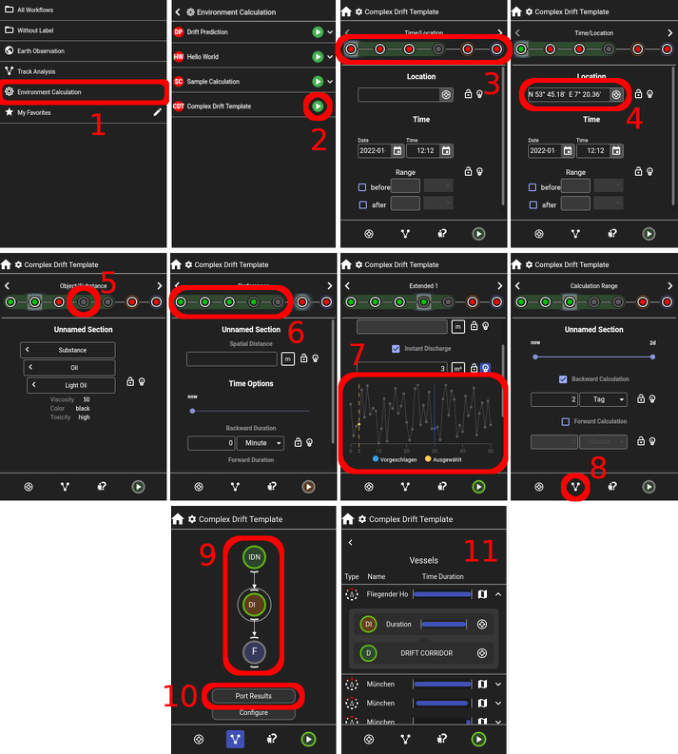
An example of performing an investigation task within the SPE is depicted in Figure 2. To describe the interface and the actions we use the numbers , , …, in the text as well as in the figure. When investigators have to work on a new case, they first select the appro- priate category in into which the case falls. After that, various templates for workflows are available to the investigators. The investigators can press the green start button to start a corresponding workflow. In this case, a workflow called “Complex Drift Workflow” is started in .
Next, the investigators are in the configuration view of the workflow, where all parameters of the workflow are set. The configuration of a work- flow is realized by means of a wizard approach. For this, the parameters of
Figure 1: The SPE’s main user interface.Figure 2: The SPE’s workflow view.
An Integrated Approach for More Efficiency in Maritime Investigations 711
a node are divided into several individual ordered pages. These pages group logically related parameters and are filled in by the investigators in sequence. The investigators can track their progress using the breadcrumbs in . Here, a breadcrumb stands for a page and can take on different colours, which represent the status of the page. For example, the breadcrumb is filled green if all necessary parameters have been entered and filled red if the parameter entry is incomplete.
On the pages, the investigators see different input fields for different types of parameters. In the figure, you can see that the geo-position for the starting point of a drift calculation has been entered in .
In addition, new parameters can be added dynamically when certain para- meter values are entered on other pages. For example, shows that a breadcrumb has been added. This has happened because oil was selected as the substance for a drift calculation. The newly added page then contains all oil-specific parameters.
Pages belonging to the same node are within the same frame, as shown in . This tells the investigators which pages all need to be filled in so that an (intermediate) result can be calculated.
As mentioned before, the SPE has a function that automatically makes suggestions to the investigators about individual parameters. The suggestion always depends on the current parameter constellation and is based on histo- rical data. In addition to the pure parameter suggestions, the SPE is also able to display statistics on the distribution of individual parameters, as can be seen in . This has the potential to increase the traceability of the suggestions and the trustworthiness of the system.
To get an overall view of the workflow, the investigators can switch to the graph view using the button . This shows the data flow between the individual nodes. In addition, investigators can jump from here to the (intermediate) results of individual nodes by selecting a node and pressing the button in . The display of the results as seen in then depends very much on the type of node. In this case, it is a list of vessels.
PLANNED EVALUATION In this section, we present how we plan to evaluate the SPE. The objective of our evaluation is to find out how high the increase in efficiency can be compared to the traditional way of working of the investigators and how the user acceptance turns out. For this purpose, we have decided to conduct the evaluation in two phases. In the following, we will present these phases individually.
Efficiency Evaluation The best approach to evaluating efficiency would be to compare the SPE with the traditional way of how investigators work. To do this, a complex inve- stigation case would be solved in an experiment by a test subject using both the SPE and conventional methods. However, it is difficult to fully reproduce the traditional way of how investigators work under laboratory conditions. On the one hand, a complex investigative case would take too much time
within an experiment. On the other hand, as we mentioned at the beginning, the traditional way of working is largely neither formalized nor standardized. Therefore, in order to evaluate the efficiency, we only concentrate on partial aspects of the investigative work, which can be compared well.
So, it makes sense to focus on how efficient investigators are when spe- cifying parameters for a drift calculation. For many cases, it is necessary to perform a drift calculation as a subtask. For this exact purpose, there is already a software system that is used by the authorities and which we can compare with the SPE. However, the comparative system lacks special features, such as the parameter suggestion function.
For the study, we plan to invite 10 test participants who have no experience with either system. We plan to define two tasks in which a drift calculation is to be performed. Both tasks differ in their parameters such as location, time of discovery, type of substance, drift-specific parameters. The participants are then to solve the two tasks on both systems in random order.
At the end, we compare how quickly the tasks were completed and how many errors the test person made. Although the test subjects should not have any experience in the systems, they should still have a certain level of know- ledge about drift calculations. To this end, there will be a preparatory phase in which we will bring the subject to such a level of knowledge. We expect that the SPE can increase efficiency by 40% with at least the same error rate due to the generally better UX and especially the parameter suggestion function.
Workshop The second phase is to evaluate the user acceptance of the overall system. This includes further functions of the SPE, such as working on large workflows consisting of several nodes, the interaction with the nautical chart, as well as the handling of event points (Wortelen et al. 2020).
For this, we plan to do a workshop with one or two investigators of the German Federal Police for the Sea, who are direct users of such a system. The workshop will be conducted as a semi-structured interview with hands-on, in which we will guide the officers through the application and work through a predefined questionnaire. The questionnaire will mainly contain questions about the usability of the system.
In addition to this, plenty of time for discussions will be planned, in which questions and suggestions on the part of the investigators will be addressed.
Overall, we hope that the workshop will provide us with a good assessment of user acceptance and suggestions for improvement. We believe that the user acceptance of the SPE can surpass the user acceptance of the existing systems.
CONCLUSION
In this paper, we have presented how we plan to evaluate a system we have developed for resolving maritime investigation cases. The evaluation will be done in two phases. In the first phase, a user study will be conducted, in which part of the SPE will be compared to an existing system. In the second phase, a workshop will be conducted with investigators from the Federal Police to get an assessment of user acceptance.
An Integrated Approach for More Efficiency in Maritime Investigations 713
Because of the outstanding features, we believe that we will surpass the previous systems both in efficiency and user acceptance.
ACKNOWLEDGMENT
The authors acknowledge the financial support by the Federal Ministry for Economic Affairs and Energy of Germany in the project EASE (03SX497B).
REFERENCES
Berthold, Michael R. and Cebron, Nicolas and Dill, Fabian and Gabriel, Thomas R.
and Kötter, Tobias and Meinl, Thorsten and Ohl, Peter and Thiel, Kilian and Wiswedel, Bernd. (2009). KNIME - the Konstanz Information Miner: Version 2.0 and Beyond, SIGKDD Explor. Newsl. Demsar J, Curk T, Erjavec A, Gorup C, Hocevar T, Milutinovic M, Mozina M, Polajnar M, Toplak M, Staric A, Stajdohar M, Umek L, Zagar L, Zbontar J, Zitnik M, Zupan B. (2013) Orange: Data Mining Toolbox in Python, Journal of Machine Learning Research. 14(Aug): 2349–2353. Goetzeler, Martin (2021). Real-time Multisensor Applications, https://www.dspace.com/en/inc/home/products/sw/impsw/rtmaps.cfm Pearl, J. (1985). Bayesian Networks: A Model of Self-Activated Memory for
Evidential Reasoning. Proc. of Cognitive Science Society (CSS-7). Wortelen, Bertram and Herdel, Viviane and Pfeiffer, Oliver and Harre, Marie- Christin and Saager, Marcel and Lanezki, Mathias. (2020). Efficient Exploration of Long Data Series: A Data Event-driven HMI Concept, Proceedings of the International Conference on Human-Computer Interaction.
LISTED IN THE AHFE DIGITAL BOOKSTORE CATALOGUE
Explore the complete digital volume
Human Factors in Transportation
Read this individual research paper free through the original publisher, or explore the full digital proceedings book.
ISBN 978-1-958651-36-0
Explore this ISBN in the AHFE Bookstore ↗Listed in the July 2026 bookstore catalogue; search by ISBN to confirm current availability · Digital book purchase optional