Shuichi Fukuda (2022). Self Sustaining Society (SSS) for the Next Generation. In: Affective and Pleasurable Design. AHFE Open Access, vol. 41, pp. 44–50. https://doi.org/10.54941/ahfe1001779
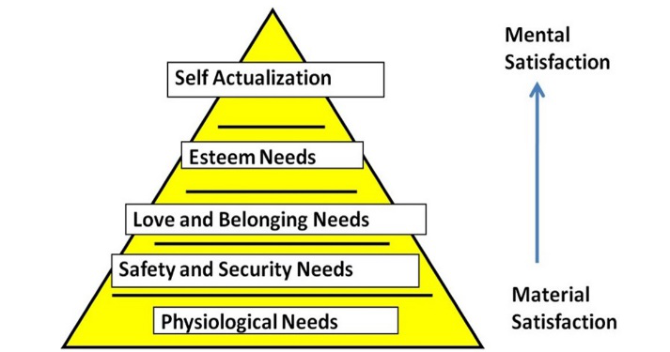
The Industrial Society is approaching its end. It satisfied our needs for products, but our needs shifted from material satisfaction to mental satisfaction, and now we are pursuing “Self-Actualization”, which is the highest need of the human. Therefore, we should change our perspective and do our best to develop such a society where self-sustaining and self-satisfying become most important. In short, we should develop a society of “Self” for the next generation. Then, most of the issues of the industrial Society will be solved. We will live no more for today, but for tomorrow. “Self-Society” brings us dreams. The efforts to make our dreams come true are really a challenge and a challenge is a core and mainspring of all human activities.
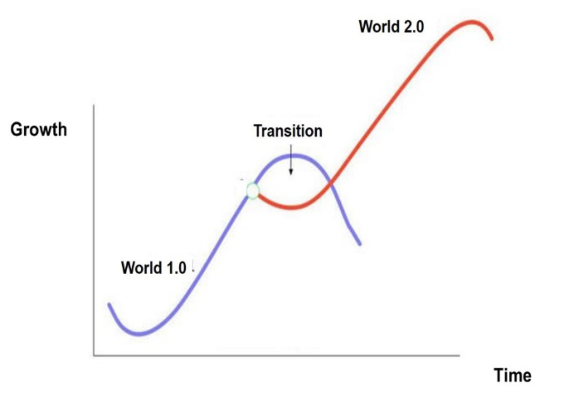
INDUSTRIAL SOCIETY IS APPROACHING ITS CEILING Growth curve (Figure 1) teaches us that our world grows and fade away one after another. New world emerges when the current world gets to its ceiling. The Industrial Revolution brought forth the Industrial Society and it kept on growing. But today, it is getting close to the ceiling. So, many issues are emerging such as decreasing workforce due to decreasing childbirth and aging population, and too much consumption of energy.
Although the world population is increasing, technologies has developed so much, so literacies of most of them are too low to keep the Industrial Society going. DX, AI are getting wide attention these days, but Ai consumes 10,000 times more than a human brain. So, it would be far better to let people work for themselves to create and enjoy their life.
Thus, there are many issues, but the most important issue is that we are still stuck with the idea of the Industrial Society. As growth curve tells us that every world fades away and another world emerges. So, now is the time to consider what world will come next and we must develop that world for the next generation.
The Industrial Society the Industrial Revolution brought forth introdu- ced “Division of Labor” and we started to work for others. Until then, we had been working for ourselves. Even when barter system was introduced, we were bartering things to satisfy our own needs or desires. But the Indu- strial Society changed the whole scene. We started to work for others. And
Self-Sustaining Society (SSS) for the Next Generation 45
Figure 1: Growth curve.Figure 2: Maslow’s hierarchy of human needs.
“Division of Labor” closed the world with curtains. We cannot see the whole picture anymore. We started to work for external rewards.
Remember Self-Determination Theory (SDT) (Deci and Ryan, 1985)? Edward Deci and Richard Ryan proposed SDT and made it clear that if the job Is internally motivated and self-determined, we can get the maximum satisfaction and feeling of achievement. And it also satisfies the important human need for growth as well.
Abraham Maslow made human needs clear about 40 years earlier (Mas- low, 1943), (Figure 2). Our needs start from material needs and as time goes on, they shift to mental needs and “Self-actualization”comes up as the highest need.
The underlying problem of the Industrial Society is we have comple- tely forgotten about “Self”. Indeed, material needs are fulfilled almost
46 Fukuda
Figure 3: Changing real world.
completely, but where can we find “Self”? Only engineers are enjoying “Self- Actualization”. They are not working for others. In fact, they are working for themselves. For non-engineers, the Industrial Society does not satisfy their highest needs for “Self-actualization”. So, they look for something that would satisfy their “Self”.
“SDGs (Sustainable Development Goals)” is getting wide attention these days. But we must pay attention to the fact that it emphasizes the importance of keeping the Industrial Society development and it does not discuss anything about the next society which would come next.
As the Industrial Society is getting close to its ceiling, as the fact that many issues are emerging indicates, what is more important is to consider and pre- pare for the next society. The Industrial Society left us a very important lesson. We must focus more on “Self” and develop “Self-Actualizing” society. We need to recover “Self” and enjoy our life to our heart’s content.
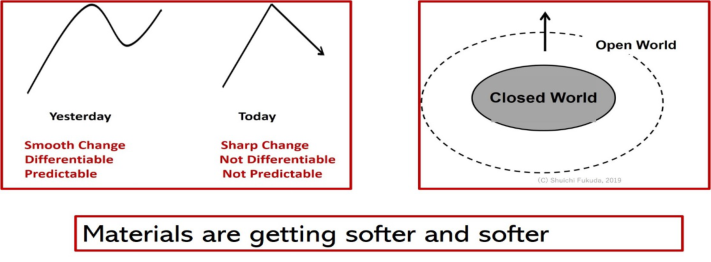
THE REAL WORLS IS CHANGING Attention should be paid to the fact that the Real World is changing rapidly (Figure 3).
Yesterday, changes were smooth. So, we could differentiate them and could predict the future. But today, changes become sharp, so we cannot predict the future anymore. And yesterday, our world was closed with boundary. But it is expanding rapidly. Now, it is an open world without boundary. So, it becomes increasingly difficult to apply mathematical approaches.
Another big change in the Real World is materials are getting softer and softer with the remarkable progress of material engineering.
SENSING AND ACTUATION As material is getting softer and softer, sensing and actuation becomes incre- asingly important. When materials were hard, in fact that is why we called them hardware, we could easily identify what the object is and how we should handle it with our eyes alone, even from a distance. But as materials are getting soft, we need to directly interact with them.
Self-Sustaining Society (SSS) for the Next Generation 47
At first sight, we think we can pick up the object, but picking up does not work. Then, we need to scoop it. We do not know how to handle it until we directly interact with it. We must determine what to do with the object by interacting with it directly.
Sensors and actuators have been developed with specific purposes. We used sensors to detect specific data or information and then we use actuators to cope with that specific situation. This was possible because environments and situations did not change much and if they did, the changes were smooth, so we could foresee the coming situation. But now changes become sharp and the future becomes unpredictable. Thus, preparing sensors and actuators for specific purposes does not work anymore. Further, sensors and actuators should work together to cope with the changing environments and situations in real time. Time delay is not allowed.
VAK (Visual, Auditory and Kinesthetic) In sensing and actuation, the importance of VAK (Visual, Auditory and Kine- sthetic) has been emphasized. As we have experienced until very recently when materials were hard, visual or eyes played an important tole in sen- sing. But with the softening of materials, we come to realize the importance of other senses. Auditory means ears. But it is important not only for hearing sounds, but also for coordinating and balancing our body. Three Semici- rcular Canals provides us the ability to coordinate and balance our body. That is why we can scratch our back, although we cannot see. They are very important to detect or feel our own movement. And Kinesthetic means movement.
Once again, living things are called Creatures. Why? It is because we create movement to survive. Movement is indispensable for our living.
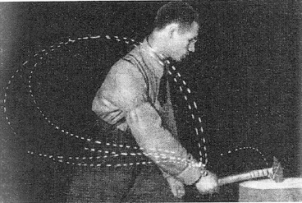
Human Movement Human movements are divided into two: Movement. Which can be observed from outside is called Motion. The other is called Motor. This is movement inside of us such as muscles. Nikolai Bernstein clarified Motion (Bernstein, 1967), (Figure 4). At the early stage, our trajectories vary widely from time to time. But as we get close to the target object, our muscles harden and start to work together with our skeleton. Thus, we can identify parameters easily and control the trajectory. Then, why our trajectories vary so widely at the first stage. It is to coordinate our body parts and balance our body to cope with the changing environment and situation.
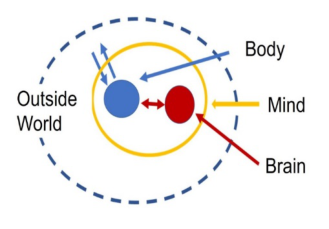
MIND-BODY-BRAIN Let us consider Mind-Body-Brain (Figure 5), It is Body that directly interact with the Real World. Brian collects inforation from Body and structure it into knowedge Mind consists of Body and Brain. We must pay attention to the fact that when we ask for a decision, we say “Make up your mind”. We do not say “Make up your brain”. Brain Is getting wide attention these days, but it is Mind which is related directly with decision.
48 Fukuda
Figure 4: Motion.Figure 5: Mind-Body-Brain.
And we must remember that after the brain is dead, blood circulates and it carries signals to our orgns. Thus, after the death of Brain, uur organs keep on working and we can transplant them to others. And it muat be emphaised that blood is analog. We need to pay attention to both digital and analog signals.
What the Octopus Teaches Us Ths octopus and the human are placed on the opposite side of the evolu- tonary tree. The otopus belongs to the invertebrates and the human to the vertebrtates.
Octopuses die immediately after their babies are born. So, they do not inhe- rit knowledge from their previous generations. They have no other way but to live on their instinct alone. But they are known as the expert of escape. They can escape from any environrments and situations. They can even escaoe from a screwed container !
They have a big head. But their brain capability is at the same level as that of a dog. Then, why they can be an expert of escape. They have eight arms and their head is used for cordinating them to cope with the environment and situation. Ehey are interacting with the Real World directy with their body and it is in real time.
Further, we should note that they use sensors and actuators together at the same time. We have highly developed sensors and acuuators. But they are designed to work for special purposes and they work separately. Sen- sors detect data relating to the context and actuators which can process that context is called on. Sensing first and then actuation follows. They do not work together at the same time. But environments and situations change from
Self-Sustaining Society (SSS) for the Next Generation 49
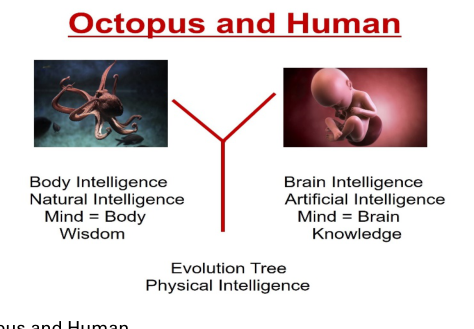
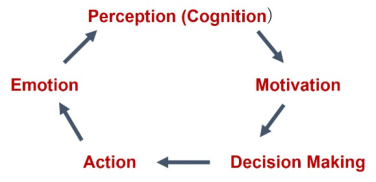
Figure 6: Octopus and Human.Figure 7: Perception Motivation Decision Making Action Emotion Cycle.
moment to moment, so such delay cannot be allowed. We need to sense and actuate at the same time. Real time interaction is indispensable.
Peter Godfrey-Smith published “Other Minds: The Octopus, the Sea and the Deep Origin of Consciousness” (Godfrey-Smith, 2016). He clarified how the octopus perceive the Real World holistically and how it makes up its mnd and takes appropriate actions.
The octopus may be the only invertebrates that can recoginize self in a mirror. In the case of vertebrates, only humans and apes can, although there might be few others. Why they can is because they can “feel” the muscle movements. This also teaches us how movement is important for our living.
To describe this another way, the octopus intelligence is body intelligence and it is widsom. The human intellignece, on the other hand, is brain intellige- nce and it is knowledge. To cope with the continuously changing Real World, wisdom is required. Knowledge is the information of the past, bu wisdom is a strategic decision and action in real time to deal with the continuously and unpredictably changing Real World today (Figure 6).
MOVEMENT AND EMOTION It is worth paying attention to the etymology of emotion. Emotion and Moti- vation originate from the same Latin “movere”. So, Emotion means e-ex=out motion, i.e., move out. Thus, Emotion works as shown in Figure 7. We perceive the environment and situation holistically and it motivates us to take action, so we move out into the Real World to establish our “Self” world.
50 Fukuda
THE NEXT SOCIETY One world comes in and gradually it fades away. Then the next world comes in. Our society has developed that way, as growth curve shows.
The underlying problem of today is we forgot this. We are still sticking to the Industrial Society. But as many indications demonstrate, the Indstrail Society is getting close to its end and we need another Society for the next generation. If we consider the emerging issues of the Industrial Society, we should realize that we should revive the society where we can sustain ourse- lves and satisfy ourselves. In short, Self-Sustaining and Self-Satisfying Society (SSS) will be the next for the coming generation. Then, as Maslow, Deci and Ryan pointed out, we can enjoy the maximum happiness and feeling of achievement.
REFERENCES
Bernstein, N. (1967). The Co-ordination and Regulation of Movements, Oxford, Pergamon Press. Deci, E.L., Ryan, RM. (1985). Intrinsic Motivation and Self-Determination in
Human Behavior, New York, Plenum. Godfrey-Smith, P. (2016). Other Minds: The Octopus, the Sea, and the Deep Origin of Consciousness, Glasgow, William Collins. Maslow. A.H. (1943), “A Theory of Human Motivation”, Psychological Review,
Vol. 50, No. 4. pp. 370–396.
LISTED IN THE AHFE DIGITAL BOOKSTORE CATALOGUE
Explore the complete digital volume
Affective and Pleasurable Design
Read this individual research paper free through the original publisher, or explore the full digital proceedings book.
ISBN 978-1-958651-17-9
Explore this ISBN in the AHFE Bookstore ↗Listed in the July 2026 bookstore catalogue; search by ISBN to confirm current availability · Digital book purchase optional