Alessandra Rinaldi, Kiana Kianfar (2022). Design-enabled innovation in smart city context. Fostering social inclusion through intercultural interaction. In: Design for Inclusion. AHFE Open Access, vol. 45, pp. 135–143. https://doi.org/10.54941/ahfe1001878
Generating design-enabled innovation implies the identification of social, technological, and cultural changes taking place nowadays and of the opportunities offered by the digital transformation, which enters these processes, playing an important role in all areas of contemporary life, from urban, domestic, health and services in general.In our era, the ambient intelligence pervades objects such as cities; electronic perception systems collect information and data from us, trying to understand our needs and give us answers. Cities are real living laboratories for experimenting new technologies on an urban scale.Big Data management represents one of the critical points of the ongoing revolution. The data can give information about people, understand behaviors, change city policies and so on. Big Data represent a qualitative leap in digital culture; nothing exists in Big Data before questions, explained De Kerckhove [1].“It is also and above all a cognitive revolution, where the answer no longer comes from the question. The large amount of data that comes from the pervasive use of technology already contains all the answers, but it has no value if it is not interrogated with the right questions. As McLuhan says, when all the answers are at hand, it's only the question that matters" [1].The perspective is then reversed: the first step in making society smarter is not to collect as much data as possible or develop an infallible algorithm, but it is necessary to identify the relevant expectations and needs in and for that society and ask the right questions, and to investigate what it represents, in the collective imagination, the quality of life and what technology can generate as a response.The project presented starts from the observation that we are faced with a strong migratory and global tourism flows that are affecting European cities, placing us in front of a growing multiculturalism in urban areas, with consequent issues related to the inclusion of cultural diversity and dialogue. The landscape of cities in many European countries has changed significantly, and the use of public space and services is no longer suited to the needs of multicultural citizens. This phenomenon has developed rapidly, without an adaptation of social policies, services, and spaces to emerging needs, creating evident problems of inclusion and dialogue between different cultures.Digital technologies and ubiquitous computing systems offer many opportunities for designing products and services aimed at increase interaction, collect, and share information, knowledge, emotions, experiences, through platforms that support the increase of social awareness.The research investigates how to use digital technologies and which design strategies and creative, communicative and process paths can be used to promote inclusion through interaction and communication between the different cultures that coexist in the same smart city context.Promoting interaction in public spaces, between citizens with different cultural backgrounds, becomes a crucial element to support social cohesion and to facilitate coexistence between different cultures. Opportunities to mix people in daily life reinforce shared values and goals.One of the best approaches that can be adopted for the design of new urban spaces and services is co-design, which indicates collective creativity as it is applied throughout a design process and involves all stakeholders, encouraging and supporting them to take an active role in this process.Following the indications of Findeli [2], this design research was carried out with the tools of design, and above all with its most original and specific characteristic, the project, developing in this specific case a pilot product-service.The project, funded within the H2020 framework program, made it possible to experiment with design tools to foster the engagement of different cultures present in the urban environment and encourage them to interact with each other, also including other types of stakeholders, from public administration to small/medium enterprises and to third sector associations.All the areas of cultural heritage, tangible, and intangible, where every culture has many stories to tell, have emerged as the most suitable areas for experimenting with new ways of interacting and communicating through which diversity can be encountered and compared. Five design for storytelling strategies guided the project: i) building relevance; ii) design for experience; iii) interactivity; iv) immersion; v) inclusion.[1] De Kerckhove Derrick, Psicologie connettive, Milano, Egea, 2014.[2] Findeli Alain, “Design research-Introduction”, Design Issues n. 15(2), 1999.
Generating design-enabled innovation implies the identification of social, technological, and cultural changes taking place nowadays and of the oppor- tunities offered by the digital transformation. The advent of digital transfor- mation in these changing processes, already in place, plays an important role in all areas of contemporary life. In our era, the ambient intelligence perva- des objects such as cities; electronic perception systems collect information and data from us, trying to understand our needs and give us answers. Cities are real living laboratories for experimenting new technologies on an urban scale. (Ratti, 2014) emphasizes how new systems of perception are pervading every aspect of urban space, revealing visible and invisible dimensions of the city and its citizens: we are getting to know our cities better and they are lear- ning to know us in parallel. At the same time, all kinds of objects, even those without a digital vocation, are becoming Internet-connected devices. These network-connected objects behave like sensors and can produce information
about themselves or their surroundings, as well as being remotely control- led. With the Internet of Things, objects can communicate with each other becoming ‘animated’; with the Internet of Things, objects can communicate with each other becoming ‘animated’; we can interact with them by giving commands, or they are the ones who control us and connect to other objects to search for what they need, collaborating in the formation of Big Data. Big Data management represents one of the critical points of the ongoing revo- lution. The data can give information about people, understand behaviors, change city policies and so on. Big Data represent a qualitative leap in digital culture; nothing exists in Big Data before questions, explained (De Kerckh- ove, 2014)1. “It is also and above all a cognitive revolution, where the answer no longer comes from the question. The large amount of data that comes from the pervasive use of technology already contains all the answers, but it has no value if it is not interrogated with the right questions. As McLuhan says, when all the answers are at hand, it’s only the question that matters” (De Kerckh- ove, 2014). The perspective is then reversed: the first step to making society smarter is not to collect as much data as possible or develop an infallible algo- rithm, but it is necessary to identify the relevant expectations and needs for the society and ask the right questions, and to investigate what the quality of life represents in the collective imagination, and what technology can gene- rate as a response. The designer is the one who asks questions, with the aim of opening a discussion on what people want or don’t want, on what kind of future propose, on what technology is able to generate as an answer. They Also open a discussion on how technological development and the myriad of computers, now invisible to the common consciousness, that people uncon- sciously use to carry out daily activities, can be addressed to create innovative services.
Designers have the role of investigating the new opportunities arising from major technological innovations, and translate them into objects that we can use every day, creating bridges between technology, society, and production, both of products and services (Antonelli, 2011). The project presented starts from the observation that we are facing a growing multi- culturalism in urban areas, both for the advent of global tourism and for the strong migration flows. These two phenomena are affecting European cities with consequent issues related to inclusion and dialogue between cultures. It investigates how to use digital technologies and which creative and com- municative path and process utilize to foster interaction between different cultures in the same urban context. The project explores design strategies to push users (Thaler and Sunstein, 2014) towards a sustainable, cohesive, and inclusive society of cultural diversity and to improve the user experi- ence through the sharing of emotions, experiences, information, and data, capable of increasing social awareness. Following the indication of (Findeli, 1999) this design research was carried out with the tools of design and as a “project-grounded research” in this specific case, a pilot product-service was developed.
1De Kerckhove D. live lecture from MIT, entitled “MIT’s SENSEable City Lab studies the future of urban mobility”, Internet Festival 2014, CNR Auditorium, Pisa, October 2014.
Design-Enabled Innovation in Smart City Context 137
The Multicultural Smart City: Increasing Citizen Interaction and Inclusion The scenario of cities in many European countries has changed significan- tly, driven by both global tourism and immigration of people from different cultures. The use of public space and services is no longer adapted to the needs of multicultural citizens. This phenomenon has developed rapidly, without an adaptation of social policies, services, and spaces to emerging needs, creating obvious problems of inclusion and dialogue between different cultures. As (Branzi, 2016) writes, each individual affirms his own sacred identity, uniqu- eness, originality, as the bearer of an unrepeatable history, of his own genome. Complexity, contradictions, hybridizations have become the reference for politics and the project, forced to deal with “problems that have no solution” ... In the multiethnic metropolis, a progressive hybridization between ethnic groups is produced... Regardless of our capacity to welcome, we are daily overwhelmed by a flow of international goods and information, by the coe- xistence with new habits, fashions, gastronomies, and religions, producing a general hybridization. The process is irreversible, what we can do is only learn to manage it. Promoting interaction in public spaces, between citizens with different cultural backgrounds, becomes a crucial element in suppor- ting social cohesion and facilitating coexistence between different cultures. Opportunities to mix people in daily life reinforce shared values and goals. One of the best approaches that can be adopted for the design of new urban spaces and services is co-design (Rizzo, 2009), which indicates the applica- tion of collective creativity throughout a design process and the involvement of all stakeholders, encouraging and supporting them to take an active role in the process. Digital technologies can create opportunities to support citizen engagement and promote their connection and communication in the context of exchanging mutually meaningful social experiences. In urban studies, there is some research that shows how digital technologies create a different use of public space and facilitated interaction for intercultural dialogue. Some recent research works showed that the communication between different people in an urban context supported by, for example, public displays assume a social role (O’Hara, 2003). They have been explored the potential of game design to promote play in public areas (De Souza e Silva, Hjorth, 2009) and its use to promote social interaction offline (Caon et al., 2013). Some pioneering researches have experienced prototype including urban furniture, that allow the use of streaming content such as music (Rubegni et al., 2008) or increase the safety of elders (Kötteritzsch et al., 2016). The world of interactive public spaces equipped with intelligent urban furniture and the world of interfaces to support intercultural communication to facilitate social inclusion have never met or, at least, there are no examples in scientific publications.
Having emerged the importance of fostering interaction and exchange between cultures to increase social inclusion and the sense of belonging to a community, the goal becomes how to use the creative tools of design thinking and service design thinking to push citizens towards new behaviours aimed at fostering the development of a smart, sustainable, inclusive city. In paral- lel, digital technologies and ubiquitous computing systems are used to create
138 Rinaldi and Kianfar
product-services designed to increase interaction, collect, and share informa- tion, knowledge, emotions, and experiences. With this goal the M-EATING was born, funded within the H2020 framework programme (DESIGNSCA- PES, 2018), which allowed the experimentation of design tools to foster the engagement of the different cultures present in the urban environment and encourage (push) them to interact with each other, including other types of stakeholders, from public administration to enterprises and third sector.
METHODOLOGICAL APPROACH The design process was planned to answer the following research questions. How do we satisfy the expectations of citizens with cultural diversity? How do we ensure that we have made cultural diversity relevant? How can we increase interaction and dialogue between cultures in a smart city context where things happen fast and there is so much competition in recreational and leisure services? The project has experimented with some tools of design thinking (IDEO, 2022) and service design thinking (Stickdorn et al., 2018) targeting them to increase the motivation of citizens to participate in the service, to make them interact with other people, especially those with dif- ferent cultural backgrounds, and to capture the attention of all stakeholders involved in the service, in other words, to make engagement.
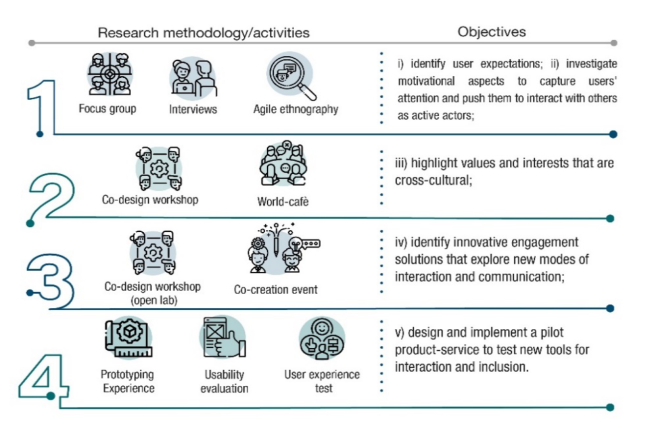
The development process followed several steps of investigation involving 10 researchers from domains of design and information technology engine- ering, 3 public administrations, 2 urban park managers, 1 catering operator, 2 social and cultural associations, 1 SME and 20 local and immigrant citi- zens from Italy, Iran, China, Peru, Colombia, Morocco, Argentina, Albania, and Ethiopia. The project objectives were: i) identify user expectations; ii) investigate motivational aspects to capture users’ attention and push them to interact with others as active actors; iii) highlight values and interests that are cross-cultural; iv) identify innovative engagement solutions that explore new modes of interaction and communication; v) design and implement a pilot product-service to test new tools for interaction and inclusion. All par- ticipants were assigned the position of “experts in their own experience,” playing an important role in knowledge formation, idea generation, and concept development of products and services that they themselves might use. Figure 1 illustrates the design tools and activities carried out to achieve the objectives listed above.
RESULTS AND DISCUSSION
The emerged ideas were translated into three main design-oriented scena- rios, which played an important role in inspiring the final design. some of cross-cultural values and interests that emerged from co-designs and world- café workshops were: i) health and well-being; ii) learning and tangible and intangible cultural heritage; iii) leisure, work, and movement. M-EATING is a product-service that represents the implementation of one of these different scenarios and aims to leverage some of the emerged values and interests, such
Design-Enabled Innovation in Smart City Context 139
Figure 1: The applied methods and the activities carried out with the related research objectives.
as leisure and sharing of cultural heritage (the culture of food, art, archite- cture, music, dance, poetry), in order to foster interaction and engagement of citizens with different cultures in a participatory and inclusive way. To foster engagement, users have been transformed from passive to active actors; new modes of communication and interaction have been developed. The involvement was supported by a multisensory design, using transmedia and storytelling, to foster an immersive and active experience. A powerful tool to engage and make engagement is storytelling: stories have the power to inspire. Design for storytelling uses digital technology and information to generate interaction, communication, and empathy, and to share the experiences and emotions that are part of human nature, whatever the cultural background is. Humans are designed to be empathetic in connecting and sharing with other individuals. Sharing makes us feel like we belong to a group and interconne- cted, and citizens, if they are ‘engaged’, participate, and feel involved. When a group of people get together, interactivity increases, through the sharing of ideas, tools, creations, and processes of cooperation. Sport, food, art, poetry, etc., represent an important element of social cohesion, a tool for sharing emotions, information, and data, capable of increasing the psychophysical wellbeing of each person and promoting social inclusion. All areas of cultu- ral heritage, tangible and intangible, where each culture has many stories to tell, have emerged as the most suitable areas to experiment with new ways of interaction and communication through which meeting and comparing the diversity. Five design for storytelling strategies guided the project: i) buil- ding relevance; ii) experience design; iii) interactivity; iv) immersion; and v) inclusion.
Building relevance. A very effective design tactic for ensuring engage- ment is collaboration, participatory design, and co-design: if a person
140 Rinaldi and Kianfar
collaborates, if it is given the opportunity to share his experience, to tell what, as an individual or as a group, is relevant, his sense of belonging grows, so he is more interested.
Design for Experience. There are two types of experience: there is the passive experience, where users watch, read, listen; then there is the active experience where people do things actively organizing, interacting, leaving feedback, personalizing their experience. These activities are much more engaging and facilitate engagement.
Interactivity. The interactive experience is not necessarily digital, that is, interacting with a touch screen to read, look, and listen. Interactivity refers to two or more elements that exert reciprocal activity on each other, so they are mutually active. It can therefore relate to social interaction, Inte- ractivity must be reciprocal and multidirectional, such as to cause and effect. It must push for response and dialogue. The interactivity does not necessarily have to be a conversation, but it is just something that allows the user to impact the experience.
Immersion. The immersive experience must be multisensory and involve several senses simultaneously, not just sight and hearing, but also touch, taste, and smell.
Inclusion. Design for inclusion uses the same principles as universal design but is even broader. Design considering all human differences, from phy- sical and cognitive to gender, language and cultural differences that are dealt with creatively from the very beginning of the project.
Key Idea: Generate a Multicultural and Inclusive Experience The M-EATING project has been used as a research ground to experiment in an applied way what has been described above. The main idea was to set the research of design in practice. In this way, the practice was considered as a study intermediary informed by and it is informing an appropriate theory (Van Schaik, 2003).
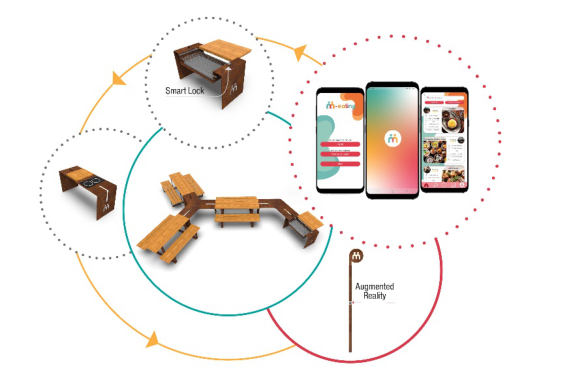
M-EATING includes urban furniture for public parks equipped with an internet of things kit, interactive signage throughout the park and the city, an APP (Figure 2) and a community of multicultural users consisting of citi- zens, public administration, catering operators, associations and cultural mediators, park managers, third sector entities.
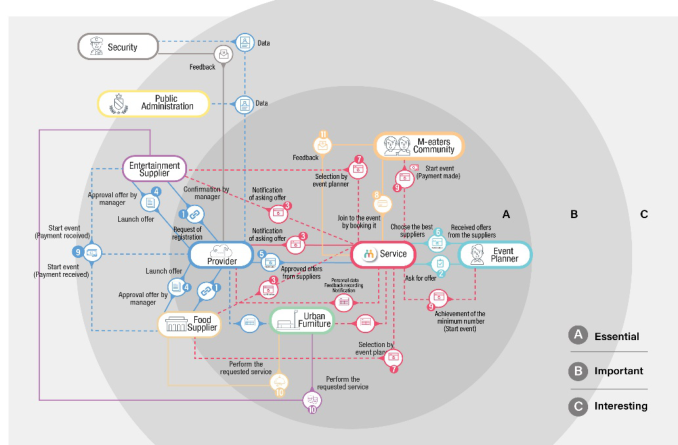
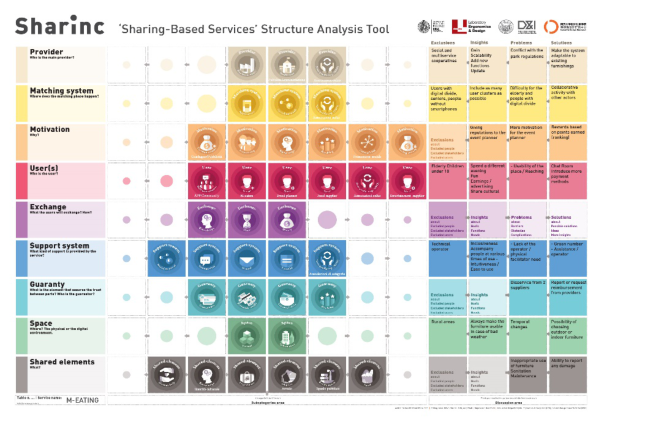
Each stakeholder is engaged according to a complex map that considers all possible factors of inclusion and exclusion (Busciantella Ricci et al., 2017) (Figure 3-4). It is possible to organize an event about the food culture of a country, select a restaurant that has already joined the service, and reserve the furniture available in the various urban parks, and in this way, all interested users, part of the community, can participate.
The event becomes an active dialogue, encouraging people to reflect and impact others by participating; each person also has the opportunity to collaborate and personalize, then create personal relevance. The experie- nce offered by the service is truly rich: the existence of passive and active design at the same time; possibility to experience both digital and phy- sical worlds; personalized, collaborative, self-expressive, and responsive
Design-Enabled Innovation in Smart City Context 141
Figure 2: The different components of the service: interactive urban furniture equipped with an Internet of Things kit and smart accessory modules for cooking; interactive signage; and a smartphone application.Figure 3: Stakeholder ecosystem map.
interactive; storytelling to empower stories and create engagement; multi- sensory design with a taste-tactile-olfactory experience as well as visual and auditory; and inclusivity. The experience is also accessible remotely through augmented reality, applied to the signage elements spread throughout the city, or through the APP. This accessibility is guaranteed by extensive coverage and prolonged engagement, sharable and viewable both from home and outdo- ors, even beyond the duration of the event. The architecture of the system is structured to obtain evaluation metrics, both quantitative and qualitative, and an integrated reporting that can be useful to the service provider, but
142 Rinaldi and Kianfar
Figure 4: “Sharing” tool for evaluating the inclusiveness of the service, developed within the doctoral school and University of Florence.
also the public administration, the catering sector, and the third sector. This information concerns the flows, behaviors, and preferences of citizens, all useful data to create strategies and policies to improve the quality of the urban environment and the inclusion of cultural diversity of citizens.
CONCLUSION
The strategies of design for storytelling, which exploit the potential of techno- logy, applied to the urban context represent a fertile ground for new research horizons, especially in the field of Design for inclusion in urban space. Thanks to the methodological approach of applied research, it was possible to use the tools of design thinking and service design thinking in a creative way aimed at making engagement for all stakeholders involved in the service. Starting from the reflection on the social and cultural factors that can compromise the use and access to urban spaces and services by all citizens and can cause their exclusion, the project aims to contribute to the knowledge of design related to the inclusion of multicultural in the urban environment through a multisen- sory project. It was possible by creating an experience with dual functioning: passive and active, physical, and digital, collaborative, and self-expressive. Following the directions of (Hummels, Overbeeke, 2000), M-EATING aims to be ‘context-dependent’ research through design, moving from product cre- ation to defining a framework for experience, with an important focus on the form of interaction. The project highlights the opportunity for a systemic approach from product design to interaction, engagement and experience design, applied to the field of inclusive design for multicultural. This appro- ach led to the definition of a multisensory experience-based project, aimed at achieving shared and co-created values and a sense of belonging to an inclusive and sustainable society.
Design-Enabled Innovation in Smart City Context 143
The article is the result of the joint work of the authors; the particu- lar contribution of each author is the following: Rinaldi A. “Introduction” and “Conclusion”; Kianfar K. “Methodological approach”and “Results and Discussion”.
REFERENCES
Antonelli, P. (2011). Talk to me: design and the communication between people and objects. New York: The Museum of Modern Art. Branzi, A. and Hara, K. (2016). Neo Preistoria: 100 Verbi. Milano: XX1T. Busciantella Ricci, D., Dong, H., Rinaldi, A., Tosi, F. (2017). “Inclusion in Sharing-
Based Services (I-SBS): an analytical tool”. 8th International Conference on Applied Human Factors and Ergonomics. 207–219. Caon, M., Mugellini, E., Abou Khaled, O. (2013). “A pervasive game to promote social offline interaction”. Proceedings of the 2013 ACM conference on Pervasive and ubiquitous computing adjunct publication. 1381–1384. De Kerckhove, D. (2014). Psicologie connettive. Milano: Egea, Milano. De Souza e Silva, A., Hjorth, L. (2009). “Playful urban spaces: A historical approach
to mobile games”. Simulation & Gaming, 40(5), pp. 602–625. DESIGNSCAPE. (2018). M-EATING. Available from: https://designscapes.eu/2021/ 08/08/m-eating/ [accessed 11 February 2022]. Findeli, A. (1999). “Design research-Introduction”. Design Issues, 15(2), pp. 1–3. Hummels, C. C. M., Overbeeke, C. J. (2000). “Actions speak louder than words:
shifting from buttons and icons to aesthetics of interaction”. Design plus Resea- rch. Proceedings of the Politechnico di Milano conference. Milano, 18–20 May. Milano: Politechnico di Milano, pp. 284–290. IDEO. (2022). IDEO DESIGNTHINKING. Available from: https://designthinking.i deo.com/ [accessed 10 February 2022]. Kötteritzsch, A., Koch, M., Wallrafen, S. (2016). “Expand your comfort zone! smart
urban objects to promote safety in public spaces for older adults”. Proceedings of the 2016 ACM international joint conference on pervasive and ubiquitous computing: adjunct. 1399–1407. O’Hara, K., Perry, M., Churchill, E., Russell, D., ed. (2003). Public and situated displays: Social and interactional aspects of shared display technologies (Vol. 2). Dordrecht: Springer Science & Business Media. Ratti, C., Claudel, M. (2014). Le smart cities di domani. Roma: Aspenia. Rizzo, F. (2009). Strategie di co-design. Teorie, metodi e strumenti per progettare con
gli utenti. Milano: Franco Angeli. Rubegni, E., Brunk, J., Caporali, M., Gronvall, E., Alessandrini, A., Rizzo, A.
(2008). “Wi-Wave: urban furniture for browsing internet contents in public spa- ces”. Proceedings of the 15th European Conference on Cognitive Ergonomics: The ergonomics of cool interaction. 1–7. Stickdorn, M., Hormess, M. E., Lawrence, A., Schneider, J. (2018). This is service design doing: applying service design thinking in the real world. Sebastopol: O’Reilly Media, Inc. Thaler, R., Sunstein, C. R. (2014). Nudge. La spinta gentile: La nuova strategia per
migliorare le nostre decisioni su denaro, salute, felicità. Milano: Feltrinelli Editore. Van Schaik, L. (2003). “The practice of practice: practice based research in architecture”. The Practice of Practice: research in the medium of design. Melbourne: RMIT Press, pp. 12–19.
LISTED IN THE AHFE DIGITAL BOOKSTORE CATALOGUE
Explore the complete digital volume
Design for Inclusion
Read this individual research paper free through the original publisher, or explore the full digital proceedings book.
ISBN 978-1-958651-21-6
Explore this ISBN in the AHFE Bookstore ↗Listed in the July 2026 bookstore catalogue; search by ISBN to confirm current availability · Digital book purchase optional