Philip Schaefer, Andre Vaskevic, Gerrit Meixner (2022). Guided by the hint: How shader effects can influence object selection in Virtual Reality. In: Human Factors in Virtual Environments and Game Design. AHFE Open Access, vol. 50, pp. 173–179. https://doi.org/10.54941/ahfe1002075
In this paper we investigated if shader effects as interaction hints can be used in a Virtual Reality simulation to manipulate peoples’ object selection behavior. We compared the effects Glowing Outline, Color Saturation and Transparency and showed in a study with 13 participants that objects with prominent shader effects get selected significantly more often in a virtual reality simulation compared to transparent or objects without any applied effect (p = 0,01). However, the impact of the annotating shader declines throughout interactions done.
During the last decade, Virtual Reality (VR) has established itself not only in the professional but also in the private sector with growing numbers in sales1. Considering real-world walking as the most natural way to locomote through a virtual environment (Langbehn et al., 2017) the physical space can be a restraining factor in the design space. To create highly immersive environments while reducing the impact of limited physical space, tangible objects from the actual surroundings can be integrated into the virtual world (Insko et al., 2001). Despite the mostly disproportional high effort of map- ping an entire setting to a virtual scene the versatility of the simulation could be lost and is therefore not always strived for (Simeone et al, 2015). To cre- ate a mixed scene with the benefits of substituted and plain virtual objects without endangering the users a technique must be implemented to show which objects can be used or not. Ideally, the users do not actively perceive a difference between proxied objects in order not to reduce the felt presence, encourage breaks in the illusion (Slater, 2015), or endanger the desired simu- lation effect. However, the information if an object is physically reliable must be transported correctly at a given moment, to prevent possible injuries e.g., if the users assume that they could take a seat on a chair that only exists vir- tually. Dillman et al. elaborated an overview of established visual interaction 1https://www.statista.com/statistics/515453/usa-virtual-reality-device-brand-interest/
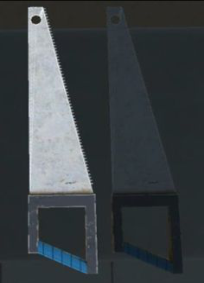
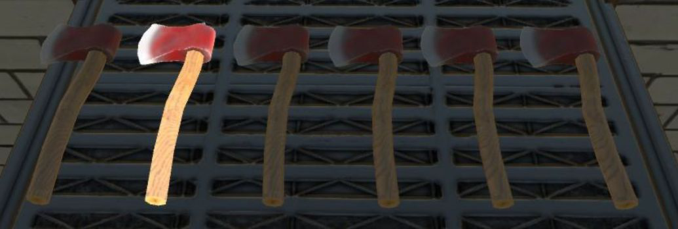
Figure 1: Color saturation (left), glowing outline (middle) and transparency (right).
cues in computer games to inform players what can be interacted with (Kody et al., 2018). We selected three promising effects and investigated if they could also be applied in a VR simulation to inform about the affordance of certain objects in relation to physical proxies.
METHODS
Participants, Experimental Task and Experimental Design An empirical study was conducted to evaluate the impact of an object’s visual composition on participant’s object selection behavior. The 13 (10 male, 3 female) participants aged 19 years to 35 years (M = 24.5, SD = 4.6) found themselves in a virtual warehouse in which groups of six items of the same type such as hammers, drills and crowbars were distributed accessibly in shelves or on tables as shown as in Figure 1. None of the subjects had adva- nced (more than 4 hours) experience with VR but 61% play computer games at least once a week. Each participant was shown a total of at least 30 rando- mized items, which they should look for in the warehouse, pick up and bring to a previously defined deposit. As they approach a pick-up location shader effects got continuously applied on the visible items peaking at a distance of less than 0.75m away from the shelf. The applied effect could be either Glowing Border, Color Saturation, Transparency or no effect (see Figure 3). Items were always grouped together like shown in Figure 2. There were four variations how effects got applied on the item-groups: Glowing Outline and no effect; Color Saturation and no effect; Transparency and no effect; Glo- wing Outline, Color Saturation and Transparency. To maintain the practical relevance of the experiment, in which usually only one out of several objects would have a physical proxy, we applied the shader effects on an item-group as shown in Table 1. At every pick-up location, e.g., in a shelf or on top of a box, the participants saw a group of six identical items (see Figure 1) with shader effects applied to them as shown in Table 1. The order of the items was randomized.
Guided by the Hint: How Shader Effects Can Influence Object Selection in Virtual Reality 175
Table 1. Showing the different shader combinations of the items at a pick-up location.
Table available in the original PDF paper.
Variation Item 1 Item 2 Item 3 Item 4 Item 5 Item 6 1 Outline none none none none none 2 Saturation none none none none none 3 none Trans Trans Trans Trans Trans 4 Saturation Saturation Outline Outline Trans Trans
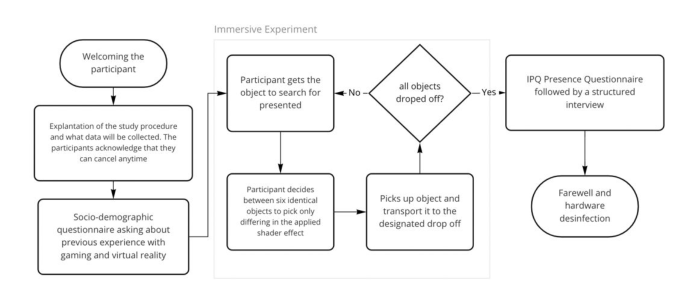
Figure 2: The shader effect applied to a group of items according to variation 2.Figure 3: The experimental procedure of the study.
We hypothesized that the Glowing Outline and Color Saturation effect make the objects stand out more from their surroundings and draw the user’s attention. The Transparency effect (see Figure 3) has the opposite feature making the object more inconspicuous and therefore reducing the chances of getting picked. The participants could only carry one item at a time. After they dropped the item at the designated location the item type to search next changed. The experiment was divided into three identical rounds. After the participants dropped ten of the asked items the round finished, and the next round started with a countdown. No introduction to the shader effects and their intended impact was given. The experiment took an approximate time of 40 minutes per participant.
Apparatus, Experimental Procedure, Data Collection and Processing The HTC Vive Pro Eye (2019) was used together with the proprietary wireless adapter to give the participants the possibility to explore the whole ~36m2
scenario by natural walking. The object picking was done by pressing the trigger button of either the left or the right HTC Vive controller with the index finger. The simulation was developed in Unity 2019 LTS and rendered with an Intel Core i7-8700k, 64GB RAM, NVIDIA GeForce GTX 1080Ti workstation. Figure 3 shows the experimental procedure. After welcoming the participants, the study procedure was explained, and a consent agreement form was given out together with a socio-demographic questionnaire asking about the previous experience with VR. After explaining how to interact in VR and calibrating the eye-tracking of the HTC Vive Pro Eye the immersive part of the experiment started and was screen recorded. After the subjects picked up and transported all of the shown items to a designated drop off location the simulation finished, and the participants were asked to rate their presence on the IPQ Presence Questionnaire (Schubert, 2003) followed by a structured interview to collect feedback about the general application and subjective impact of the effects. During the experiment the items a participant picked up together with the applied shader-effect on each visible item was logged. The experiment finished with the disinfection of every used item. The statistical calculation was done with IBM SPSS Statistics v28. The One- Sample Nonparametric Chi-Square test was performed with an accepted a- level of p=0.05.
RESULTS
Presence Questionnaire (IPQ) The IPQ consists of 14 items rated on a seven-point Likert Scale ranging from 1 to 7 with a higher value indicating a stronger presence. The questionnaire is categorized into four sub-scales. The general item relates to the sense of being in the virtual environment (VE) and had a mean rating of 6.38 (SD = 0.87). The spatial presence represents the experience of being physically inside the VE (M = 5.49 SD = 0.70). The awareness of doing things in the VE had a mean rating of 4.62 (SD = 1.23) and the sub-category of how real a situation in the VE is imitated was rated M= 3.54 with an SD of 0.82.
Object Selection Behavior
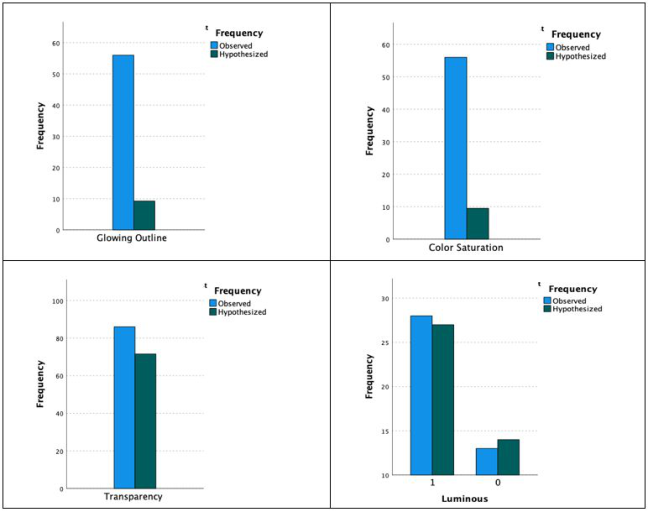
Table 2 shows the selection frequency (n) of items with a certain shader effect during the experiment compared to the statistically expected number (n’). In total 416 valid item pick-ups from the 13 subjects could be recorded through- out three rounds. The results for the presented groups of objects with shaders applied according to the mentioned variations in Table 1 are the following: Variation 1: Items with the Color Saturation effect applied got picked signi- ficantly (p = 0.001) more often (n= 56) than statistically expected (n’= 21) compared to items without an applied shader effect. In this variation a total of 121 items were picked up.
Guided by the Hint: How Shader Effects Can Influence Object Selection in Virtual Reality 177
Figure 4: Observed and hypothesized selection frequencies of the items with the glowing outline, color saturation, transparency, or no shader effect applied.
Variation 2: Compared to items without any applied shader effect the objects with the Glowing Outline shader applied were chosen (n = 56) significantly (p = 0.001) more often than statistically expected (n’=20). In this variation a total of 125 item selections from the participants could be recorded.
Variation 3: Objects with the Transparent effect applied were significantly (p = 0.001) less selected (n = 86) as statistically expected (n’=104) compared to objects without any applied effect. A total of 125 items were picked up in this variation.
Variation 4: The items with the Color Saturation or the Glowing Outline shader applied were not picked significantly (p = 0.3) more often than Tran- sparent items. The structured interview revealed that only two out of 13 participants could distinguish between the Color Saturation and the Glowing Outline effect, which is why we combine both effects for further evaluation as Luminous effect. But even after grouping the two effects and recalculating the statistically expected selection frequency, items with the Transparency effect were not picked less significantly (p = 0.74) (n = 10) than statistically expected (n’=13.7).
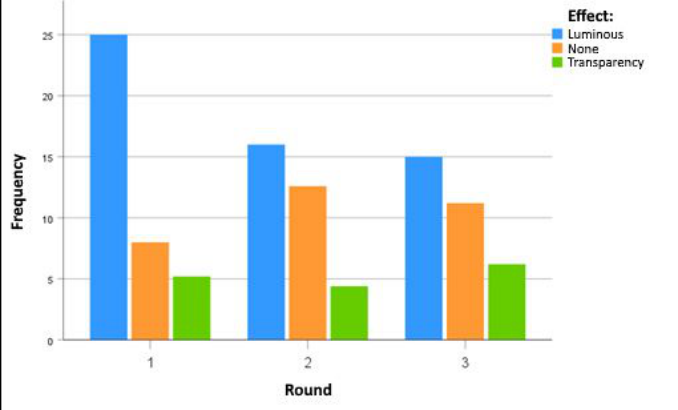
However, comparing the interaction behavior by each round (see Figure 5) items affected by the shader group of the Luminous effects draw more user attention than Transparent items or objects without any applied effect. But throughout the experiment this reaction evened more and more out. This finding also corresponds to the observations made during the experiment. In
Table 2. Results of the one-sample nonparametric chi-square test. Where n is the actual number of items selected and n’ the excepted statistical output.
Table available in the original PDF paper.
Variation Outline Saturation Trans none p n n’ n n’ n n’ n n’
Figure 5: Impact of the shader effects throughout the experimental rounds.
the beginning, the user’s attention was determined by the occurrence of an effect, which became less impressive as the simulation progressed and other factors guided the user’s selection process more, like the distance to an item of the object group. We noticed that users tend to optimize their walking routes towards to end of the experiment and get less affected by events in the simulation.
In the structured interview after the simulation, participants rated on a six- item Liker Scale from -3 (not at all) to 3 (very much) that the shader effects had no significant impact (mean = −0.94; Minimum = −2, Maximum =0, SD = 0.84) on their felt presence. The question if the shader effects influe- nced their decision on which item to pick the mean answer was 0.48 with a Minimum of −2, a Maximum of 2 and the SD of 1.39. Four participants sug- gested colorizing the Luminous effects in red or green to signalize a positive or negative behavior and one subject suggested fading out an item completely as the last stage of the Transparency shader.
Guided by the Hint: How Shader Effects Can Influence Object Selection in Virtual Reality 179
CONCLUSION
In this paper we investigated if shader effects as interaction hints can be used to manipulate peoples’ object selection behavior. We conclude that item annotation with the Glowing Border or Color Saturation together with the Transparency effect can steer user’s attention in VR. However, the impact of the annotations declines throughout the interactions done and can be affe- cted by other factors like time pressure or approaching position. For crucial application such as the proposed annotation of items to identify physical counterparts the shader effects alone are not applicable to draw the user’s focus reliable throughout a prolonged simulation. We suspect that not the accentuation of the object with the shader draws most of the attention but the progress how the shader was applied continuously while approaching the item. After this process has lost its fascination, the actual task of finding and running objects has been optimized and items with shorter walking distances were preferred independent of their appearance.
ACKNOWLEDGMENT
We want to thank Ketoma Vix Kemanji for the fundamental design of the used warehouse scenario and the participants for taking part in the expe- riment among the infection protection measures due to the SARS-CoV-2 pandemic.
REFERENCES
A. L. Simeone and E. Velloso, “Substitutional reality: bringing virtual reality home,” XRDS, vol. 22, no. 1, pp. 24–29, Nov. 2015, doi: 10.1145/2810044. B. E. Insko, “Passive haptics significantly enhances virtual environments,”, PhD
thesis, The University of North Carolina at Chapel Hill, 2001. E. Langbehn, P. Lubos, G. Bruder, and F. Steinicke, “Bending the Curve: Sensitivity to Bending of Curved Paths and Application in Room-Scale VR,” IEEE Transactions on Visualization and Computer Graphics, vol. 23, no. 4, pp. 1389–1398, Apr. 2017, doi: 10.1109/TVCG.2017.2657220. Kody R. Dillman, Terrance Tin Hoi Mok, Anthony Tang, Lora Oehlberg, and Alex
Mitchell. 2018. A Visual Interaction Cue Framework from Video Game Environ- ments for Augmented Reality. Proceedings of the 2018 CHI Conference on Human Factors in Computing Systems. Association for Computing Machinery, New York, NY, USA, Paper 140, 1–12. DOI: https://doi.org/10.1145/3173574.3173714 M. Slater, “Place illusion and plausibility can lead to realistic behaviour in immersive virtual environments,” Philos Trans R Soc Lond B Biol Sci, vol. 364, no. 1535, pp. 3549–3557, Dec. 2009, doi: 10.1098/rstb.2009.0138. T. W. Schubert, “The sense of presence in virtual environments:,” Zeitschrift für
Human Factors in Virtual Environments and Game Design
Read this individual research paper free through the original publisher, or explore the full digital proceedings book.
ISBN 978-1-958651-26-1
Explore this ISBN in the AHFE Bookstore ↗Listed in the July 2026 bookstore catalogue; search by ISBN to confirm current availability · Digital book purchase optional