Frank Lorne, Jamel Vanderburg, Aanchal Sharma, Jaan Malik, Kitti Sandhu, Siva Sateesh Pitchuka, Anvitha Satti, Pooja Telagu, Rishabh Neb, Reshwanth Reddy Kota, Ganesh Reddy Bollapu (2022). Establishing a Student-Community Book Club for Civic Engagement. In: Human Factors, Business Management and Society. AHFE Open Access, vol. 56, pp. 177–183. https://doi.org/10.54941/ahfe1002266
This paper articulates the reasons and the implementation steps for the forming of a student-community book club that aims to build small communities motivated by Raghuram Rajan’s 2019 book: The Third Pillar: How Markets and the States Leave the Community Behind. We believe humans and societies survive based on rational dialogues. A book club of this type can provide escape valves for individuals holding strong unbendable beliefs on how society should function, which has dichotomized America since 2016. Themes generated from books (fictions or non-fictions) contain scientific or humanistic views can encourage community network building of the type that will broaden people's view, rather than focus on specific disagreements. Disintegration of various factors, according to Rajan, is the crisis that communities all over the world are facing. Building communities have always been some historical endeavors, resulting often from wars and land grabbings. The urgent needs to do so now are due to technological changes. Technologies are disrupting the lifestyles in the world that can amplify as well as compromise disagreements. A web-ground co-development is necessarily for bringing out the goods while managing the bad of technologies.
Society has many needs. However, individual needs also have to be recogni- zed. Sometimes the two needs do not coincide. Society and individual needs might coincide when the individuals behave appropriately and as per their recognition of one another (Schwartz, 1979; Andre and Velasquez, 1992; Hossain and Korban, 2014). This does not always happen. The focus of this project is an attempt to align the society’s need of rebuilding communities using rational dialogues with individuals living in the communities. The pro- position was suggested in a 2019 book titled, The Third Pillar: How Markets and State Leave the Community Behind by Raghuram Rajan. The rapid tech- nological change especially via digital media in this new century has caused an imbalance between three pillars of a society, the state, the market, and the community. In a historical context (Chp. 1–4), although communities have
evolved from competition between rights, might, religions and minds from long history, most notably during the medieval history of the West, Rajan points out the identity of community as a distinguishing organization stru- cture different from State and market. It had been driven by “the transfer of large unproductive land holdings from the monasteries and aristocrats into the hands of the more commercially minded gentry [in town neighborhood] (Rajan, 2019, p. 72).
Yet, competition in the new century we live in today is a competition of minds and eyeballs, a community as a location identity has ceased its importance because of substitution and competition of different types of com- munities. Given the powerful force of technology disruption, it is not that land as a productive resource in the medieval time is no longer important, it’s the “disruptive technology change” that “wrong choices could derail human economic progress” (Rajan, 2019, xiii). Therefore, the society’s need is that we should address the issues now, before the system completely collapses.
To be sure, the imbalance of three pillars had happened before, due to war or great economic depression (Rajan, 2019, p. 137). The disruption due to technology advances, infiltrated at the ground community level has long started with schooling and the community lacking the building of market capabilities. The Third Pillar, in discussing how technology (ICT) has impacted our modern society (pp. 173–192), also suggests directions on how community can be reinvigorated. However, the role of technology in its strengthening or splitting communities seem somewhat ambiguous (pp. 326–331).
If the impact of technology on rebuilding local communities is uncertain, it will depend on how technology is selectively used. When the future contains both goods and evils, there is a need to reinvent the future for the purpose of restoring the balance between the three pillars of a society. Technology is forever a tool only, it can never be used to define a community or its identity. A community identity needs to be defined by the people in that community. However, individuals living in a community all have their own basic needs and aspirations that a community identity is not a priority that they consci- ously cultivate. It is an after-the-fact outcome that will be impossible to plan and to invent. The appropriate question to ask, therefore, is how technology can facilitate that recognition of the important things that matter to a commu- nity that help to shape the identity of that community. It is in that sense that a back-to-basics dialogue when people can know about each other’s aspirati- ons and wants that a future of local community can be reinvented. Dialogues entail language, culture, emotions, accompanied often by actions (Hayakawa and Hayakawa, 1990; Hakenson, 2007; Linquist, et.al., 2015; Strathern and Stewart, 2019).
A dialogue can be triggered by a theme initially privately conceived in someone’s mind. That theme usually can be traced back to a written piece of work, usually by someone else. That the piece of work has been published in a tangible form means that at least someone else in this world has thou- ght the theme to be meaningful enough to spend money in printing it (rather than just a moment of reflection over a beer in a bar). The nourishment of this theme requires an audience, because an audience can give feed-backs;
Establishing a Student-Community Book Club for Civic Engagement 179
they embellish or constructively critical about the theme. The scope of the conversation can extend to other aspects of a community life. Indeed, exten- ding the scope of a dialogue can grow a community relationship. Community relationships are stronger if members interact over multiple activities (Rajan, 2019, p. 16). A challenge of implementing community invigoration right from the start is how to provide guidelines to local leaders of a community so that individual interests in that community can be aligned with the social interest of that community. We see books, the ideas and themes initiated by books, can be a good method to build communities. But books can be of various types, with various themes. Rajan asserted in this age of violent disagreements, it will be good that society allows the outlet of voice of discontent, even though it may not be rational, as the consequence of letting that being hidden will undoubtedly lead to revolutions in the future. Therefore, dialogues of all kinds are to be permitted in the theme chosen by an individual’s, as long as it is backed by a published book. The attractiveness of a particular theme chosen by an individual is objectively determined by the number of likes the theme is able to garnish on a platform or in a meet-up. What the society needs in this endeavor is that the interaction is to be based on rational dialogue and reasoning. It is assumed that rational and informed dialogue will coincide with society interests.
The core subject that Raghuram Rajan focuses on in his book is that of improving the relationships between the markets and the civil society. His main focus was to restructure the market interaction with the States and the community. With time, markets and the states became more prominent and achieved an important position in comparison to the community.
To reverse the disintegration of the communities, Raghuram Rajan reth- inks a rebalancing act between states, markets and communities. Although the book gives examples of many rebalanced communities, it does not suggest methods of how to achieve that. We believe the setting up of a university-community book club can be a step heading for that direction.
DO, MAKE, INNOVATE, REINVENT THE FUTURE-AN NYIT MOTTO Undoubtedly, there are existing book clubs going on in many neighborhoods. The nature of these book clubs usually center around a pre-set theme, e.g. sustainability, psychology, writing improvements, finance and business, etc. Some center around an organizer, some center around age groups , hobbies, cultural identities. Some center around celebrities such as Agatha Christie, Bill Gates, Reese Weatherspoon, etc. Many have a business revenue model associated with it, e.g. those organized by bookstores, emphasizing the lau- nching of new books with invited authors doing book signings and talks, etc. Without question, there are people who like books, and like talking and listening to books.
Yet, none have yet been formulated along a University-Community plat- form. A university and its local community may or may not have a relati- onship. Many universities in the world are located in communities where people struggle with basic survival needs; indeed, not safe for visitors. Those
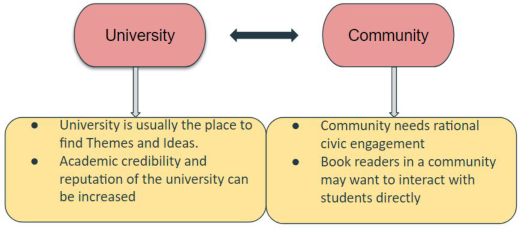
Figure 1: A university-community book club.
are not the University-Community that is suitable for implementation of civic dialogues through books. There are other University local communities where market and commercial activities overwhelm, such as those in busy metropolitan hubs. These communities arguably are more difficult to build a university-community platform based on books, but not impossible. Cer- tainly, there are many other university-communities in the world that would be open to having books as means to drive a civic dialogue.
Civic dialogue can be defined as gathering of individuals or communities to discuss various situations or challenges surrounding peoples’ life or pro- blems and situations existing or bothering the community as a whole. Civic engagement can drive a meaningful conversation between individuals sharing common interests. When there develops a communication link between two individuals sharing similar thought patterns and interests it is a benefit for both parties. Hence such civic engagement can be considered the need of time as people these days are caught up in their routine daily life. Such activities can help them have a positive and a motivated environment.
Universities and its local communities can certainly build a win-win relationship, as Figure 1 illustrates.
CIVIC ENGAGEMENT EX-POST Prof. Raghuram Rajan talked about how the third pillar, the society, is being neglected the most in the 21st century, because of technological changes. Civic Engagement is the vehicle which helps anyone to make sure that society is being involved in whatever they are doing. Rajan promotes the rethinking of the relationship between the market and civil society by arguing for the strengthening and empowerment of local communities as a means to com- bat growing despair and unrest. In the new era of nationalism emerging in countries around the world, with rational civic dialogue being replaced by violence, disrespect of public facilities, terrorisms, restoring civic engagement in communities is the most urgent need. A podcast in 2019 of Big Brain at the University of Chicago warned the world that ignoring real solutions for these problems could lead to future collapse of societies similar in magnitude to the 2008 world financial crisis!
Civic engagement refers to people from our society so that they can improve or help in bringing a change in someone else’s life in some positive
Establishing a Student-Community Book Club for Civic Engagement 181
ways, and in some cases, to change the future of the society (Adler and Gog- gin, 2005). Undoubtedly, conversations of this type will touch on “What’s good or bad?” - emphasizing the values and ethics of the community. But there is no need to quickly arrive at value judgments in our conversations. Conversations need to be incrementally constructive, gradually leading to some type of a common framework.
Here, the “Story of US”comes into action. It was one of the parts of public narrative developed by Harvard Prof. Marshall Ganz along with the other two parts, Story of self and story of how. The story of us is what explains the values shared by us. This helps to create a community, to distinguish with other communities and make it much better for the people in our community (Ganz,2009). In reading a book, we often find elements in the book reflecting what we believe or what had happened to our experience in life. It is very important for people to have civic dialogues to first relate something in their personal lives to what a theme that is mentioned in a book. It is very easy then to relay that to enable a theme-based discussion in a face-to-face meet up.
The “Story of Us”also relates to “What’s actually going on”- Emphasizing on the facts. In this aspect, we understand how important it is to have real life connections to share knowledge, to have a community. But from the past few years with the increase in technology and pandemic in 2019, people started to lose their taste of in-person meetings, losing connections, and completely depending on the widgets. This is the time to return to normal. Finally, after having some knowledge/ facts about what’s going on we take the next step to build strategies about “What will work?”. As expressed earlier in this section, Prof. Raghuram Rajan, emphasized how important it is to build communities, to build society via the balancing of the three pillars.
A question that we will probe over some period of time of running the book club is to ask: What are the most important elements of acquiring pro- blem solving skill using civic engagement. For students in universities, this is equivalent to asking them how the book club will improve their presentation and networking skills. Civic Engagement in civic studies describes the process involving the following steps:
Getting to know the problem or the situation or challenge in question. In clear words to fully understand the situation on hand and gaining as much information about it as possible.
Secondly, studying and evaluating the nature of the situation or the chal- lenge. When we know the nature of the problem it is easy to address it.
Once you know the nature of the situation, finding a feasible and a solution that serves the greater good.
Such acts can be done voluntarily. This creates a positive environment and accentuates the concept of kindness and also a feeling of helping the community and the society.
However, we do not see civic engagement necessarily to come about this way as described. After all, civic engagements are not doing an exam, necessarily starting with a problem and reaching a solution. Very often,
engaging in civic life merely requires “bringing one’s knowledge, skills like public narrative, public speaking, collective evaluation, negotiation, values, and motivation into the civic life of the community and contributing to the improvement of it. It helps to develop conceptual skills as well as action skills. Through both political and non-political ways, it means promoting good living conditions in a community.”
Participation in civic engagement includes both paid and unpaid activi- ties, such as activism, environmental advocacy, and community and national service. Civic Engagement allows people to learn about politics, their history, educational or career development concept, their culture, last but not the least, the issues they are facing as a community which acknowledges them of their responsibilities towards their community. Through building community one book at a time, we believe civic engagement can be achieved ex-post.
A WEB-GROUND CO-DEVELOPMENT APPROACH We initially identified three university-community locations as a trial run for this book club idea. The community selection needs to be strategic, as we do not expect any community will have the socio-economic environment that can naturally enable a dialogue. Also, we have to take into consideration of distractions and competitions. A metropolitan city, for example, will have many distractions that the forming of a network, however, micro it is in nature, might not come about easily.
The development of the club requires a web component as well as a ground component. The web component will seek ways to utilize technology to improve the organization of the meet-ups. We intentionally do not want discussion to be online, as it will dilute the purpose mentioned in Section I. A face-to-face meetup to discuss a theme is very important, as we expect there will be an organic life to a theme. A top-down approach in discussing a theme is good as a matter of a structured presentation, but we advise all participants in a meet up to practice the skill of listening, and integration of others’ intere- sts, and style of communications into various reflections of the themes. This is the process we see how micro-networks can arise. This is how we see how a broadening of views can arise.
We believe that technology, if applied appropriately, will contribute to the building of communities. However, doing so does require a face-to-face com- ponent and not strictly an online endeavor. We note that online stores in the past, such as VarageSale, had in mind generating face-to-face interactions for the community, but we know that if fundamental transaction cost pro- blems such as moral hazard and adverse selection persist, such Web-Ground development efforts are likely to fizzle out.
CONCLUSION
Rational dialogues, as a distinguishing feature of how humans communicate, need to be promoted in communities suffering from prejudices, bias resulting from commitment to deliberately self-decapacitate reasoning, as prompted by disintegration due to markets and states. We perceive book clubs based on
Establishing a Student-Community Book Club for Civic Engagement 183
themes, backed by books, nominated by anyone in a university-community geographical neighborhoods to allow the building of community starting from small scale, growing over time to exert influence in the broader level. The alignment of social and private interests remains a challenge that this project expects to incrementally resolve. This paper articulates a blue-print on how we plan to do that.
ACKNOWLEDGMENT
The authors would like to acknowledge the administrative support of New York Institute of Technology. We particularly want to thank Amy Bravo for her encouragement when ideas of this project was at a very preliminary stage.
REFERENCES
Adler, R. P., Goggin, J. (2005). “What Do We Mean By “Civic Engagement”?”
Journal of Transformative Education, 3(3), 236–253. https://doi.org/10.1177/ 1541344605276792 Andre, A., Velasquez, M. (1992). “The Common Goods”. Issues in Ethics, 5(1).
https://www.scu.edu/mcae/publications/iie/v5n1/common.html Ganz, M. (2009). What is Public Narrative: Self, Us & Now. Harvard University’s DASH repository. https://dash.harvard.edu/bitstream/handle/1/30760283/Public- Narrative-Worksheet-Fall-2013-.pdf Hakenson, L. (2007). “Creating knowledge: the power and logic of articulation.”
Industrial and Corporate Change 16: 51–58. Hayakawa, S. I., Hayakawa, Alan R. (1990). Language in Thought and Action, (5th ed.) San Diego, CA: Harcourt Brace. Hossain, F., Kouban, A. (2014). “Relationship between individual and society.” PLoS
ONE, 13(3), Article 49227. https://file.scirp.org/Html/8-1760197_49227.htm Lindquist, K. A., MacCormack, Jennifer K., Shablack H. (2015). The Role of language in emotion: predictions from psychological constructionism. Frontiers in Psychology. 6: 444. Rajan, R. (2019). The Third pillar: How markets and the state leave the community
behind. Penguin. Schwartz, N. (1979). “Distinction between Public and Private Life: Marx on the Z¯oon Politikon.” Political Theory. Vol. 7, No. 2 (May, 1979), pp. 245–266. Strathern, A.J., Stewart P.J. (2019). Language and Culture in Dialogues. Taylor and
Francis.
LISTED IN THE AHFE DIGITAL BOOKSTORE CATALOGUE
Explore the complete digital volume
Human Factors, Business Management and Society
Read this individual research paper free through the original publisher, or explore the full digital proceedings book.
ISBN 978-1-958651-32-2
Explore this ISBN in the AHFE Bookstore ↗Listed in the July 2026 bookstore catalogue; search by ISBN to confirm current availability · Digital book purchase optional