Yuhan Liu, Baosheng Wang (2022). Promoting indigenous cultural awareness through participatory game design with children. In: Training, Education, and Learning Sciences. AHFE Open Access, vol. 59, pp. 236–245. https://doi.org/10.54941/ahfe1002406
As urbanization progresses in China's rural areas, so do the severity of social issues, including the decline of social assets, the recession of agricultural industries, the lack of community cohesion, and a weak sense of belonging. A decline in cultural awareness is the reason behind such phenomena, which stems from changes to residents' lifestyles and a lack of cultural beliefs. This issue also results in insufficient cultural awareness, weak cultural inheritance, and neglect of cultural values among community residents. To this end, this paper aims to examine an educational model to enhance the cultural awareness of local community residents.At present, there are two types of education methods to enhance cultural awareness: passive types and active types. For example, passive education refers to the enhancement of participants’ cultural qualities through the problem-solving style lesson and ‘implicit’ curriculum, while an active education might use reflective writing or PD to promote cultural awareness. Of the two, active education, represented by PD, is more conducive to participants' acceptance of cultural knowledge. PD is also an effective method for developing humanitarianism in developing countries. It can be applied to the special scenario of rural communities in China as a new solution for raising the cultural awareness of residents. This paper shares a specific case study of enhancing residents' cultural awareness in community collective memory using participatory game design.A total of eight subjects were selected in this study. Since children are the future of the community's cultural development, the subjects included 6 children and 2 adults. Unlike traditional PD, this study focused on attracting the interests of subjects and enhancing their abilities to inherit traditional culture through participatory game design. The study consisted of three workshops: the cultural exploration workshop, the game design workshop, and the game testing workshop. Activity theory was used as a basis to guide the choice of time, location, and power dynamics, from which a framework of participatory activities covering the four approaches of "probing", "telling", "acting", and "making" was developed for the workshops. To further enhance collaboration, participants were also provided with a complete set of toolkits during the three workshops, including role-playing tools, game idea cards, house of cards, scaffolding, etc. At the end of each workshop, the Cultural Awareness Scale, which contains the three elements of cultural cognition, cultural heritage, and cultural values, was administered to measure the change in cultural awareness of the subjects. A mixed methods approach was used in analysis to uncover underlying cultural associations. The study qualitatively analyzed the transcribed spoken words and behaviors of the subjects using multimodal analysis, and quantitatively analyzed the variations in the word count of the text and the level of detail in the elaboration. In summary, this case study is important for examining cultural education models and improving the cultural awareness of the population. It also provides a framework of activities for participatory design workshops, which can serve as a reference for further research.
Participatory design (PD) has a history of addressing power relations and issues of democracy and empowerment. It is also a history of engaging local and marginalized groups, citizens, and organizations in processes of mutual learning and development (Turgut et al., 2015). For better empower- ment, researchers used a participatory game design to stimulate the subjects’
Promoting Indigenous Cultural Awareness Through Participatory Game Design 237
cultural awareness. The Peijia community selected in this paper is an effe- ctive case. The area is in dire need of empowerment opportunities due to the low sense of belonging and insufficient cultural identity of the residents. This paper also employs a combination of qualitative and quantitative meth- ods, using multimodal analysis to meet children’s preferences for nonverbal expression. The analysis shows that PD was effective in the case study of Pei- jia community and had a positive impact on the cultural awareness of the residents. Finally, the article introduces with a framework for participatory design that can be used as a reference for rural revitalizers.
BACKGROUND
Lack of cultural awareness is a common phenomenon faced by rural China in the last decade. It is exemplified by loss of cultural values, insufficient cultural cognition, and lack of cultural inheritance among community resi- dents. To solve this problem, Good conducted an 8-week traditional song and dance program to reconnect Native youth with cultural traditions (Good et al., 2021). Additionally, researchers such as Rokhmawan and Firmansyah have proposed ways to empower cultural carriers through specific design. They collected local oral stories and transformed them into written forms of children’s stories in picture books to enhance their cultural awareness (Rokhmawan and Firmansyah, 2017). In general, the existing research on improving the cultural awareness of local residents is relatively small. Alth- ough many scholars have realized the “pain point” of the loss of cultural awareness, they have not yet given proper recognition of the importance of improving the ability of community cultural innovation. Co-creation must be first considered for cultural innovation. Co-creation refers to co-design, co- building, co-evaluation and co-funding (Pozzo et al., 2020). At the same time, our research also recognizes the important role of children as the future of the community. According to the current situation, children’s cultural awareness education is divided into passive type and active type: passive education refers to the enhancement of participants’ cultural qualities through the problem- solving style lesson and ‘implicit’ curriculum; active education uses methods such as reflective writing and PD. The PD approach can be used not only as a method of co-design to enhance cultural innovation, but also as an effective way to develop humanitarianism. It can be precisely applied to the scenario of rural China and provide a new solution to raise cultural awareness (Drain et al., 2018).
Rice and Haynes mentioned that, “The use of social media and digital technologies has grown rapidly in Australia and around the world, including among Indigenous young people who face social disadvantage (Rice et al., 2016).” Young people can use digital media as a medium of social change, applying it to cultural preservation and innovation. Gaming is an important pathway to do so. During the last decades, there is an increasing tendency for integrating game-based approaches with learning, a trend that is supported by educational theories like experiential learning, active learning and situa- ted learning. Cultural heritage is one of the application fields of game-based education. Games can carry both intangible heritage and tangible heritage
238 Liu
(Malegiannaki and Daradoumis, 2017). Therefore, serious games with both entertainment and educational functions can be used as the output of parti- cipatory design, which can stimulate participants’ learning interest, improve learning effect, and enhance users’ domain knowledge. Participatory game design with strong cultural carrying capacity provides important support for the development of workshops.
CASE STUDIES Cultural Context
Peijia Village covers an area of 8 square kilometers and includes several ham- lets (which are affiliated with Peijia village), such as Peijia hamlet, Xima hamlet, Dongma hamlet, Yangjia hamlet and Qijia hamlet. The current names of the hamlets and villages are all abbreviations which are derived from the surnames of the ancestors who “braved the journey to the Northeast”. For example, the name Peijiayaopu hamlet (Pei’s pharmacy Hamlet) commemo- rates Doctor Pei who was benevolent, the name Yangwuxiansheng hamlet (Mr. Yang Hamlet) commemorates the ancestors YANG who were dedica- ted to education, the name of Ximajiazi hamlet (West Horse Shelf Hamlet) commemorates the hard-working ancestors old MA and the name of Don- gmayoufang hamlet (East Horse Oil Hamlet) commemorates the innovation of Master Xiao Ma.
Design Process In this project, 7 subjects (2 adults and 5 children) were selected in Pei- jia village to participate the cultural exploration workshop the game design workshop and the play testing workshop. First, in the cultural exploration stage, subjects need to find community residents to obtain detailed cultural content of Peijia village. Secondly, in the game design stage, it is necessary to ease the atmosphere, understand the cultural content and technology in advance, stimulate the brainstorming of the subjects, produce the plans, and present their ideas. Finally, in the post-game design stage, the research needs to test serious games. In addition, in order to observe the changing trend of the subjects’ cultural awareness, we tested the cultural awareness assessment after each workshop. The specific process of workshops is shown in Table 1.
“Peijia Village Ancestors’ Adventure to Northeast”Game Based on the specific game plan provided by the participants in the game design workshop, the team (as designer) and external programmers jointly completed the game and created the prototype of “Peijia village Ancestors’ adventure to Northeast” (see Figure 1). The game is a single player gameset in Peijia village. The characters include Pei’s ancestor Dr. Pei, Yang’s ancestor Mr. Yang, Xima hamlet’s ancestor Master LaoMa, and Dongma hamlet’s ancestor Master XiaoMa. Players need to take control of the character of Dr. Pei and interact with other villagers in Pei’s village to solve their problems, such as helping a sick villager get ginseng or helping a villager fix a house damaged by a spider monster and so on.
Promoting Indigenous Cultural Awareness Through Participatory Game Design 239
Table 1. Workshops activity map.
Table available in the original PDF paper.
The cultural exploration workshop
The game design workshop
The play testing Workshop Place Online meeting A room with computer facilities
PowerPoint
The residential house in Peijia village Toolkit Cultural exploration checklist tools, PowerPoint
Reflective journals, The role-playing tool, House of cards, Game idea cards, Storyboards, PowerPoint
Main activities
(1) Experiencing “Peijia village Ancestors’ adventure to Northeast” game
(1) Experiencing relevant games (2) Designing games (3) Explaining prototypes
(1) Elaborating the process and significance of the project (2) Probing local culture
Figure 1: Prototype of “Peijia village Ancestors’ adventure to northeast”.
Figure available in the original PDF paper.
Figure 2: Change chart of cultural awareness assessment.
ANALYSIS As described above, at the end of each workshop, the group tested the subjects individually using the Cultural Awareness Assessment to reflect the changes in their cultural awareness. Because children occupied a large proportion of the sample, the study used a transcription method (speech to text) during data collection to avoid data contamination caused by randomly filling in the que- stionnaire. Thereafter, the study also measured changes in cultural awareness in a comprehensive manner by corresponding subjects’ behaviour and spe- ech in participatory game design to each element of the Cultural Awareness Assessment. According to literature, the three elements in the Assessment are should be cultural cognition, cultural inheritance and cultural values. They corresponded to three questions: “What are the cultural feature of the vil- lage you live in?”, “How do you preserve village culture?” and “Why do you want to preserve village culture?”.
240 Liu
Mixed methods have been used in the influential research agenda in recent years. The need for new research tools gives rise to integrated research meth- ods that combine qualitative and quantitative approaches (Sbalchiero et al., 2016). Therefore, we synthesized both. In the quantitative analysis, we exa- mined the detail of the text, such as the number of words used to answer the questions to measure cultural awareness. In the qualitative analysis, we focu- sed on the specificity of the sample with child subjects as the main subjects. Scholars Khaled R and Vasalou A argue that “Child subjects have a higher preference for non-verbal expressions (Khaled and Vasalou, 2014).” In this context, multimodal analysis can be extended by collecting and analyzing data from the various resources (i.e.gestures, gazes, actions, etc.) (Malinverni et al., 2016). Therefore, the multimodal analysis was used to complete the qualitative analysis.
Cultural Cognition As workshops progressed, it was found that the adult subjects had an advan- tage in cultural cognition due to their richer social experiences and higher education level. In the game design workshop, the adult subjects were able to apply more cultural elements to the game design. The study revealed deeper findings in the Cultural Awareness Assessment test. The content of the qua- litative analysis showed that about 80% of the initial responses to the test questions were “I don’t know” statements. Scholars pointed out that “When habitually right-handed people look to the right, they may be imagining a constructed event, whereas when they look to the left, they are recalling the memory of the event. The study was more significant in subjects who used their right hand (Wiseman et al., 2012).” Corresponding to the first Cultural Awareness Assessment test, the study noted that several right-handed subje- cts’ faces showed features such as eyes rolling upward to the right and were accompanied by head scratching and frowning, which is a characteristic of lying. In the second Cultural Awareness Assessment test, the subjects also presented a low level of cultural cognition. Take the sentence “Peijia village pharmacy is just a pharmacy owned by the ancestor Mr. Pei, it sells medicine, and then the medicine is very good. It’s no big deal.” as an example. The tone of the sentences directly reflected the subject’s negative attitude. However, in the last workshop, participants’ posture and facial expressions changed significantly. Their posture was more upright, facial expressions were more attentive, and tone of voice was more assertive. The expression of emotions was more pronounced in the child subjects than in the adult subjects.
The study can also be viewed at the level of quantitative analysis. As workshops progressed, the subjects’ responses to the questions became more complex and the number of words in the text increased. The average num- ber of text words that subjects responded to at the end of the first workshop was approximately 87, the average number of text words in the second test was approximately 272, and the third test found that the text words in their responses rose to approximately 438. In contrast, the response texts of adult subjects tended to be higher than the average and far exceeded the responses of child subjects: the former’s three response text word counts respectively averaged 135, 498, and 201, while the child subjects’ averages were 24,
Promoting Indigenous Cultural Awareness Through Participatory Game Design 241
130, and 169. However, it is noteworthy that the child subjects showed more positive attitudes under the guidance of the adult subjects and workshops.
Cultural Inheritance To discuss cultural inheritance ability, the game design workshop simulated real-life scenarios to observe the ways and effects of subjects’ cultural tran- smission to their surroundings. Subjects were guided with the principle of equality and found that they participated in the discussion from less to more frequently, which laterally reflects improvement of cultural inheritance. With guidance, they gradually transformed into “listeners”, “tellers” and “conne- ctors”. Many of the subjects shared their content in the workshop, creating a good interactive environment. For example, they listened to others’ sug- gestions, used copper coins as currency, regarded spiders as monsters, and designed animals such as chickens outside. This demonstrates the ability of the teller in cultural transmission. The subjects who were listeners listened patiently to the tellers’ suggestions and incorporated them into what they drawn. Additionally, some of the “connectors” integrated and processed the ideas of others and then relayed to others. Here, the study found child subjects shared more positively, while adult subjects showed more negative attitudes toward content sharing.
Combining the three tests, the qualitative analysis revealed a tendency for the child subjects to be more specific in their responses to the cultural design scheme. They moved from “I don’t know” at the beginning to relatively sim- ple positive responses such as “upload it to the Internet, cartoons, games” and so on. After that, they put forward more detailed plans, such as “make these stories into cartoons, comics... we can make toys out of horse frames and sell them” and so on. In the last Cultural Awareness Assessment test, some of the child subjects tried to express their designs using gestures and speech. This desire for body language expression reflects their potential iden- tification with cultural inheritance. In contrast, the adult subjects were less competent in cultural inheritance. Although they also moved from “don’t know” to autonomous cultural programming through continuous learning, their responses were still general in terms of the Assessment statistics. Their responses resembled “internet promotion, building features, ...... or making video games that children will particularly enjoy” and so on.
Through quantitative analysis, the study found an increase in words that were relevant to cultural Inheritance. The average number of words for the three Assessment tests was respectively 3, 62, and 268. After the second workshop, the subjects’ awareness of cultural inheritance showed a dramatic increase. In addition, when the subjects’ game design was materialized, their cultural beliefs increased significantly dramatically, so their cultural inherita- nce awareness increased at a higher rate was higher after the third workshop. It was found that the child subjects showed a more positive attitude to cultural inheritance than adult subjects.
Cultural Values During the first workshop, most of the subjects viewed the local cultural culture negatively and showed little interest in the activity topic. As the second
242 Liu
and third workshops progressed, the study found that the subjects’ emotions became more and more elevated. As Gennari and Melonio stated, happiness (positive, active) was positively associated with engagement behaviors, while anxiety (negative, boring) was negatively associated with engagement beha- viors (Gennari et al., 2017). The game design workshop presented subjects with great difficulties, yet overall completion rates was high and participants were in a more positive mood. Based on their activity participation, cultural awareness Assessment tests, and emotional expressions, we revealed that the subjects’ participation quality gradually improved. They demonstrated their identification with a high degree of self-awareness, showing an affirmation of local cultural values as well as a clear shift in attitude.
In the Cultural Awareness Assessment, the study recorded the subjects’ responses to elements such as cultural values. Through qualitative analysis of the texts, changes in the subjects’ underlying psychology and cultural awa- reness were clearly reflected. In the second indicator, the subject had a tense facial expression when answering the questions, frowned several times and paused for a long time when answering the questions, “It’s pretty hard to say if you protect ....”. While in the third indicator, the subjects showed a dif- ferent positive posture from the previous one, “I actually find it particularly meaningful in protecting and spreading the culture”. Relatively, the child sub- jects’ cultural values changed at a faster rate. One child noted on the second Cultural Awareness Indicator “I have a lot of admiration for my ancestors. I am in awe of my ancestors and admire them. And I miss my ancestors.” In analysis, the subjects’ voices were loud and firm when speaking of positive words such as “admire”, “respect”, and “miss” in the sentence, and the ove- rall content of the speech tended to be more detailed and organized. These phenomena related to cultural value change are evidence of the gradual iden- tification of cultural values by the child subjects during the workshops and the more pronounced rate of change than that of the adult subjects.
Quantitative analysis is another effective analysis strategy. The average word count of subjects’ responses about cultural awareness content was 0, 22, and 73, which shows a trend of growth in cultural values as subjects responded in progressively more detail. However, the variation of text words between the child and adult subjects was different: the adult subjects respon- ded with an average text word count of 0, 317 and 88 on three occasions, while the child subjects responded with an average word count of 0, 26 and 76, showing an increasing trend, with the second and third statistics being above average. This shows the more positive attitude of child subjects in the cultural values.
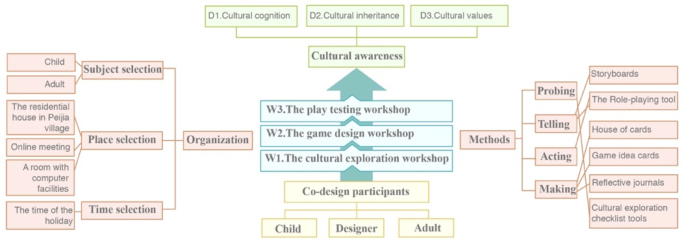
A FRAMEWORK OF PARTICIPATORY DESIGN Finally, the study summarizes a framework of participatory design. At the method level, it is divided into four forms: “probing”, “telling”, “acting” and “making”. In the “Probing” format, the cultural exploration method was provided to the participants to assist. In the “Telling” format, the study used storyboards to guide participants in presenting their prototype game designs and used the role-playing tool to facilitate their communication. In
Promoting Indigenous Cultural Awareness Through Participatory Game Design 243
Figure 3: A framework of participatory design.
the “Acting” format, we used the role-playing tool based on the culture of Peijia village to make connections between the participants and the local cul- ture. In the “Making” format, participants were asked to quickly learn how to design games and write reflective journals after experiencing games. In addition, they were assigned to brainstorm with the help of house of cards and game idea cards. The use of these tools effectively promoted cultural innovation among the subjects, motivating them to draw game content and write scenarios.
At the organizational level, “subject selection”, “place selection”, and “time selection” are all elements that the study needs to focus on. In terms of “subject selection”, children are an important group for the long-term development and sustainable transmission of culture, so the study focuses on them as the main educational target for the activities. However, this group also faces certain limitations. As Könings points out, students are not usually actively involved in the design process and their perceptions of teaching and learning determine their learning behavior. Researchers need to help them break out of the solidified patterns shaped by education and guide them to active them to participate actively. With adult guidance, children are able to participate equally in activities (Könings et al., 2014). Therefore, a com- bination of children and adults was selected for the project, with children as the main subjects. Throughout workshops, the team no longer acted as representatives of the subjects, but as facilitators of the guiding force dyna- mic. Considering that the adult subjects were teachers of the child subjects in real life, we then asked the adults to supervise and motivate the chil- dren to participate in the workshops. At the same time, the child subjects became the focus of our observations and the main output of the program. The team encouraged positive thinking among the child subjects, the adult subjects were asked to be inclusive and avoid negative comments and so on. Thus, our study was able to avoid subject skewing by the dominant view- point and can more effectively develop their cultural outreach skills more effectively. In terms of “Place selection”, the project consisted of three work- shops: a cultural exploration workshop, a game design workshop, and a play testing workshop. Natasha Blanchet Cohen and Rosemary C. Reilly used an educational approach based on a pro-environmental behavioral perspective,
244 Liu
selecting different cultural settings to expand students’ horizons in the archi- tectural design workshop (Blanchet Cohen and Reilly, 2016). Therefore, our project also chose various scenarios depending on the needs of the activity: the cultural exploration workshop was held online to reduce sample wear and tear, the game design workshop was set up in a room with computer facilities to assist subjects in designing games and the play testing workshop was selected to take place in a nearby villager’s house to stimulate the cultural perception of the subjects. In addition, in terms of “Time selection” we try to choose the time of the holiday and avoid scheduling it on the eve of the subject’s work or exam. target level: cultural awareness assessment is divided into three elements. Cultural cognition that is reach an agreement through the connotation and spiritual essence of; cultural values is the era value con- taining Chinese excellent traditional culture; Cultural inheritance, that is the innovation of cultural heritage. The study used a multimodal analysis method for analysis to achieve the goal.
ASSESSMENT Overall, the cultural cognition, cultural Inheritance, and cultural values of both the child and adult subjects increased during workshops. The adult subjects and the child subjects guided and promoted each other. The chil- dren showed strong potential in cultural transmission, which is in line with the project’s expectation that children will be the pillars of future, reflecting the original purpose of selecting child subjects. Compared to the adult subje- cts, the child grew faster than the adult subjects in cultural values, and they perceived culture more valuable. And in cultural cognition, the adult subje- cts had higher levels of cultural cognition and guided children to make them grow together.
CONCLUSION
This paper takes the rural cultural heritage of Peijia village in China as the research object, aiming to improve the local children’s cultural awareness. We select the most potential community children as the target object, adopts the participatory design method, introduces a generative toolkit to assist the subjects in cultural research and game design. Ultimately, the research conclu- des with a framework for stimulating children’s cultural awareness through a participatory game design process. This framework has certain practical significance that provide reference for rural revitalization design research and practitioners and government decision-makers.
ACKNOWLEDGMENT
This work was supported by China National Social Science Fund Art Project(17CG216).
Promoting Indigenous Cultural Awareness Through Participatory Game Design 245
REFERENCES
Blanchet-Cohen, N., & Reilly, R. C. (2017). Immigrant children promoting environmental care: enhancing learning, agency and integration through culturally- responsive environmental education. Environmental Education Research, 23(4), 553–572. Drain, A., Shekar, A., & Grigg, N. (2018). Participatory design with people with
disability in rural Cambodia: The creativity challenge. The Design Journal, 21(5), 685–706. Good, A., Sims, L., Clarke, K., & Russo, F. A. (2021). Indigenous youth reconnect with cultural identity: The evaluation of a community and school-based traditional music program. Journal of Community Psychology, 49(2), 588–604. Gennari, R., Melonio, A., Raccanello, D., Brondino, M., Dodero, G., Pasini, M., &
Torello, S. (2017). Children’s emotions and quality of products in participatory game design. International journal of human-computer studies, 101, 45–61. Kensey, M. O. C. (2018). Promoting Cultural Awareness with Reflective Writing. Nurse Educator, 43(6), 301–301. Khaled, R., & Vasalou, A. (2014). Bridging serious games and participatory
design. International Journal of Child-Computer Interaction, 2(2), 93–100. Könings, K. D., Seidel, T., & van Merriënboer, J. J. (2014). Participatory design of learning environments: integrating perspectives of students, teachers, and designers. Instructional Science, 42(1), 1–9. Lu, F., Tian, F., Jiang, Y., Cao, X., Luo, W., Li, G., ... & Wang, H. (2011, May).
ShadowStory: creative and collaborative digital storytelling inspired by cultu- ral heritage. In Proceedings of the SIGCHI Conference on Human Factors in Computing Systems (pp. 1919–1928). Malegiannaki, I., & Daradoumis, Τ. (2017). Analyzing the educational design, use and effect of spatial games for cultural heritage: A literature review. Computers & education, 108, 1–10. Malinverni, L., Mora-Guiard, J., & Pares, N. (2016). Towards methods for evalua-
ting and communicating participatory design: A multimodal approach. Internati- onal Journal of Human-Computer Studies, 94, 53–63. Pozzo, R., Filippetti, A., Paolucci, M., & Virgili, V. (2020). What does cultural innovation stand for? Dimensions, processes, outcomes of a new innovation category. Science and Public Policy, 47(3), 425–433. Rice, E. S., Haynes, E., Royce, P., & Thompson, S. C. (2016). Social media and
digital technology use among Indigenous young people in Australia: a literature review. International journal for equity in health, 15(1), 1–16. Rokhmawan, T., & Firmansyah, M. B. (2017). Cultural Literacy Development Based on Local Oralstories As the Cultural Identity Of Kebonsari Elementary School. ISLLAC: Journal of Intensive Studies on Language, Literature, Art, and Culture, 1(1), 224–238. Sbalchiero, S., & Tuzzi, A. (2016). Scientists’ spirituality in scientists’ words. Asses-
sing and enriching the results of a qualitative analysis of in-depth interviews by means of quantitative approaches. Quality & Quantity, 50(3), 1333–1348. Turgut, H., & Cantürk, E. (2015). Design workshops as a tool for informal architectural education. Open House International. Wiseman, R., Watt, C., ten Brinke, L., Porter, S., Couper, S. L., & Rankin, C. (2012).
The eyes don’t have it: Lie detection and neuro-linguistic programming. PloS one, 7(7), e40259.
LISTED IN THE AHFE DIGITAL BOOKSTORE CATALOGUE
Explore the complete digital volume
Training, Education, and Learning Sciences
Read this individual research paper free through the original publisher, or explore the full digital proceedings book.
ISBN 978-1-958651-35-3
Explore this ISBN in the AHFE Bookstore ↗Listed in the July 2026 bookstore catalogue; search by ISBN to confirm current availability · Digital book purchase optional