Martins Danusevics, Liga Braslina, Daina Šķiltere, Anda Batraga, Jelena Salkovska, Aija Legzdina, Henrijs Kalkis (2022). Comparative analyses of construction classification systems in a context of benefits, challenges and required resources. In: Social and Occupational Ergonomics. AHFE Open Access, vol. 65, pp. 15–22. https://doi.org/10.54941/ahfe1002654
The research performs a comprehensive analysis of the existing most widely used international and local construction classification system application practices, to identify the main benefits or problematic aspects of their application in the context of BIM. The research estimates the time and cost resources required to classify the standard BIM model in the three selected classification systems - Uniclass 2015, CCI and LBN 501-17, thus identifying the time and costs to be considered when classifying or reclassifying BIM models in different classifica-tion systems. The novelty and added value of the study are the empirical evi-dence obtained for scientists and policymakers on the comparative characteris-tics of classification systems and the time and cost resources required to apply them to national building digitization policies.
Implementing a digital strategy for construction for countries is an impor- tant part of planning for more productive and green economies. The link between economic growth and investment is part of many models of eco- nomic growth not only in construction area, but also in many other areas, even in education and culture (Saksonova, 2014), (Saksonova and Vilerts, 2015). The digitalisation of construction is associated with many challenges, one of the key issues being the creation of a united common classifica- tion system in which all building materials, processes and structures are classified according to a united classification structure, which is closely lin- ked to BIM - building information modelling. Without an accurate and harmonized classification, high-quality digitization of construction and the introduction of BIM at the national or regional levels is not possible. To achieve this, countries or regions should provide a common language for clas- sifying building information so that accurate data can be exchanged between stakeholders. Common classification of information ensures that all stages of the construction lifecycle, from component and class code matching to data
exchange and transmission time components, remain constant, consistent in interpretation and are not duplicated. There are currently more than 30 diffe- rent classification systems commonly used in the international construction environment, operating both locally in national systems and interacting in smaller and larger international regions. This creates a deep gap of produ- ctivity between the actors involved, especially in international construction projects.
The aim of the research is to perform a comprehensive analysis of the existing most widely used international and local construction classification system application practices and to identify the main benefits or problema- tic aspects of their application in the context of BIM. In total, more than 20 different construction classification systems were analyzed, including both international and national - Uniclass 2015 (UK), OmniClass (USA, Canada), MasterFormat (USA, Canada), UniFormat / UniFormat II (USA, Canada), CoClass (Sweden), CCS / CCI (Denmark), TALO (Finland), NS 3451 & TFM (Norway), LBN-501-17 (Latvia), CCI-EE (Estonia), Industry Foun- dation Classes (IFC), ETIM, ISO 81346-12, SfB (Sweden), CI / SfB (United Kingdom), NL / SfB (Netherlands), BB / SfB (Belgium), Building 90 (Finland), EPIC, etc.
The research estimates the time and cost resources required to classify the standard BIM model into the three selected classification systems - Uniclass 2015, CCI and LBN 501-17, thus identifying the time and costs to be consi- dered when classifying or reclassifying BIM models in different classification systems.
The research methods used include the monographic document analy- sis method, content analysis method, in-depth expert interviews, grouping method and graphical analysis method. Trimble Connect, Solibri, Bexel Manager, and SimpleBIM were used to classify the BIM model.
THEORETICAL FRAMEWORK OF CONSTRUCTION CLASSIFICATION Construction classification is the way of describing construction objects in a standardized way (Ekholm and Fridqvist, 1996). To classify means dividing a collection of objects into separate sets or classes (Ekholm and Häggström, 2011), where a class is a conceptual design that refers to a set of information objects with one or more common properties. (ISO, 2015). Classification systems are standard terminology and semantics for the construction indu- stry that can be used in a variety of aspects (Ekholm and Fridqvist, 1996). It helps to gather and arrange the available knowledge in a structured way (Dikbas and Ercoskun, 2020). In the context of BIM, the classification of construction product models in a standard way is one of the key elements (Afsari and Eastman, 2014), (Lou and Goulding, 2011). By identifying the correct classification codes for product models, they can be arranged for con- struction information or cost calculations in a construction model, as well as arranged in product databases (Liu, Gegov and Stahl, 2015), (Khan and Madden, 2014).
Comparative Analyses of Construction Classification Systems 17
Two categorization principles are used in the development of classification systems: (Ekholm and Häggström, 2011) hierarchic (direct) categoriza- tion (Ekholm and Häggström, 2011) and faceted (combined) categorization (Afsari and Eastman, 2016). In hierarchic categorization, elements are grou- ped according to their characteristics, for example, functions or construction systems, and new elements cannot be added without a formal review (Cann, 2017). A systematic organization of construction information is essential for a better understanding and efficient use of data (Saleeb, Marzouk and Atteya, 2018). Over the past fifty years, several countries and institutions have deve- loped various classification systems, such as TALO in Finland, Uniclass in the United Kingdom, CCS in Denmark and OmniClass in North America. Although all these classification systems have been developed with a pur- pose to classify building artifacts, there are significant differences between them (Jørgensen, 2011), (Caldas and Soibelman, 2003), (Lou and Goulding, 2008), (Afsari and Eastman, 2016), (Dikbas and Ercoskun, 2020). Each system has its own different way of classifying building elements (Saleeb, Marzouk and Atteya, 2018), (Ekholm and Häggström, 2011), (Lou and Goulding, 2011), (Caldas et al., 2002), (Swift et al., 2015) (Gelder, 2015) and others. Crawfords (2015) believes that while international compliance will improve cooperation between countries, a well-defined national frame- work is needed for local needs. Ekholm and Haggstrom discuss the need for translation between national classification systems in international con- struction projects and trade in products, as well as the need to develop a common system (Ekholm and Häggström, 2011). The great diversity still cre- ates cognitive dissonance and costs for industry experts in adapting the costs of different systems to industry and administration, thus further comparing the systems and comparing the costs of implementing two of the most widely used systems. Industry experts should follow events in the environment and analyze the extent, to which they affect the performance of the organization (Kalkis and Roja, 2016; Cekuls, 2016).
BENEFITS AND PROBLEMATIC ASPECTS OF CLASSIFICATION SYSTEMS Any classification system in its daily contact with real projects is most effe- ctively characterized by its taxonomy and classification principles. These criteria are most closely linked to the practical work and readiness of the business environment to implement classification in their work processes. It is therefore valuable if the classification is sufficiently detailed, easy to use, automated and easy to implement.
The study compared classification systems for a more detailed assessment using a matrix. The number of tables in the classification system, the num- ber of levels in the code, as well as the binary criteria - the link with the ISO standard and the existence of a lifecycle coverage in the classification principles were evaluated in the matrix comparison, highlighting the most important criteria previously identified in content analysis (see Table 1). If there is a need for multidimensional classification with a high development
Table 1. Construction classification systems according to classification principles (Summary of classification systems, made by the authors based on empirical research).
Table available in the original PDF paper.
Organization and taxonomy
Classification system
Classification principle Uniclass 2015 Faceted classification Division into facets alphabetically in 12 tables, each facet has a decimal scale of up to 6 digits. OmniClass Faceted classification
15 interconnected tables sorted by number and name. MasterFormat Hierarchic classification
One table with six serial numbers and names, first level with 50 divisions, each divided into second, third and fourth level. UniFormat Hierarchic classification
One table with alphabetical divisions and names in five levels. In the first level, nine categories by function, in the second level by components, in the third, fourth and fifth, by subdivision. CoClass Faceted classification
Division into five categories, division of structural elements into three tables, detail of information in three levels. CCS Faceted classification
Divided into six tables, the level of detail is provided at seven levels. CCI Faceted classification
Division into three classes and division of each class into several tables. Highly automated code system.
and further digitization possibilities, the authors recommend to choose the facet classification approach to the classification system. It is concluded that it is important that the classification system in question covers as wide and detailed a range of tables as possible, avoiding a one-dimensional classifi- cation approach that would in the long run necessitate integrating different classifications. In the national construction business environment, it is often the aim is to move to a single system.
Taking into account the evaluations of the analysis, it was concluded that the potentially most appropriate multidimensional classifications with high development and further digitization capabilities are the classification systems Uniclass 2015 and CCI, for which their adaptation and combination potential was further assessed in the context of the study. In the case of the Uniclass system, a significant advantage of selection is the widespread use of this system in the business environment, which would facilitate the transition to it, as well as the extensive number of tables.
The CCI classification system uses facet classification. If necessary, it is possible to supplement the classification system with innovations in several tables at the same time. The classification system is divided into three main categories - construction result, construction object and process. The CCI system has two significant advantages. First of all, this system is being deve- loped taking into account the latest trends in the industry and would allow to implement the most modern approach.
Comparative Analyses of Construction Classification Systems 19
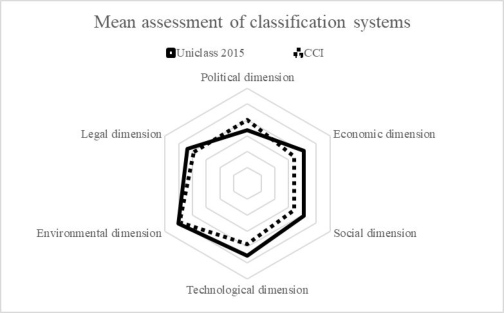
Figure 1: Mean assessment of classification systems based on PESTLE framework (Source: graph made by the authors, based on PESTLE analysis).
Based on the review of construction classification systems and the compa- rison of selected classification systems, the researchers argue that an essential precondition for the choice of construction classification systems is its poten- tial to be applied throughout the active life cycle. To assess the comparative advantages of classification systems, the researchers performed PESTLE analysis of two classification systems (see Figure 1). The systems were asses- sed based on political factors (mainly ease of control and development), economic dimension (cost of implementation and use), social dimension (potential reception in the industry), technological dimension (integration and availability of plugins), environmental dimension (life cycle) and legal dimension (documentation and use in tenders).
The best rating is for the Uniclass system, which is a clear leader in four of the six dimensions. At the same time, this system is not a leader with a major breakthrough. The highest overall score is achieved in the environ- mental dimension, although the breakthrough here is small at 5.02 points compared to 4.93 of followers. The second-best performance is in the legal dimension with 4.38 points.
CCI classification system, does not lag far behind in many positions and even has a leading position in one. In the political dimension, the CCI rating of 4.00 surpasses both Uniclass 3.38. Thus, it can be argued that if the CCI system lags slightly behind Uniclass in other positions. There is also a very small difference from the Uniclass in the environmental dimension, as the CCI also responds well to both the EU’s green course and the requirements of the circular economy, which will become increasingly important in the coming years. There are bigger differences in the economic and social dimensions. Uniclass is rated as socially superior, which can be explained by the system’s greater visibility in the industry and the technological dimension that could be associated with Uniclass being easier to use than CCI. Overall, both Uniclass and CCI perform well, and if the overall rating is in favour of Uniclass, CCI is not significantly behind.
Table 2. Time consumption evaluation for BIM model classification in manhours (Evaluation table made by the authors based on BIM model classification).
Table available in the original PDF paper.
BIM model classification stage Uniclass 2015 CCI
80 110
Assignment of classification (assignment of time element to construction parameters, terms of delivery and assembly of elements)
40 55
Creation of 4D simulation (linking 3D model elements with time graph) 5D cost model creation 40 55 Total time consumption: 160 220
Table 3. Monetary expenditure evaluation for BIM model classification in euro (Evaluation table made by the authors based on BIM model classification).
Table available in the original PDF paper.
BIM model classification stage Uniclass 2015 CCI 1,120 1,540 Assignment of classification (assignment of time element to construction parameters, terms of delivery and assembly of elements)
560 770
Creation of 4D simulation (linking 3D model elements with time graph) 5D cost model creation 560 770 Total time consumption: 2,240 3,080
THE TIME AND COST RESOURCES REQUIRED TO CLASSIFY THE STANDARD BIM MODEL Uniclass and CCI were evaluated from a time and cost dimension supplemen- ted by evaluation of Latvian national standard LBN 501-17. For this purpose, the researchers used a pre-made BIM model of an apartment house with 7 BIM model disciplines. Designers experienced in implementing BIM soluti- ons were involved to classify the apartment house project using the selected classification systems to evaluate the necessary amount of time and money.
It was determined, that the use of Uniclass 2015 classification can attribute to overall time savings of 27% compared to CCI classification system. The effect can be attributed to a more human-readable system and ease of table enumeration based on types of model attributes and classes (see Table 2).
The evaluation of monetary expenditure was based on mean compensa- tion for a specialist in the EU region - Latvia industry. Researchers used the average value of 14 euro per hour before taxes. This value can vary in diffe- rent countries; thus, a comparison should be done with currency and income adjustments in mind (see Table 3).
CONCLUSION AND DISCUSSION The study identifies the unifying components of the classification systems, different elements and development trends that may affect the ability of coun- tries to implement a common classification system, as well as identifies the
Comparative Analyses of Construction Classification Systems 21
necessary time and cost resources for different classifications of the BIM model. The novelty and added value of the study are the empirical evidence obtained for scientists and policymakers on the comparative characteristics of classification systems and the time and cost resources required to apply them to national building digitization policies. Overall results showed a bet- ter result both on financial and time scale for Uniclass classification compared to CCI. The main reasons for these differences can be attributed to the more complex classification taxonomy of CCI that is less human-readable and more appropriate for automation processes that are not topical yet.
The findings in the context of the digitalisation of construction allow policy makers to assess and compare the key features of construction clas- sification systems and to assess the time and financial resources required to implement them, or not to implement them. The results and conclusions of the study can be used at both national and regional levels, such as the Euro- pean Union, to decide on the need and modalities for establishing a common classification for construction. The criteria implemented in the comparison can be adapted on a national level, since different markets have their own peculiarities leading to different weight of assessment criteria.
ACKNOWLEDGMENT
The research has been possible thanks to the financial contribution of the Latvian national standardisation organization “Latvian Standard” and the support of the Ministry of Economics of the Republic of Latvia.
REFERENCES
Afsari, K. Eastman, C. (2014) “Categorization of building product models in BIM Content Library portals.” Afsari, K. Eastman, C.M. (2016). A Comparison of Construction Classification
Systems Used for Classifying Building Product Models. 52nd ASC Annual Inter- national Conference Proceedings. Caldas, C. H. Soibelman L. (2003) “Automating hierarchical document classification for construction management information systems.” Automation in Construction 12.4 pp. 395–406. Caldas, C. H., Soibelman L. and Han J. (2002) Automated classification of constru-
ction project documents, Journal of Computing in Civil Engineering. (October) 16 (4), pp. 234–243. Cann, J. (2017). Principles of classification. NBS-UK. Cekuls A., (2016) The concept of information sharing behaviors in complex organizations: Research in Latvian enterprises, IMCIC 2016 and 7th International Conference on Society and Information Technologies, ICSIT 2016 – Proceedings, Volume 1, pp. 66–71. Dikbas, A., Ercoskun, K. (2020) “Construction information classification: an
object oriented paradigm.” eWork and eBusiness in Architecture, Engineering and Construction. CRC Press, pp. 317–325. Ekholm, A. Fridqvist, S. (1996) “A Conceptual Framework for Classification of Construction Works.” J. Inf. Technol. Constr. 1 pp. 25–50. Ekholm, A. Häggström, L.(2011) “Building classification for BIM–Reconsidering the
framework.” CIB W78-W102 2011: International Conference. CIB.
Gelder, J. (2015) The principles of a classification system for BIM: Uniclass 2015, R.H. Crawford and A. Stephan (eds.), Living and Learning: Research for a Better Built Environment: 49th International Conference of the Architectural Science Association 2015, The Architectural Science Association and The University of Melbourne. pp. 287–297. ISO (International Organization for Standardization) (2015) ISO 12006-2 Buil-
ding construction – Organization of information about construction works – Framework for classification, ISO, Geneva Jørgensen, K. A. (2011) “Classification of Building Object Types: Misconceptions, challenges and opportunities.” Kalkis, H., Roja, Z. (2016). Strategic Model for Ergonomics Implementation in
Operations Management. Journal of Ergonomics, 6(4), 6:173 Khan, S.S. Madden, M.G. (2014) “One-class classification: taxonomy of study and review of techniques.” The Knowledge Engineering Review 29.3 pp. 345–374. Liu, H., Gegov,A., Stahl, F.(2015). “Unified framework for construction of rule based
classification systems.” Information Granularity, Big Data, and Computational Intelligence. Springer, Cham, pp. 209–230. Lou, E.C.W. and Goulding, J.S. (2008). Building and Construction Classification Systems. Architectural Engineering and Design Management, 4(3-4), pp. 206–220. Lou, E.C.W. Goulding, J.S. (2011). Building and Construction Classification Systems.
Architectural Engineering and Design Management, 4(3-4), pp. 206–220. Saksonova, S. (2014). Foreign Direct Investment Attraction in the Baltic States.
Verslas: teorija ir praktika, 15(2), pp. 114–120. Saksonova, S. and Vilerts, K. (2015). Measuring Returns to Education: The Case of Latvia. Annals of the Alexandru Ioan Cuza University - Economics, 62(2), pp. 252–262. Saleeb, N., Marzouk, M. and Atteya, U. (2018). A comparative suitability study
between classification systems for BIM in heritage. International Journal of Sustainable Development and Planning, 13(01), pp. 130–138. Saleeb, N., Marzouk, M. Atteya, U. (2018). A comparative suitability study between classification systems for BIM in heritage. International Journal of Sustainable Development and Planning, 13(01), pp. 130–138. Swift, J., Ness, D., Chileshe, N., Xing, K. and Gelder, J. (2015) Enabling the reuse of
building components: A dialogue between the virtual and physical worlds, Unma- king Waste 2015 conference proceedings. Adelaide, SA: Zero Waste SA Research Centre for Sustainable Design and Behaviour pp. 252–260.
LISTED IN THE AHFE DIGITAL BOOKSTORE CATALOGUE
Explore the complete digital volume
Social and Occupational Ergonomics
Read this individual research paper free through the original publisher, or explore the full digital proceedings book.
ISBN 978-1-958651-41-4
Explore this ISBN in the AHFE Bookstore ↗Listed in the July 2026 bookstore catalogue; search by ISBN to confirm current availability · Digital book purchase optional