Zeyu He (2022). Status Quo and Strategies of Prefabricated Buildings in the Context of Carbon Neutrality and Carbon Peaking. In: Applied Human Factors Research. AHFE Open Access, vol. 67, pp. 389–395. https://doi.org/10.54941/ahfe1002701
Carbon peaking and carbon neutrality are among the most important arenas for sustainable design and increasingly attract broader interest from both countries and companies. Prefabricated buildings are typical approaches to building houses by assembling modules prefabricated in plant. However, the broken industrial chain in this field leads to problems in the poor cooperation and management built in the design process. Strategies and methods for engaging every part in this field more deeply in co-creation are needed to address these issues. Following systematic review of case study and policies from governments, we explored the efficient design strategies with the goal of building a more sustainable prefabrication industry in China to meet the requirements of carbon peaking and carbon neutrality. The results from the case study are meaningful and generic, with clear indicators of sustainability. The lessons learnt and approaches discussed in this paper provide a starting point for decreasing companies' carbon emission with prefabrication.
China has long attached importance to addressing the challenge of climate change and promoted energy conservation and emission reduction. In 1998, China signed the Kyoto Protocol, which is the first protocol to limit carbon emissions in the form of regulations. In 2009, China made a commitment at the Copenhagen conference that compared with 2005, the carbon dioxide emissions per unit of GDP will be reduced by 40% to 45% by 2020, and the commitment was realized three years ahead of schedule. In September 2020, China announced at the United Nations climate conference that China’s car- bon dioxide emissions would reach a peak in 2030 and strive to achieve carbon neutrality in 2060. Subsequently, each province has successively star- ted to prepare corresponding “carbon peaking” and “carbon neutralization” plans (Hu, 2021).
The field of building plays an important role in greenhouse gas emission every year. Domestically, there are 16 billion square meters newly constructed buildings annually, over one third of which are high energy consumption buildings. More than half of domestic greenhouse gas emissions come from
the construction industry. That means this industry accounts for 5 billion tons carbon dioxide emissions every year (Li, 2021).
Prefabrication is regarded as a promising way to cut down costs, shorten construction period, and reduce resource consumption and environmental impacts in building industry. Prefabrication is different from traditional buil- ding. Prefabricated building is a innovative way to construct buildings, by which components, elements, panels or modules are manufactured in the plant and then assembled on the final house location (Tavares et al., 2019). Besides, from the perspective of LCR, prefab can be available much lon- ger than conventional buildings. Moreover, at the end of life, prefab can be recycled. However, conventional buildings have to be demolished.
Lots of researches and papers demonstrate that prefab is much greener than traditional buildings. For example, according to the experiment by Tava- res et al., the embodied impact of prefab is 1000 mega joule per square meter lower than the traditional ones. And the carbon emission is around 170-kilogram carbon dioxide eq per square meter lower (Tavares et al., 2019). Mao et al. found in their experiment that the semi-prefabrication method produces less GHG emissions per square meter compared with the conventional construction, with the former producing 336kg/m2 and the lat- ter generating 368kg/m2 (Mao et al., 2013). Prefabricated buildings can be divided into different degrees from low to high: component manufacture and sub-assembly, non-volumetric preassembly, volumetric pre-assembly and modular building (Kamali and Hewage, 2016). The more completed the pre- fabrication, the less the use of materials, energy and greenhouse gas (GHG) emissions (Tavares et al., 2019, Pons and Wadel, 2011, Mao et al., 2013, Hong et al., 2016).
STATUS QUO IN CHINA China did not start prefab industry in a very late time. The first prefab in China is Beijing Minzu Hotel in 1959. The whole duration of the construction is only 10 months. After that, China stepped into a slow development period during the midterm mainly due to underdeveloped technologies and cheap labor. However, when entering the 21st century, China rekindled the industry with positive policies and grand currency. Prefab industry is developing at a rather fast speed now.
More and more companies come in this field. In the ten years since 2011, the registration of prefabricated construction enterprises has increased year by year. According to the enterprise survey data, 143 enterprises were newly registered in 2011. Starting from 2016, the industry entered a period of rapid growth. In 2019, the number of registered enterprises reached the highest 3594 in the past decade, an increase of 59% year-on-year. Geographically speaking, from September 2020 on, up to 30 cities are chartered as pilots for prefabricated buildings, much more than at the beginning.
According to the data of 2020 from Ministry of Housing and Urban-Rural Development of the People’s Republic of China (MOHURD), there are 0.63 billion square meter newly built prefab in 2020. It accounts for about 20.5% of the new building area, 50% more than 2019. The ratio in Shanghai is
Status Quo and Strategies of Prefabricated Buildings 391
the highest - 90%. The aim of 2026 is to reach 30% domestically. Accor- dingly, the carbon emission has been lowered down at a pretty large scale, around 10% - 30%, ranging according to the location, size and the level of prefabrication.
The results are promising. However, there is a deep gap compared with developed countries. Among them, U.S. has the most completed system with prefab ratio of 90%, and Sweden, as another example, 80% (Navaratnam et al., 2019).
PROBLEMS Problems in development period are intricate. According to the research of Qi et al., policies, cheap labor and high costs caused by underdeveloped technologies are to blame. Moreover, the problem of standardization, indivi- dualization and broken industrial chain are also the main reasons for the gap (Qi, 2015).
Among them, broken industrial chain is the most crucial one. There are many links during the whole life of a prefab – concept design, schematic design, design management, construction documentation, construction bid- ding, construction administration, construction and asset management etc. However, the whole chain in China is fragmented. The typical state in China is that companies have specific major fields, while do not cooperate very well. Especially, top enterprises do not perform well in taking the responsibility of overall coordination and management.
Take some typical companies in China for example. In the upstream, Board is the leading company, which is very famous for its Holon project. Its stainless-steel wall is a kind of very sustainable modules. In the mid- stream, Hangxiao Steel Structure focuses on the assemblage. Vanke in the downstream is a mega distributor in China, knowing how to get the market share in estate, though lacks experience on research and development. The companies have their own advantages, but need to expand their business or cooperate more in the future to help form a systematical industrial chain.
METHODS
The problems China faces today have also puzzled developed countries for many years. They changed this situation by building a complete and indepen- dent industrial chain in this field. Katerra, Inspace, Blokable and Lindbacks are leading corporations in this field. Their effort helps both themselves and their customers to reach their carbon emission goals. For example, Inspace, the subsidiary of the world top 500 Saint - Gobain, focusing on prefab is helping Starbucks build their greener coffee stores. They use leading, energy- efficient technologies to reduce energy consumption by 25% compared to prior store designs.
Case Study Lindbacks is the top Swedish prefab company. According to their sustaina- ble development report, using their prefab can help lower carbon emission
392 He
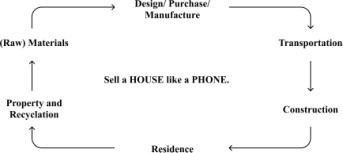
by 50%. In China, the best figure now is 30%, according to Investment estimation index of prefabricated construction engineering (Exposure Draft) from MOHURD. It is very hard for a top company to improve its performa- nce. However, Lindbacks did well in 2021. Here are some important figures from it. Last year, it reduced 337-ton greenhouse gas emission in the depar- tment of transportation, and 7-ton CO2eq by collecting IT waste. The rate of classification and recycling of waste both on site and in plant were very high. Meanwhile, the solar power cell in its plant in Haraholmen genera- ted 775,586 kWh electricity last year, meeting 34% electricity need of the company. 360-ton waste was reduced in its factories in 2021 compared with 2020. According to Lindbacks Sustainable Development Report 2021, its busi- ness and value chain (Figure 1) is a perfect loop from material access and design to property and recyclation. It can flow in just one company, also it welcomes co performance. They want to sell a house like a phone, treating a house as a product.
Figure 1: Value chain of lindbacks (Adapted from Lindbacks Sustainable Development Report, 2021).
Starting the loop from the materials, Lindbacks uses the most sustainable material - timber. According to the research of Tavares et al., compared with concrete and steel, timber prefab’s embodied impact and GHG emission is much lower (Tavares et al., 2019). What’s more, Lindback’s share of Swedish wood raw materials does not exceed 0.07%. 2 or 3 trees are planted for every tree cut down. Besides, it makes contribution to biodiversity through the hives of the Haraholmen factory – 60,000 bees pollinate the vegetation in the area.
During the process of manufacturing, Lindbacks invests in the most adva- nced solar cell, to meet 34% of the power demand of the plant. It also invests much money in upgrading its technologies to improve the efficiency.
Transportation is also a major climate culprit in this industry. Proximity to ports and railways enables Lindbacks to transport materials and goods by ship and train. To avoid empty-backhaul transportation, it transports materi- als to their factories or their other industries with the same vehicle. Moreover, it regularly runs its own trucks for transportation to understand the transpor- tation challenges, improve logistics and cooperate better with transportation companies.
Not only does it build, but it also sells and rents its houses. Besides, its Sati- sfied Tenant Index, Loyal Tenant Index and total occupancy rate are much
Status Quo and Strategies of Prefabricated Buildings 393
higher than the average in Sweden. More than this, Lindbacks works syste- matically to understand the user phase of the property life cycle and how it can digitally track and reduce the climate footprint of energy consumption in its property.
DISCUSSION
Linbacks performance is impressive. But transplanting its mode to China without adaptation is unfeasible because of many differences between the two countries.
First of all, since the phase of development is different, Swedish prefabri- cation companies at a higher level will set a higher goal, which would be too radical if imposed on Chinese enterprises. A mature industrial chain needs long-term investment and a stable foundation.
Secondly, the cost of labor between China and Sweden is extremely huge. At present, the on-site labor cost in the domestic construction market is still relatively low. The prefabricated building structure system save little on the labor cost of the project. Compared with the traditional cast-in- place structure system, it does not have an advantage in the comprehensive cost. Hence, cultivating well-educated talents and developing high-tech to improve the production efficiency in the industry and reduce the compreh- ensive cost will become the focus of the prefabricated construction industry in the future. Solutions to keep a lower cost through the industrial chain is indispensable.
Thirdly, the scale of population is different between Sweden and China, which requires Chinese companies focus on research and development on high-rise buildings. So far, China is still the most populous country in the world, with over 1.4 billion people. To make prefabricated building bene- fit the whole country, different building maneuver from Sweden should be adopted. In Sweden, thanks to their less population, nearly everybody could live in an individual house or a villa. Hence, personalized customization is also relatively easy for them. In China, however, the situation is different. Many people are still pouring into cities, and they have to live in high-rise residence. Therefore, enterprises in China should focus on the research & development of technologies related to high-rise building prefabrication and its individualized and prefabricated decoration to form a complete industrial chain.
Fourthly, based on the same reason stated above and considering Chinese vast territory, research and development in the field of material - the first and important link in the industrial chain - becomes very significant. On the one hand, although timber is a very sustainable material, high-rise buildings urgently need another kind of material to ensure the stability of the structure. Board has been investing in this field for many years. Its investigation in light steel frame for high-rise building makes it the top and leading corporation in this field. On the other, the significant climate difference between the North and the South requires China’s prefabricated construction industry to cho- ose materials that are more tolerant to the climate as raw materials other
394 He
than timber. In this regard, there is a failed case that can be used for refere- nce. Katerra was a promising start-up in prefabrication in the U.S. Katerra claims that it can connect the upstream, middle and downstream of the entire industrial chain to provide customers with systematic and full life-cycle pre- fabricated building solutions. The business model is so impeccable that in the five years since its establishment, it obtained a total of 2 billion dollars of financing from well-known funds such as Softbank and Khosla ventures, with a valuation of 3 billion dollars which makes it a rare unicorn in the dif- ficult field of construction technology. It chose the same material – timber – as Lindbacks. However, unlike the legend story of Lindbacks, this is the rea- son why Katerra got bankrupted. In a construction project, Katerra lumbered from Washington state, transported it by road to the plant in Phoenix for pro- cessing, and then transported it back to the construction site in Washington state. Due to the great difference in temperature and humidity between the two places, all the wooden wallboards delivered to the project site were bent and deformed and could not be used. While the weather in different places of Sweden is quite similar, Swedish companies will not have to worry about this problem.
Finally, the inequality between urban and rural is noteworthy, though it is not the case in Sweden. Chinese style development always shows obvious urban-rural gap and imbalance. From September 2020 on, up to 30 cities are chartered as pilots for prefabricated buildings. However, most of them are coastal cities in Southern or Eastern China. Whereas, we have to admit that in Chinese rural areas, prefabricated buildings have great potential(Wang, 2021). Since a mature industrial chain should cover the whole country, how to build a distributed industry, overcome the transportation problems caused by vast territory, and enable rural areas to enjoy the dividends of prefabri- cated buildings is the next topic that prefabricated construction companies should consider.
CONCLUSION
Carbon peaking and carbon neutrality are very important links in China’s sustainable development strategy. In the construction industry, prefabrica- tion is regarded as a promising way to cut down costs, shorten construction period, save resource consumption and lower environmental impacts in buil- ding industry. This paper analyzes the status quo of prefabricated buildings in China and finds the problem of a broken industrial chain. After a case study of a top company – Lindbacks - in Sweden, combined with analy- sis of characteristics of China’s development, this paper puts forward some strategic suggestions for the formation of a complete industrial chain in the future. They include setting reasonable goal, controlling the compreh- ensive cost, focusing on high-rise residence, choosing sustainable material, and promoting balanced urban and rural development. It could help prefa- brication companies, especially top ones, make their sustainable strategies. This will also make China a more responsible and sustainable power in the future.
Status Quo and Strategies of Prefabricated Buildings 395
REFERENCES
Hong, J., Shen, G. Q., Mao, C., Li, Z. & Li, K. 2016. Life-cycle energy analysis of prefabricated building components: an input–output-based hybrid model. Journal of Cleaner Production, 112, 2198–2207. Hu, A. 2021. China’s Goal of Achieving Carbon Peak by 2030 and Its Main Appro-
aches. Journal of Bejing University of Technology ( Social Sciences Edition), 21, 1–15. Kamali, M. & Hewage, K. 2016. Life cycle performance of modular buildings: A critical review. Renewable and Sustainable Energy Reviews, 62, 1171–1183. Li, Z. L., Jinshuo 2021. Research on the Development and Countermeasures of Green
Building under the Goal of “Carbon Peak and Carbon Neutrality”. SOUTHWEST FINANCE, 55–66. Mao, C., Shen, Q., Shen, L. & Tang, L. 2013. Comparative study of greenhouse gas emissions between off-site prefabrication and conventional construction methods: Two case studies of residential projects. Energy and Buildings, 66, 165–176. Navaratnam, S., Ngo, T., Gunawardena, T. & Henderson, D. 2019. Performa-
nce Review of Prefabricated Building Systems and Future Research in Australia. Buildings, 9. Pons, O. & Wadel, G. 2011. Environmental impacts of prefabricated school buildings in Catalonia. Habitat International, 35, 553–563. Qi, B. Z., Yang 2015. Prefabricated Construction Development Bottleneck and
Countermeasures Research. Journal of Shenyang Jianzhu University (Social Sci- ence), 17, 156–159. Tavares, V., Lacerda, N. & Freire, F. 2019. Embodied energy and greenhouse gas emissions analysis of a prefabricated modular house: The “Moby” case study. Journal of Cleaner Production, 212, 1044–1053. Wang, W. 2021. Discussion on the application of prefabricated architecture in rural
construction. New Agriculture, 32–33.
LISTED IN THE AHFE DIGITAL BOOKSTORE CATALOGUE
Explore the complete digital volume
Applied Human Factors Research
Read this individual research paper free through the original publisher, or explore the full digital proceedings book.
ISBN 978-1-958651-43-8
Explore this ISBN in the AHFE Bookstore ↗Listed in the July 2026 bookstore catalogue; search by ISBN to confirm current availability · Digital book purchase optional