Chaomin Ma, Duzhi Yang (2022). A Bibliometric and Visual Analysis of Interactive Distance Perception. In: Applied Human Factors Research. AHFE Open Access, vol. 67, pp. 554–561. https://doi.org/10.54941/ahfe1002699
The issue of distance and spatial cognitive differences on the process of interacting behavior is of increasing interest and involves multiple fields of inquiry. However, there is a lack of bibliometrics and literature reviews on this topic to systematically evaluate the current state of research. This study synthesizes previous research on the interactive distance perception and its related influencing factors, and summarizes it by clustering and trending the relevant research literature through bibliometrics. The conclusions show that the overall number of literatures within the search area is on the rise, and the research directions are gradually refined, with the research hotspots mainly focusing on social distance, risk perception, mental health, and influence factors and life. Relying on the theoretical system based on distance perception and interaction behavior model, the application of virtual or augmented reality interaction distance perception and virtual social life scenarios becomes a new trend for future research development.
Distance perception is an interaction research content and concept that star- ted to emerge in the late 1970s and now forms a broad research system in various disciplines in the academia. J. Gibson first proposed the principles and logical composition of visual perception and the theory of affordance in The Ecological Approach to Visual Perception in 1979 embodiment and application of lower distance perception in interactive behavior. It provi- ded the theoretical basis for subsequent research. With the popularization and development of technologies such as virtual reality and augmented rea- lity, the research on the interaction paradigm of user interfaces has become more and more diversified, and the research related to the physiological response and psychological acceptance during the interaction behavior is also being carried out (the interaction behavior here can include human-human interaction, interaction with robots, interaction with interfaces and virtual interaction, etc.).
Distance perception refers to a process in which an observer perceives an interval between two points in space, but perception of a straight-line distance has been most extensively studied (Naohide, 2017). It can be seen that there are many factors affecting distance perception, and distance perception and feedback from the human eye to objects or the environment in interactive
A Bibliometric and Visual Analysis of Interactive Distance Perception 555 scenarios occurs all the time. In real, human-to-human social interactions, physical distance is a prominent feature. The physical spatial distance of an interaction object determines the type of interaction, and similarly, the intera- ction distance can largely influence the emotional response during the object interaction. In order to explore the current situation, hotspots and trends of interaction distance perception research more comprehensively, this study uses the Web of Science (WOS) database as the main data source, CiteSpace and VOSviewer as the main tools, visualizes the knowledge structure of exi- sting relevant literature based on bibliometrics, clusters the research topics, and discusses the important research. We also discuss the important research arguments and their trends and shortcomings, and provide an overview of the overall research direction for scholars in related fields.
RESEARCH DESIGN The following study chose to search the Web of Science core database with the search terms “interaction” and “distance perception”. The five major citation indexes of the WOS core collection databases, SSCI, SCI-Expanded, A&HCI, CPCI-S, and CPCI-SSH, were selected as the search sources. In order to collect all relevant articles, the search time span was set to the full year (i.e., from 1900 to June 2022). A total of 1666 articles were obtai- ned by exporting the literature and eliminating interfering articles, and by using scientific bibliometric methods and knowledge structure visualization, VOSviewer and CiteSpace were used to obtain more comprehensive data. And further quantitative analysis.
BIBLIOMETRIC RESULTS AND ANALYSIS Basic Features of Interaction Distance Perception Research
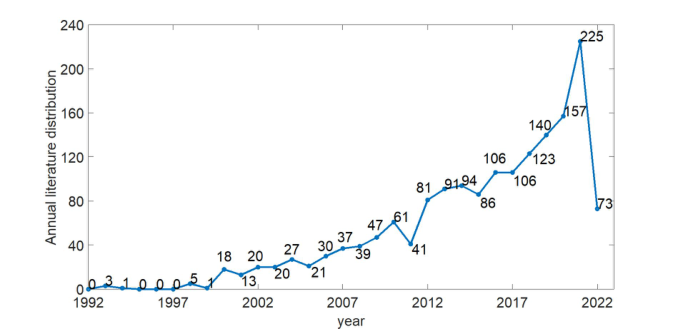
According to all relevant literature extracted by WOS, the first article in the search scope was published in 1993, and the overall number of publications has been on the rise since 1993 - 2022, reaching a peak in 2021 with 225 annual publications, which shows that the research topic of interactive dista- nce perception is receiving increasing academic It is a cross-cutting topic. Interaction distance perception is a cross-cutting topic that involves multi- disciplinary knowledge. According to the statistical analysis of disciplines, the top five disciplines and types of publications are Neurosciences (204 publi- cations), Education Educational Research (192 publications), Psychology (191 publications), Computer Science Artificial Intelligence, and Engineering Electrical Electronic. Neurosciences, Educational Research, and Psychology accounted for 12.2%, 11.5%, and 11.4 of the total 1666 articles, respectively. These research topics are important research areas for interactive distance perception, and are also the main research hotspots in recent years, provi- ding a good theoretical basis and research direction for interactive distance perception research.
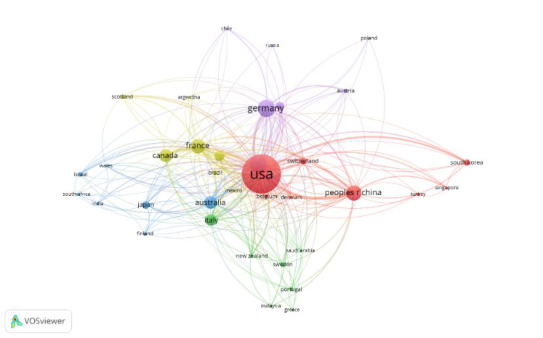
Distribution of Literature in Countries and Research Institutions In terms of country/region output, 90 countries have conducted research on this topic, of which 38 countries have more than 10 publications. The United
556 Ma and Yang
Figure 1: Annual literature distribution statistics.Figure 2: Cooperation and co-occurrence of countries/regions.
States, the United Kingdom, Germany, China, and France are each in the top five for the topic of interaction distance research and are important sources of output for interaction distance research worldwide. The US has 531 publi- cations, the UK 170, Germany 166, China 139, and France 128. The top five countries in terms of number of publications are all cited more than 2000 times. From the point of view of literature output time, the research time of the United States, Britain and France is earlier, and the research is more for the theoretical basis and method of the research system of interactive perce- ption distance, while the research time of China and Germany is later, and more for the analysis and research content of new trends and recent hot spots.
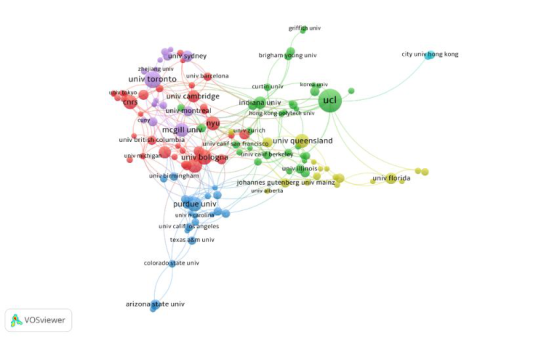
In global countries, 1818 research institutions have conducted research on the topic of “interaction distance perception” during 1993–2022. The node threshold for the number of publications was set to 5, resulting in a collaborative network of 141 academic institutions.
Within the search, UCL (25 articles), University of Toronto (17 articles), University of Bologna (15 articles), University of Utrecht (15 articles), and
A Bibliometric and Visual Analysis of Interactive Distance Perception 557
Figure 3: Cooperation and co-occurrence of institutions.
Purdue University (15 articles) are the most influential and most published institutions. The top five academic institutions in terms of influence and number of articles published.
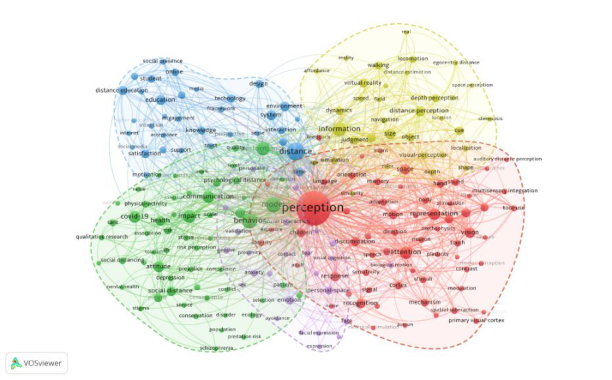
Research Hotspot Clustering and Analysis The 1666 documents within the search range contained 8926 keywords. VOSviewer was used to select all keywords co-occurrence, and the minimum threshold of keyword co-occurrence frequency was set to 10, and the co- occurrence clusters formed by 215 keywords were obtained after screening and merging synonyms, as shown in Figure 4. keywords with the same color in the figure are the same clusters, and 5 main clusters were formed. From the analysis results, the five clusters and their main contents can be summarized as #1 Influence factors of perception, #2 Interaction behavior, #3 Distance perception of multiple scenes, #4 Information perception differences and #5 Psychological perception and social relations.
Cluster #1 - The influence factor of perception contains 65 cluster mem- bers, mainly containing peripersonal space, spatial interaction, multisensory integration, auditory perception, motion, psychophysics, representation, attention, vision and other keywords. The current research on the influence factors of distance and spatial perception is mainly reflected in multisen- sory perceptual differences, physiological states, etc. Many literatures take the possible role and influence of body parts in interactive behaviors as an important factor in studying distance perception from the level of sen- sory perception. Some scholars have defined peripersonal space (PPS) as a low-level multisensory-motor interface mediating hand-object interaction (Pellencin et al., 2018). However, it has also been shown that the perfor- mance of PPS can be influenced by multilevel cognitive factors. It is evident that an individual’s interaction distance and spatial perception are influe- nced by multiple factors, and that different distances and interaction objects can and do affect the multisensory representation of space between oneself and others.
Cluster #2 - Interaction behavior contains 57 cluster members, mainly including behavior, impact, COVID-19, physical-activity, psychological distance, social distance, and life, service and other keywords. This refle- cts the interaction behavior of and the influence of the environment. For example, when users change their self-representation in the interaction beh- avior of the virtual environment, their self-representation will in turn affect the user behavior to some extent (Yee et al., 2007). Related to the proteus effect, this change is due to the individual’s knowledge of the behaviors typi- cally associated with these characteristics by other users belonging to that virtual environment. Likewise, research on COVID-19 related interaction distance has been important in recent years. In particular, perceived behavio- ral control and attitude were important predictors of intention and behavior (Cavicchiolo et al., 2021).
Cluster #3 - Distance perception of multiple scenes contains 34 cluster members, mainly including human-computer interaction, design, computer- mediated communication, distance education, social media and other keyw- ords. Research spanning psychology, neuroscience and HCI found that depth perception distortion is a common problem in virtual reality. this distortion results in depth compression, where users perceive objects closer than their intended distance (Makin et al., 2019). For the distance of interaction in distance education scenarios and virtual reality scenarios, more immersive and secure user experience design and research are needed.
Cluster #4 - Information perception differences contains 34 cluster mem- bers, mainly including distance perception, egocentric distance, space perce- ption, stereopsis, virtual reality, and visual perception, depth perception, affordance and other keywords. This clustering indicates that scenarios about interaction distance perception focus on virtual reality interaction scena- rios, shifting from the flat information perception paradigm of physical interaction/Internet to three-dimensional information perception, as well as, interaction in virtual scenarios has limitations for stimulus simulation of dif- ferent senses, and asynchronous and differentiated information reception is
A Bibliometric and Visual Analysis of Interactive Distance Perception 559
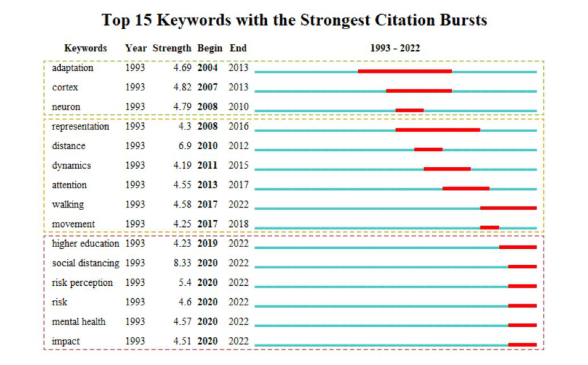
Figure 5: The keyword burst of interactive distance perception.
a major obstacle. There are many interfaces and interaction paradigms that need to be rethought and redefined.
Cluster #5 - Psychological perception and social relations contains 26 clu- ster members, mainly including personal-space, interpersonal distance, social cognition, human-robot interaction, and accuracy, emotion, anxiety, and other keywords. The clusters mainly emphasize the cognitive and interactive states of users at the psychological level, and study the changes of emotio- nal states and interactive feedback caused by different variables. Similarly, psychological factors are important for the perception of the social environ- ment. For example, it has been argued in the literature that accurate control of interpersonal distance in social environments is an important determinant of effective social interactions (Alice et al., 2018). The interpersonal distance is not only the distance in physical space, but also the distance determined by a combination of psychological and social factors such as the role orientation and social relationship perception of the person with whom the interaction takes place. The threshold of interaction distance that users can accept for different role definitions is very different.
Keyword Burst Term and Research Trends In order to further corroborate and explore the frontier development trend of interactive distance perception, CiteSpace’s burst term mapping is synth- esized in the study, as shown in Figure 5. Figure 5 lists the keywords with top15 emergent strength, and the information in the figure shows the main research years of the keywords in more detail. It shows the research keyword trends from 2004 as the starting point to 2022. The research hotspots are divided into 3 intervals according to the time order, and from the keyword evolution of the 3 intervals, the research content shows a trend of change from physiological information to motion logic under physical interaction to virtual interaction and psychological cognition. In particular, the distance of
560 Ma and Yang
social and educational scenes, risk prediction and mental health have become the new frontier of interaction distance perception research.
CONCLUSION
The overall trend of interaction distance perception in the output of time- series papers is on the rise and growing very rapidly, which shows that this research topic is very popular in recent years. The keyword clustering analy- sis shows that the research on distance perception of interaction focuses on human-centered perception and experience. 5 clusters including #1 Influe- nce factors of perception, #2 Interaction behavior, #3 Distance perception of multiple scenes, #4 Information perception differences and #5 Psych- ological perception and social relations together form the hot areas and topics of this research, covering both the basic perception theory and explai- ning the interaction patterns in new future scenes. Also, interaction distance perception gradually focuses the topic on virtual interaction in the context of VR and AR, to generate new thoughts on virtual interaction based on metaverse.
REFERENCES
Bönsch, A., Radke, S., Overath, H., Asché, L.M., Wendt, J., Vierjahn, T., Habel, U.
and Kuhlen, T.W., 2018, March. Social VR: How personal space is affected by virtual agents’ emotions. In 2018 IEEE Conference on Virtual Reality and 3D User Interfaces (VR) (pp. 199-206). IEEE. Belkaid, M., Kompatsiari, K., De Tommaso, D., Zablith, I. and Wykowska, A., 2021. Mutual gaze with a robot affects human neural activity and delays decision-making processes. Science Robotics, 6(58), p.eabc5044. Cartaud, A., Ruggiero, G., Ott, L., Iachini, T. and Coello, Y., 2018. Physiologi-
cal response to facial expressions in peripersonal space determines interpersonal distance in a social interaction context. Frontiers in psychology, 9, p.657. Cavicchiolo, E., Manganelli, S., Girelli, L., Cozzolino, M., Lucidi, F. and Alivernini, F., 2021. Adolescents at a distance: The importance of socio-cognitive factors in preventive behavior during the COVID-19 pandemic. European Journal of Health Psychology, 28(4), p. 161. Choudhary, Z., Gottsacker, M., Kim, K., Schubert, R., Stefanucci, J., Bruder, G. and
Welch, G.F., 2021, March. Revisiting distance perception with scaled embodied cues in social virtual reality. In 2021 IEEE Virtual Reality and 3D User Interfaces (VR) (pp. 788–797). IEEE. Makin, L., Barnaby, G. and Roudaut, A., 2019, December. Tactile and kinesthetic feedbacks improve distance perception in virtual reality. In Proceedings of the 31st Conference on l’Interaction Homme-Machine (pp. 1–9). Pellencin, E., Paladino, M.P., Herbelin, B. and Serino, A., 2018. Social perce-
ption of others shapes one’s own multisensory peripersonal space. Cortex, 104, pp. 163–179. Plumert, J.M., Kearney, J.K., Cremer, J.F. and Recker, K., 2005. Distance perception in real and virtual environments. ACM Transactions on Applied Perception (TAP), 2(3), pp. 216–233. Shao, M., Yin, J., Ji, H., Yang, Y. and Song, F., 2020. Distance perception war-
ped by social relations: Social interaction information compresses distance. Acta Psychologica, 202, p.102948.
A Bibliometric and Visual Analysis of Interactive Distance Perception 561
Wilcox, L.M., Allison, R.S., Elfassy, S. and Grelik, C., 2006. Personal space in virtual reality. ACM Transactions on Applied Perception (TAP), 3(4), pp. 412–428. Yamamoto, N., 2017. Distance perception. Encyclopedia of clinical neuropsychology
[2nd edition], pp. 1–5. Yang, U., Kim, N.G. and Kim, K.H., 2018, July. Egocentric distance perception control for direct manipulation interaction on hmd platform. In International Conference on Human-Computer Interaction (pp. 137–142). Springer, Cham. Yee, N. and Bailenson, J., 2007. The Proteus effect: The effect of transformed self-
representation on behavior. Human communication research, 33(3), pp. 271–290.
LISTED IN THE AHFE DIGITAL BOOKSTORE CATALOGUE
Explore the complete digital volume
Applied Human Factors Research
Read this individual research paper free through the original publisher, or explore the full digital proceedings book.
ISBN 978-1-958651-43-8
Explore this ISBN in the AHFE Bookstore ↗Listed in the July 2026 bookstore catalogue; search by ISBN to confirm current availability · Digital book purchase optional