Haoyu Jiao, Jianrun Zhang (2023). Evaluation Method of TV Wall Layout Design. In: Intelligent Human Systems Integration (IHSI 2023): Integrating People and Intelligent Systems. AHFE Open Access, vol. 69, pp. 742–754. https://doi.org/10.54941/ahfe1002897
This paper proposes the design priority of the aesthetic elements of the TV wall layout through the analysis of concepts of Aesthetics calculation. Firstly, this paper selected 9 representative TV wall layout design samples and simplified 7 main indicators among indicators proposed by Ngo through interviews. Then, the calculation result matrix of the beauty index is calculated by Matlab, and then the subjective evaluation method is used to obtain the weight of each beauty index of the subjective evaluation method. Then, combined with the entropy method, the result is obtained in the mathematical calculation. According to the subjective evaluation method, the weights were artificially revised, and finally the weights of the seven aesthetics indicators for the layout design of the TV wall were obtained, and the priorities of the aesthetic development were sorted. Finally, verified the reliability of the mathematical modeling results through the establishment of a five-point Likert scale method. This paper establishes the design priority of the elements of TV walls layout and provides some design guidance for TV walls.
Human-machine interface layout design is to achieve effective information exchange through the reasonable layout of interface elements. Therefore, the quality of interface design not only affects the user’s visual sense, but also has a great impact on work performance (Maquet, 1989). With the deve- lopment of the times, perceptual engineering has been integrated into the traditional human-machine interface, which has attracted the attention of many scholars, and has verified the interrelation and mutual influence betw- een perceptual and rational through a series of scientific research(Arnheim, 1969). The concept of “beauty” has also become an important part of inter- face research, which has a profound impact on the efficiency of information transmission and the decision-making and cognition of users. Many research methods have proved that “beauty” is also useful (Dondis, 1974).
With the continuous development of the times, designers can’t just consider the realization of functions based on the user’s personal abilities and other factors. Designers should also pay attention to the aesthetics of the product (Tullis, 1988).
In the scientific research of Aesthetic measures, there are two main meth- ods: one is a subjective investigation method, and the other is a quantitative
numerical calculation analysis, that is, Aesthetic calculation. Ngo et al. pro- posed 13 metrics for calculating beauty on the basis of Tullis et al. Later, the calculation model was applied to 57 book sense input interfaces of different beauty. The results of the test showed that balance, overall, and Continuity is the index with the highest contribution (Ngo et al. 2003). In addition, Mich- ael Bauerly, Simon Lok, Balinsky, Kang, Zhou Lei, Yuan Peisa, etc. have all put forward great progress in aesthetic evaluation methods.
The arrangement of interface elements is generally achieved through the designer’s subjective aesthetics to achieve a higher degree of beauty. This method is not completely objective, and needs to be discussed and modi- fied for many times, and it is unstable for the aesthetics that can meet market needs Therefore, it will produce a series of design problems that cannot meet the needs of users (Bauerly and Liu, 2006).
Quantified Index of Interface Element Layout Evaluation This article starts with the interface beauty of the TV wall in the living room, and selects 7 of the 14 indicators proposed by Ngo as the factors in the evalu- ation system-balance (BM), Symmetry (SYM), Unity (UM), Proportion (PM), Simplicity (SMM), Density (DM), Rhythm (RHM) are quantified as evalu- ation indicators, and the entropy method and subjective evaluation method are combined to calculate the comprehensive beauty of the TV wall. The rela- tionship of formula, quantitatively evaluate the existing TV wall layout, and optimize the design based on this. (1) Balance Balance refers to the visual balance of the overall arrangement of the elements in the
wL−wR max(|wL|,|wR|)
Equations and mathematical formulas are available in the original paper PDF.
wT−wB max(|wT|,|wB|)
interface to the user’s perception. The visual imbalance is avoided by calcu- lating the difference between the total weight of the elements on both sides of the horizontal and vertical symmetry axis(Bauerly and Liu, 2006).
L, R, T and B respectively represent the left, right, upper and lower areas of the interface; aij represents the area of the element in the j area; dij indicates the distance between the centre line of the element and the centre line of the interface; nj represents the number of elements in the j area. (2) Symmetry Symmetry refers to the degree of symmetry of the elements in the interface in the vertical, horizontal and diagonal directions. Good symmetry can bring users a sense of visual comfort.
Svertical
Shorizontal
Sradial
744 Jiao and Zhang
Svertical, Shorizontal and Sradial Indicates vertical, horizontal and radial symme- try, where, , X′UL −X′UR
X′LL −X′LR
Y′UL −Y′UR
Y′LL −Y′LR
B′LL −B′LR
B′UL −B′UR
H′LL −H′LR
+ H′UL −H′UR + θ′LL −θ′LR
R′UL −R′UR
R′LL −R′LR
+ θ′UL −θ′UR , X′UL −X′UR + X′LL −X′LR
Y′UL −Y′UR
Y′LL −Y′LR
B′LL −B′LR
B′UL −B′UR
H′LL −H′LR
+ H′UL −H′UR + R′LL −R′LR
R′UL −R′UR
θ′LL −θ′LR
+ θ′UL −θ′UR , X′UL −X′UR + X′LL −X′LR
Y′UL −Y′UR
Y′LL −Y′LR
+ H′UL −H′UR
H′LL −H′LR
B′UL −B′UR
B′LL −B′LR R′LL −R′LR + R′UL −R′UR
θ′LL −θ′LR
+ θ′UL −θ′UR
X′, Y′, H′, B′, θ′ and R′ are respectively, X, Y, H, B, θ and R are dimensionless value after normalization, and has
yij −yc i
yij −yc
nj X
nj X
nj X
xij −xc
nj X
q
2 +
2
xij −xc
yij −yc
−min
oj
oj l<j<n
max l<j<n
(3) Unity Refers to the compactness of the distribution of interface elements to prevent users from losing information due to loose information layout.
Among them, ai is the area of the element; a layout is the area of the design area, aframe is the area of the overall interface, and n is the total number of elements in the interface.
alayout
ai alayout
aframe
i
Evaluation Method of TV Wall Layout Design 745
(4) Simplicity Simplicity is to determine the simplicity of the overall layout of the interface by calculating the degree of alignment or combination of interface elements.
i ai aframe
Among them, n represents the number of alignment points in the verti- cal direction, nNOJ:POBK$M represents the number of alignment points in the horizontal direction; n is the number of elements in the interface. (5) Density Refers to the density of the layout of elements in the interface. According to the research of Zhou Lei et al., when the optimal value is 50%, the interface is most comfortable.
i ai aframe
Among them, ai and aframe are the area of the element and the interface respectively; n is the number of elements in the interface.
(6) Rhythm The concept of rhythm comes from the rhythm and rhythm mentioned in the ancient Greek law of formal beauty. It refers to the visually pleasing feeling produced by the change of elements in the design. In interface design, through the arrangement and size of the elements, Quantity and form can be calculated.
Ry
+ |Rarea| 3
Among them:
X′UL −X′LR
X′UL −X′LL
X′UR −X′LR
X′UL −X′UR
+ X′UR −X′LL
X′LR −X′LL
Y′UL −Y′UR
Y′UL −Y′LR
Y′UL −Y′LL
Y′UR −Y′LR
+ Y′UR −Y′LL
Y′LR −Y′LL
3′UL −3′UR
3′UL −3′LR
3′UL −3′LL
3′UR −3′LR
+ 3′UR −3′LL
3′LR −3′LL
X′j, Y′j, A′j are the dimensionless values after normalization of Xj, Yj, and Aj respectively, where
nj X
nj X
xij −xc
yij −yc
i
i
oi −min
−min
oj
746 Jiao and Zhang
(7) Proportionality Proportional aesthetics refers to the similarity between the ratio values betw- een interface elements and layouts and the commonly used aesthetic ratio values (1/1, 1/1.414, 1, 1.618, 1/1.732, 1/2), which brings visual perception to users The promotion.
Pobject
Playout
Pobject is the difference between the proportions of objects, Playout is the difference between the proportions of the layout, in which
!
n X
1 −min tj −ti
i
!
min
tj −tlayout
hlayout blayout
bi and hi are the width and height of the object i respectively, blayout and hlayout are the width and height of the layout respectively, tj is the 5 commonly used ratios, expressed as t j = {1/1, 1/1.414, 1/1.618, 1/1.732, 1/2}.
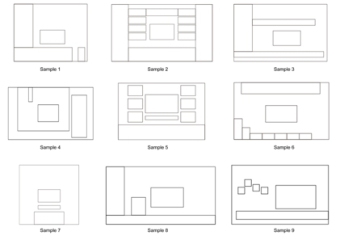
Establishment of Beauty Measurement Data of Different Video Wall Background Layouts In this experiment, a total of 9 TV wall layout designs were selected for aesth- etic evaluation (Collaud, 2022). The layout design styles of these TV walls are different and each has its own characteristics. First of all, in order to avoid the additional psychological impact of factors such as colour and brand on the subjects, these samples were decolorized through the MATLAB program, and simplified processing through Photoshop, as far as possible to remove irrelevant pollution factors such as Logo, and simplify various elements to rectangle (see Figure 1).
By processing the product outline in Photoshop software with pen tools and vector tools, and using the information window in the software to read, including the width and height of the product outline, the length and width of various layout elements (display screen and buttons) A series of information such as related data and its coordinates in the coordinate system. Through the information window of the Photoshop, the width, height and coordinate information of each interface layout element can be accurately obtained.
After obtaining the above-mentioned data information, use MATLAB to calculate the selected 7 beauty indicators for these 9 samples, and get the scores of different styles of TV walls in different beauty indicators, and the
Evaluation Method of TV Wall Layout Design 747
Figure 1: Selected Samples of TV Walls Sample interface element layout information.Table 1. Calculation results of sample aesthetics of TV wall layout.
balance of each sample can be obtained. Symmetry, Unity, Proportion, Sim- plicity, Rhythm. The calculation results are shown in Table 1 below (see Table 1).
Analysis of the Calculation Results of the Aesthetics of Different Styles of TV Walls Through the calculation results of MATLAB, the above table 1 is obtained, and the following analysis can be obtained:
In terms of balance, sample 6 and sample 9 have higher scores. Comparing the original image of the sample, it is found that these two samples adopt a symmetrical style, especially sample 6, which is a perfect horizontally sym- metrical layout. This shows that The balance of the layout does come from the symmetrical layout; but sample 5 is a completely axisymmetric layout but the score is not high, while sample 9 is asymmetric but the score is not low, indicating that the balance algorithm needs to be improved to a certain extent.
In terms of symmetry, sample 5 and sample 8 have high scores. Sample 5 has a perfect axisymmetric interface. Although sample 8 has asymmetric layout, it has achieved similar visual weight on both sides of the vertical centre axis effect.
748 Jiao and Zhang
In terms of overall degree, sample 2 achieved the highest score. Observing the sample, we can find that sample 2 has a vertical symmetrical pattern layout, and the TV is in the centre, surrounded by patterns of the same spa- cing and size. Subjective aesthetics also agree that it is the most The overall layout shows that the beautification results are effective and convincing.
In terms of simplicity, sample 7 achieved the highest score, while sam- ple 2 achieved the lowest score. Because sample 2 is densely arranged, it is indeed lacking in simplicity, while sample 7 has only three graphics and a strong sense of visual space. A high score also shows that the quantitative results are effective. However, after subjective evaluation and measurement, the simplicity of sample 5 is similar to that of sample 7, and the aesthetics is slightly higher than that of sample 7, indicating that there is still room for improvement in the quantification method.
In terms of intensity, sample 1 and sample 8 have the highest scores, but after comparing subjective evaluation results, it is found that the scores of this beauty index vary greatly due to the different aesthetics and understanding of each person, so the quantitative method of this beauty index There is a lot of room for improvement.
In terms of rhythm, sample 4 and sample 8 have the highest scores. The subjective evaluation results show that the patterns of these two samples are arranged in a staggered manner, and they do have a high sense of rhythm, but they are not orderly enough, and sample 9 does not score. However, many subjects think that it has a high sense of rhythm. Therefore, to judge this index, it is necessary to evaluate the interface layout in conjunction with other beauty indexes, and independent evaluation is not applicable.
In terms of proportion, sample 9 has the highest score, while sample 8 has the lowest score. After subjective evaluation results and observations, sample 9 adopts a regular layout with similar shapes and decreasing area; sample 8 with the lowest score The interface is scattered, and each pattern does not form a strong connection with each other. Therefore, it shows that the quantitative results of this beauty index are referential and desirable (Ngo et al., 2003).
A Aesthetic Evaluation System Based on the Combination of Entropy Method and Subjective Evaluation Method Entropy method is an objective weighting method, which determines the wei- ght of indicators according to the size of the information provided by the observation values of various indicators (Hu et al. 2022). In information theory, entropy is a measure of uncertainty. The greater the amount of infor- mation, the smaller the uncertainty and the smaller the entropy; the smaller the amount of information, the greater the uncertainty and the greater the entropy. There are m plans to be evaluated and n evaluation indicators to form the original index data matrix X=(xij)m×n. For a certain index xj, the greater the gap between the index value xij, the more the index will be used in the comprehensive evaluation The greater the effect.
According to the characteristics of entropy, the randomness and disorder degree of an event can be judged by calculating the entropy value, and the
Evaluation Method of TV Wall Layout Design 749
Table 2. User’s subjective evaluation scale for various beauty indicators of TV wall samples.
degree of dispersion of an index can also be judged by the entropy value. The greater the degree of dispersion of the index, the influence of the index on the comprehensive evaluation The larger the (weight), the smaller the entropy value. Therefore, the information entropy tool can be used to calcu- late the weight of each indicator according to the degree of variation of each indicator to provide a basis for the comprehensive evaluation of multiple indicators.
The advantage of the entropy method is that the entropy method determi- nes the index weight according to the degree of variation of the index value of each index. This is an objective weighting method that avoids the devia- tion caused by human factors. The entropy method also has shortcomings: it ignores the importance of the index itself, and sometimes the determined index weight will be far from the expected result, and the entropy method cannot reduce the dimension of the evaluation index (Wan et al. 2021). (1) Perform data processing on the subjective evaluation results to obtain artificial weights. On the basis of the entropy method, the subjective evaluation results obtained by the subjective evaluation scale are subjected to data weighting processing, and they are substituted into the initial stage of the entropy method for arti- ficial weighting processing, and then the entropy method is used to establish each The final objective empowerment of the aesthetic measurement index provides certain guidance for the design layout.
The following table is an example of a user’s subjective evaluation scale for various beauty indicators of the TV wall samples. All partici- pants participated in the study voluntarily and both parties signed their consent.
750 Jiao and Zhang
(2) Entropy method for data weighting processing. According to the calculation result matrix of aesthetic established in Table 1 above (see Table 1), 9 layout schemes are given for us to choose. Each scheme has the same 7 aesthetic attributes (assuming all positive indicators). We need to use Entropy method, after initial artificial weight modification combined with the weight obtained by subjective evaluation method, the weight of each attribute and the comprehensive score of each program are calculated.
Select n video wall samples and m (beauty) indicators, then Xij is the value of the j-th index of the i-th sample (i = 1, 2…, n; j = 1,2,…, m);
2. Normalization of indicators: homogenization of heterogeneous indica- tors
Since the measurement units of the various indicators are not uniform, before using them to calculate the comprehensive indicators, they must be standardized, that is, the absolute value of the indicator is converted into a relative value, and the Xij=|Xij|, So as to solve the homogeneity problem of various quality index values. Moreover, because the meanings of the positive and negative indicators are different (the higher the positive indicator, the bet- ter, the lower the negative indicator, the better), we use different algorithms for data standardization for high and low indicators. The specific method is as follows: Positive indicators:
xij, · · · , xnj
x′
x1j, · · · , xnj
Negative indicators:
xij, · · · , xnj
x′
−xij max
−min
x1j, · · · , xnj
x1j, · · · , xnj
Then X′ij is the value of the j-th beauty index of the i-th TV wall sample (i = 1, 2..., n; j = 1, 2,..., m). For convenience, the normalized data is still recorded as Xij.
3. Calculate the proportion of the i-th TV wall sample under the j-th beauty index in the index: , i = 1, · · · , n, j = 1, · · · , m pij = xij Pn
4. Calculate the entropy value of the j-th index:
Evaluation Method of TV Wall Layout Design 751
Table 4. The final weight result of entropy method after artificial weight modification.
7. Calculate the comprehensive score of each video wall sample:
(3) The result of weight processing by entropy method After the above-mentioned weight calculation processing, the final weight ratio of the final 7 beauty indicators can be obtained, which are rhythmi- city > proportionality > symmetricalness > balancedness > simplicity > density> unity. So as to sort the development priority for subsequent designs. The final processing results are shown in the following table (see Table 4): Subjective Evaluation and Verification of TV Wall Layout Design
After obtaining the above-mentioned priority ranking, to verify the reliability of the results, another subjective evaluation survey was carried out to confirm that the results of this paper have certain reliability.
Through the establishment of a five-point Likert scale, the subjective evalu- ation data was collected again, including “very dislike”, “dislike”, “neutral”, “like”and “very like”, corresponding to 1, 2, 3, 4, 5 points, and then calculate
752 Jiao and Zhang
Table 6. Five-point Likert scale for survey of aesthetics of TV wall layout.
Table available in the original PDF paper.
Samples 1 2 3 4 5
Dislike very much Dislike Neutral Like Like very much
Table 7. User subjective evaluation results— average score of sample aesthetics.
Median 3 3.5 3 2 3 3 3 3 4 Proportion greater than 3 points
the average of the results to select the best sample (Tullis, 1988). Investigate as many respondents as possible, with multiple backgrounds, and multiple age groups to make the data obtained more comprehensive and representa- tive. The establishment of the five-point Likert scale is shown in the following table (see Table 6).
Analysis of the Results of the Subjective Evaluation Scale for the Background Layout of Different Styles of TV Walls By analysing the data results obtained from the subjective evaluation scale survey, the average score and median of the data are calculated, and the pro- portion of each sample score greater than 3 points is calculated, and then the subjective evaluation score of each sample is obtained. As shown in Table 7 below (see Table 7). All participants participated in the study voluntarily and both parties signed their consent.
On the basis of the above scores, each sample image is analysed, and after comparing with the priority ranking of aesthetic development obtained by the above mathematical calculation, it is found that although there is a small deviation, to a large extent, the evaluation results of the two Relatively con- sistent, indicating that the method in this article has certain reliability and applicability.
CONCLUSION
After investigation and calculations in this article, it can be found that the development priority of the seven beauty indicators is in order of Rhythm degree> Proportion degree> Symmetry degree> Balance degree> Simplicity degree> Density degree> Unity degree, among which, rhythm and propor- tion Symmetry and symmetry are the top three aesthetic factors, and finally
Evaluation Method of TV Wall Layout Design 753
verified by subjective evaluation using the five-point Likert scale, which can show the reliability of the mathematical calculation results.
Therefore, the conclusion of this article is that designers and other relevant personnel can take rhythm, proportion and symmetry as the main consi- derations in the layout design of indoor TV walls. The results obtained through such calculation methods can be Ensure a certain degree of design beauty.
This article combines theories and methods in different fields to analyse the beauty of interface layout in real life scenarios, and extracts the seven beauty of balance, symmetry, unity, proportion, simplicity, density, and rhy- thm. The index is quantified as an evaluation index, and combined with entropy method and subjective evaluation method to calculate the compre- hensive beauty of the TV wall, and finally verified by subjective evaluation survey again. It can be found that in the TV wall layout design, rhythm, symmetry, and proportion are the three most influential factors. Therefore, in the future TV wall layout design, the results of this article can provide designers with a certain degree Reference value, to solve the designer’s flaws in quantitative analysis and interpretation, so that the design becomes more reasonable.
But at the same time, the experiment in this article still has certain defects and limitations, such as: Colour matching is also an important factor but it is not taken into account, because colour also has “visual weight”.
Similarly, materials, textures, lines, patterns, etc. will also have an impact on visual effects to a certain extent, but they are not taken into account in the interface calculations in this article.
The sampling is not sufficient, and the survey population is mainly concen- trated in young office workers or student groups. The aesthetic evaluation has certain limits and may be biased.
Due to the continuous development and change of the aesthetics of the times, the design reference provided in this article may only be applicable in the current era.
ACKNOWLEDGMENT
The studies reported here were supported by supervisors and participants. Thank you to Professor Zhou Lei and Professor Zhang Jianrun for their help in conducting experiments and analysing data.
REFERENCES
Arnheim, R. (1969) Art and Visual Perception: A Psychology of the Creative Eye.
University of California Press. Bauerly, M. and Liu, Y. (2006) ‘Computational modeling and experimen- tal investigation of effects of compositional elements on interface and design aesthetics’, International Journal of Human-Computer Studies, 64(8), pp. 670–682.
754 Jiao and Zhang
Collaud, R., Reppa, I., Défayes, L., McDougall, S., Henchoz, N. and Sonderegger, A. (2022) ‘Design standards for icons: The independent role of aesthetics, visual complexity and concreteness in icon design and icon understanding’, Displays, 74, p. 102290. Dondis, D.A. (1974) A Primer of Visual Literacy. MIT Press. Hu, H., Liu, Y., Lu, W.F. and Guo, X. (2022) ‘A quantitative aesthetic measurement
method for product appearance design’, Advanced Engineering Informatics, 53, p. 101644. Maquet, J. (1989) ‘The Aesthetic Experience: An Anthropologist Looks at the Visual Arts’, Journal of Aesthetics and Art Criticism, 47(2), pp. 200–200. Ngo, D.C.L., Samsudin, A. and Abdullah, R. (no date) ‘Aesthetic Measures for
Assessing Graphic Screens’, p. 21. Ngo, D.C.L., Teo, L.S. and Byrne, J.G. (2003) ‘Modelling interface aesthetics’, Information Sciences, 152, pp. 25–46. Tullis, T.S. (1988) ‘Chapter 18 - Screen Design’, in M. Helander (ed.) Handbook of
Human-Computer Interaction. Amsterdam: North-Holland, pp. 377–411. Wan, H., Ji, W., Wu, G., Jia, X., Zhan, X., Yuan, M. and Wang, R. (2021) ‘A novel webpage layout aesthetic evaluation model for quantifying webpage layout design’, Information Sciences, 576, pp. 589–608.
LISTED IN THE AHFE DIGITAL BOOKSTORE CATALOGUE
Explore the complete digital volume
Intelligent Human Systems Integration (IHSI 2023): Integrating People and Intelligent Systems
Read this individual research paper free through the original publisher, or explore the full digital proceedings book.
ISBN 978-1-958651-45-2
Explore this ISBN in the AHFE Bookstore ↗Listed in the July 2026 bookstore catalogue; search by ISBN to confirm current availability · Digital book purchase optional