Da Zheng, Xiaodan Liu, Shuya Zhang (2023). Design in the folding calculation of origamis in interactive installation art. In: Intelligent Human Systems Integration (IHSI 2023): Integrating People and Intelligent Systems. AHFE Open Access, vol. 69, pp. 819–827. https://doi.org/10.54941/ahfe1002906
With the rapid development of digital technology, new media installation artists explore the possibilities of "human-computer interaction" in installation art by computer using sensing technology, communication technology, and other new artificial intelligence technologies. Modern origami shapes flat surfaces into an orderly three-dimensional structures through the design of creases, allowing the works to display both rigidity and flexibility of mechanical properties. By analyzing the mechanical properties and mathematical laws contained in the rules of modern origami, we have built a visual interface model using Touch Designer software. Based on the computational model, we designed an intelligent interactive origami installation with “autonomous behavior” that can be encoded or decoded and automatically read and executed by the acoustic collision rebound. Driven by artificially empowered, the "folding" of paper extends into visible, interactive, and perceptible "movement behavior The inter-media integration attempts to combine material, structure and algorithm, hopefully providing a new perspective for the innovation of new media dynamic installation art.
New media installation art is rooted in contemporary technological art and is a combination of computable media and installation art. The works are usually characterized by three features: multi-dimensional Spatial-temporal narrative, dynamic morphological changes, and data-algorithm driven, which are a concentrated response to the interdisciplinary nature of art. Art challen- ges technology and technology inspires art (Pang and Xue, 2018). Modern origami is based on the traditional paper folding craft and influenced by modernist design thinking, incorporating the principles of three-dimensional composition. Modern origami is the study of paper folding from a deeper perspective of paper space and has begun to set clear requirements for fol- ding methods (Deng, 2012): the integrity of the paper must be maintained during folding. The folding must be carried out without destroying the paper and the finished product must be restored to the original state of the paper. The distribution of folds must be “continuous” and “regular”.
In recent years, modern origami has begun to appear in the field of new media installation art, breaking away from the heavy metal and rational
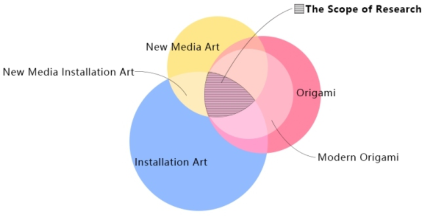
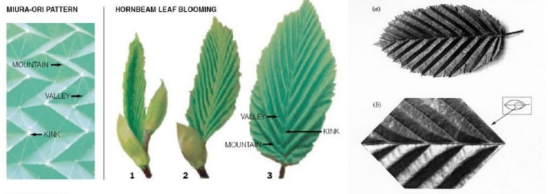
Figure 1: Illustration of the scope of research.Figure 2: Folding variation of Carpinus betulus during the growth cycle (Adapted from https://naturalorigami.wordpress.com/2016/07/18/the-miura-ori-fold/).
machine oppression of previous works. This innovation in creation is not simply a reproduction or upgrade of traditional techniques by new media technology, but a reflection of inter-media thinking. As shown in Figure 1, this paper has explored the influence of computable folding in the conce- ption and creation of new media installation art design from three levels: material, structure, and algorithm.
The Mediatization of Origami The transition period in the way of art creation started at the end of the 20th century to the beginning of the 21st century. New media installation arti- sts began using computers to assist in creative art. They collaborated with engineers to use new technologies such as lasers, electronic screens, and mech- anical power systems for poetic transformation. New media installation art presented the obvious characteristics of immateriality and media synthesis, and the laws of folding gradually became a new way to enrich the movements of the installation.
The folding structures have been the core of many natural phenomena although modern origami art has been proposed for several years. For exam- ple, in the leaf buds of the Carpinus betulus, the leaves are tightly wrapped and folded before budding, while at budding the leaves expand into a broad and flat structure (see Figure 2), which was later summarized as one of the modern origami type structures.
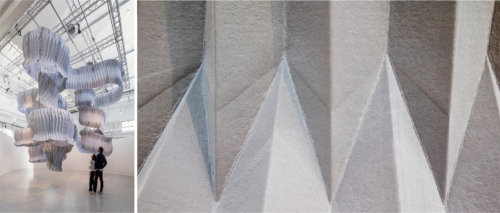
Breath/ng (2018), a pollution-absorbing sculpture designed by Japanese architect Kengo Kuma, is an artwork that borrows from the “natural
Design in the Folding Calculation of Origamis in Interactive Installation Art 821
Figure 3: Kengo Kuma, Breath/ng (Adapted from https://kkaa.co.jp/).
properties” of origami art (Figure 3). The work draws on the distribution of the folds of periodic folding, folding the fabric uniformly in the same dire- ction with a great sense of order. In addition to the aesthetic stimulation of the visual aspect, the undulating and consistent folds provide stable support to each other. Allowing the fabric’s surface to achieve maximum contact with the air in a limited space so that the work can enhance the ability to capture pollutants, purify particles and produce clean air. The continuous adsorption capacity of this environmentally friendly material gives the work a continu- ous dynamic change in the temporal dimension. The material properties make the work not only aesthetic but also functional, giving the folded sculpture the ability to narrate in the temporal dimension.
Modern origami combines natural and new technological materials, dee- pening the work’s hierarchical expression of the concept of nature. Moreover, it also provides an opportunity for the work to escape from the traditional sculptural art scope while better presenting the installation’s characteristics in the temporal and spatial dimensions.
Mechanical Properties Embedded in the Folded Structure The modern art of origami was influenced by the Modernism design’s emph- asis on “function” and “structure”, and the creation of origami began to focus on the process of folding. As Lisa Iwamoto mentioned in Digital Fabri- cation, folding offers the most significant potential for diversity because it can express a wide range of forms inherently. In the past decade, the study of folded structures has expanded from design and kinematics to mechanics and dynamics. Rigid foldable, flat foldable, and deployable properties allow for a wide range of potential applications of structures inspired by rigid ori- gami. The three-dimensional structures created by different folding patterns will present different geometric shapes, mechanical properties, and functi- ons (Zadpoor, 2016). The most widely used modern origami structure is the Miura-ori, a rigid origami structure created by the flat-folding method. It consists of successive parallelograms intertwined to form a regular tessella- ted lattice-like folding structure. In the field of mechanics, the positive and negative Poisson’s ratio coefficients are used to measure the transverse shrin- kage strain and the longitudinal extension strain in the direction of tensile force during the folding of the material.
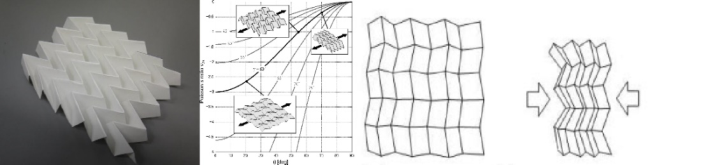
Figure 4: Illustration of the rigid folding principle (Adapted from https://www.pnas.org /content/110/9/3276).
In the Miura-ori, the special mode of folding and unfolding gives the stru- cture rich dynamic properties. Each folded surface of the structure is flat in the fully unfolded state, and it behaves as an auxiliary material with a negative Poisson’s ratio, showing the characteristic properties of a flexible material. The folding surfaces in the folded state show a parallel relationship with each other, and each crease supports each other with a positive Poisson’s ratio, constituting a stable rigid structure. As shown in Figure 4, it is a com- posite foundation with dual properties of interconnecting structural folds. Therefore, the whole structure can be folded and unfolded from a single or multiple drive points. With the help of an external force, the structure can be unfolded into a wide plane or compressed folded strip structure by simply stretching or squeezing the end of the folded structure (Miura, 1985). In the field of new media installation art, the mechanical properties of modern ori- gami, a composite structure, focus on altering the work’s state of motion by the folds.
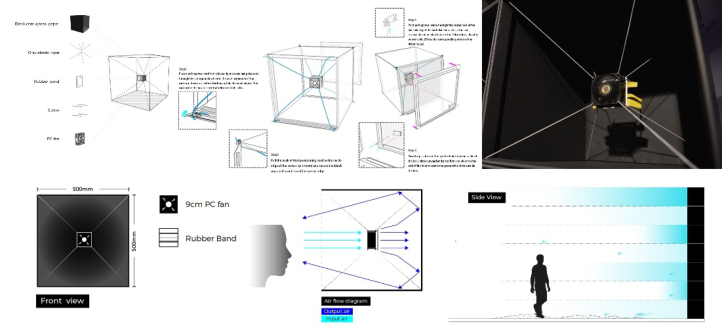
In the data sound installation Physiological Reaction III, the author uses the rigidity of the Miura-Ori method to optimize the carton support structure of the work. The work is composed of 288 black cube cartons with 50cm sides, which are arranged in a triangular shape as an “array wall”. A mecha- nical fan hangs from the center of each carton module, which is designed to switch freely between rigid and flexible states without adding connections, simply by folding, to match the needs of complex exhibition spaces.
As shown in Figure 5, the inspiration for the creation of modern origami in Physiological Reaction III is manifested in three specific ways. Firstly, the box body can be restored to a box structure in a flexible state; the carton that constitutes the work pushes and pulls the folds at the opposite corners of the box in the direction of the opposite folds, reducing it to a two-dimensional plane with a thickness of no more than 3cm. The structure guided by folds gives the material a specific directional force and replaces the structural ske- leton used to support the work with folds, strengthening the visual sense of “natural purity” of the work while at the same time having practical value. Secondly, the structure and weight support of individual modules are borne by the rigid folding surface of the carton after folding. By designing the folds at the structural edges of the work so that the folds are stable under the three-dimensional space for support, the work does not need any facilities for additional support. The fan suspended from the center of each carton is held in place by the elastic lanyard that holds the four corners of the fan to
Design in the Folding Calculation of Origamis in Interactive Installation Art 823
Figure 5: Illustration of the structural characteristics of the continuity of the carton surface of Physiological Reaction III, the bounce direction of the cavity to the sound, and the sound generation characteristics of the fan wall.
each top point of the carton. Instead of a crease, the elastic lanyard creates a continuous tension in the center that contracts from all around to the center, stabilizing the structure inside the carton.
Thirdly, the “sound” direction is guided by the folding structure. In addi- tion to the dynamics of mutual folding, the geometric periodicity in the rigid origami makes the folded structure a universal “acoustic metamaterial”. The material of the carton of Physiological Reaction III is corrugated paper with a continuous “W-shaped”periodic folding structure, which provides a way to adjust the potential periodicity. Consequently, when the sound waves hit the periodic folding, the structure causes the sound waves to bounce back within a certain period, creating a resonance effect. The periodicity of the folding structure becomes a way to achieve adjustable acoustic behavior. The sound of the natural wind from the fan is received by the folding structure, colliding with each other, and bounces back into space by the structure, transforming it into a natural chorus. The space of rigid origami extends the direction and movement of the “force(power)”of the lower sound waves in the middle bou- nce. Whether it is the structural movement of the work guided by the folds or the rebound and enhancement of the machine sound by the cavity enclo- sed by the rigid folding surface, the dynamic performance of modern origami brings the work various movement changes. It enables a single structure to have a continuous dynamic change in the time dimension, making the work a medium with the ability of spatial narrative. While linking the perception of the place and the participant, it also facilitates the dialogue and communica- tion between them, evokes the participant’s emotional experience, and thus achieves the purpose of spreading a certain message.
Computable Origami In the digital age, the dynamic art presentation after computer intervention is a study of aesthetic activity from a cybernetic perspective. This type of
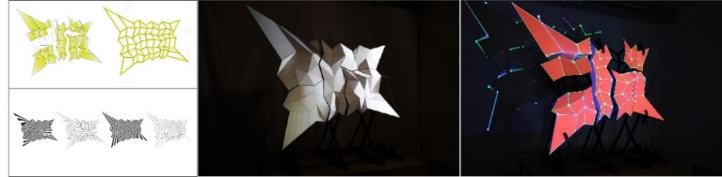
Figure 6: Steven Wong’s augmented power installation MEMESIS, 2015 (Adapted from http://www.oksteven.com/memesis-process).
art considers the process of movement of the work as a kind of information transmission. In contrast, the cybernetic references in new media installation art are more about introducing the concept of “system” and replacing the traditional sense of “machines”. It aims to decode movement into informa- tion through computation, deconstructing, transforming, and restructuring the media of creation.
As new media technologies extend art into the exploration of “objects”and begin to turn “physical presence” into a more “process-oriented presence”, art is no longer about physical space but also about abstract space, the space in which works are created and displayed. As Lucy Lippard noted in her monograph Six Years: the dematerialization of the art object from 1966 to 1972, art became immaterial and form became less important (Graham and Cook, 2010).
From the 1980s onwards, it was noticed that origami could be used as a mathematical problem and was constantly studied, giving the art of fol- ding paper the ability to be “computable”. On this basis, the emergence of the control system, guided by computers and the theory of cybernetics, gave great freedom to the behavior of foldable materials and machines. The pro- perties can be “programmed” by designing the basic crease pattern before folding, or “controlled” by the folding method according to different target configurations. In the augmented kinetic installation MEMESIS(2015), the artist’s folding algorithm applies the principles of rigid origami to the move- ment of a screen, which moves to simulate a realistic folding interface and interacts with the projected animation (Fig. 6). The use of the folding algori- thm in the installation is divided into two levels: (1) The motion of the real screen. The motion mechanism of the screen is based on the Miura folding structure and the V-shaped folding law. A model of the interface is constru- cted in the computer and the folding algorithm is given to this model. The result of the simulated folding will be converted by the computer into the actual drive of a series of servo motors to complete the real folding motion; (2) The animation of the projected screen. By computing the position of the folding surface, the animated content of the projection is kept synchronized with the folding surface to present the folding in virtual 3D space. The inte- rconversion between the real folding motion and the virtual folding effect is achieved by computability.
The origami algorithm gives the installation “limited” freedom of move- ment, and the motion of the installation is no longer the articulation of two
Design in the Folding Calculation of Origamis in Interactive Installation Art 825
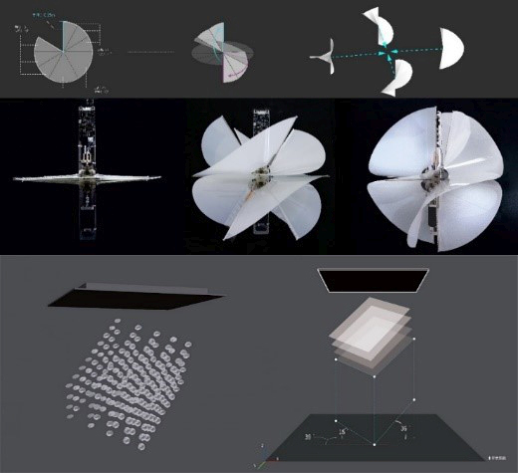
Figure 7: Design and prototype of the modular form of Luster of Unknown Universe.
illogical movements, but a computed, rhythmic and logical reproduction. In recent years, the study of “autonomy” or self-operation (or ‘autonomous’) operation of the work, has become increasingly popular in new media instal- lation art. Autonomy in modern origami art emphasizes the controllable and computable nature of the materials themselves, which can actively adjust their folding state in response to changes in the environmental conditions in which it is placed. Self-Assembly emphasizes the physical properties and memory of the materials themselves, and is essentially precise computability and control of the variables in the external environment. A combination of sensing and computational functions is required to achieve this precise com- putability and control, allowing smart materials to bend, stretch, compress, wrinkle, and other near-infinite degrees of freedom and even become meta- materials. The data interactive installation Luster of Unknown Universe is a sublimation of the author’s 2019 approach to creating new media installation art inspired by modern origami. The main body of the installation consists of a combination of 180 structurally identical spherical folding structures capable of their independent operation, suspended from a commercial space of nearly 20 meters, in conjunction with a natural ecology outlined by the folding design combined with intelligent materials, sensors, and computer control system.
In the stylistic design of the work, the design is divided into two levels, the single modular form and the overall group design (Fig. 7). The single- module form is inspired by the logic of Modular Origami, first known as the “Tamatebako”, a three-dimensional structure made up of multiple identical folds, and in the 1965 publication World of Origami, published in 1965, also refers to a box made up of six identical folds; what distinguishes Modular
Origami from other forms of multi-piece origami is whether the body is made up of multiple identical folds. With the idea of Modular Origami, we designed the morphology of the folded sphere, which consists of replicating multiple rigid folded structures rotated and assembled at their centers. We adjusted the number of assembled modules to refine the fullness of the silhouette in the sphere state. With the simulation of the computer, we got a model of the spiral folding structure. The folds were replaced by structural supports to assist the folding., the scalloped surfaces outside the folds were positioned as diaphragms and auxiliary connectors were added to allow for dimensional changes and ensure stable use of the materials. The overall form of the work was inspired by the tilting phenomenon of floating objects, with the array of spheres flipped in the x, y, and z axes to reinforce the lightness of the “origami”.
In the control system of the work, the input end of the system was conne- cted to multiple natural data collection stations in the city; the change in the movement of the folding was located at the “output” end of the system and was directly related to the dynamic transfer of the folding and closing of each sphere and cluster, with the computational process of folding becoming invi- sible. The work remotely collected data on wind and air quality from multiple local areas and mapped it to the module opening and closing drivers, with the control system enabling each sphere to be individually “visible” in real time. The computability of the folds allows modern origami art to be coded and decoded so that it can be read and executed by the system, driven by natural and human data, using technology and art to fold social space and natural ecology, presenting a symbiotic system of human and nature.
Driven by the automated control system and the controllability and com- putability of the materials themselves, each sphere module is able to adjust its folded state to provide different feedback depending on the environmen- tal conditions it is exposed to, being an independent individual, while the dynamics of the installation is superimposed by the movement of several inde- pendent individuals, this cluster linkage makes the work a cybernetic system matrix.
CONCLUSION
The interdisciplinary character of new media installation art is not only refle- cted in the use of various media in the works but also permeates the level of creative thinking and creative methods, which is the integration of “com- putational thinking” into the art creation process. The characteristics that mechanical aesthetics presents are based on the inherited function of the machine, whose ‘intrinsic properties’ become an aesthetic image. At the same time, modern origami has been transformed by a deepening digital environ- ment. In contrast to creating new media installations using origami shapes, the movement of the new media installations is enriched by the mechanical properties of modern origami folding. The internal properties of the mach- ine release modern origami from its static coordinates, and in the alternation of potential and kinetic energy, “folding” is no longer a monotonous verb, but extends into a visible, interactive, and perceptible “act of movement”,
Design in the Folding Calculation of Origamis in Interactive Installation Art 827
achieving an innovative shift in cognitive thinking. Whether it is the inter- media design of folding dynamic structures or the algorithmic design of integrating various folding laws, the inter-media integration of materials, structures, and algorithms, crease computing may become a breakthrough in the new media era of thinking innovation.
ACKNOWLEDGMENT
This work was supported by the 2021 Humanities and Social Science General Program sponsored by the Ministry of Education of the People’s Republic of China, Grant Number: 21YJA760098. Any opinions, findings, and conclusi- ons or recommendations expressed in this material are those of the authors and do not necessarily reflect the views of the Ministry of Education. Each audience contributed to this paper’s final form, any flaws remain our own.
REFERENCES
Deng Y. (2012) An Exploration of the Creativity of Origami Art in Contemporary Design Art, Art Review, (10), pp. 108–112. Graham, B. and Cook, S. (2010) “Rethinking Curating: Art After New Media”. MIT
Press, pp. 20. Miura K. (1985) Method of Packaging and Deployment of Large Membranes in Space. Inst. of Space and Astronautical Science, pp. 19. Pang J. and Xue Y. (2018). The Development of Artificial Intelligence and the Future
of Aesthetic Art, Art Review, (09), pp. 45–56. Zadpoor, A.A. (2016) “Mechanical meta-materials”, Materials Horizons, 3(5), pp. 371–381.
LISTED IN THE AHFE DIGITAL BOOKSTORE CATALOGUE
Explore the complete digital volume
Intelligent Human Systems Integration (IHSI 2023): Integrating People and Intelligent Systems
Read this individual research paper free through the original publisher, or explore the full digital proceedings book.
ISBN 978-1-958651-45-2
Explore this ISBN in the AHFE Bookstore ↗Listed in the July 2026 bookstore catalogue; search by ISBN to confirm current availability · Digital book purchase optional