Dongxinyi Li, Jun Yi (2023). Future Information Input Mode and Case Study of Intelligent Operation Cabin of Construction Machinery. In: Ergonomics In Design. AHFE Open Access, vol. 77, pp. 536–543. https://doi.org/10.54941/ahfe1003413
Intelligence is an inevitable trend in the construction machinery industry. Under this trend, the interaction, spatial pattern, and information transmission of the operation cabin will all change. The intelligent operation cabin is an important space for information interaction between people and construction machinery. It is a complex workplace with a large number of information input interfaces. It is necessary to understand how information is entered in current and future intelligent operation cabins. Through the analysis of the current situation and the study of relevant cases, combined with the characteristics of the construction machinery itself, the future information input mode of the intelligent operation cabin of the construction machinery is summarized and discussed. This research can provide some reference and thinking for the design of the future intelligent operation cabin of construction machinery.
With the advent of Industry 4.0, technologies such as artificial intelligence, 5G network, automation, industrial Internet, cloud computing, big data, and new detection and sensing technologies have been widely used, the constru- ction machinery industry has gradually emerged an intelligent and digital development trend. In 2016, Hyundai released a series of conceptual constru- ction machinery, representing its thinking on future : innovative mechanical design, intelligent human-computer interaction, cool industrial design, and interconnected operating system (Hyundai, 2023).
The use space of construction machinery products is generally divided into the cab and the operation cabin. The function of the cab is to move the mach- inery, and the function of the operation cabin is to manipulate the machinery to complete the input task. Domestic and foreign scholars’ research on con- struction machinery operating cabins is mainly to design the shape of the operating room through various methods (Ou et al. 2019), or to optimize the interior design based on various methods such as ergonomic evaluation (Kushwaha and Kane, 2016). The future intelligent operation cabin should realize deeper intelligent interaction and humanized operation, and the layout in it will be interconnected and integrated design according to the functional characteristics of components and information input methods.
Future Information Input Mode and Case Study of Intelligent Operation Cabin 537
Construction machinery is a function-oriented large-scale product, and the main purpose of operating construction machinery is to accurately input and let it complete the corresponding tasks. Different input methods have an impact on the performance of the operation (Zhang et al. 2023), so an appropriate input method should be selected. If there is a deviation in the input, it will not only affect the construction efficiency, but may even affect the personal safety of the operator.
Therefore, as the information in the operation cabin of construction mach- inery becomes complex and diverse under the process of intelligence, the information input methods also increase randomly, and the interaction will also change accordingly. This paper attempts to explore the future informa- tion input mode by summarizing the current situation and problems of the input of the construction machinery operation cabin, and combined with the characteristics of the construction machinery itself. So as to provide a cer- tain reference for the subsequent design of the input and interaction of the intelligent operation cabin.
CURRENT STATUS OF INFORMATION INPUT IN OPERATION CABIN OF CONSTRUCTION MACHINERY Current Input Modes and Practical Cases
The input of current construction machinery is mainly based on tactile input, which mainly through the contact of physical components and touch screen for information input.
Due to technical limitations, the functions of early construction machi- nery products were relatively limited, and operators input information by touching physical operating elements. A display with physical buttons then replaced the traditional instrument cluster. The input behavior based on the touch screen began to replace part of the input through physical buttons, and also changed the spatial layout of the construction machinery operation cabin and the classification of its functional modules. Nowadays, interactive full touch screens are also gradually entering. The information input mode has changed again, and the user can input a variety of different information through different actions in contact with the screen: such as clicking, long pressing, dragging, zooming and so on.
In addition to tactile-based input, speech-based input methods are rela- tively mature in other fields. Speech interface has many advantages in the application of smart products. Speech input using natural language is one of the most natural, flexible and efficient ways in human communication. This input method can improve the cooperation between human and construction machinery, greatly improve the efficiency of operation, and even promote intelligent operations such as remote operation. In the field of construction machinery, there has been research on the conceptual design of an innova- tive speech interface for controlling loader cranes (Majewskiet and Kacalak, 2016), but this is currently only a concept, and it will take some time to be widely used in actual construction.
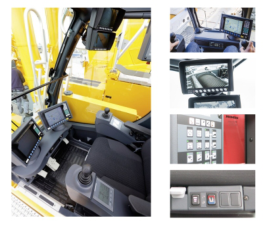
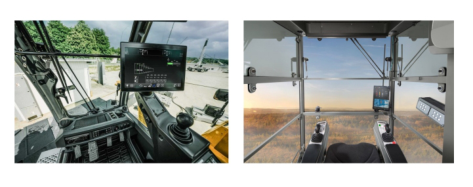
Liebherr is a leading manufacturer of construction machinery, but most of its products are still with touch screen products and digital buttons (see Figure 1). Liebherr has also launched products using smart touch screens
538 Li and Yi
Figure 1: Liebherr LTM series mobile crane operator cabin & part details.Figure 2: Liebherr mobile crane operator cabin & LiCAB – the crane cabin.
in the past two years (see Figure 2). It can be seen that these two operation cabins have added a comprehensive smart touch screen, which greatly reduces the design of physical buttons. The operating platform will be more concise, and the user’s behavior of inputting information will also be simplified.
There Are Certain Limitations With the increase in product complexity, new functions and the emergence of digital interactive screens, a large amount of product information is assem- bled on a small screen. The screen interface design lacks intuition, and the information hierarchy design is not perfect. At the same time, it also increases the user’s learning cost and easily causes the user’s cognitive burden.
Moreover, the overall interaction capability in the current operating cabin is limited, multi-task coordination is difficult, the operating efficiency is low, and the user experience is not good.
Therefore, the current relatively traditional construction machinery pro- ducts need new input methods and new input interfaces (Kim et al. 2015).
FUTURE INFORMATION INPUT MODES FOR INTELLIGENT OPERATION CABIN OF CONSTRUCTION MACHINERY In order to make the intelligent operation cabin provide better user experience for users, through emerging technologies such as haptics, gestures, wearable
Future Information Input Mode and Case Study of Intelligent Operation Cabin 539
sensors and augmented reality, virtual reality, the traditional display is expe- cted to be extended to a graphical user interface with a multi-mode interface outside (Alves et al. 2013). In this way, the interface for information input will become multimodal, and the input method will also undergo new changes. This will be more conducive to solving complex problems such as multi-task collaboration and promote the progress of human-computer interaction. In the following content, the exploration of future information input modes based on new technologies will be explained respectively.
The input behavior between the user and the intelligent operation cabin can be divided into active input and passive input. Among them, there are four different modes of active information input, namely: tactile-based input, speech-based input, gesture-based input and multi-modal input.
Active Input Users can actively input information to the intelligent operation cabin of con- struction machinery by operating functional components, making gestures, and making sounds. Whether it is based on touch, voice, or other chan- nels, multi-modal information input behavior is an active interaction between humans and machines.
Tactile-Based Input With the development of more tactile-based technologies such as smart surfa- ces, the overall layout of the smart operating cabin of construction machinery will no longer be limited by the size and structure of the original operating components, and can become more integrated and concise. Changes in space and operating elements will produce new input interfaces, input locations and new input methods.
Smart surface technology is mainly to add electronic functions on the sur- face of materials, so that the product structure integrates decoration and functionality, whether it is on decorative fabrics, artificial skin and other materials (Che et al. 2022). The smart surface does not require a screen, allowing people to input operating information anywhere in the operation cabin. In the future, any physical equipment in the intelligent operation cabin of construction machinery, such as joysticks, seat armrests and so on, may be embedded in the display device and become an intelligent surface integrating information input and display (Fang, 2019). These more intuitive and ubiqui- tous input interfaces can effectively reduce the operator’s range of activities and allow the operator to input information in a more comfortable way.
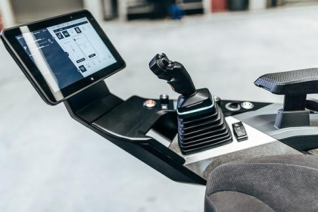
In the context of intelligence, the input behavior of a specific physical device can also be innovated. Such as Liebherr’s new user interface INTUSI (see Figure 3). As long as the joystick or a newly designed main operating element on the console is pressed, the machine operator can quickly and dire- ctly control the relevant operation by clicking the screen. For example, when using the joystick to activate the machine for support, just open the control interface corresponding to the support claw directly on the tablet computer. There is no need to go to the table to find the corresponding button before
540 Li and Yi
Figure 3: Liebherr INTUSI–intuitive operating environment for excavators in the digitized.
moving the joystick as in the traditional way (Liebherr, 2019). This fast and precise input saves the operator time to prepare for work and also improves operator efficiency.
Speech-Based Input In the future intelligent operation cabin of construction machinery, users can control the temperature of the air conditioner, the volume of the radio in the cabin, communicate, and understand the operating status of the machine in a short period of time through the input method of speaking.
Simmons mentioned in their research that the time it takes for a user to input a piece of information by speaking is shorter than the time it takes for a user to manually use a physical button or a touch screen (Simmons et al. 2017), which is more conducive for the user to input more voice informa- tion in a short period of time. At the same time speech-based input does not compete for visual resources. Especially when the user uses both hands to operate the machine, if there are other urgent tasks or some environmen- tal adjustments, commands can be input by speaking, so that there is no need to free up one hand to input task information on physical buttons or touch screens, thereby reducing the need for undesirable effects of ongoing job tasks.
Gesture-Based Input Gesture-based interaction is gradually appearing in smart products and put into actual production. In the intelligent operation cabin of construction machinery in the future, gesture-based input may also appear. The input posi- tion of the gesture is random, and the gesture used can be a natural gesture or a specific gesture set by the system.
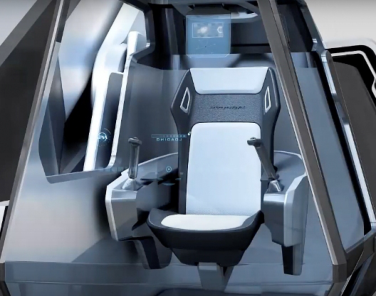
Gesture-based input is usually combined with technologies such as virtual projection, 3D display, and enhanced display, and used in smart produ- cts. For example, a conceptual future smart excavator released by Hyundai (Hyundai, 2020). In the future, the head-up display will replace the most common display screen (see Figure 4), all information will be displayed on the front windshield, and the interior space will become more compact. Users can input information through voice and air gestures. Such an input method
Future Information Input Mode and Case Study of Intelligent Operation Cabin 541
Figure 4: Hyundai construction equipment concept model excavator.
can not only reduce the range of the operator’s activities, but also simplify the design of the overall space of the intelligent operation cabin.
Multi-Modal Input With more and more functions in the intelligent operation cabin in the future, multi-modal input is becoming an effective way of interaction (Mül- ler and Weinberg, 2011). A multi-modal system can be defined as a system that processes two or more combined user input modalities in a manner that is coordinated with the multi-modal system output. Multi-modal input methods can be divided into: temporally cascaded modalities, redundant modalities and fused modalities (Murali et al. 2017). The intelligent ope- ration cabin of construction machinery can provide users with more natural and more optional input methods through multi-modal input methods. Users can choose their favorite and familiar methods to input operation informa- tion. For example, the user can control the temperature in the operating cabin through the tactile-based input of the smart screen at the same time, and can also control it through speech-based input. Multi-modality is also the best way to solve the difficulty of multi-tasking collaboration and reduce the cognitive burden of users.
Passive Input The user also interacts implicitly and passively with the cabin. The user’s emotions, body posture and other physiological activities are all unintentio- nal information inputs. If the intelligent operating system can automatically receive these input information and accurately recognize the user’s intention or state, it can guide the user to the most suitable mode for him at present. Always pay attention to the user’s emotions and improve the user’s comfort during work.
For example, Luo proposed a conceptual design study of an intelligent cab of a tower crane after analyzing the actual needs and sorting the demand points hierarchically (Luo et al. 2022). Among them, the intelligent operating system can automatically detect the user’s breathing and pulse for evaluation
542 Li and Yi
through cameras and other equipment, and monitor the user’s body and working status in real time.
CHALLENGE Considering the gap between the present and the future, there will also be some challenges in the implementation process during the transition to various input modes in the future.
The first is the technical challenge. Some emerging technologies may not be maturely used in actual products, or whether some technologies are appli- cable to construction machinery products, and how to gradually add these technologies to the design of intelligent operating cabins, these need to be fur- ther improved more studies and even related experiments have been carried out to verify.
The second is the challenge of cost. Compared with smart products such as mobile phones and automobiles, construction machinery products target a smaller number of customers, the actual production quantity is small, and the product unit price is also higher. The production process itself is relatively complicated, and the cost of each product is also high. How to ensure more economical cost control while innovating is also a question that designers and related industries need to think about.
The third is integration with existing systems. From now on to the new input mode is a transitional process. In the process of each innovation itera- tion, how to smoothly integrate the changes brought about by the new input mode into the existing system and realize the integration of information is also a point that needs attention..
The last is human emotion. Traditional construction machinery products are function-oriented, that is, function-centered. With its continuous inno- vation and iteration, future construction machinery products must also be human-centered, taking into account the emotions of users, and provide users with a more comfortable and natural operating experience.
CONCLUSION
The development of intelligence and digitization is a necessary trend in the construction machinery industry. The intelligent operation cabin of constru- ction machinery is the most important space for users to interact. Users interact with entities in the space and input operation information to com- plete tasks. The input mode of information in the intelligent operation cabin is related to the performance and operation of construction mach- inery. This paper analyzes the current status of information input in the operation cabin of construction machinery and finds its current limitations. Through the analysis of emerging technologies and the characteristics of con- struction machinery products and cases, this paper proposes several new high-availability input modes for information input in the future intelligent operation cabin. These include tactile-based, speech-based, gesture-based, and multi-modal inputs, as well as passive physiological inputs. These new input modes can help construction machinery break through the current
Future Information Input Mode and Case Study of Intelligent Operation Cabin 543
limitations, provide users with a better operating experience, and can also provide certain references for the design of future intelligent operating cabins. These future models proposed in this paper are mainly based on the current technology and status quo. With the maturity and development of emerging technologies, more innovative input methods may appear in the future. In the future, it may be necessary to conduct practical exploration and verification for different input methods, and at the same time, it is necessary to explore the input mode under various influencing factors.
REFERENCES
Alves, P. R. et al. (2013) “Forward collision warning systems using heads-up displays: Testing usability of two new metaphors,” 2013 IEEE Intelligent Vehicles Symposium (IV) [Preprint]. Che, Y. et al. (2022) “Interactive design for intelligent vehicles in the context of Smart
City,” Ergonomics In Design [Preprint]. Fang, H. (2016) Multi-Dimension Styling of Highly Automated Intelligent Car.
Thesis. Hyundai Construction Excavator Equipment Concept Model 2020 (2020) YouTube.
YouTube. Available at: https://www.youtube.com/watch?v=biY9M8gC_5M (Accessed: March 26, 2023). Hyundai Series concept design End equipment product industrial design (no date) Construction Machinery from the Future--Conceptual Design of Hyundai Series | Hunan Changsha No. 98 Industrial Design Company | Focus on industrial design of high-end equipment products. Available at: https://www.98-id.com/post/1013 (Accessed: February 2, 2023). Kim, J., Ryu, J. H. and Han, T. M. (2015) “Multimodal interface based on novel HMI
UI/UX for in-vehicle infotainment system,” ETRI Journal, 37(4), pp. 793–803. Kushwaha, D. K. and Kane, P. V. (2016) “Ergonomic assessment and workstation design of Shipping Crane Cabin in steel industry,” International Journal of Industrial Ergonomics, 52, pp. 29–39. Liebherr launches New Era of machine communication with Intusi (no date) Liebh-
err. Available at: https://www.liebherr.com/en/deu/latest-news/news-press-release s/detail/liebherr-launches-new-era-of-machine-communication-with- Luo, X. et al. (2022) “Design and Research of Tower Crane Intelligent Cab Based on AHP,” Packaging Engineering, pp. 144–152. Majewski, M. and Kacalak, W. (2016) “Conceptual design of innovative speech
interfaces with augmented reality and interactive systems for controlling loader cranes,” Advances in Intelligent Systems and Computing, pp. 237–247. Murali, P. K., Kaboli, M. and Dahiya, R. (2021) “Intelligent in-Vehicle Interaction Technologies,” Advanced Intelligent Systems, 4(2), p. 2100122. Müller, C. and Weinberg, G. (2011) “Multimodal input in the car, today and
Tomorrow,” IEEE Multimedia, 18(1), pp. 98–103. Ou, J. et al. (2019) “Study of forklift cab shape design based on behavior analysis,” Advances in Intelligent Systems and Computing, pp. 296–308. Simmons, S. M., Caird, J. K. and Steel, P. (2017) “A meta-analysis of in-vehicle and
nomadic voice-recognition system interaction and driving performance,” Accident Analysis & Prevention, 106, pp. 31–43. Zhang, T. et al. (2023) “Input modality matters: A comparison of touch, speech, and gesture based in-vehicle interaction,” Applied Ergonomics, 108, p. 103958.
LISTED IN THE AHFE DIGITAL BOOKSTORE CATALOGUE
Explore the complete digital volume
Ergonomics In Design
Read this individual research paper free through the original publisher, or explore the full digital proceedings book.
ISBN 978-1-958651-53-7
Explore this ISBN in the AHFE Bookstore ↗Listed in the July 2026 bookstore catalogue; search by ISBN to confirm current availability · Digital book purchase optional