Agustin Pumarejo Ontañon, Rogelio Bustamante-Bello, Sergio Navarro Tuch, Ariel Lopez Aguilar, Lili Marlene Camacho Bustamante (2023). Design and proof of concept of chatbot for people with dementia. In: Healthcare and Medical Devices. AHFE Open Access, vol. 79, pp. 162–169. https://doi.org/10.54941/ahfe1003484
Dementia is a chronic, degenerative, incapacitating disease that affects millions of people yearly. People with dementia require constant supervision and assistance, unfortunately, most caregivers are informal since professional healthcare can be unaffordable. We believe that this burden could be alleviated using a chatbot. Chatbots have seen an increase in use in healthcare over the past decade and they have been proven especially effective dealing with mental health disorders and chronic conditions. However, there is still room for improvement regarding their intelligence when compared to other cutting edge conversational agents and there are barely any bots that support Spanish. Furthermore, there are fewer chatbots specialized for people with any type of dementia. Alzheimer’s being the most common one, this research’s goal is to determine what features and characteristicsa chatbot for people with Alzheimer’s dementia should have. A comparative analysis of healthcare chatbots and development tools was conducted as groundwork for the design. An underdeveloped instance of said chatbot was implemented as a proof of concept, the architecture proposed allows for progress to be made on the chatbot without compromising its integrity. All the development was done using Azure tools, namely the bot framework composer, which was sufficient for the intended purposes but it poses serious limitations.
Alzheimer’s disease (AD) affects 800 million people around the globe, older people being especially vulnerable, 96% of all cases are of individuals over 65 years of age, the risk of contracting the disease grows with age, dou- bling every 5 years. The number of cases worldwide is expected to double in the next 50 years (Hickman et al., 2016), there is no known cure for it and no certain way to slow it down (Gaugler et al., 2019) making it a seri- ous international public health threat. AD is the leading cause of dementia, which is a condition that leaves the subject in the need of constant supervision causing memory loss, personality changes, disorientation, anxiety, decline of cognitive abilities and ultimately death (World Health Organization, 2022).
Design and Proof of Concept of Chatbot for People With Dementia 163
There are many challenges left to face to overcome this epidemic. Since only the second stage of AD shows symptoms (Jack et al., 2011) and testing for it is complicated and expensive (Alzheimer’s Association, 2022a), tre- ating the disease in time is almost never possible (Gaugler et al., 2019). Often times, the best course of action is treating the symptoms with therapy which improves the overall quality of life of people with dementia (Choi & Twamley, 2013). There is a shortage of caregivers and most of the ones cur- rently working are informal (unpaid and untrained) and in a financial struggle (Friedman et al., 2015).
BACKGROUND
A conversational agent or “chatbot” is a system that uses natural language processing (NPL) to derive semantic meaning of text messages and then the intent of the message’s transmitter (Kumar & Ali, 2008). Customer service, digital personal assistants and healthcare have been some of the areas that have benefited from using chatbots as user interface or as a service (Schachner et al., 2020; Serban et al., 2015). However, systems like those are still on their infancy, and the demand for personalized, high quality chatbots far surpasses what is in existence nowadays (Ruggiano et al., 2021).
Conversational agents can be implemented in a variety of ways but for simplification purposes they can be divided into two groups: rule-based and intelligent. Rule-based chatbots use programming to define the way the dia- log with the user flows, intelligent chatbots use machine learning instead (Abd-alrazaq et al., 2019). The use case of a chatbot determines how intel- ligent it needs to be (Grudin & Jacques, 2019), task oriented chatbots such as bank answering machines can be ruled-based and fulfil its job. Intelligent assistants like Siri or Alexa have to be able to respond to almost any que- stion and virtual companions like XiaoIce (Zhou et al., 2020) need to be able to empathise with the user and be charismatic. There is also much to say about the process of making an intelligent bot. One can make a Neural Network from scratch which involves implementation, data gathering and training or one can use transfer learning which consists on re-training an exi- sting network (Soria Olivas, 2010). A third option is using a bot building framework. These are services offered by software companies like Google, AWS and Microsoft that give developers tools and resources to build bots.
STATE OF THE ART There have been studies that approach healthcare using chatbots for AD pati- ents and caregivers for multiple purposes such as diagnosing and cognitive stimulation (de Arriba-Pérez et al., 2022), measuring attention (Griol & Cal- lejas, 2016), personal healthcare record management, which keeps track of the patient’s medical record, appointments and medicine (Chung & Park, 2019; Tiersen et al., 2021), and even treatment (Carós et al., 2020). Each study combined different technologies such as cloud computing, multimodal interfaces and computer vision to enrich the user’s experience.
Currently the tools for making intelligent, context-aware, knowledgeable chatbots can be used by most developers and researchers (Abadi et al., n.d.; Chollet & others, 2015; Sabharwal & Agrawal, 2020; Serban et al., 2015) thus, there are several chatbots available for the public that can be potentially used by AD patients or caregivers. Digital nurses that can schedule appoin- tments or give rough diagnostics like Healthtap, Sensely and Molly. bots can guide treatment like Life Story and for monitor patients like Neurotrack. Nevertheless, they are all missing intelligence or real-world testing to make them fully effective and usable according to systematic reviews (Abd-alrazaq et al., 2019; Ruggiano et al., 2021; Thabtah et al., 2020).
DEVELOPMENT The general objective of this project is to Design and develop a proof of concept of a conversational agent designed for people with dementia. Other specific objectives are determining the characteristics of and ideal conversa- tional agent for people with dementia, generate a design specifying structure and technologies used and propose a course of action to build a fully functional prototype.
As a starting point for defining the ideal agent, 5 distinct and well docu- mented chatbots were compared. Since no convention for classifying bot could be found, the most relevant properties for the research’s particular objective were arbitrarily selected as comparison points. These features aren’t independent or mutually exclusive, more than proposing a set of definitive qualities of a chatbot the goal of Table 1 is to show the qualities an ideal chatbot would have.
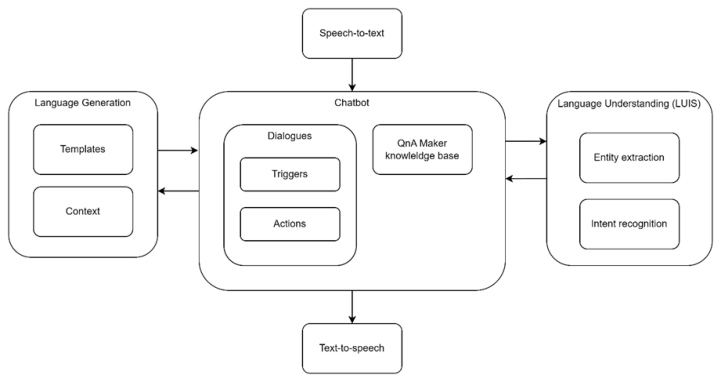
Since the purpose of this project is a proof of concept, making a neural network from scratch was excessive. Transfer learning was a great option if there were a suitable dataset in Spanish which couldn’t be found, leaving frameworks as the preferred option. Azure’s bot framework composer was selected to undertake development since it had all the necessary functionality and it was accessible. Figure 1 shows the different components of the chatbot and how they interact.
RESULTS
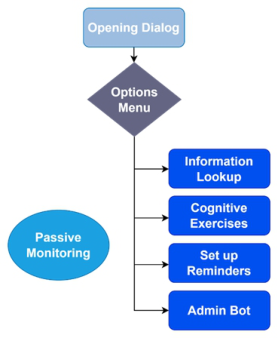
Figure 2 is a high-level representation of the functionality of the proof of concept. The opening dialog prompts the user to a profile initialization and then to a menu of the bot’s features. Information lookups includes the modu- les Consult Bot Options, Ask for Help and Caregiving Assistance. These modules offer relevant information about AD, caregiving, the chatbot itself and it can connect to Azure’s QnA resource to fetch information available online. Cognitive exercises prompts a series of mini-mental style questions and then stores the score for the caregiver to review afterwards (Instituto Nacional de Geriatría, n.d.). The Set Up Reminders module adds, deletes and shows user-defined reminders. Admin bot is made up of the modules Cancel Current Dialog, Reset Bot, Edit or View Profiles and Switch User. It inclu- des all the thing unrelated to dementia that are useful for using the chatbot.
Design and Proof of Concept of Chatbot for People With Dementia 165
Ideal Dementia
Companion
Reminiscence
therapy chatbot
(Carós et al.,
2020)
Griol, Callejas
(Griol &
Callejas, 2016)
Replika
(cakechat)
(Smetanin, 2020)
(Mazzei et al.,
2022)
et al., 2020) GEN-DS
Sequence-to-
Sequence X
End-to-End X X X
learning) X Intelligent Assistants
Task-Oriented X X X
NLG X X X
Context Awareness X X X X X
Intent Recognition X X X X
High Intelligence
Quotient X
High Emotional
Quotient X X X
Connection to
external database X X X
Internet Access X X
AI Chatbot Standard (Deep Conversational
Focus Virtual Companions X X X
Features NLU X X X X X
Supplementary
Components User data storage X X X X
Table 1. Comparative analysis of different chatbots and their characteristics.
Table available in the original PDF paper.
Characteristic Classification XiaoIce (Zhou
Architecture Rule Based X
Figure 1: Chatbot for people with dementia architecture diagram.Figure 2: Functionality diagram of proof of concept.
Passive Monitoring is a trigger that goes off every time some discomfort, anxi- ety, anger or any negative feeling is detected from the user. It is not reliable since the language understanding works by using examples that are manually selected. Each time it goes off the event will be registered on the person with dementia’s profile.
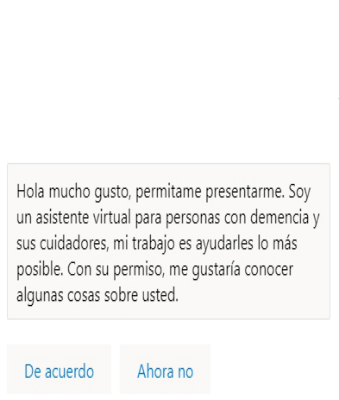
Although Azure’s Composer uses state diagrams to implement the bot, it has features that make it more flexible than a conventional rule-based bot. For example, if a user says “Anota algo”, the add reminder dialog will trigger and the bot will ask the user what they want to write down but if the user says “Recuerdame comprar manzanas”the bot will skip the input prompt and will save the reminder immediately. This way if the user knows exactly what they want the bot to do, they can ask it and skip most of the conversation. Figure 3 shows the bot running on a web chat emulator. The bot can make response
Design and Proof of Concept of Chatbot for People With Dementia 167
Figure 3: Chat sample showcasing suggestions and variable storage.
suggestions that are clickable, on top of sending the text. It is also possible to send audio or to have a live conversation using Direct Line Speech. The bot can store information provided by the user and make messages based on it.
The experience of people with dementia was a crucial aspect on the design of the bot but results would be much better if they themselves were included in the design process. This process has many proven advan- tages (Morrissey et al., 2017) but unfortunately, we didn’t have the opportunity of working directly with people with dementia during this project.
CONCLUSION AND CONTRIBUTIONS The major struggle of the project was that the exploratory research deter- mined that the missing part in chatbots was intelligence but the state of the art showed that making a social chatbot wasn’t practical. The solution was to use a rule-based approach for language generation but some mach- ine learning for the dialog state management. Even though it is not ideal it is still an improvement over the intelligence of most bots found in the syste- matic reviews mentioned (Abd-alrazaq et al., 2019; Ruggiano et al., 2021; Schachner et al., 2020; Thabtah et al., 2020) and it would be the first one in Spanish made for people with dementia. although the bot is very basic in features, Azure’s bot framework makes it easy to modify and expand upon it. The way the conversation flows using triggers makes it so one can poten- tially add more and more modules without getting in the way of existing ones. It is very easy to connect one bot made in composer with another, to connect an external one requires separate hosting and an API but it is still manageable.
REFERENCES
Abadi, M., Agarwal, A., Barham, P., Brevdo, E., Chen, Z., Citro, C., Corrado, G. S., Davis, A., Dean, J., Devin, M., Ghemawat, S., Goodfellow, I., Harp, A., Irving, G., Isard, M., Jia, Y., Jozefowicz, R., Kaiser, L., Kudlur, M.,… Research, G. (n.d.). Ten- sorFlow: Large-Scale Machine Learning on Heterogeneous Distributed Systems. www.tensorflow.org. Abd-alrazaq, A. A., Alajlani, M., Alalwan, A. A., Bewick, B. M., Gardner, P., &
Househ, M. (2019). An overview of the features of chatbots in mental health: A scoping review. International Journal of Medical Informatics, 132. https://doi.or g/10.1016/j.ijmedinf.2019.103978. Carós, M., Garolera, M., Radeva, P., & Giro-I-Nieto, X. (2020). Automatic reminiscence therapy for dementia. ICMR 2020 - Proceedings of the 2020 International Conference on Multimedia Retrieval, 383–387. https://doi.org/10.1145/3372278. 3391927. Chollet, F., & others. (2015). Keras. GitHub. https://github.com/fchollet/keras. Chung, K., & Park, R. C. (2019). Chatbot-based heathcare service with a knowledge
base for cloud computing. Cluster Computing, 22, 1925–1937. https://doi.org/10. 1007/s10586-018-2334-5. de Arriba-Pérez, F., García-Méndez, S., González-Castaño, F. J., & Costa- Montenegro, E. (2022). Automatic detection of cognitive impairment in elderly people using an entertainment chatbot with Natural Language Processing capabi- lities. Journal of Ambient Intelligence and Humanized Computing. https://doi.or g/10.1007/s12652-022-03849-2. Griol, D., & Callejas, Z. (2016). Mobile Conversational Agents for Context-Aware Care Applications. Cognitive Computation, 8(2), 336–356. https://doi.org/10. 1007/s12559-015-9352-x. Grudin, J., & Jacques, R. (2019, May 2). Chatbots, humbots, and the quest for arti-
ficial general intelligence. Conference on Human Factors in Computing Systems - Proceedings. https://doi.org/10.1145/3290605.3300439. Instituto Nacional de Geriatría. (n.d.). Mini-Mental State Examination (MMSE) Mini-Examen del Estado Mental. Retrieved October 27, 2022, from http://inger.gob.mx/pluginfile.php/96260/mod_resource/content/355/Archiv os/C_Atencion_Mixto/Materiales/Sesion_4/8%20Mini-Mental.pdf. Kumar, R., & Ali, M. M. (2008). A Review on Chatbot Design and Implementa-
tion Techniques. International Research Journal of Engineering and Technology. www.irjet.net. Mazzei, A., Anselma, L., Sanguinetti, M., Rapp, A., Mana, D., Hossain, Md. M., Patti, V., Simeoni, R., & Longo, L. (2022). Anticipating User Intentions in Custo- mer Care Dialogue Systems. IEEE Transactions on Human-Machine Systems, 1–11. https://doi.org/10.1109/thms.2022.3184400. Morrissey, K., McCarthy, J., & Pantidi, N. (2017). The value of Experience-Centred
Design approaches in dementia research contexts. Conference on Human Factors in Computing Systems - Proceedings, 2017-May, 1326–1338. https://doi.org/10. 1145/3025453.3025527. Ruggiano, N., Brown, E. L., Roberts, L., Suarez, C. V. F., Luo, Y., Hao, Z., & Hristidis, V. (2021). Chatbots to support people with dementia and their caregivers: Systematic review of functions and quality. Journal of Medical Internet Research, 23(6). https://doi.org/10.2196/25006. Sabharwal, N., & Agrawal, A. (2020). Cognitive Virtual Assistants Using Google
Dialogflow. In Cognitive Virtual Assistants Using Google Dialogflow. Apress. https://doi.org/10.1007/978-1-4842-5741-8.
Design and Proof of Concept of Chatbot for People With Dementia 169
Schachner, T., Keller, R., & Wangenheim, F. v. (2020). Artificial intelligence-based conversational agents for chronic conditions: Systematic literature review. Journal of Medical Internet Research, 22(9). https://doi.org/10.2196/20701. Serban, I. V., Lowe, R., Henderson, P., Charlin, L., & Pineau, J. (2015). A Survey of
Available Corpora for Building Data-Driven Dialogue Systems. https://arxiv.org/ abs/1512.05742. Smetanin, N. (2020). cakechat. GitHub. https://github.com/lukalabs/cakechat. Soria Olivas, E. (2010). Handbook of research on machine learning applications and trends : algorithms, methods and techniques. Information Science Reference. Thabtah, F., Peebles, D., Retzler, J., & Hathurusingha, C. (2020). Dementia medical
screening using mobile applications: A systematic review with a new mapping model. Journal of Biomedical Informatics, 111. https://doi.org/10.1016/j.jbi. 2020.103573. Tiersen, F., Batey, P., Harrison, M. J. C., Naar, L., Serban, A. I., Daniels, S. J. C., & Calvo, R. A. (2021). Smart home sensing and monitoring in households with dementia: User-centered design approach. JMIR Aging, 4(3). https://doi.org/10. 2196/27047. Zhou, L., Gao, J., Li, D., & Shum, H. Y. (2020). The design and implementation of
xiaoice, an empathetic social chatbot. Computational Linguistics, 46(1), 53–93. https://doi.org/10.1162/COLI_a_00368.
LISTED IN THE AHFE DIGITAL BOOKSTORE CATALOGUE
Explore the complete digital volume
Healthcare and Medical Devices
Read this individual research paper free through the original publisher, or explore the full digital proceedings book.
ISBN 978-1-958651-55-1
Explore this ISBN in the AHFE Bookstore ↗Listed in the July 2026 bookstore catalogue; search by ISBN to confirm current availability · Digital book purchase optional