Gemma Alejandra Martínez Santos, Ariel Lopez Aguilar, Sergio Navarro Tuch, Lili Marlene Camacho Bustamante, Rogelio Bustamante-Bello (2023). Granting a better verdict of the Mini-mental State Examination (MMSE) with new technologies. In: Human Factors in Aging and Special Needs. AHFE Open Access, vol. 88, pp. 48–58. https://doi.org/10.54941/ahfe1003661
There are millions of people in the world who have been diagnosed with dementia and this condition not only directly affects the patient, but also their family members and caregivers; That is why it is sought to have a verdict in which it can be reliably seen if a person suffers from dementia. The way to know if the patient have dementia, is doing a test, one of the most famous tests is the Mini-mental State Examination (MMSE) this is test that is formed by five different sections: Orientation Registration, Attention and calculation, Language, Deferred memory; where it will seek to implement new parameters that will be recollected during al the test with a non-invasive sensor named shimmer, such as emotional response through facial expression analysis, galvanic skin response, heart rate and image similarity, using iMotions and OpenCV; the collected data is useful to the doctors to have an insight about the patient and they can give a better diagnose, and they can see the most difficult part to the participant.
Dementia, is a disease that has various problems beginning that, like other types of diseases, has no cure. According to the World Health Organization (WHO), dementia is “A syndrome in which there is deterioration in cognitive function beyond what might be expected from the usual consequences of bio- logical ageing”(Wold Health Organization, 2022) “Dementia affects around 50 million people globally, of whom around 60%live in low- and middlei- ncome countries. Every year about 10 million new cases are registered. It is estimated that between 5% and 8% of the general population aged 60 and over have dementia at any given time. The total number of people with dementia is projected to reach 82 million by 2030 and 152 million by 2050. “ (Wold Health Organization, 2022) Seeking to increase research in the area of Alzheimer’s, the United States of America increased its annual investment to about US$ 2.8 billion in 2020 (Wold Health Organization, 2022).
Granting a Better Verdict of the Mini-Mental State Examination (MMSE) 49
Dementia was heard for the first time in the Roman Empire and means “madness, out of one’s mind” and in Latin is: de- without and men- mind and together means away and less of mind (Nitrini, 2011).
People who suffer from this disease have various restrictions to carry out activities within society, including violating their human rights, all this, due to their medical condition. The people that suffer this disease needs: right love, optimal conditions, respect and right in many ways; according to the article “The rights of persons with dementia and their meanings”(Cohen-Mansfield, 2021). Currently there are many therapies that improve the state of the patient, some of these therapies are:
Effects of a personalized music intervention for persons with dementia and their caregivers (Bufalini et al., 2022): The article explains the impact of music on people and conducts sessions for both caregivers and patients; where it results in a benefit, since both patients and caregivers feel less overwhelmed after the sessions that were done to them.
Cognitive behaviour therapy and the person with dementia (Gibson, 2014): This article talks about cognitive behavioural therapy (CBT) and the impact it has on its patients, since for everything that involves having dementia, patients can become depressed or worried. This therapy consi- sts of talking and approaching the patient; where it is proven that it has a positive effect on patients.
Animal assisted therapy for persons with dementia (Hodži´c and Mimica, 2020): With this therapy, it is verified that it reduces the stress and the anxiety of the patients, and it must be carried out by specialists.
Art therapy as a multidimensional and complementary therapy in persons with brain damage (Martinec and Pivac, 2021): In this therapy with the help of different artistic techniques, the patient is subjected to develop greater emotional expression, socialization, adaptation, and acceptance.
The communication supporting robot based on “Humanitude” concept for dementia patients (Iwabuchi et al., 2019): Through “Humanitude” (a method of contact with patients where touch, eye contact, kick, words, among other things, are worked on); It is linked to a robot, to work these two parts, applying a robot based on the humanity technique.
With these therapies the patients can be benefited, both in their state of mind, and in the diagnosis or monitoring of the disease.
BACKGROUND
Dementia has always existed; however, the word dementia was mentioned during the Roman Empire, referring to memory loss due to aging and this term was attributed to all people with any mental or behavioural disorder; we continue in the middle ages where the same definition of the Roman empire was preserved, ideas that are related by calling them stupidity or madness. Already by the eighteenth century, the word dementia appears formally in Blancard’s Physical Dictionary, in 1726 referring to the mindless or mental deficiency; said dictionary refers to madness or extravagance, and by the
50 Martinez-Santos
nineteenth century this changed (Nitrini, 2011). During the 19th century, the concept of dementia is attributed to it as an irreversible disease related to age and that goes hand in hand with the central nervous system, the years went by and brain imaging techniques increased in quality, the Treatise on Psychiatry Wilhelm Griesinger (1845) introduced concepts such as apathetic dementia, states of mental weakness, presenile dementia, presenile demen- tia, among others. Research continues for the 20th century and terms such as Alzheimer’s, Pik and Jacob are added, activating neurological interest in kno- wing more about this disease (Nitrini, 2011). For the 21st century or today, various methods are being sought to treat this disease, to seek a treatment that counteracts the symptoms caused by it, especially for Alzheimer’s, since the majority of people with dementia have this type (Nitrini, 2011).
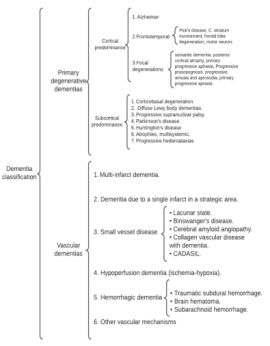
Theoretical Framework Dementia is the state of a person where they manage a loss or suffer from a weakness or alteration or deterioration where a person is not able to make decisions, remember things or even think. Also this state causes a deteriora- tion of cognitive ability or neurocognitive disorder, it is worth mentioning that there are many types of dementia, this is caused by the loss of nerve cells in the brain, it is the accumulation of abnormal proteins in neurons, such as: peptide beta-amiloide, tau protein, alphamononucleotide, among others. As mentioned, there are many types of dementia, as it is shown in the Figure 1.
Dementia affects the person in his mental processes and in his persona- lity, however there are different terms that are necessary to know for the understanding of this condition, such as: Amnesia, memory loss; agnosia, loss of ability to recognize objects; apraxia, loss of awareness of activities or motor skills; aphasia, losing the ability to speak both in comprehension and emission; anosognosia, patient’s inability to cope with cognitive deficits.
All these depend on the type of dementia and the stage in which the patient is. Some initial symptoms are mild complaints and disorientation.
Figure 1: Dementia classification based on the book sindromes geriatricos (Ning et al., 2022).
Granting a Better Verdict of the Mini-Mental State Examination (MMSE) 51
Later, this forgetfulness is more continuous, and the deterioration is more advanced, there may be aggressive behaviours and even motor difficulties.
Bringing therefore in any type of dementia cognitive, motor, and social deficits, it is chronic progressive that deteriorates mental functions. According to the Alzheimer’s Association there are various existing tests to identify whether there is cognitive impairment, where the patient is asked various questions about object identification, calculation, drawings, among other things. Some of the tests are: Minimental-State Examination (MMSE), Mini-Cog, Montreal Cognitive Assessment Test (MoCA), Functional Activities Questionnaire (FAQ), among others (Alzheimer’s Association, no date).
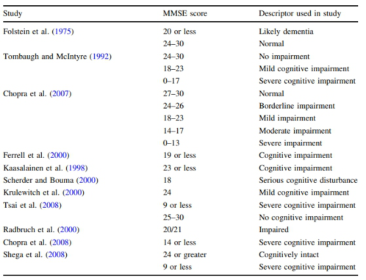
State of De Art I would like to emphasize the way in which the tests are done to detect demen- tia, these tests are very important, because in the same way with these patterns it will be possible to observe what the patients respond and the form of eva- luation of the doctors so that wandering can be identified. One of the main tests is the Mini-mental State Examination (MMSE), the test is measured with a score of 30, this depends on the questions, the test and the doctor or method applied (Figure 2). The questions have different categories, among which are: spacetime and space (dates or time), memory/attention/concen- tration (memorize words), calculation (mathematics), language (play with sentences and speech), instructions (understand and acts), drawing (repeats patterns), writing (creates a coherent sentence), naming (knows the names of things). It is worth mentioning that this test is for all people, even if they do not have academic studies, in case they do not have them, what is done is to add certain number of points that are equivalent to the questions that require said education.
In the Figure 2 are some examples of the way to evaluate the Mini-Mental State Examination test(de Baeman et al., 2004).
It is worth mentioning that this test is for all people, even if they do not have academic studies, in case they do not have them, what is done is to add
Figure 2: Table of number of points retrieved from using the, Mini-Mental State Exam (MMSE) (Monroe and Carter, 2012).
52 Martinez-Santos
a certain number of points that are equivalent to the questions that require said education.
There are already many methods or therapies to detect dementia, below are some ways or methods that have currently been used to treat people with dementia. One of music therapy, this improves communication, the way of socializing, which impacts the attitude and quality of life of people with this condition, in addition a study was carried out where if this type of practice is carried out with their caregivers, the results are better, this is mentioned in the article Effects of a personalized music intervention for persons with dementia and their caregivers (Bufalini et al. 2022).
Different equipment is also used such as: ultrasound, transcranial static magnetic field stimulation (TMS), photobiomodulation, transcranial direct current modulation (tDCS), Deep Brain Stimulation (DBS); with which vari- ous treatments can be carried out or help them to be carried out, such as: Ultrasound Stimulation, this stimulates the tissues by means of a high- frequency shot in a region of interest, causing brain stimulation; Electrical Stimulation, this works with the stimulation or elimination of one or seve- ral nerve cells, this system is adapted so that both patients and doctors can monitor them; Electrical Brain Implants, this is a therapy that uses neurote- chnology, with transistors and integrated circuits, the process of this implant takes about a week to be accepted and the brain tries to encapsulate said tech- nology; Magnetic Brain Stimulation, this is a non-invasive method, that is, the patient does not have to be opened as a usual operation and it is a magnetic stimulation to activate brain regions through magnetism; Nanovectors, these are divided into 3 categories that are, lipid-based, non-lipid organic-based, and inorganic, these to load the exact amount of drug or medication requi- red by the patient or administer brain agents; Magnetic Nanoparticles, are made of a nanomaterial that brings together various technologies that pro- vide different benefits, but the main one is the controlled administration of drugs; all these tests are shown in the article Neurotechnological Approaches to the Diagnosis and Treatment of Alzheimer’s Disease (Ning et al., 2022).
It is also important to mention a therapy that has become the most used, which is Cognitive Behavioral Therapy (CBT), which aims to help people deal with their feelings, understanding the links between those who think, feel and they do. Now, within CBT it is important to understand emotions when we are dealing with a patient, that is why it is also important to mention humanity as a method of care, it uses various methods to empathize with the person while we are treating them, by maintaining eye contact and in this way you can also realize what the patient feels or with the gestures they make, that is, their emotions, thus treating depression and anxiety in patients, it is also important to mention the part of the speech, since sometimes patients even limit themselves to answering, but the way in which they are spoken to is very important, that is, the speed, tone, vocabulary, volume, among others. On the other hand, when making physical contact with the patient, it is important that it be broad, slow, and soft, as mentioned in the article Cognitive behavior therapy and the person with dementia (Gibson, 2014).
One of the tactics that also works to maintain ties with the patient is the humanitude technique, which consists of looking, touching and speaking, all
Granting a Better Verdict of the Mini-Mental State Examination (MMSE) 53
this through various actions such as games, questions, among other things, having conversations or some type of contact that provokes positive emoti- ons in the patient, according to the article The Communication Supporting Robot based on “Humanitude” Concept for Dementia Patients (Iwabuchi et al., 2019).
The methods that were used to obtain our state of the art were according to whether there was a solid base and that it was as descriptive as possible, most of the time the papers were about the same thing, however some were not as complete as others, so the report and state of the art is based on those that can provide us with more information.
Project Development The project is based on the MiniMental State Examination (MMSE) (de Baeman et al., 2004) the same one that is applied in the National Institute of Geriatrics, this test consists of different parts where different aspects are evaluated, such as: orientation, registration, attention and calculation, lan- guage and deferred memory, where according to the score, it is determined if the person does not have the condition, suffers from dementia and in what stage it is (mild, moderate or severe).
The project consists of the application of the Mini-Mental State Examination (MMSE) the same one that is applied in the Instituto Nacional de Geriatria (de Baeman et al., 2004) later the data will be analyzed with a python code that gives us the percentage of similarity between both images. Throughout the exam, the person undergoing the study will have a shim- mer to obtain the data of the heart rate and the galvanic response of the skin; likewise, the video is taken to later analyze with iMotions and iden- tify the emotions that the patient has during the study, finally the percentage of similarity of drawings (required in one of the parts of the test) will be measured.
OBJECTIVES
Implement the investigated methodology and the construction of the data- base through a pilot test (in this first stage of patients without conditions), which focuses on the care, follow-up and monitoring of people with dementia during the MMSE test.
Evaluate the implemented methodology, through a validation of a statisti- cal analysis that is implemented in the analysis of results; to subsequently determine the adjustments required for the data recovery methodology.
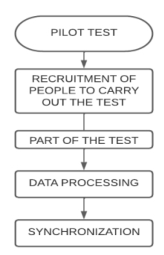
PILOT TEST The parts of the pilot test will be shown below (Figure 3), the recruitment part, to the synchronization part of the obtained data. Each part of the pilot test is described in detail later.
a) People recruitment Firstly, it is necessary that the participants meet the age requirements and that they do not suffer from any neurological disease; subsequently,
54 Martinez-Santos
Figure 3: General diagram of the pilot test.
the entire procedure and the objectives of the pilot test are explained to them; Once having this, the participants must sign a consent letter and the necessary tools for its development are placed. b) Start of the test The applied test was an adapted version for Spanish speaking patients. The test was carried out in an testing booth. The test composition is was at follows.
Orientation: 9 questions (4 time questions, 5 space questions)
Registration: Repetition of 3 words
Attention and calculation: 1 question
Language: 3 instructions
Deferred memory: 4 questions: Within this part, the patient will be asked to copy a drawing and this will be done on a tablet in order to also study the drawing later. Finally, the respondent is thanked for participating and we remove the equipment. c) Data processing Subsequently, the data obtained during the test will be collected, which are galvanic skin response, emotional response, image similarity, heart rate and the result of the test score.
The recorded videos of the emotional response of the people during the MMSE test where they will later be processed in the iMotions softw- are to measure the evidence of each emotion present in the test subject. Obtaining the data of the galvanic skin response (GSR) in ohms and heart rate, by a shimmer sensor and the data will be taken in real time, where the data will be seen and exported in csv format. By means of a python open CV code, the similarities of both drawings (original and test) will be measured as a percentage, using the spatial cosine function (finds the best image match); in order for the result to be positive and put as correct in the test, it must first pass 60 percent in the similarity test and also have a manual check.
The results of the test are evaluated with the Chopra 2007 score, and these will be useful to us in the same way to gather the data.
Granting a Better Verdict of the Mini-Mental State Examination (MMSE) 55
d) Synchronization In this part, the data per person is gathered in the same excel where the event number is added to the parameters and the results of the test, the last one will always be kept until there is a new one in case there are more events in others parameters occur.
Project Development The results of 21 participants between 18 and 35 years of age were obtained where the aforementioned process of the pilot test was carried out.
The results obtained from a participant in all parameters (correct questi- ons, heart rate, galvanic skin response, similarity, emotional response) will be explained.
For the development of the test, the same procedure was carried out with each one of them, a confidentiality letter was established, instructions and the sensor was placed, the MMSE was carried out and the results were obtained by the iMotions software.
Below are the results obtained from one subject. It is worth mentioning that to make a more detailed analysis, it is necessary to know up to which event number corresponds to a section, these number can be appreciated in the figures 4, 5, 6 in the x-axis.
Orientation: 148–1407
Registration: 1408–1758
Attention and calculation: 1759–2500
Language: 2501–3644
Deferred memory: 3645–4990 Correct answers in the test. Firstly, we observe the number of correct and incorrect answers within the test, in this case, the participant answered all the questions correctly.
Orientation: 10 correct
Registration: 3 correct
Attention and calculation: 5 correct
Language: 5 correct
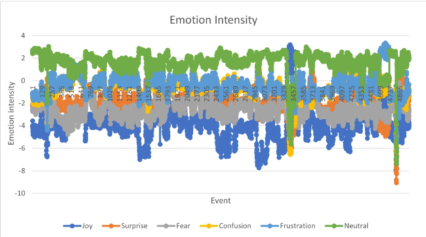
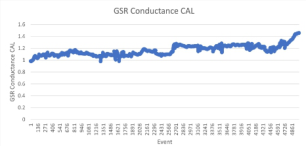
Deferred memory: 7 correct Emotional response This first graph (Figure 4) shows the emotional response, to see if at any time he felt or made an expression of: joy, surprise, fear, confusion, frustra- tion, neutral. The event number is shown on the x-axis while the intensity of emotion is shown on the y-axis. It can be seen that he had a mostly neutral response, with some frustration during all the test. Galvanic Skin Response GSR For the part of the galvanic skin response (Figure 5), the event number is shown on the x axis, while the skin conductivity is shown on the y axis. In this case, there are sections where greater conductivity appears, that is, the subject became more nervous and it is reflected in the sweating of their extremities.
56 Martinez-Santos
Figure 4: Graph of the emotional response.Figure 5: Graph of GSR.
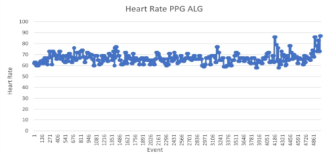
Heart Rate For the heart rate, in certain parts we have a much larger response, as can be seen in the following Figure 6, we seek to see at which point it has a greater response and observe the behaviour of the peaks. The event number is shown on the x axis while the heart rate is shown on the y axis.
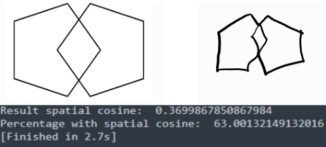
Image Similarity For the image similarity part, it was established through different tests that to have a response similar to the original drawing, a response of 60 or more
Figure 6: Graph of heart rate.Figure 7: Image similarity.
Granting a Better Verdict of the Mini-Mental State Examination (MMSE) 57
is needed. In Figure 7 is the original image of the test and in the right is the drawing of the test taker, giving a result of 63.00132149132016.
From this it can be concluded that although he had all the correct answers, there were sections that cost him more work.
CONCLUSION
With this work it is verified that there are new ways to evaluate the test and not only with the MMSE but also with the behaviour, at this point we already have the databases of the participants; so now it is necessary to identify the algorithm that encompasses said behaviour of all participants. It seeks to give a more accurate verdict to the patient and their families, new technologies were implemented where the diagnosis is not only sought to be obtained or based on the response of the participants to the test, but also to evaluate the behaviour during the test.
ACKNOWLEDGMENT
We want to thank to Tecnologico de Monterrey for the installations for the research, also to the Dr. Alberto Palacios from Dementia Friends Mexico Association and Dr. Luis Arturo Sirgo for their advice and support.
REFERENCES
Alzheimer’s Association (no date) Medical Tests for Diagnosing Alzheimer’s. Available at: https://www.alz.org/alzheimers-dementia/diagnosis/medical_tests (Acces- sed: 14 November 2022). Bufalini, J. et al. (2022) ‘Effects of a Personalized Music Intervention for Persons
with Dementia and their Caregivers’, Journal of Alzheimer’s Disease Reports, 6(1), pp. 43–48. Available at: https://doi.org/10.3233/ADR-210043. Cohen-Mansfield, J. (2021) ‘The Rights of Persons With Dementia and Their Meanings’, Journal of the American Medical Directors Association, 22(7), pp. 1381–1385. Available at: https://doi.org/10.1016/j.jamda.2021.03.007. de Baeman, S. et al. (2004) Validation of a Modifiied Version of the Mini-Mental
State Examination (MMSE) in Spanish, Aging Neuropsychol Cong. Aging, Neu- ropsychology, and Cognition. Gibson, J. (2014) CBT and the Person With Dementia Chapter: Grief and Loss Book: The Impact of Mental Health and Wellbeing on Effective Learning and Teaching: A Practical Guide for Those Responsible for Learners. View project. Available at: https://www.researchgate.net/publication/263338341. Hodži´c, J. B. and Mimica, N. (2020) ‘Animal-assisted therapy for persons with
dementia Side effects of psychopharmacs View project Posttraumatic stress disorder in Croatia View project’, in Croatian Congress onAlzheimer’s Disease (CROCAD-20v), p. 58. Available at: https://www.researchgate.net/publication /345733971. Iwabuchi, Y. et al. (2019) ‘The communication supporting robot based on “humanitude”concept for dementia patients’, in 2019 IEEE 1st Global Conference on Life Sciences and Technologies, LifeTech 2019. Institute of Electrical and Electronics Engineers Inc., pp. 219–223. Available at: https://doi.org/10.1109/LifeTech.2019. 8884049.
58 Martinez-Santos
Martinec, R. and Pivac, D. (2021) ‘ART THERAPY AS A MULTIDIMENSIONAL AND COMPLEMENTARY THERAPY IN PERSONS WITH BRAIN DAMAGE’, in 2nd International Scientific Conference of the Department of Psycology at the Catholic University of Croatia. Zagreb, Croatia: Catholic University of Croatia, pp. 211–223. Available at: https://www.researchgate.net/publication/359768101. Monroe, T. and Carter, M. (2012) ‘Using the Folstein Mini Mental State Exam
(MMSE) to explore methodological issues in cognitive aging research’, Euro- pean Journal of Ageing, 9(3), pp. 265–274. Available at: https://doi.org/10.1007/ s10433-012-0234-8. Ning, S. et al. (2022) ‘Neurotechnological Approaches to the Diagnosis and Treatment of Alzheimer’s Disease’, Frontiers in Neuroscience. Frontiers Media S. A. Available at: https://doi.org/10.3389/fnins.2022.854992. Nitrini, R. (2011) Evolución histórica del concepto de demencia y las principales
enfermedades relacionadas. Atheneu. Wold Health Organization (2022) Dementia, WHO News Room Dementia. Available at: https://www.who.int/news-room/fact-sheets/detail/dementia (Accessed: 24 September 2022).
LISTED IN THE AHFE DIGITAL BOOKSTORE CATALOGUE
Explore the complete digital volume
Human Factors in Aging and Special Needs
Read this individual research paper free through the original publisher, or explore the full digital proceedings book.
ISBN 978-1-958651-64-3
Explore this ISBN in the AHFE Bookstore ↗Listed in the July 2026 bookstore catalogue; search by ISBN to confirm current availability · Digital book purchase optional