Constantin Jomir, Carmen Mihai, Alexandra Gabriela Ene, Mihaela Jomir (2023). Mathematical Models for the Assessment of the Composite Structures of Cylindrical Floating Elements Level of Performances, Used in Brackish Seas. In: Human Aspects of Advanced Manufacturing. AHFE Open Access, vol. 80, pp. 200–206. https://doi.org/10.54941/ahfe1003522
The safety of life and navigation in the areas with high risk potential adjacent parts to the coast, the fight against pollution with oil fractions, as well as the protection of marine biodiversity, all represent the central objective of this research action. One of the critical points was to statistically assess and decide the performance level of the composite structures of the modular systems with a cylindrical form, designed for the sustainable development of biodiversity and aquatic ecosystems. For this purpose, a database that includes two independent variables related to the physical-mechanical/physical-chemical values of the used raw materials was created. There were considered 1000 values associated to the: i) mass per surface unit; ii) maximum breaking force in the warp; iii) elongation at break in the warp; iv) tearing force in the warp and batting; v) film type. Moreover, 800 values related to the raw material were included for the determination of the length density, resistance and elongation at break, torsion, resistance and elongation at the knot, resistance and elongation at the loop. Descriptive statistics were used for the: a) determination of the parameters that evidence the homogeneity degree of the analysed data; b) assessment of the coefficients of variability that demonstrate the extent to which the data groups are homogeneous or heterogeneous; c) histograms of each variable, which highlight the asymmetry of the distribution, with the predominance of frequencies or variables. The statistical data analysis enabled the prediction of the asymmetries of the data series, related to Skewness and Kurtosis. The links between the considered variables were established according to the values of the correlation coefficients for each of the composite structures studied. The regression equations were developed to express the influence on the resistance to tearing for the transverse/longitudinal system of: mass, resistance and elongation at break of the composite material and resistance to knot breaking of the yarn from composite matrix structure. It was shown that for the prediction of the value of the composite element’s resistance to tearing, the values of this characteristic in the warp should be preferentially considered. In the weft direction, the introduction of additional independent variables is necessary. The two tested variants of composite material were differentiated by the fibrous composition and structure of the reinforcement matrix, for the longitudinal and transversal systems (45//55%PES//PA6.6, ratio: 1:1/100//100 PES//PES, ratio 2:1). Four mathematical models that are approximately normally distributed and follow the cumulative percentage line described by the normal curve were created. The mathematical models demonstrated that, in the design stage, for dynamic conditions (impact factor 2.5), the tear resistance value should be considered in both systems.
The technique of signalling of the risk areas for the marine domain in general, and for brackish water in particular, takes into consideration the following specific situations: i) for inland waterways, and in international waters, the particularities are related to the hydrological characteristics (Borsa, 2014; Borsa, 2015)defined by: the cross-section, flow rate, level and slope of the watercourse, bathymetric curve, valley, navigable channel and its overall dimensions (Atanasiu, 2022); ii) for the protection of marine biodiversity,
Mathematical Models for the Assessment of the Composite Structures 201
this is especially related to the coastal geomorphology, the bottom confi- guration of the aquatic environment (Bejan et al. 2019; Georgescu, 2021) the thermal regime of the water in the shore area, etc.; iii) for oil spills, which have dramatic effects on marine ecosystems, as a result of the expo- sure of living organisms to chemical compounds, it is particularly important to assess the state of agitation of the sea, the type-size of the stain, the hydro- meteorological conditions at the time of the intervention, etc (Olteanu, 2004; Cipollari et al. 1999).
One of the critical point was to statistically assess and decide on the level of performance of the matrix structures of the modular systems with cylindrical form, designed and developed for the sustainable development of biodiversity and aquatic ecosystems for brackish seas (water with low salinity, of −0.5 −30 ⣰) found in areas where a river flows into the sea or ocean (Vasiliev et al. 200; Cita, 1982; Andreescu, 1972).
For this purpose, a database that includes independent variables related to the physical-mechanical/physical-chemical values of the used raw materials was created.
Were considered 1400 values associated to the: i) mass per surface unit; ii) maximum breaking force in the warp and weft; iii) elongation at break in the warp and weft; iv) tearing force in the warp and weft; v) film type.
Moreover, 1600 values related to the raw material, were included for deter- mination of the: resistance and elongation at break, resistance at the knot and loop.
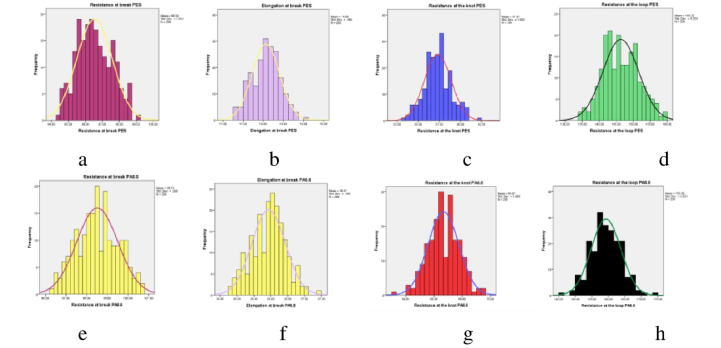
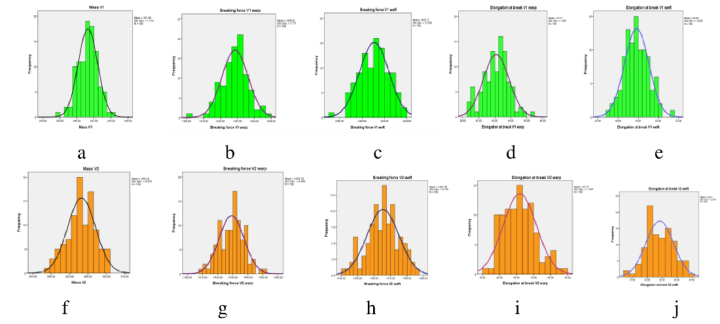
Descriptive statistics were used for: a) determination of the parameters that evidence the homogeneity degree of the analysed data; b) assessment of the coefficients of variability that demonstrate the extent to which the data groups are homogeneous or heterogeneous; c) drawn the histograms of each variable in order to highlight the asymmetry of the distribution, with the predominance of frequencies or variables.
MATERIALS AND METHODS
The testing was carried out in accredited laboratories according to SR EN ISO/CEI 17025:2001 for 2 variants of textile structures and 2 variants of threads from their component. Relevant information related to the data stru- ctures, analyses performed and the number of determinations is presented in Table 1.
The database created includes 3000 values and 11 variables divided as fol- lows: a) 3 independent variables representing the physical-chemical/physico- mechanical characteristics for 2 variants of raw material (V1 and V2) used to make the components of high-tech composite structures for the sustaina- ble development of biodiversity and aquatic ecosystems, cylindrical in shape and used in brackish seas and b) 3 independent variables representing the physical-mechanical characteristics for 2 variants of raw material (PES and PA 6.6).
The tearing force in the warp and weft for the 2 variants tested were considered as dependent variables (400 values).
Table 1. Identification data of variants of structures and threads for composite materials achievement and the performed analyzes.
Table available in the original PDF paper.
Characteristics Variant 1 Variant 2
1000den/195fx1/120Z 1000den/195fx1/120Z
Data for textile structures identification Raw material:Warp 100% PES 100% PES Raw material:Weft 100% PA6.6 100% PES Length of density: Warp 940den/120fx1/80Z 1000den/195fx1/120Z Length of density: Weft
Film type/colour polyurethane film /green teflon/orange film Performed analyzes /No. of determinations Textile structures mass per surface unit/200 data maximum breaking strength in warp and weft/400 data elongation at break in warp and weft/400 data breaking strength in warp and weft/400 data Raw materials (yarns) PES and PA6.6
Braking resistance and elongation/800 data knot resistance /400 data loop resistance /400 data
Using descriptive statistics: a) were determined the amplitude, standard deviation and dispersion; b) were calculated coefficients of variability and was evidenced the homogeneity or heterogeneity of the data groups; c) were drawn the histograms of each variable; d) were represented the level and dispersion indicators - the box - plot graphs.).
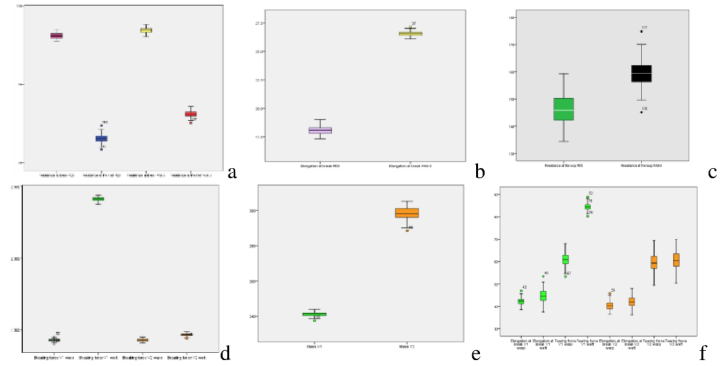
The histograms drawn for all 11 studied characteristics for raw materials (yarns: PES and PA6.6 and 2 variants of textile structures) are presented in Figure 1 and 2, and the boxplot graphs for the same characteristics (Figure 3 and 4). Statistics are presented in Table 2.
Figure 1: Histograms for raw materials (yarns): - breaking resistance: a. PES, e. PA6.6; - braking elongation: b. PES, f. PA6.6; - knot resistance c. PES, g. PA6.6; - loop resistance d. PES, h. PA6.6.
Mathematical Models for the Assessment of the Composite Structures 203
Figure 2: Histograms for textile structures: - mass a. V1, f. V2; - breaking force in warp b. V1, g. V2; weft c. V1, h. V2; - breaking elongation in warp d. V1, i.V2, weft e.V1, j. V2.Figure 3: Box plot graphics - variable for raw materials (yarns): a) breaking and knot resistance for PES vs. PA6.6; b) breaking elongation for PES vs. PA6.6; c) loop resi- stance for PES vs. PA6.6; - variable for textile structures: d) breaking force for V1, V2 warp, weft; e) mass V1, V2; f) breaking elongation V1, V2 warp, weft, tearing force V1, V2 warp, weft.
The obtained asymmetry indicators evidenced that for all variables the series present left or positive asymmetry, with small values predominating.
Skewness negative and much different from zero (Table 2) demonstra- tes that the data series is strongly negatively asymmetric, the curve being elongated to the left.
For positive Kurtosis values the curve is sharp, so the distribution is leptokurtic, and for negative values the curve is platykurtic with a strong variation of the variable in parallel with a weak variation of the frequencies.
Table 2. Statistics.
Table available in the original PDF paper.
Characteristics N Mean Skewness Kurtosis Percentiles
25 50 75
Raw materials (yarns) - PES Breaking Resistance, N 200 96.5 0.180 −0.659 95.73 96.45 97.40 Breaking Elongation, % 200 18.1 −0.036 −0.410 17.83 18.01 18.32 Knot Resistance, N 200 57.3 0.124 0.094 56.26 57.31 58.31 Loop Resistance, N 200 146.3 0.169 −0.419 142.23 145.93 150.25
RESULTS AND DISCUSSIONS An extensive study has been conducted and the obtained results evidenced the following.
The series are very homogeneous, with reduced variation. As the vari- ability coefficient for all variables V ≤5%, could be concluded that the representatively is the average value of the analysed series.
For all 11 variables the box-plot graphs demonstrate a very low variability of the results, because the dimensions of the box are small and, in most cases, median. The central tendency overlaps its edges.
The links between the considered variables were established according to the values of the correlation coefficients for each of the studied composite structures.
The correlation analysis carried out highlighted that the modulus of the correlation coefficient is in the interval [0.646; 0.903] for V1 in the interval [0.646; 0.900] for V2, and that there are strong links between them.
The quadratic multiple correlation coefficient determined with the help of a specialized software demonstrates that for the corresponding mathematical model for tearing force in warp V1, 100% of the variation of the dependent variable is explained by this model. The regression equation is:
Mathematical Models for the Assessment of the Composite Structures 205
Tearing force V1warp = 324.7 −0.9 mass + 0.1 Fmax break elongation V1U – 1.95 brake elongation V1U −0.06 break elongation V1B −0.49 Knot Rbreak PES For the corresponding mathematical model of tearing force in weft V1, 75% of the variation of the dependent variable is explained by the model and the predictive power is approximately 83%. The regression equation for tearing force weft is:
The value of the quadratic multiple correlation coefficient of 61.4% demonstrates that, for the corresponding mathematical model tearing force in warp V2, the variation of the dependent variable is explained by this model. The regression equation is of the form: Tear resistence V2U = 576.9 −3.2 mass + .08 Fmax breakV2U −.007 Fmax breakV2B + 3.39 breaking elongation V2U + 3.9 breaking elongation V2B + 3.2 Rbreak PES −.6 knot Rbreak PES −.42Loop Rbreaj PES
The significance threshold for the F test has a value of 0.945, which leads to the idea that the model explains significantly more variation if other unfore- seen or uncontrolled factors are considered (design on systems, connection, mounting and adjustment parameters, thickness of deposit on the surface, etc.)
It was demonstrated that the Mathematical Model for predicting tearing force in weft V2 is of 93.7% from the variation of the dependent variable and is explained by the model. The regression equation for Tear Strength V2B is: Tear resistance V2B = 1191.2 −3.8 mass −.16 Fmax breakV2U -.18 Fmax breakV2B – 2.5 breaking elongation V2U - 11.3 breaking elongation V2B − 10.37 Rbreak PES −.61 Knot Rbrak PES + Loop1.36 Rbreak PES It can be stated with a probability of 95% that there is a dependency betw- een the variables considered for each version of the woven structure and this aspect must be considered in the design stage of the fabrics. In addi- tion, considering the sign of the correlation, that is positive, there is a directly proportional relationship between the analysed variable.
CONCLUSION
For the V1 variant, the mathematical models created for the tear resistance in the warp and the weft highlighted the fact that for the prediction of the value of the tear resistance of the composite element, the values of this characteristic in the warp must be considered. For the values of this characteristic in the weft, it is necessary to introduce additional independent variables. In the design stage for the woven structure, this aspect must be considered as a function of the tear resistance value in the weft under dynamic conditions (impact factor of 2.5).
For the V2 variant, the value of the significance threshold for the F test highlights the fact that the mathematical model for the V2 tearing force in warp explains significantly more variation if other unforeseen or uncontrolled factors are considered (system design, connection, mounting
and adjustment parameters, thickness deposition on the surface, etc.). The values obtained for tearing force Vs2 in weft are approximately normally distributed, but there is a tendency to underestimate the reality.
ACKNOWLEDGMENT
This scientific paper is funded by the Ministry of Research, Innovation, Digi- talisation within Program 1 - Development of the national RD system, Sub- program 1.2 - Institutional Performance - RDI excellence funding projects, Contract no. 4PFE/2021.
REFERENCES
Andreescu I., (1972): “Contribu¸tii la stratigrafia Dacianului ¸si Romanianului din zona de curbur˘a a Carpa¸tilor Orientali”, D. S. Inst. Geol., VIII, 4, Bucure¸sti. Atanasiu, T. (2022): “Bazele navigatiei. Navigatie estimata si costiera”, Editura
Academiei Navale “Mircea cel Batran” Constanta. Bejan, A., Bujenita, M., (2019) “Dictionar de Marina”, Editura Militara, Bucuresti. Borsa, G, (2015): “Complementi di Nautica, Posiziamento di Precisione nella Guerra di Mine”, Accademia Navale, Livorno. Borsa, G, (2014): “Complementi di Nautica, La Strumentazione Nautica”, Accade-
mia Navale, Livorno. Cipollari P., Cosentino D., Esu D., Girotti O., Gliozzi E., Praturlon A., (1999): “Thrust-top lacustrine-lagoonal basin development in accretionary wedges: late Messinian eoisode in the central Apennines (Italy)”, Paleogeography, Paleoclima- tology, Paleoecology, 151, 149–166, Roma. Cita M. B., (1982): “The Messinian salinity crisis in the Mediterranean”, In
Berckhemer H., Hsü K. J. (Eds.), Alpine Mediterranean Geodynamics, 7, 113–140. Georgescu St. (2021): “Note de curs – Navigatie – Academia Navala”, Constanta. Olteanu R., (2004): “Oscillations of the Black Sea level during the Miocene-Pliocene times”, Geo-Eco-Marina 7-8, Bucure¸sti. Vasiliev Iuliana, Krijgsman W., Stoica M., Langereis G., (2005): “Mio-Pliocene
magnetostratigraphy in the southern Carpathian foredeep and Mediterranean- Paratethys correlation”, Terra Nova, 17, 376–384.
LISTED IN THE AHFE DIGITAL BOOKSTORE CATALOGUE
Explore the complete digital volume
Human Aspects of Advanced Manufacturing
Read this individual research paper free through the original publisher, or explore the full digital proceedings book.
ISBN 978-1-958651-56-8
Explore this ISBN in the AHFE Bookstore ↗Listed in the July 2026 bookstore catalogue; search by ISBN to confirm current availability · Digital book purchase optional