Carmen Mihai, Alexandra Gabriela Ene, Constantin Jomir, Mihaela Jomir (2023). Analysis of the behavior of the floating systems used for boundary of river-sea recreational activities area. In: Human Factors in Software and Systems Engineering. AHFE Open Access, vol. 94, pp. 38–43. https://doi.org/10.54941/ahfe1003768
The network of river courses that cross the territory of Romania has a total length of 118,000 km, to which is added the aquatic part of the Romanian coast (the Black Sea and the harbors), with an area of 39,940 km2. From this territory the UNESCO Biosphere Reserve (the shore of the Delta Danube and the Razim Sinoe complex) cover an area of over 6000 ha. Under these conditions, tourism that includes recreational activities (if the environment allows it) can be extended within the arranged natural aquatic reserves, mainly including the swimming. The natural areas for swimming are protected areas to avoid possible risks of pollution and are specially arranged, respectively: for depths up to 1.50 m, the slope is uniform and the inclination respects the ratio of 1:10 - 1:15, while, for greater depths, the inclination of the slope does not exceed the ratio of 1:3. Considering the strict restrictions imposed on the recreation area, the swimming areas must be strictly and visibly delimited from the areas where other recreational activities are carried out (mooring of charter ships, practicing water sports, etc.) with possible health risks. Additionally, special attention is paid to the delimitation of the bathing area with a depth of less than 0.70 m, for children and people who do not swim for various reasons. In these particular situations, to avoid possible accidents, the delimitation and marking is performed with the help of floating systems made of composite material based on woven structure matrix. For the purpose of ensure the delimitation and signalling of the maritime and fluvial areas, for a depth of 3 m, the researches were focused on the digital development of a flexible composite structure. The geometric, dimensional and structural elements of the composite architecture were predicted based on FEM modeling and were calculated for a solid body in the form of a right circular cylinder. The design and developed flexible structure was experimented at the shore and the main conclusions leaded to the following: i) the composite material behaved appropriately, and, during the monitoring period of 72 hours, no potentially interventions caused by damages were needed; ii) no damage of the textile material or change in geometrical of the solid shape was recorded. The experiments carried out in open sea conditions required the consideration of the specific features of a continuously moving surface (due to sea waves and currents), with large temperature variations and difficult weather conditions. During the experimental trials, the floating systems were placed at Lat. 43.985 Lon. 28.607 Altitude 50m and the meteorological observation were made at every 24 hours within a period of 10 days, during May when dangerous phenomena, such as descending gusts (white squalls, formed as a result of the rise of water in the atmosphere with the cumulonimbus clouds development) and nebulousness were recorded. Regular inspections were performed and the appropriate behavior of the composite material used as core part of the floating marking/signalling systems was registered.
The network of river courses that cross the territory of Romania has a total length of 118,000 km, to which is added the aquatic part of the Romanian coast (the Black Sea and the harbors), with an area of 39,940 km2 (Andrei et al. 2021). The UNESCO Biosphere Reserve (the shore of the Delta Danube and the Razim Sinoe complex) has an area of over 6000 ha. In these areas, tourism that includes recreational activities (when the environmental con- dition are suitable) can be extended within the natural aquatic reserves set up, being mainly represented by swimming. Nautical agreement beaches and ports located on the Black Sea coast and natural inland waters are defined by the land parts or coastal strip adjacent to the sea, lakes or any other aqua- tic zones dedicated for the general public recreational and sportive activities. For example, Tomis is a leisure port located at north part of Constanta city,
Analysis of the Behaviour of the Floating Systems 39
with an area of 22 ha that is intended for seasonal - summer activities such: mooring of charter ships, practicing water sports and swimming. For the Marine Reserve 2 Mai - Vama Veche, the custodian is the Constanta Envi- ronmental Protection Agency with external coordinates in the western part, the shoreline defined by the following coordinates: NW: 43
47’18” lat. N and 28
34’ 57” long. It is; NE: 43
47’ 18” lat. N and 28
41’ 30” long. E; SW: 43
44’20” latitude-N and 28
34’ 51” longitude-E; SE: : 43
44’20” latitude - N and 28
41’ 30” longitude-E. The areas set up for swimming and recreation are protected by international law and are carefully supervi- sed, marked and delimited with the help of signalling systems that warn in cases of potential risk areas (e.g., unevenness of the slope, with an inclina- tion that exceeds the ratio 1:10 - 1:15 for depths up to 1.50 m or 1:3 for greater depths) (GAaf-Deac et al. 2015, Peterson et al. 2021). Additionally, special attention is paid to the delimitation of the bathing area with a depth of less than 0.70 m, for children and people who do not swim for various reasons, the marking for avoiding possible accidents being ensured by flo- ating systems made of composite material, with a woven structure matrix (Wang et al. 2019, Williams et al. 2000). Moreover, the area base litho- logy represented by the bottom of the river, lake or sea - for max. 1.50 m should be made of sand and small gravel, without stones or other materials that can cause injury to swimmers and without aquatic vegetation that can generate the danger of drowning (Li et al. 2022). The researches were tar- geted to the design and development of a floating system in the shape of a right circular cylinder, based on a flexible composite structure, with fabric matrix, for signalling and demarcation of the coastal areas. This innovative system can be used in maritime and fluvial areas, for a depth of 3 m. The geometric, dimensional and structural elements were predicted using FEM modeling.
MATERIALS AND METHODS
The experimental trials at shore were carried out between 28.05 - 08.06.2022 in meteorological conditions specific to this interval and to the zone were the product was placed. The physical-mechanical characteristics of the compo- site material used for the fabrication of the floating element for marking the agreement areas are presented in Table 1.
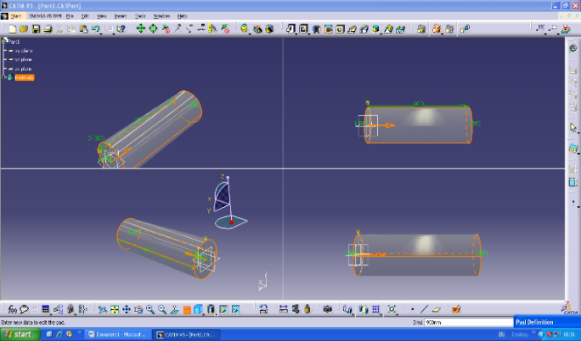
The types and dimensions of the panels and the functional characteristics of the floating element are presented in Figure 1.
The meteorological data were measured in the following conditions: i) sta- tion set up in Tuzla at 22.3km from Constanta, ii) coordinates of the floating system placement: Lat. 43.985 Lon. 28.607 Altitude 50m, iii) period: 28.05 – 08.06.2022, iv) frequency: every 24 hours. The dangerous phenomena, such as descending gusts (white squalls, formed as a result of the rise of water in the atmosphere and the formation of cumulonimbus clouds) and nebulosity were recorded.
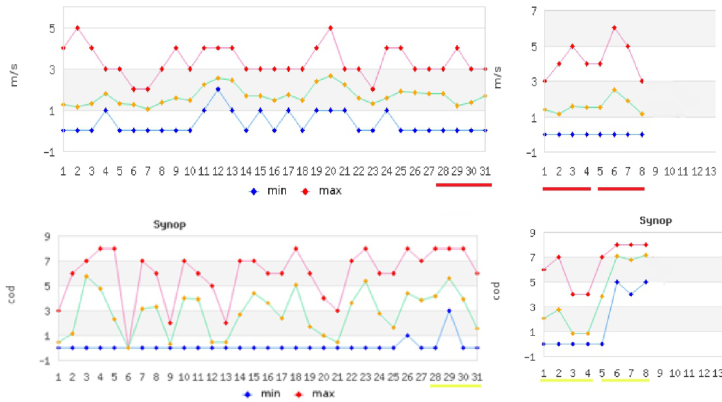
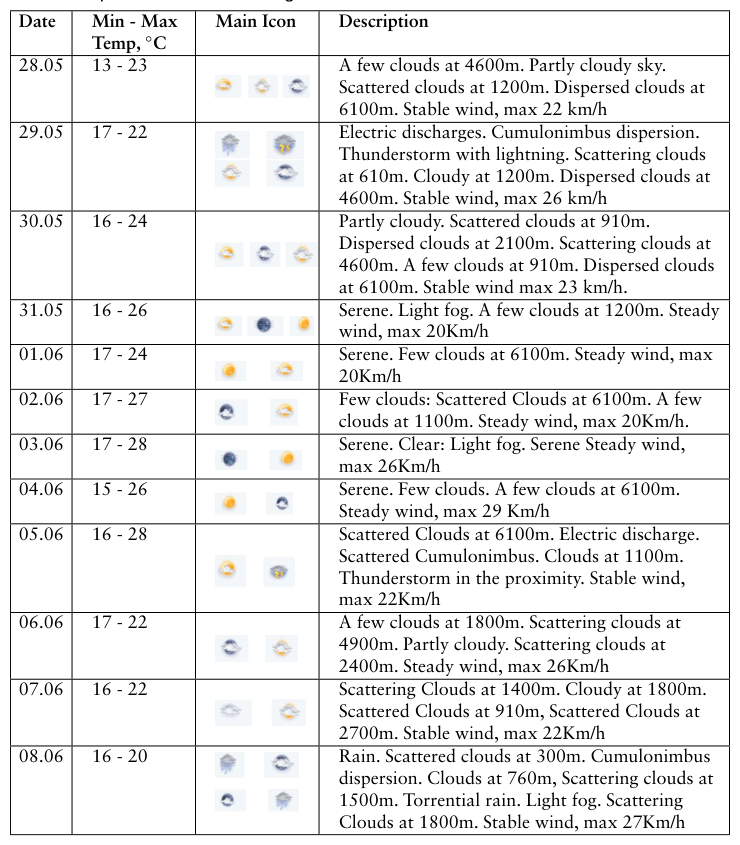
Experimental meteorological conditions are presented in Figure 2 and Table 2.
Table 1. Physical-mechanical characteristics of the composite material and floating element dimensions.
Table available in the original PDF paper.
Variant of the composite material V1 Fibrous composition warp/weft 100% PES Mass, g/sqm 280 Tear resistance, warp/weft, daN 2.2/2.3 Breaking resistance, warp/weft, daN 180/200 Breaking elongation, warp/weft % 18/18 Colour green Constructive shape right circular cylinder Diameter x generators, mm 450 × 1200 Floating element mass, kg 3.65
Figure 1: Right circular cylinder panels.Figure 2: Wind speed and cloudiness assessed according to Synop messages.
Analysis of the Behaviour of the Floating Systems 41
Table 2. Experimental meteorological conditions.
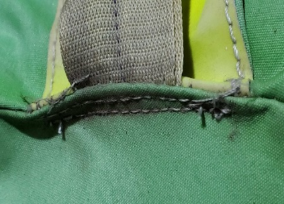
Between 28.05 - 08.06.2022, inspections of the floating element located in the open sea were carried out. Aspects from the performed inspections are presented in Figure 3.
Figure 3: Aspects from the inspections performed during 28/05/2022 and 08/06/2022.
RESULTS AND DISCUSIONS
- During the experimental trials, there were no implosions of the floating ele- ment, it maintained the geometry and implicitly the dimensions, the dynamic loads arising under the action of external forces (min. 250 daN) being evenly distributed on anchors.
- The functional trials evidenced that the subassemblies used to fix and support the floating element have a suitable behavior. Thus, the main “dead head” type anchors used for reinforcement were buried in the substrate, and the anchor chains did not presented any damage. Additionally, the anchoring system ensured the stability of the floating element in the previously defined hydrometeorological conditions.
- The buoyancy was kept according to the values imposed by the project of execution, namely 85 kgf.
- Graphic interpretation: a. no dangerous meteorological phenomena, such as descending gusts, were recorded because the maximum value of the wind speed (recorded by the TUZLA Meteorological Station) was 6m/s, on 06.06. For the rest of the experimental period, the wind speed values were in the range of 3–5 m/s.
b. regarding nebulosity: - on 28/05, 29/05, 30/05, 06/06, 07/06 and 08/06/2022 the sky was com- pletely covered by clouds, the minimum value recorded with code 5, and the maximum with code 88.
- on the other days of experimentation, the sky was covered with Alto- cumulus or Stratocumulus perlucidus clouds (code 7 or lower). Persistent condensation trains, formed in the condensation trains left by aircraft, were considered as clouds (corresponding to the code for CH or CM).
CONCLUSION
The experiments carried out in the open sea conditions imposed the con- sideration of the specific features of a continuously moving surface (due to sea waves and currents), with large temperature variations and difficult meteorological conditions.
The inspections were carried out by an interdisciplinary team of resea- rchers and specialists of The National Institute for Marine Research and Development “Grigore Antipa” Constanta - curator for protection and management of coastal and marine environment in the economic exclusive zone of Romania at the Black Sea coast.
The selected composite materials, the geometry chosen for the floating element – right circular cylinder and the types of sewing joints corresponded to the specific hydrodynamic demands of the open sea.
ACKNOWLEDGMENT
This scientific paper is funded by the Ministry of Research, Innovation, Digitalisation within Program 1 - Development of the national RD system, Subprogram 1.2 - Institutional Performance - RDI excellence funding proje- cts, Contract no. 4PFE/2021.
Analysis of the Behaviour of the Floating Systems 43
REFERENCES
Andrei J. V., Avram S., B˘ancescu I., Gâf-Deac I. I., Gheorghe C., - “Evolution of Romania’s Economic Structure and Environment Degradation – An Asses- sment Through LMDI Decomposition Approach”, Risk Manag Health Policy, 24 August 2021, Volume 2021:14 Pages 3505—3521 Taylor & Francis Group, The Academic Publishing Division, ISSN: 1179–1594. Gâf-Deac Ioan I. et al., (2015)- “Circular economy and ethics of profit sharing, -
W.3, Human Capital, Knowledge, Innovation, Smart Development”, The Eco- nomic Scientific Research – Theoretical, Empirical and Practical Approaches, ESPERA 2015, International Academic Publishing Group, Peter Lang, Deutsche Nationalbibliothek. Li Yanwei, Li Xiang, Ren Nianxin, Ou Jinping (2022)– “Hydrodynamic Responses of a Novel Modular Floating Structure System With Multi-Direction Expansion” - Journal of Offshore Mechanics and Arctic Engineering. The American Society of Mechanical Engineers, volume 145, Issue 3. Peterson, Bjork Christina, Jeppesen Bekker Maj, Aadahl Mette, Lau Juel Cathrine,
(2021) “Participation in recreational activities varies with socioeconomic posi- tion and is associated with self-rated health and well-being”, Preventive Medicine Reports, Vol. 24, 10610. Wang Gil, Goldfeld Yiska, Drimer Nitai, (2019) - “Expanding coastal cities – Proof of feasibility for modular floating structures (MFS)”, Journal of Cleaner Production, Volume 222, pp. 520–538. Williams A. N., Lee H. S., Huang Z., (2000) – “Floating pontoon breakwaters”
Ocean Engineering, Volume 27, Issue 3, pp. 221–240.
LISTED IN THE AHFE DIGITAL BOOKSTORE CATALOGUE
Explore the complete digital volume
Human Factors in Software and Systems Engineering
Read this individual research paper free through the original publisher, or explore the full digital proceedings book.
ISBN 978-1-958651-70-4
Explore this ISBN in the AHFE Bookstore ↗Listed in the July 2026 bookstore catalogue; search by ISBN to confirm current availability · Digital book purchase optional