Rosa Navarrete, Diana Martinez- Mosquera, Lorena Recalde, Marco Aguirre (2023). Evaluating embedded semantics for accessibility description of web crawl data. In: Human Factors in Software and Systems Engineering. AHFE Open Access, vol. 94, pp. 95–103. https://doi.org/10.54941/ahfe1003774
The Web is ever expanding, even more by the need for content consumption derived from the pandemic. This fact highlights the need for equity in access to Web content by all people, regardless of their disabilities. To this end, it is essential to focus on web accessibility issues. The World Wide Web Consortium (W3C), the leading organization responsible for ensuring the growth of the social value of the Web, establishes standards, protocols, and recommendations to improve the reach extent of web content for people. For instance, Web Content Accessibility Guidelines (WCAG) promote the achievement of web accessibility. Furthermore, other W3C recommendations foster embedded semantic into the web content to help browsers build a machine-readable data structure aiming to produce an enriched description in search results supporting people to find the right content for their queries and, consequently, improving user experience. Searching for specific web content is especially striving for people with disabilities because they could be forced to explore many search results before finding some content that matches their accessibility requirements. If embedded semantic communicate the accessibility properties of the content, the search will be more productive for everyone but even more for people with special needs. For embedded semantic, two components are required, a vocabulary and an encoding format. Schema.org vocabulary has experienced high growth and encompasses plenty of descriptors for each type of web information, including the set of descriptors for accessibility conditions information. Regarding the format, JSON-LD is the latest W3C recommendation for encoding due to its ability to make JSON data interoperate at Web-scale. It provides a quickly transforming for Linked Data format and is simple enough to be read and written by people. This research conducts a quantitative analysis of the embedded semantic into the web content by processing a dataset obtained from millions of web crawl data for 2021. The data arrive from distinct provenance and purposes at a global scale. In this web content, each annotation is made through script JSON-LD of embedded semantic with Schema's vocabulary. The analysis defines how the accessibility descriptors are used in conjunction with other classes and properties to describe the web information on personal blogs, organizations, events, educational content, universities, persons, commerce, sports, medicine, entertainment, and more. The results provide a perspective of the awareness for accessibility in the different purposes of the Web.The processing was performed on collected zip files that contain over three hundred million records. This analysis was conducted using massive data analysis techniques such as key-value modeling with Python for processing and a NoSQL database such as MongoDB for storage. A new dataset with normalized data was generated with information about domains, types of web content, and properties associated with the accessibility descriptor. The collection and storage layers were implemented on a computing platform with 30GB of RAM, 10 CPUs, and 2TB of storage.This research delivers two main contributions. Firstly, the analysis of the interest in the Web for using accessibility descriptors in embedded semantic. The quantitative results enable us to appreciate the concern about equity and inclusion made visible through accessibility issues in different entities, according to the web domains. Moreover, these results reveal how the W3C recommendation of embedded semantic is being adopted to create a more organized and better-documented Web. Second, processing the raw dataset result in a new normalized dataset in JSON format with information about domains, web content types, and properties associated with the accessibility descriptor. This new dataset will be available for further analysis of the embedded semantic.
People globally use the Web as primary platform for communication, lear- ning, work, commerce, business, entertainment, and more. Therefore, acces- sing the web must be equitable for all people, regardless of their disabilities, which implies addressing web accessibility issues. The World Wide Web Con- sortium (W3C), the leading organization responsible for ensuring the growth of the social value of the Web, establishes standards, protocols, and recom- mendations to improve the reach extent of web content for people. For instance, Web Content Accessibility Guidelines (WCAG) promote the ach- ievement of web accessibility. Furthermore, other W3C recommendations foster embedded semantics into the web content to help browsers build a machine-readable data structure aiming to produce an enriched description in search results supporting people to find the right content for their queries and, consequently, improving user experience (Guha et al., 2015). Searching for
specific web content is especially striving for people with disabilities because they might require examining many search results before finding some con- tent that matches their accessibility requirements (Aizpurua et al., 2016). If embedded semantics communicate the accessibility properties of content, sea- rch will be more productive for everyone, but even more so for people with special needs.
Embedded semantics requires two components, a vocabulary, and an enco- ding format. The Schema.org vocabulary has experienced a great growth and encompasses plenty of descriptors for each type of web information (Yu, 2014), including the set of descriptors for accessibility characteristics information (Schema.org, 2022). Regarding the encoding format, JSON- LD is the latest W3C recommendation due to its ability to make JSON data interoperate at Web-scale. It provides a quickly transforming for Lin- ked Data format and is simple enough to be read and written by people (W3C, 2021).
This research conducted a quantitative analysis of the semantics embedded in web content by processing a dataset obtained from millions of web crawl data released in the year 2021. The dataset included web content from distinct provenance and purposes at a global scale. In this web content, embedded annotations are done using JSON-LD script that uses Schema vocabulary elements to communicate inherent semantics.
The analysis defined how the accessibility descriptors are used jointly with other classes and properties to describe the web information on personal blogs, organizations, events, educational content, universities, commerce, sports, medicine, entertainment, among others. The results provided a per- spective of the awareness of accessibility issues in the different fields of the Web. The processing was performed on collected zip files that contain over three hundred million records. This analysis was performed using techniques applied to big data, such as key-value modelling with Python for processing and a NoSQL database such as MongoDB for storage.
The contributions of this research are twofold. In the first place, the analy- sis of the interest in the Web in using accessibility descriptors in embedded semantics. The quantitative results enable us to appreciate the concern for equity and inclusion that is made visible through accessibility issues in diffe- rent entities, according to the web domains. In addition, these results reveal how the W3C recommendation of embedded semantics is being adopted to create a more organized and better-documented Web. Secondly, processing the raw dataset results in a new normalized dataset in JSON format with information about domains, web content types, and properties associated with the accessibility descriptor. This new dataset will be available for further analysis of embedded semantics.
The remainder of the paper is organized into the following sections: Rela- ted Works, which presents a summary of relevant works; Materials and Method, which explains the provenance of the dataset for the analysis and the method used to obtain the results; Results, which details and discus- ses the findings; and finally, Conclusions and future work expose final ideas.
Evaluating Embedded Semantics for Accessibility Description of Web Crawl Data 97
RELATED WORKS Some research works have addressed embedded semantics and related issues. The use of embedded semantics to enhance results on a web search was pre- sented by (Haas et al., 2011). In this work, the authors propose the use of mechanisms to translate web page metadata into search result displays in terms of terms of users’ search experience. The findings show that users appreciate refined search results with content such as images and other intera- ctive elements. In addition, how Google obtains enriched search by exploring embedded semantics is presented in (Ohshima and Toyama, 2018). On the other hand, the embedded semantics to support device interactions is exposed in (Mayer and Basler, 2013), and the embedded semantics applied to nume- rical series data is developed in (Hossayni et al., 2018). The application of Schema’s vocabulary for markup in the Cultural Heritage domain is exposed in (Freire et al., 2018). In the same way, the use of Schema’s vocabulary in metadata is presented in (Gregory et al., 2020) with application to the disco- very of data needed for research. The importance of embedded markup to accuracy in describing search results is presented in (Bakhouyi et al., 2020), while the discoverability issues in web searching using embedded semantics are presented in (Kraker et al., 2021). A guide for best practices in embedded structured data have been published by (Wu et al., 2021).
Several research works have been carried out concerning the use of embed- ded semantics in specific fields; as instance, in the educational field we have (Navarrete et al., 2019); (Bakhouyi et al., 2020); (Recalde et al., 2021); (Recalde et al., 2022).
However, despite the importance of the topic, in the literature review, we do not find, so far, any research focused on the use of accessibility descriptors for embedding semantic annotations. For this reason, it is valuable to know, through the findings in the present work, how accessibility is considered for web admins and developers in the world concerning the use of this alternative to produce structured data.
MATERIALS AND METHOD The currently accepted vocabulary of Schema.org that represents accessibi- lity properties is depicted in Table 1. The names of properties are written in cursive format, as usual in the Schema context. The accessibility properties complement and document different kinds of descriptors for Things, Creative Works, Organization, Person, Place, Product, Event, and more.
The dataset for analysis is provided by Web Data Commons (WDC), an organization that releases extracted data from Common Crawl (CC), the largest web corpus available to the public. The dataset was released in Octo- ber 2021, containing structured data with semantic annotations made with JSON-LD (WDC, 2021). The raw data are presented as a compressed set with 6240 gzip files, with around 100MB each.
Every.gz file has many records, and each record represents an N-quad that means a triple RDF in a single line; it can configure a valid RDF (subject, predicate, object), a label or blank node, or an IRI (URI or URL) to identify the web page where the triple was extracted. The processed data is presented in Table 2.
Table 1. Set of accessibility properties of schema.org.
Table available in the original PDF paper.
Property Purpose accessibilityAPI Compatibility with the referenced accessibility API. accessibilityControl Input methods that are sufficient to control the described resource fully. accessibilityFeature Content features of the resource, such as accessible media, alternatives, and supported enhancements for accessibility. accessibilityHazard A characteristic of the described resource that is physiologically dangerous to some users. accessMode The human sensory perceptual system or cognitive faculty through which a person may process or perceive information. accessModeSufficient A list of single or combined accessModes that are sufficient to understand all the intellectual content of a resource. accessibilitySummary A human-readable summary of specific accessibility features or deficiencies, consistent with the other accessibility metadata.
Table 2. Values of corpus and datasets.
Table available in the original PDF paper.
Subject CC Corpus WDC dataset Number of HTML pages 2,500,000,000 900,000,000 (36% of the HTML pages in CC) Number of domains 32,884,530 9,650,571 (29.3% out of the total domains in CC) Size of data 54 TB (compressed) 653 GB (compressed) .gz files 6240 N-quads processed 38,420,581,511
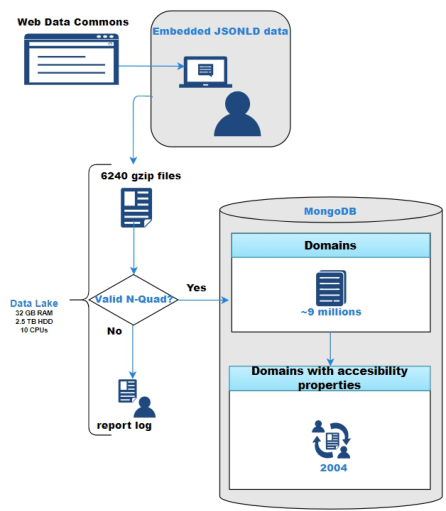
A total of 6240 zip files with embedded JSON-LD data were downloaded and contain over 38 billion N-quads. The architecture deployed for analyzing accessibility data is presented in Figure 1.
These data were processed into a data lake with 32GB of RAM, 2.5TB of storage, and 10 CPUs. In addition, they were stored in a collection of JSON documents in MongoDB. The data cleanup process included the following steps:
1. Decompress the gzip files. 2. Find the schema.org tag in the rows. 3. Verify if that is a valid N-quad. 4. Split the N-quad. 5. Verify whether every N-quad contains accessibility properties. 6. Store valid quads with accessibility properties in a MongoDB collection with the following records: N-quad identifier, N-quad number, property, value property, and domain. 7. Store non-valid N-quads in a MongoDB collection named logs.
Evaluating Embedded Semantics for Accessibility Description of Web Crawl Data 99
Figure 1: Architecture for JSONLD data processing.
A new dataset containing normalized data was generated with informa- tion about domains, types of web content, and properties associated with the accessibility descriptor. The collection and storage layers were implemented in MongoDB and are available for new consumption in the cloud.
RESULTS AND DISCUSSION
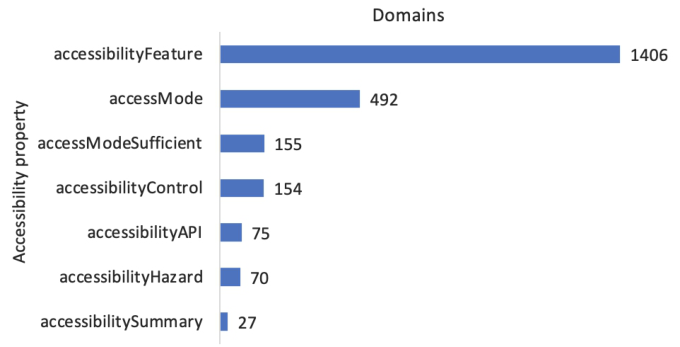
As a result of this research, we found that, out of 9,650,571 domains obtained within the dataset, only 2004 contained accessibility properties, barely 0.02%. Figure 2 indicates the number of domains that include accessibility properties. The top three most representative properties were accessibilityFeature, accessMode, and accessModeSufficient; these proper- ties provide significant information about accessibility, so they are the most used. The remaining properties did not have a considerable presence in domains.
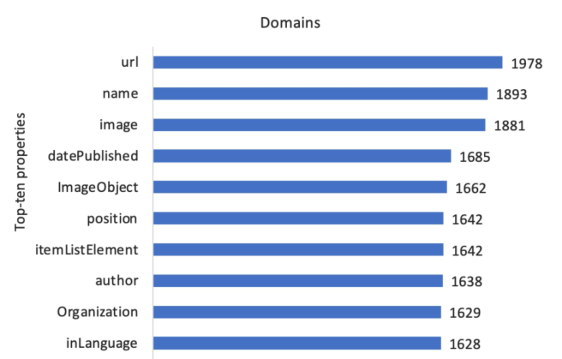
Figure 3 shows the outcome of other properties used in domains that also used accessibility properties. Only Organization is a “superior class” property found jointly with accessibility properties. A “superior class” is a schema vocabulary term representing something that can be described with more attributes or descriptors.
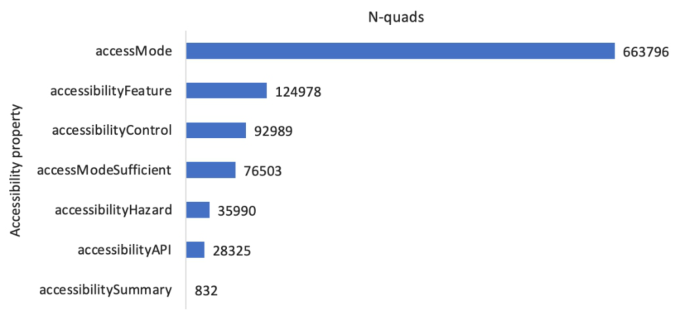
Considering the N-quads processed, Figure 4 shows the number of N- quads for each accessibility property. We found that accessMode is the property most used, representing almost 65% of total N-quads that pre- sent accessibility properties. This finding corroborates the importance of this
Figure 2: Number of domains with accessibility properties.Figure 3: Number of domains with co-occurrence of accessibility properties and others.
property which declares the type of perception required about the informa- tion (auditory, tactile, textual, or visual). Also, accessibilityFeature appears as the second property; because it conveys information about specific accessibi- lity characteristics, such as caption or transcript for videos or sign language availability as an alternative to audio.
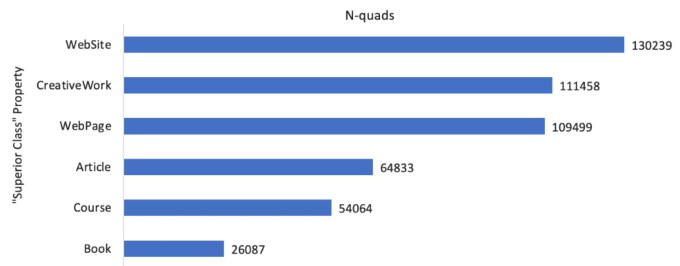
The number of N-quads of “superior class” properties found in domains that use accessibility properties is presented in Figure 5. The class WebSite, CreativeWork, and WebPage are prevalent. Nevertheless, Website and Web- Page, as well as other “superior class” properties such as article, course, and book, are subclasses of CreativeWork. In some cases, the “superior class” CreativeWork has probably not been described with specific proper- ties. These results confirm the purpose of embedded semantics to provide information about the entire element more than a particular one.
Evaluating Embedded Semantics for Accessibility Description of Web Crawl Data 101
Figure 4: Number of N-quads for each accessibility property.Figure 5: Number of N-quads for “superior class” in domains with accessibility properties.Table 3. Types of domains with accessibility properties.
Table available in the original PDF paper.
Description Root zone Number
.vn 49
VeriSign Global Registry Services .com 1217 Public Interest Registry (PIR) .org 87 Stichting Internet Domeinregistratie Nederland (SIDN) .nl 55 DENIC eG .de 54 Viet Nam Internet Network Information Center (VNNIC) .fr 37 VeriSign Global Registry Services .net 48 Association Française pour le Nommage Internet en Coopération (AFNIC)
.co 18
IIT - CNR .it 34 Nominet UK .uk 33 Ministry of Information and Communications Technologies (MinTIC) Finally, concerning the typology of domains that use accessibility pro- perties, we grouped them attending the root zone defined by the Internet Assigned Numbers Authority (IANA). Table 3 exposes the number of the
domains for each root zone found in the analysis. As can be seen, .com domains are by far the most representative; this fact suggest that comme- rce websites are interested in use the embedded semantic to deliver search information aimed to people with special needs.
CONCLUSION AND FUTURE WORK Considering the great diversity of people using the Web, including peo- ple with special needs, and regardless of the purpose of web domains, it is essential to take advantage of all tools that enhance user experience. In such context, embedded semantics enable search engines and user agents to parse and convey better and complete search results descriptions (Rese- arch Data Alliance, 2020). Incorporating accessibility descriptors enriches the information transmitted to people with special needs (Navarrete et al., 2019). Contrary to what has been exposed, the results of the data analysis show a minimal use of accessibility descriptors in the websites included in the data. Even though web pages have embedded vocabulary, developers and web admins do not seem to know about this set of accessibility descriptors.
As relevant results of our research, we found that the most used acces- sibility properties are accessMode, and accessibilityFeature, because these properties communicate substantial information regarding accessibility cha- racteristics of the web content. Also, we found that “superior classes” more frequently used in domains that also incorporated accessibility properties are WebSite and WebPage, confirming the decision to embed semantics that describe preferably the entire web content more than the specific elements.
Regarding the domains, we found that, .com domains are prevalent for including accessibility descriptors in embedded semantics. That indicates that commercial organizations are most concerned about accessibility issues.
In future work, we propose to make a multi-year analysis considering the last three years in crawling data to detect if, gradually, the use of accessibility descriptors is incremented. Also, it is essential to discover if web developers and publishers do not know the existence of these descriptors or if they consi- der that the use is not convenient, probably because they are not meaningful to the delivery of information.
REFERENCES
Aizpurua, A., Harper, S. and Vigo, M. (2016). Exploring the relationship between web accessibility and user experience. International Journal of Human-Computer Studies, 91(), pp. 13–23. Bakhouyi, A., Dehbi, R., Banane, M. and Talea, M. (2020). A Semantic Web Solution
for Enhancing the Interoperability of E-Learning Systems by Using Next Genera- tion of SCORM Specifications. Advances in Intelligent Systems and Computing, 1102 AISC, pp. 56–67. Freire, N., Charles, V. and Isaac, A. (2018). Evaluation of Schema.org for Aggregation of Cultural Heritage Metadata. The Semantic Web. ESWC 2018. Lecture Notes in Computer Science, 10843() . Springer, Cham, pp. 225–239.
Evaluating Embedded Semantics for Accessibility Description of Web Crawl Data 103
Gregory, K., Scharnhorst, A. and Wyatt, S. (2020). Lost or Found? Discovering Data Needed for Research. Harvard Data Science Review, 2(2). Guha, R., Brickley, D. and MacBeth, S. (2015). Schema.org: Evolution of Structured
Data on the Web: Big data makes common schemas even more necessary. Queue, 13(9), pp. 10–37. Haas, K., Mika, P., Tarjan, P. and Blanco, R. (2011). Enhanced results for web search.
Proceedings of the 34th International ACM SIGIR Conference on Research and Development in Information Retrieval, pp. 725–734. Hossayni, H., Khan, I. and Kaed, C. (2018). Embedded Semantic Engine for Numerical Time Series Data. 2018 Global Internet of Things Summit, pp. 1–6. Kraker, P., Schramm, M. & Kittel, C. (2021). Discoverability in (a) crisis. ABI
Technik, 41(1), pp. 3–12. Mayer, S. and Basler, G. (2013). Semantic metadata to support device interaction in smart environments. UbiComp 2013 Adjunct - Adjunct Publication of the 2013 ACM Conference on Ubiquitous Computing, pp. 1505–1514. Navarrete, R., Montenegro, C., Recalde, L. and Lujan-Mora, S. (2019). Analyzing
embedded semantic with JSON-LD and microdata for educational resources in large scale web datasets. 6th Annual Conference on Computational Science and Computational Intelligence, CSCI 2019, pp. 1133–1138. Ohshima, T. and Toyama, M. (2018). SDC: Structured data collection by yourself.
ACM International Conference Proceeding Series, (March), pp. 16–18. Recalde, L., Navarrete, R. and Correa, L. (2022). A Framework for data mining of structured semantic markup extracted from educational resources on University websites. AHFE 2022 Open Access, Usability and User Experience, pp. 482–489. Recalde, L., Navarrete, R. and Pogo, F. (2021). Making Open Educational Resou-
rces Discoverable: A JSON-LD Generator for OER Semantic Annotation. Eighth International Conference on eDemocracy & eGovernment (ICEDEG 2021), pp. 182–187. Research Data Alliance (RDA) WG, 2020. Guidelines for publishing structured metadata on the Web V2.0, [Online] Available at: https://www.rd-alliance.org/ [Accessed November 2022]. Schema.org, 2021. Organization of Schemas. [Online] Available at: https://schema.o
rg/docs/schemas.html [Accessed November 2022]. W3C, 2021. JSON-LD 1.1: A JSON-based Serialisation for Linked Data. [Online] Available at: https://w3c.github.io/json-ld-syntax/ [Accessed November 2022]. Wu, M., Juty, N., RDA Research Metadata Schemas WG, Collins, J., Duerr, R.,
Ridsdale, C., Shepherd, A., Verhey, C., and Castro, L. J. (2021). Guidelines for publishing structured metadata on the Web V3.1. Research Data Alliance. Yu, L. (2014). A Developer’s Guide to the Semantic Web, Berlin Heidelberg, Springer- Verlag.
LISTED IN THE AHFE DIGITAL BOOKSTORE CATALOGUE
Explore the complete digital volume
Human Factors in Software and Systems Engineering
Read this individual research paper free through the original publisher, or explore the full digital proceedings book.
ISBN 978-1-958651-70-4
Explore this ISBN in the AHFE Bookstore ↗Listed in the July 2026 bookstore catalogue; search by ISBN to confirm current availability · Digital book purchase optional