Elizabeth Koumpan, Anna Topol (2023). Value-driven architecture enabling new interaction models in Society 5.0. In: Human Factors in Software and Systems Engineering. AHFE Open Access, vol. 94, pp. 11–21. https://doi.org/10.54941/ahfe1003765
Industries are struggling to deliver the information and insights required for top performance. They also need to invest in developing new knowledge to create a foundation of trusted data necessary for the cognitive business. However more change is coming, as we envisioned Society 5.0, new interaction models will be generated, enabling a move to connected industry ecosystems supported by value-driven architecture akin to the next generation of society-centric internet. Society 5.0 trends will cause a shift from the output-based business model focused on buy/sell/own for-profit interaction to the impact-based model. The new model will be a personalized and purpose-led service involving ecosystem participants from multiple industries and drive higher incomes for participants and additional business while decreasing the cost of acquiring customers. Trust and human centricity of that model will lead to advancements in :· Ethics, Impact & Purpose - open, trusted, peer-endorsed services and products.· Decentralization of Power - more loosely coupled ecosystems where ecosystem leaders release more power to participants to fuel the “network” effect.· Data Democratization - bring your data, data used for social and sustainable innovation.· Connected Cyber/Physical Society -the instrumentation of the physical world with IoT and Edge Computing.· New data sources and standards will combine existing data sets with new ones to set the foundation for contextual computing and highly adaptive cyber-physical systems for many industries· Resiliency by design - a guiding design principle that is not only a technology requirement but also a business imperative that will create opportunities for new entities like “Group Formed Networks” based on shared interests. In this paper, we focus on a solution tackling Society 5.0 problems based on a globally scalable platform that is trusted to preserve individuals’ and businesses’ privacy and confidentiality while using the data to create value alongside social and individual good—simply providing value while maintaining values. We will describe innovative architecture at both a societal and a technical level, resting on a logical framework in which several technology components interact to provide value to society. We address the industry dynamics of Society 5.0, tracking new business trends and drivers influencing social infrastructure, societal engagement, cohesion, and new value creation. We define the building blocks required to support a Society 5 ecosystem solution in the future, in alignment with new business models to promote economic development and solve social issues.
A Society 5.0 ecosystem leader drives industry innovation, collaboration, and the realization of shared goals. As a result, such a leader provides substan- tial value for both members and external parties by orchestrating, enabling, and governing a platform that the members of the ecosystem shape. In con- trast to earlier ecosystems, the Society 5.0 ecosystem creates value chains that extend beyond the interests of the ecosystem participants to society without dispersing the cost of that value outside the ecosystem (Koumpan, Topol, 2021). Society 5.0 leaders help connect different participants in an ecosystem as orchestrators by developing a series of strategic partnerships and facilitating alliances using digital technology to make links, provide products and servi- ces, and share customers and resources (for example data) with partners. Orchestrators offer products and services that begin with but extend beyond their original product range and, in addition, share customers and data with their partners to expand the scope and relevance of the ecosystem.
To seed an ecosystem, we propose to begin with discrete service webs that are extremely valuable to end users. To achieve broad adoption and extend the reach of the value system, the active participation and party-to-party inte- raction of non-enterprise entities, e.g., Small & Medium Businesses (SMB), would be facilitated. We selected 3 use cases based on the societal need and incorporated them into the platform. These use cases are interconnected and can be considered in tandem:
AI and analytics for business planning and resiliency The COVID pandemic has put unprecedented stress on many SMBs. The loss of these businesses resulted in extensive job loss and service disruption and has a far-reaching impact across all sectors of the world economy. Indu- stries that provide services to SMBs are highly motivated to contribute to ecosystems that can provide analytics and tools to allow small and medium enterprises to adapt to changing markets and maintain viability. These interested parties can become key ecosystem enablers through their access to data and ability to facilitate relationships that can draw SMBs into value-providing ecosystems.
Food supply chain: Moving beyond the pandemic world The global food supply chain decentralizes and diversifies to become more resilient in the face of disruption of supply chains, access to workers, and the shifting of normal modes and patterns of doing business, facilitating the gro- wth and development of a more adaptable cooperative food economy. This use case has concrete links to agriculture, transportation, the employment and safety of temporary workers, retail food sales, restaurant food acqui- sition and alternate distribution forms, alternate packaging availability, the redistribution of products to avoid waste, and payment options. SMB is inte- gral to the success of the global food chain, and it will be necessary for these businesses to adapt quickly to new models to survive the current shift (Albaz, et al. 2020).
Value-Driven Architecture Enabling New Interaction Models in Society 5.0 13
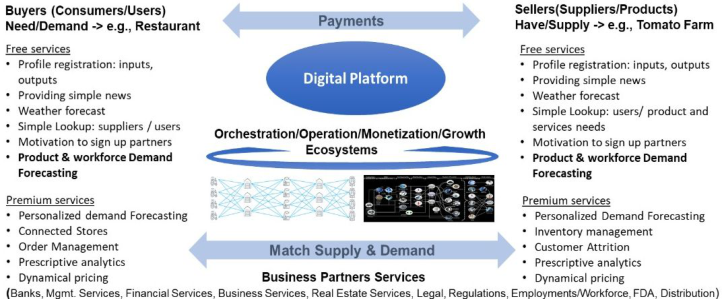
Digital payments The global economy is shifting from physical to digital currency (Lopez, 2020), and the demand for frictionless payment grows and ties the physical world to the digital world in a very concrete fashion. The digital wallet sim- plifies the digital marketplace experience, tying digital and physical worlds closer together. To address the needs of these use cases, and provide oppor- tunity for transformation towards Society 5.0, our study focused on defining a digital platform which we called One4All (see Figure 1).
SOCIETY 5.0 SMART ARCHITECTURE The fundamental purpose of creating a Society 5.0 ecosystem is to acce- lerate and lead the ongoing shift in global interaction models (Baig et al. 2020). This shift leads toward connected ecosystems bringing the most value from data sharing. AI in such system is the mechanism that help build upon the usage of data and extract the correct value.
However, to succeed, we need to develop a solid understanding of data flow across the ecosystems, including creation, usage, storage, destruction, ownership & business responsibility, regional laws & regulations, and then define the data’s purpose. Developing an architecture that will enable flexible data sharing, seamless micro-product integration, and transparent scaling of the gap between the physical and digital worlds needs to be accomplished. The application of the concept of digital twins, which are virtual representa- tives of a product, process, service, or ecosystem, is rising in prominence as a way to address this gap. By providing digital twin data to ecosystem partici- pants, new and unique business models can be created, and various business scenarios can be tested in a shorter timeframe. Embedded analytics levera- ging artificial intelligence (AI) and machine learning (ML) take advantage of streams of data from connected products and processes to create insights and deliver them for utilization by the orchestrator, technology and service busi- ness partners, and customers. Monetizing data and information create the need for price management systems for new services and products, enabling
14 Koumpan and Topol
ecosystem participants to price more effectively and companies to implement new business models faster.
In the sections below, we summarize our study focused on defining the goals and principles of the desired architecture, functional and non- functional requirements, architectural blocks, data flow, techniques, practi- ces, assumptions and hypotheses validated against the use cases described above.
Architecture Goals A solution tackling Society 5.0 problems requires a globally scalable plat- form that is trusted to preserve individuals’ and businesses’ privacy and confidentiality while using the data to create value alongside social and indi- vidual good. It is a Smart Architecture at both a societal and a technical level.
1. Using ecosystem to grow value: The Society 5.0 proposition (Government of Japan Cabinet Office, 2023) rests on a logical framew- ork in which many technology components interact to provide value to society, whether or not the members currently derive value from their participation in technology-oriented ecosystems. Such a logical architecture supports the function of new, more inclusive, higher-value ecosystems by defining the content and relationships among a set of constituent physical architectures and, by extension, the parties affected by those ecosystems. The components in these physical architectures will change over time as technology evolves due to market and other forces. 2. Moving to a better perception of cost: The Society 5.0 ecosystems incor- porate externalities into an overall representation of ecosystem costs and benefits. A more significant proportion of mutually beneficial and shared public goods is delivered simultaneously, limiting or eliminating costs typically displaced onto parties external to an ecosystem. In earlier ecosystem models, these costs imposed on external parties implied that ecosystems benefited specific parties in society, often at the expense of other parties, rather than helping the whole ecosystem. However, in a Society 5.0 representation, the longer-term interests can be addressed by shared information flowing through Society 5.0 ecosystems. 3. Balancing value archived and costs for each member of the ecosy- stem: With a longer time-horizon, the logical architecture should have ecosystem participants account for the value and costs imposed on soci- ety, thus limiting distortions found in earlier economic systems and ecosystem designs. 4. Incentivizing transparency to enable growth and equitable outcomes -> To accomplish either improvement of positive externalities and inter- nalities and to limit negative externalities and internalities, the logical architecture must answer how its components provide incentives such that ecosystem participants will give and derive value from members of society who formerly were not represented as stakeholders to those ecosystems.
Value-Driven Architecture Enabling New Interaction Models in Society 5.0 15
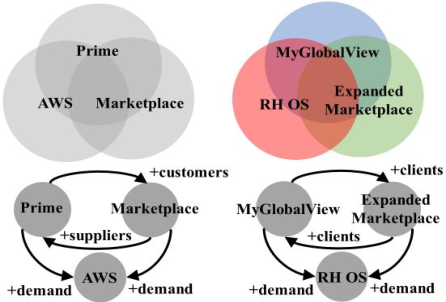
To illustrate similarities and differences between a commonly cited high-level Society 4.0 (exemplary Amazon ecosystem) and a Society 5.0 ecosystem architecture (the proposed One4All Ecosystem Orchestration Platform) similar technologies were considered to provide goods and transfer value (see Figure 2).
Both ecosystems involve cloud-based architectures, incentives for partici- pation, and purchasing and exchange mechanisms. Many of these techno- logies are derived from open-source and open-content enablement. For any given ecosystem participant, the bulk of code and open-source assets are cre- ated by other parties, with standardized implementations lowering barriers to entry and scaling participation. While it is possible to use open source to implement a highly successful Society 4.0 ecosystem, that ecosystem is in many respects extractive of value (Zutshi, 2019, Keidanren, 2016). A Society 5.0 ecosystem, in contrast, aggregates, compounds, and distributes value. Data transparency is a crucial attribute enabling this ecosystem and making it more advantages over Society 4.0 ecosystems. Ecosystem builders must be trusted parties capable of identifying and attributing value in direct exchange, mutual benefits, or public goods.
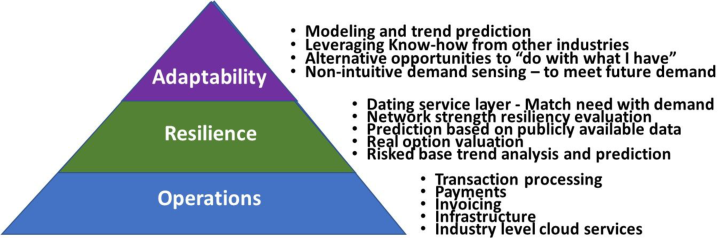
Architecture Principals The build for the desired architectural view of the Society 5.0 started with layered Smart Architecture Pyramid model based on ‘buy-in’ approach (see Figure 3) as it leads toward greater stability, scalability and effectiveness of that system.
1. Reduce cost of operations: by providing access to services common to existing marketplace (transnational processing/payments, invoicing, infrastructure, large scale file upload and storage, activity reporting and analytics. 2. Increased Resilience (Shih, 2020): by providing services that allow ecosystem members to better withstand network volatility. e.g., match
supply to demand, gain data on potential risk (weather, geographic dependency, medical risks). 3. Increased Adaptability: by enabling pivots as things change, e.g., cross industry models for prediction of non-intuitive demand, trends in complex systems, exposure to alternative opportunities (disruption prevention).
True to the Scientific Method approach (Popper, 1959 and Hey, 2009), fundamental to our study in defining the architectural principles was identi- fication of hypotheses which can be validated against the use cases mentioned before (see introduction section of this paper):
Hypothesis #1: A Society 5.0 solution cannot be the product of a sin- gle organization and will need to be engineered in a manner akin to the internet.
Hypothesis #2: A Society 5.0 solution can deliver value and resilience for individuals and businesses by creating open, adaptive marketplaces that can co-exist and exchange value.
Hypothesis #3: Society 5.0 architecture will require a significant step change from today’s marketplace and ecosystem architectures.
Based on these hypotheses we evaluated technologies which could address drivers leading from today’s ‘as-is’ Society 4.0 architecture toward the ‘to-be’ architectural solution (see Table 1).
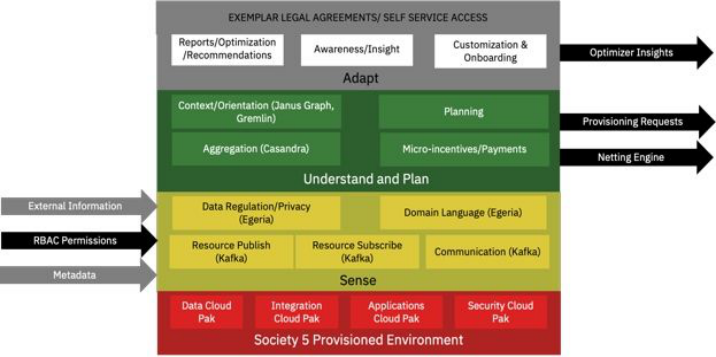
Architecture Overview and Building Blocks Next our study focused on taking all the information on perceived functional and non-functional requirement with focus on architectural design sup- porting sense-understand-plan-adapt (SUPA) loop to compose exemplary architectural overview with foundational building blocks (see Figure 4).
This work focused on the cross-industry platform design but was also tested against the 3 use cases mentioned before and led to the following hypothesis:
Hypothesis #4: Society 5.0 Architecture is a ‘value-driven’ middleware. At the lower levels of the stack, there will be a Container Platform with an
Value-Driven Architecture Enabling New Interaction Models in Society 5.0 17
Table 1. ‘As-is’ and ‘to-be ‘ architecture perspective on what will be required to meet the outlined principles.
Table available in the original PDF paper.
Drivers of change Today’s ‘as-is’ architecture Society 5.0 solution architecture ‘to-be’
Marketplace-controlled customer experience
Seamless customer experience under user control and preference
User experiences are fragmented and complex. It would be desirable for companies and individuals to get a more unified experience. Island-based, low-trust security models
It is necessary to extend security models to the edge to enable a cognitive enterprise.
Holistic metadata-driven trust data privacy model Deterministic ‘top down’ bilateral incentive models Adaptive ecosystem-informed incentives
COVID-19 has shown that our supply chains are fragile. Creating new dynamic ecosystem-wide incentives (based on Society 5 principles) or removing constraints in certain circumstances may be necessary to thrive and be truly resilient. ‘Battery farmed’ microservices
Today’s microservices are confined to a single cloud or platform without individual business value. We need micro products that generate and earn value and drive deployable incentives where the need is.
‘Free range’ micro products (value-carrying microservices) deployable at the edge and hybrid cloud
Predictable performance/ behaviour
Quantum optimization algorithms
Optimizing multiple transparent supply chains to optimize the benefit to Society 5 (or the ecosystem) is several orders of magnitude more complex than optimizing the behaviour of a single closed supply chain. Development of Quantum Computing will lead to new solutions to address this issue. Disproportionate/abusive use of personal data for monolithic centralized AI models
Society 5 must enable a more symbiotic relationship between the customer/consumer and the increasingly broad AIs. Trust may be cultivated by not centralizing data and using machine learning models to assist consumers in context rather than manipulating them at a distance.
Context-aware algorithm zoo with training at the edge (reducing the need for centralization of data and enabling training models to be shipped rather than data)
evolved set of shared standard services. Above this layer is the Sense layer- a suite of value-oriented middleware used to secure, translate and monetize data and transactions transmitted using an Enterprise Service Bus with addi- tional protocol layers to provide privacy and provenance (Chessell, 2022). Microproducts will use this layer to achieve peer-to-peer communication, onboarding, and offboarding information.
The Ecosystem Context is a graph that provides the basis for supply chain and incentive operations. The next layer (Understand and Plan) provides the context for each ecosystem and enables it to optimize day-to-day operational
decisions. At this layer, trends would be identified to allow for resource pro- curement decisions to be made such that operational and financial stability can be maintained.
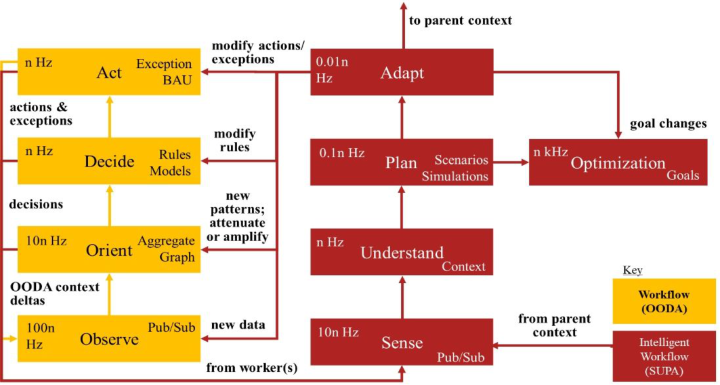
The top level provides the human-facing aspects of the Ecosystem Platform. Legal agreements and self-service access functions are surfaced. Toolkits are used to modify and customize the Ecosystem definition and rules. Simulations and hypotheses are used at this level to predict the future and optimize the ecosystem in the context of other Ecosystems (that are simi- larly willing to share their anonymized context data). Critically this top level of holistic analysis does not just make recommendations; it pushes neces- sary changes (aligned with the ecosystem goals) down into the operational layer.
The two levels of optimization are characterized by the aforementioned SUPA and observe–orient–decide–act (OODA) loops which drive the decision making process (see Figure 5). In recent years OODA has been succes- sfully applied to understand commercial operations and learning processes (example: cyber security and cyberwarfare (Clarke, 2019). These two loops represent fast thinking (everyday intelligent actions, basic machine learning processes -> cognition) and slow thinking (reflective and changing behaviors, model scopes, and evaluation models -> meta-cognition).
To support the notion of most effective optimization in the environment where context would play a critical role (from multi-party data flow and ownership perspective, monetary and non-monetary value benefit accoun- ting, etc.) we arrived at the following 2 hypotheses:
Hypothesis #5: Ecosystems and micro products can generate additional value through context-driven optimization.
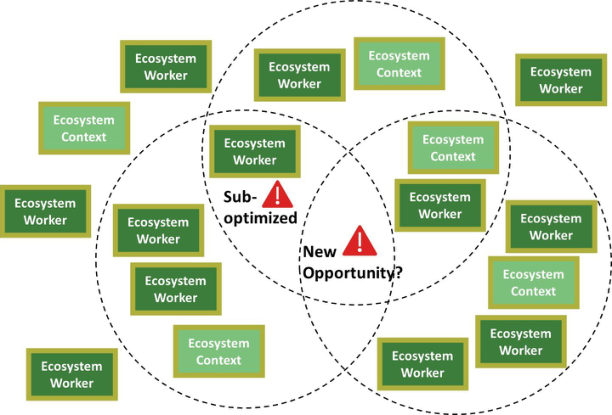
Hypothesis #6: Micro products can bridge and encapsulate ecosystems.
Micro products can belong to multiple ecosystem contexts enabling gatew- ays to open between ecosystems (see Figure 6). Initially, ecosystem platforms
Value-Driven Architecture Enabling New Interaction Models in Society 5.0 19
extend existing supply chains; then they work together to generate value; eventually, entirely new ecosystems arise at the overlaps or edges of society. This change will enable incremental evolution of increasingly sophisticated Society 5 marketplaces.
Our final findings in the study related to exchanges driven by the micro product offerings. We asked, “What would be the output of these exchan- ges?”
Hypothesis #7: Society 5.0 will be built on the exchange of value that is described by trusted metadata. The value they exchange can be data,
20 Koumpan and Topol
information, services, or goods, but each will come with a provenance and inbuilt permissions that, on today’s platforms, only blockchain provides.
Hypothesis #8: Micro products will use a Data Mesh. The Society 5.0 micro products will either use data and metadata received in channel or a data mesh protocol to retrieve the data they are entitled to.
CONCLUSION
Businesses can only drive transformation based on technology if they’re highly adaptive and can shift their business models quickly. Recommended transition to the Society 5.0 technology model entails moving through a series of the following phases, which will enable the growth of capabilities and shift in the model:
1. The food provenance model is mainly based on SaaS/3rd generation marketplace. It has the benefit of uniting large and small enterprises while providing needed services and value (a resiliency/flexibility proof of concept). 2. As the ecosystem evolves into the second phase, the focus is put on creating the interface capabilities for a more sophisticated industry platform-based approach using a defined marketplace. This phase auto- mates the adoption and expansion of the earlier platform by introducing the ability to provide/consume market-provided add-on components based on the outlined model. Such an approach would allow for the growth of market-driven capabilities and should align with a second industry. This phase uses the expanding scope to utilize the growing body of democratized data, incorporating more control tower functions and less apparent uses of data. 3. By phase three, microservices become more automated, as do the control tower functions. This phase expands on the cross-functional language model and increases the richness of available data, enabling exchanges between industries and boosting the cognitive enterprise’s development. At this phase, synergies between components become more pronounced, and the ecosystem requires less direction to evolve and take on market- driven forms as the need arises.
ACKNOWLEDGMENT
The authors would like to acknowledge Richard Hopkins for leading Society 5.0 architecture stream, Marshall Lamb, Scoichiro Watanable, Scott Gerard, Cloe Wang, Cynthia S Unwin, and IBM Academy of Technology.
REFERENCES
Albaz, Abdulaziz. Dondi, Marco. Rida, Terek. Schubert, Jorg. (2020). Unlocking growth in small and medium-size enterprises, Mckinsey website: https://www.mc kinsey.com/industries/public-and-social-sector/.
Value-Driven Architecture Enabling New Interaction Models in Society 5.0 21
Baig, Amer. Hall, Bryce. Jenkins, Peter. Lamarre, Eric. McCarthy, Brian. (2020). The Covid 19 recovery will be digital: A plan for the first 90 days. McKinsey web- site: https://www.mckinsey.com/capabilities/mckinsey-digital/our-insights/the-co vid-19-recovery-will-be-digital-a-plan-for-the-first-90-days. Chessell, Mandy. (2022). Egeria Open Source, The Linux Foundation Projects. Egeria
home web page https://www.odpi.org/projects/egeria, What next after you built a data catalog https://egeria-project.org/education/webinar-program/overview/#p revious-webinars. Clarke, Richard (2019). The Fifth Domain: Defending Our Country, Our Companies, and Ourselves in the Age of Cyber Threats. Penguin Press. p. 81. Government of Japan, Cabinet Office (2023) web site: https://www.japan.go.jp/ab
enomics/_userdata/abenomics/pdf/society_5.0.pdf, https://www8.cao.go.jp/cstp/e nglish/society5_0/index.html. Hey, Tom. Tansley, Steward. Tolle, Kristin and Gray, Jim. (Eds.) (October 2009). The Fourth Paradigm, Data-Intensive Scientific Discovery. Microsoft Corp. Keidanren (April 19, 2016). Towards realization of the new economy and society.
Keidanren Japan Business Federation Web site: http://www.keidanren.or.jp/en/p olicy/2016/029_outline.pdf. Koumpan, Elizabeth. Topol, Anna. (2021). Promoting Economic Development and Solving Societal Issues Within Connected Industries Ecosystems in Soci- ety 5.0, Advances in Artificial Intelligence, Software and Systems Engineering (pp. 174–183). Lopez, Claud (2020). The promise and Peril of Digital Currency in a Global Eco-
nomy, Milken Institute website https://www.milkenreview.org/articles/the-promis e-and-peril-of-digital-currency-in-a-global-economy. Popper, Karl, (1959). The Logic of Scientific Discovery. New York: Basic Books. Shih, Willy. (2020). Global Supply Chains in a post-pandemic world, Harvard Business Review web site https://hbr.org/2020/09/global-supply-chains-in-a-post-pan demic-world. Zutshi, Aroop. (2019). Industry 5.0 – Bringing Empowered Humans Back to the
Shop Floor, Frost & Sullivan web site: https://www.frost.com/frost-perspectives/i ndustry-5-0-bringing-empowered-humans-back-to-the-shop-floor/.
LISTED IN THE AHFE DIGITAL BOOKSTORE CATALOGUE
Explore the complete digital volume
Human Factors in Software and Systems Engineering
Read this individual research paper free through the original publisher, or explore the full digital proceedings book.
ISBN 978-1-958651-70-4
Explore this ISBN in the AHFE Bookstore ↗Listed in the July 2026 bookstore catalogue; search by ISBN to confirm current availability · Digital book purchase optional