Alexandra Gabriela Ene, Carmen Mihai, Mihaela Jomir (2022). Experimentation in open sea of the composite structures for the sustainable development of aquatic ecosystems. In: Human Factors in Architecture, Sustainable Urban Planning and Infrastructure. AHFE Open Access, vol. 58, pp. 362–369. https://doi.org/10.54941/ahfe1002373
Protecting water and marine resources - and ensuring their environmental status - is one of the pillars of EU environmental policy. The acceleration of the process of loss of marine biodiversity or of essential goods to the ecosystem has required the adoption of special measures on nature and biodiversity (Sixth Community Environment Action Program). The process of recovering the natural bio filter from the coastal area of the sea coast requires the development of ecological methods designed to increase populations of epibiotic organisms that are filters capable of accelerating the restoration of marine quality in tourist areas - leisure on the coast. The modular system designed and developed by our specialists is intended both for the extension of the natural epibiont bio filter in traditional coastal areas, and for the cultivation for food purposes of mussels - Mytillus Galloprovincialis - the largest bivalve in the Black Sea and oysters - Crassostrea gigas. The location of the modular system has the following specific hydro meteorological characteristics: the winds in the northern sector have the highest dominance and intensity, the orientation of the Romanian Black Sea coast (from north to south) favors the dominance of currents parallel to the shoreline, and the structure of the substrate is composed of an alternation of submerged rocks and stony platforms covered with terry mud. The system has been successfully tested until the third stage of development of the epibiont organisms, the tests continuing at present. The presented solutions will contribute to the restoration of the sea filters, by ensuring an optimal breeding place for a variety of marine organisms.
The objectives and priority areas for action on nature and biodiversity mentioned by the European Parliament and the Council in the Sixth Com- munity Action Program include (Moriss et al. 2019): the implementation of the necessary technical and financial instruments and measures and the promotion of the protection of marine areas by feasible Community methods.
As a Contracting Party to the Convention on Biological Diversity (CBD), the European Community has developed a Biodiversity Strategy and Action
Experimentation in Open Sea of the Composite Structures for the Sustainable 363
Plans aimed primarily at integrating biodiversity issues into other Community policies.
The European Environment Agency (EEA) and WISE (a joint initiative of the European Commission and EEA) have as one of the most important targets - Aquatic Life (Global Objective No. 14) which aims to prevent and significantly reduce marine pollution in especially from land-based activities, including waste and nutrient pollution.
The recommendations of the European Strategy for Integrated Coastal Zone Management and Maritime Spatial Planning identify aquaculture among the most important sectors and areas that serve as a model for sustainable development in coastal and maritime flowing waters.
The development of artificial modular systems for fixing the epibiotic fil- ter bodies leads to the extension of the support area of the organisms and, implicitly, the significant increase of the bio-cleaning capacity of the water from the formed epibiotic filter (Alvarenga et al. 2017, Hart et al. 2020).
The system for the development of the bio filterting material made by our specialists is composed of: six floating elements, two mooring anchors type; 10 submerged enclosures for the development of oyster larvae and 60 artificial collectors for the direct growth of mussels and the development of oysters.
The floating elements were made of composite structures that have: – woven fabrics reinforcing materials from the following raw materials: 55%/45% PA6.6/PES; 50%/40% PA/PES; 100% PES si 100% Cotton; – Mass: [200; 500] g/sqm; – Breaking resistance, min., warp/weft: [200/300; 200/450] daN; – Breaking elongation, max., warp/weft: [30/35; 30/45] %; – Tear resistance, min. warp/weft: [25/25; 60/65] daN,
Depending on shore location and field of use (type of bio filter material). The modular system for the development of biofilter material was tested on the shore by a multidisciplinary team of specialists in textiles, biology, biotechnology, hydrology, marine development and research. The chara- cteristics for each subassembly of the modular system component for the development of the biofilter material corresponded to those stipulated in the requirements imposed for this type of application in terms of geometry, sta- bility, dimensions and colors. Thus, additional tests were required to verify the characteristics under real conditions of use.
MATERIALS AND METHODS
Taking into account the evolution cycle of the biofiltrating material in high open conditions, through the “Program of experimentation of the modu- lar system for the development of the biofiltrating material” designed by the specialists involved in the development of this product, weekly controls were imposed and after any violent storm the four phases of development.
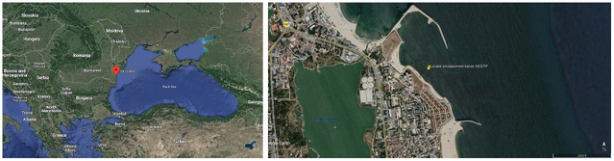
The system tests were performed in the Mamaia Constanta Fishing Area (coordinates 44 ° 12’54.80 “N; 28 ° 38’55.94” E - Fig. 1), according to the
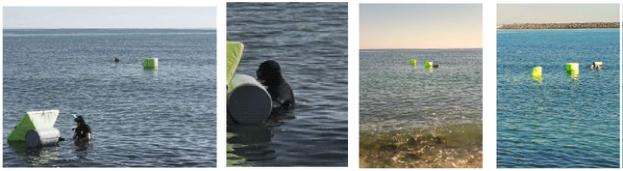
Figure 1: Location of the experimental positioning of the modular system dedicated to bio filtrant material growing: Fishing Zone, Black Sea, East European Area.Figure 2: Aspects from launching and arming the system.
periods of development of the biological material, and consisted of specific activities (Table 1).
To avoid the destructive action of sea currents during violent storms, the launch of the experimental model was made parallel to the shoreline, in the direction of advancing sea currents from north to south. The anchors, due to the high weight and the dangers during the handling on the boat, were embar- ked with the help of a crane on a platform arranged at its stern. The materials moved with a ship in the established area were marked on the anchor fixing positions.
Phase III development lasts until April 2022. The tests continue and the dimensions of the mussels and oysters will be further verified, and at the end of the month the bio filter material will be placed in submerged enclosures for the development of larvae, in order not to cause the buoyancy of the entire floating system to decrease.
Phase IV of the evolution of the biological material lasts from May to September (the bivalves reach marketable dimensions of 50 - 80 mm) and controls and verifications will be performed on the system (according to the experimental program) especially in the fixing areas of the floating elements - anchor cord and floating elements - artificial collectors.
RESULTS AND DISCUSSION
The system was launched and armed in the open sea in March (Fig. 2).
With the help of the diving teams, it was checked how the anchors were fixed on the substrate, if the superstructure is in the established position and sufficiently stretched. After the launch and assembly of the system at sea, controls were made to verify its behavior, as well as to ensure optimal operation.
Experimentation in Open Sea of the Composite Structures for the Sustainable 365
Table 1. Main activities developed as a function of testing period of the year (Junxiong et al. 2022).
I / March-April (the larvae of epibiont bivalves with dimensions of 0.5 - 1.0 mm are fixed on the artificial collectors) wind speedmax = 6 m/s sea current speedmax =1,5 m/s wave hwightmax = 3 m air temperaturemax = 20 °C water temperaturemax = 15 °C
- launching and arming the modular system with the help of the main and secondary mooring type anchors; - maintenance and control of the system following: possible dama- ges, barnacles deposits (Balanus); - checking the position of the anchors and the horizon of the collectors. II / May - September (compact agglomerations of mussels larvae) wind speedmax = 5 m/s; sea current speedmax =1,5 m/s; wave hwightmax = 2 m; air temperaturemax = 38 °C; water temperaturemax = 28 °C.
- checking the floating elements, the subassemblies and the develo- pment cycle of the epibiont mate- rial; - checking stability and buoya- ncy; - scraping of floating elements that evdences the deposits of bar- nacles (Balanus); - repair of accidental defects (if applicable). III / October - February (mussels and oysters with dimensions of 5-10 mm) wind speedmax = 25 m/s sea current speedmax =1,5 m/s wave hwightmax = 6-7 m air temperaturemin,max =[−15;+ 18]°C water temperaturemax = 15 °C
- checking the floating elements, the subassemblies and the develo- pment cycle of the epibiont mate- rial; - checking stability and buoya- ncy; - scraping of floating elements that evdences the deposits of bar- nacles (Balanus); - preparation of the modular system for the critical period (additional reinforcement).
After 350 days of testing in open sea conditions, the following were found: - The anchoring system functioned in the calculated parameters, main- taining its initial shape and dimensions. The findings made by comparing the position of the floats and the on-site verifications with the help of the diving team, which investigated the position of the anchors and the horizon of the collectors led to the conclusion that the floating superstructure kept its design shape and dimensions. Exteriors are evenly distributed on anchors and anchors.
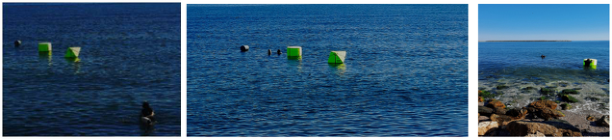
- From a mechanical point of view, the tested composite materials offer a special resistance, maintaining their initial characteristics (Fig. 3);
Figure 3: Aspects from the inspection carried out with the diving team of the modu- lar system anchored in the selected location, (coordinates 44 ° 12’54.80 “N; 28 ° 38’55.94” E), October 2021.
- in the warm season, the preference of bivalves was found for the areas clo- ser to the surface, the largest agglomerations of larvae being located towards the upper part of the collectors;
- the system withstood the ice sheets that formed in the cold period and no cracks or fissures of the composite materials from the floating elements were observed, and the clamping areas of the subassemblies were kept within normal operating limits and did not show cracks or damage; In the following phases of experimentation in open sea conditions (March - August 2022) the development of biological material will be followed because the amount of mussels and oysters that will be fixed on the artificial collectors is conditioned by the reproduction period and a conglomeration of natural factors with direct influence on the biological cycle (e.g., a reduced fixation on the collectors, at the same reference depth can determine the deposition of Balanus specimens over the mussels, causing the death of the latter).
In addition, systemic analysis (with the help of a point homomorphic math- ematical model) was used to to simulate the activity of ecosystems based on epibiont organisms in order to make a prediction of its behavior in different conditions associated with the analyzed biological development periods. The model allows the study of the behavior of the ecosystem according to different scenarios, with the possibility of specifying the mode of action of different environmental parameters, as well as testing the effects of their action on different processes in the ecosystem. The biological production and the level of productivity of the ecosystem depend on the quality of the existing nutri- tive materials in the ecosystem defined by min. 3 components along the food chain: phytoplankton - zooplankton - biofiltrating epibiont material.
Working hypotheses for the realization of a point homomorphic model, in which at the level of each component, the biomass evolves permanen- tly according to the “inputs” and “outputs” of biological materials: the temperature and intensity of the solar radiation are constant; each trophic level is considered homogeneous; elements of the system such as macrophyte plant populations, dissolved or suspended organic substances or other biotic components are not taken into account (Gustafsson et al. 2013).
From an ecological point of view, the system was considered a closed one (no material is lost, but energy).The logical relations between the conside- red links can be described taking into account the model that defines the kinetics of the chemical reactions in which the speeds of these processes are taken into account as well as the efficiency of the transformations. Defining:
Experimentation in Open Sea of the Composite Structures for the Sustainable 367
x = phytoplankton; y = zooplankton; z = biofiltrating epibiont material; s = mineral elements (biogenic substances); a1, a2, a3 = transfer speeds betw- een links, the equations are: x + s
a1 →(1 + R1) x; x + y
a2 →(1 + R2) y; y + z
a3 →(1 + R3) z; z
a4 →0. Biological transfers between different levels of the model are associated with the system of equations defined by:
Equations and mathematical formulas are available in the original paper PDF.
It can be seen that the biomass in each component interacts at all times with the “substrate” or element of the lower trophic level, in order to achieve its own growth determined by the limits of a reaction that occurs with the spped ai and the efficiency Ri. However, hatching must also be taken into account, so that the system (1) can be written in the form:
where: x - phytoplankton biomass expressed in mg/ l; y - zooplankton bio- mass (mg/l); n - density of epibiont material (specimens/l); z - mass of epibiont material (mg/specimen); a = a1R1, s - the rate of daily growth of phytoplan- kton; b = a2 - speed with which zooplankton filter food (l/mg and day); d = a3 - feeding rate of the epibiont material with zooplankton (l/mg and day); e = a3 - daily mass loss of epibiont material; R2 - the efficiency with which the phytoplankton biomass is transformed into the zooplankton biomass; R4=efficiency with which zooplankton biomass is transformed into biomass of epibiont material; k - mortality rate; n1 - density of epibiont material at the end of the studied time period (specimens /l).
Considering a degree of survival with nf = 15% and that a number nt = 25% of the total epibiont material is eliminated by mortality in the first days of life (at most one week) then the correction applied in the form of the coefficient k is justified.
n −nf
t log
n −nt
Considering also the limit values of the food density, the system of equations (2) changes and will thus have the following form:
Equations and mathematical formulas are available in the original paper PDF.
This mathematical model will be the basis for the development of a model that will enable to highlight the fluctuation of some parameters that for sim- plification were from the beginning considered constant, and at the end of the experimental programme will permit the assessment of the grow process and efficiency.
CONCLUSION
In order to improve the quality of the marine environment in coastal areas affected by anthropogenic impact, it is recommended to build “epibiotic biofiltration barriers”.
The system developed and tested so far (Phase III development of epibionic material), corresponds to:
- the extension of the natural epibiont bio filter in the traditional coa- stal areas, and the cultivation for food purposes of Mytillus galloprovincialis mussels and Crassostrea gigas oysters
- the hydro-meteorological and cartographic conditions of the Black Sea coast
- the structure of the marine substrate constituted from of an alternation of submerged rocks and stony platforms covered with terry mud.
The modular system will be further tested until the end of the epibiont material development cycle (18 months).
The developed mathematical model will enable at the finalisation of the experimental programme the evaluation of the growing process of the epibiont materials and its efficiecy.
ACKNOWLEDGMENT
This scientific paper is funded by the Ministry of Research and Innovation within Program 1 - Development of the national RD system, Subprogram 1.2 - Institutional Performance - RDI excellence funding projects, Contract no.4 PFE/2021.
REFERENCES
Alvarenga, R., Galindro, B., M., Martinez, A., F., Carro, L., D., ‘Performance of mussel shell as aggregate in plain concrete’, Constr Nuid Mater., 139, 570–593, (2017) Gustafsson, B., Kreiss, H.-O., Oliger, J.: Time-Dependent Problems and Difference
Methods, vol. 121. Wiley, New York (2013)
Experimentation in Open Sea of the Composite Structures for the Sustainable 369
Hart, A., ‘Mini review of waste shell derived materials’ applications’, Waste Manage Res., 38, 514–527, (2020) Junxiong, Z„ Jinshan, L., Wang, D.: ’Review of shell waste reutilization to pro-
mote sustainable shellfish aquaculture’, Reviews in Aquaculture, 14 (1), 477–488, (2022) Morris, J., P., Backeljau, T., Chapelle, G., ‘Shells from aquaculture: a valuable material, not a nuisance waste product. Rev.Aquac., 11 (1), 42–57, (2019)
LISTED IN THE AHFE DIGITAL BOOKSTORE CATALOGUE
Explore the complete digital volume
Human Factors in Architecture, Sustainable Urban Planning and Infrastructure
Read this individual research paper free through the original publisher, or explore the full digital proceedings book.
ISBN 978-1-958651-34-6
Explore this ISBN in the AHFE Bookstore ↗Listed in the July 2026 bookstore catalogue; search by ISBN to confirm current availability · Digital book purchase optional