Alexandra Gabriela Ene, Carmen Mihai (2024). Computational Design of a Naval Unit For Rapid Intervention In Case of Marine Eco-system Disaster. In: Human Factors in Design, Engineering, and Computing. AHFE Open Access, vol. 159, pp. 234–241. https://doi.org/10.54941/ahfe1005587
The design and accomplishment of the systems used in the marine field (targets with direct sight, radar targets, floating units) require the analysis of the hydrometeorological conditions characteristic of the open areas of the marine shore areas of the coast, respectively: H wave = 6 - 8 m; L wave = 25 - 30 m with trochoidal waves (multi-directional and multi-component waves), V current = 1.5 m/s, as well as the nature of the substrate (sandy areas). For the digital design and loading of the patterns of the Naval Rapid Intervention Unit, the Optitex Pattern Making software was used. With the help of the modules included in the program, the changes made on the patterns were additionally transferred to the virtual model that provided: visualization of modules created as 2D patterns in virtual 3D mode; analysis of how changes made to 3D models affect 2D patterns; direct transition from concept to virtual 3D model with all aspects related to the fully defined product (material properties and their behavior). The equipment was tested and analyzed based on the physical-mechanical performance level, and the main statistical parameters were determined as essential elements for the optimization of the proposed technological solution.
The development of international trade through maritime transport naturally led to an increase in the number of accidents resulting from oil spills, a situation in which different types of oil fractions, including alkanes and asphaltenes, are quickly spread by waves, tidal currents and wind, on extensive surfaces, causing major damage to marine ecosystems, the economy and human health (Choe et al., 2021; Dave et al., 2011).
Spilled oil represents an extremely valuable raw material resource, which, through efficient processing, can be reintroduced into the economic value chain. In this context, the oil fractions can be collected by various means and transported from the spill site to specially arranged areas for the purpose of applying specific treatments for reprocessing (Yaw et al., 2021; Gerring et al., 2022). Currently, skimmers and sorbents are frequently used to remove spilled oil (Chen et al., 2020; Gerring et al., 2022).
The Computational Design of a Naval Unit for Rapid Intervention 235
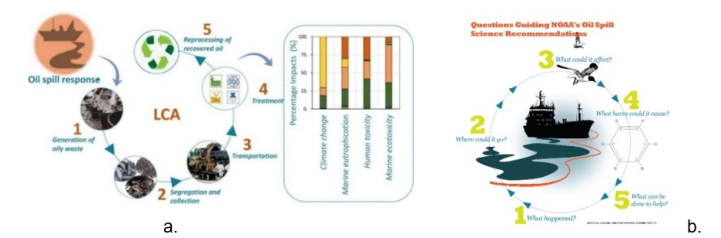
The usage of the mechanical methods for removing oil spills in the marine environment involves the completion of two main stages, namely isolation and recovery for the purpose of post-processing. Figure 1a highlights the diagram related to the management of oil waste and figure 1b the response method of the maritime authorities in case of naval accidents resulting in oil spills/leaks (Choe et al., 2021).
Figure 1: a. Oil waste management principle scheme; b. Management of the response in case of oil spills.
For isolation, physical barriers are used to limit the spread of oil on the water surface. Thus, favourable conditions are created both for the oil recovery and for the habitats and shores adjacent to the isolated area protection (Gâf-Deac et al., 2015).
The most common types of barriers are in the form of floating dams. The removal of spilled oil in aquatic environments can be performed through: i) mechanical isolation, by hydrodynamic processes, recovery and transport; ii) use of chemical dispersants; iii) “in situ” combustion (Cao et al., 2022; Vijayaraghavan et al., 2021).
In the context of global concerns in the field of environmental protection and for limitation of the effects of maritime disasters, the paper presents the results of research focused on the design and development of a rapid intervention unit, made of composite materials - based textiles for the storage, recovery and transport of oil fractions resulting from oil spills.
MATERIALS AND METHODS
The design and development of the modules from composite structures, as components of the naval unit for rapid intervention (UNIR) in case of marine disasters (e.g., oil spill) were carried out according to:
- the hydrometeorological conditions specific to the coast open areas, respectively: Hwave = 6–8 m,; Lwave = 25–30 m, wave type: trochoidal with multi-directional and multi-component Gerstner waves; Vwind = min. 1.5 m/s; sandy areal type substrate (Gâf-Deac et al., 2015; Handren et al., 2008);
- the values of the loading coefficients established according to: i) the possibility of the failure of a component element that can generate the destruction of the entire structure (safety coefficient, Cs = 1.65); ii) the specific effects of the dynamic application of the loads in the interval [1.3; 1.6] - dynamic loading coefficient Cd = 1.5; iii) the symmetry of
236 Ene and Mihai
the force distribution regardless the level of the section perpendicular to the axis of symmetry (asymmetric loading coefficient Ca = 1.6); iv) the need to ensure the safety operation of the entire system (ultimate loading coefficient Ci = Cs·Cd·Ca = 4.00); v) the breaking resistance should be equal to that of the component element with the lowest resistance (coefficient of loss of resistance in joints Cr = 1.8); vi) the aggressive action of the marine environment against the composite material from the structure of the floating systems and the existence of the possibility of the abrasion of the storage tank by the sandy soil once it is located in the area of the treatment stations (coefficient of loss of resistance due to abrasion Cf =1); vii) the multiple uses of the system of blocking and capturing oil fractions (coefficient of loss of resistance due to fatigue Co = 1.0); viii) aggressions generated by solar radiation and sea water on composite structures (strength loss coefficient due to environmental factors Cm = 0.85). Thus, the total strength loss coefficient will be Cp = Cr·Cf·Co·Cm = 1.53, and the ultimate load coefficient CU = Ci/Cp = 2.61.
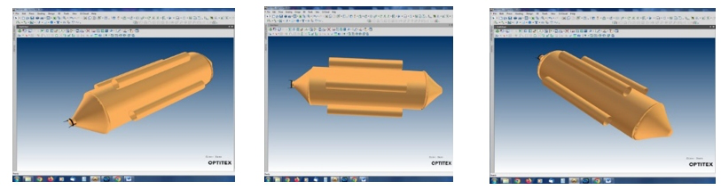
Starting from these assumptions, the Optitex Pattern Making - PDS (EFI Optitex) software was used for the digital design and avatar loading of the patterns of the UNIR demonstrative model. Figure 3 evidences the changes based on the modules included in the program on the patterns that were transferred to the virtual model.
Additionally, with the help of specialized software, the modules created as 2D patterns were visualized in virtual 3D mode; the analysis of how the changes made to the 3D models affect the 2D patterns was carried out and the direct transition from the concept to the virtual 3D model with all aspects related to the fully defined product (material properties and their behavior) was ensured.
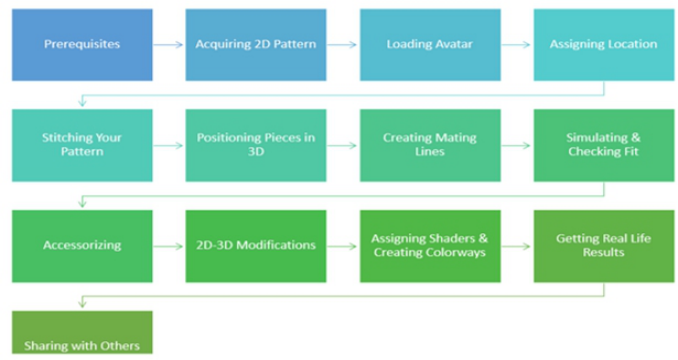
The workflow for taking over the 2D models and transforming them into 3D samples is presented in Figure 2.
Figure 2: Workflow for transformation of the 2D models into 3D samples.
The Computational Design of a Naval Unit for Rapid Intervention 237
Figure 3: 3D simulation and verification of the architecture of the UNIR demonstration model. Visualisation of the modules created as 2D patterns in virtual 3D mode.
The main characteristics of the components and subassemblies of the naval unit for rapid intervention are: total length: 2650 mm; shape/dimensions fine prow - cone trunk / height: 400 mm; DBxDb = 600 x 200 mm; stern shape/dimensions (immersed vertical structure) - cone trunk/height: 400 mm, DBxDb = 600 × 200 mm; shape/dimension of the central vertical structure (point 1) - right circular cylinder/G = 1800 mm; D = 600 mm; shape/dimensions of floating structures (3 pcs) (part 2) -right circular cylinder/G = 1200 mm; D = 150 mm; green colour; anchor eyelet – strap: 25 – 800; handle band: 25 – 600; inner material (core) float system - polystyrene of min. 50 mm, 15 kg/m3.
The physical and mechanical characteristics of the composite materials used to create the Naval Rapid Intervention Unit are presented in Table 1.
Table 1. Physical-mechanical characteristics of the composite materials.
Table available in the original PDF paper.
Characteristics - Composite Materials
MC2 (Fine Prow and Stern Vertically Immersed)
MC1 (Floating Structures and the Central Vertical Structure)
2100/2100 4400/3300
Composition 100% PES 100% PES Mass, g/sqm, min 850 1800 Breaking resistance, warp/weft, daN, min 28/30 16/24 Breaking elongation, warp/weft, max.%
230/132 450/300
Tear resistance, trouser test, warp/weft, N
140/105 350/250
Tear resistance, fin test, warp/weft, N
RESULTS AND DISCUSIONS Within the experimental program, the panels doubled and joined with five types of stitches, based on the composite textile structure with the characteristics presented in the Table 1, were tested and assessed in terms of the physical-mechanical performance level.
238 Ene and Mihai
The database containing the values resulted from the physical-mechanical determinations based on the experimental plan involving the panel variants and subassemblies was created and the following statistical parameters were calculated:
the dispersion of the data around the central value of the mean;
mean and median - the parameters that define the central tendencies;
skewness and kurtosis indicators, as appropriate;;
correlation coefficients for the basic woven textile structures subjected to testing.
In addition, the histograms, normal distribution curves and Box Plot graphs were generated and analysed.
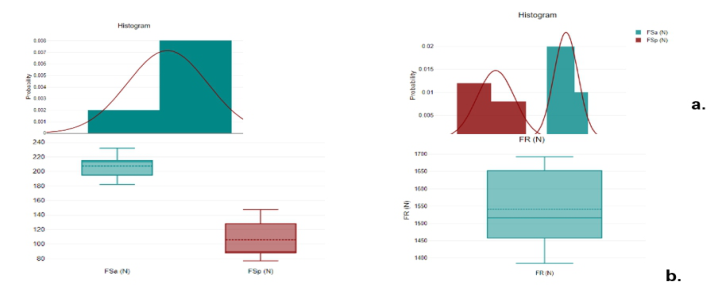
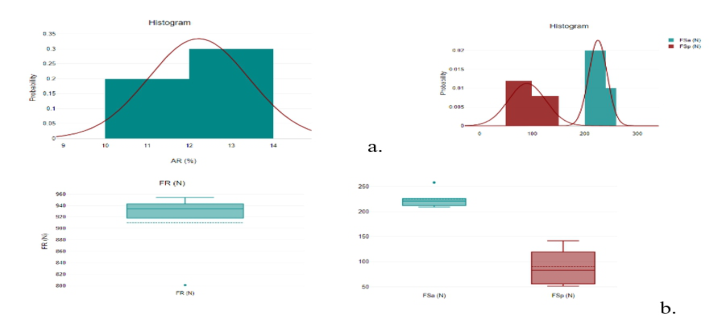
The values obtained for the maximum strength, strip test (N) – FR (weft/warp) (N); elongation at maximum force, strip test (%) - AR (%); tearing strength, fin type specimen (N) – Fsa (weft/warp) (N); tear strength, trouser type specimen (N) - FSp (weft/warp) (N) of the panels doubled and joined with two different stitches types are presented in Table 2 and Table 3 In the figure 4 are highlighted the generated histograms and the BoxPlots graphs correlated to the values presented in the Table 2 and in the figure 5 the histograms and the BoxPlots graphs according to the values presented in the Table 3.
Table 2. Statistic parameters for the panels doubled and joined with the stiches M1.
The Computational Design of a Naval Unit for Rapid Intervention 239
Figure 4: Statistical parameters for panels doubled and jointed with the stitch M1. a. Histograms, b. Box Plot graphs.Table 3. Statistical parameters for the panels doubled and joined with the stiches M2.
Figure 5: Statistical parameters for panels doubled and jointed with the stitch M2. a. Histograms, b. Box plot graphs.
240 Ene and Mihai
Analyzing the data presented in Tables 4 and 5, the followings are highlighted:
the disperion degree of the scores is reduced and the average can be taken into account as an indicator of the central tendency for the analyzed populations. These can be considered homogeneous, because for none of them the value of the coefficient of variability did not exceed 8.5%, the degree of dispersion of the scores being reduced and the average being in this case a good indicator of the central tendency;
for skewness with positive values, the curves move to the right, and, in the opposite direction, to the left, so the distribution is asymmetric, the data are negatively inclined, the mean and median are lower than the module. Conversely, for the presented data, if the skewness has negative values, the mean and median are greater than the module;
the drawn histograms highlight the probability distributions for the variables considered. The probability experiments performed for the variables considered in the analysis demonstrate that the distribution is normal (the frequency of data occurrence for all variables taken into the study is highlighted).
CONCLUSION
The designed and development of a naval unit for rapid interventions in case of disasters occurred in marine ecosystem were iteratively performed for each part of the assembly, starting from materials characterisation, computation designed of the modules and validation of the most relevant performances. For each new iteration, the elements defined by the previous iterations were detailed, added and modified (e.g., the type-dimensions of the assembly - the technological flow of its accomplishment).
The second phase of the incremental development was focused on the experimental design with the help of the Optitex Pattern Making PDS (EFI Optitex) software, obtaining the type-dimensions of the system and the multiplication (2D pattern construction, 3D simulation and visualization).
The validation of the entire system was performed through physical and mechanical analyses and statistical analyses of the databases developed for each step of the experimental plan. The naval unit for rapid interventions developed so far will be tested under real conditions of use, in the hydromete- orological conditions that are specific the open areas of the seaside.
ACKNOWLEDGMENT
This scientific paper is funded by the Ministry of Research, Innovation, Digitalisation within Program 1 - Development of the national RD system, Subprogram 1.2 - Institutional Performance - RDI excellence funding projects, Contract no. 4PFE/2021.
REFERENCES
Cao, Y., et al.; (2022) “Machine learning-aided causal inference for unraveling chemical dispersant and salinity effects on crude oil biodegradation”, Bioresources Technology, Vol. 345, 126468.
The Computational Design of a Naval Unit for Rapid Intervention 241
Chen, Z. K.; et al. (2020) “Use of surface-washing agents for the treatment of oiled shorelines: research advancements, technical applications and future challenges”. Chemical Engineering Journal, Vol. 391, 123565. Choe, Y.; Lee, J.; Jung, W.; Park, J.; Jho, J. Y., et al.; (2021) “Gravity-based oil spill
remediation using reduced graphene oxide/LDPE sheet for both light and heavy oils”. Process Safety and Environmental Protection, Vol. 156, pp. 617–624. Dave, D.; Ghaly, A. E.; (2011) “Remediation Technologies for Marine Oil Spills: A Critical Review and Comparative Analysis”. American Journal of Environmental Sciences, Vol. 7(5), pp. 423–440. Gâf-Deac, I. I., et al., (2015) “New development: from linear to nonlinear economy.
Challenges from the perspective of sustainable development”, - W.1, Romania’s Sustainable Economic and Social Development. Models, Scenarios, Evaluations, The Romanian Academy, The 3rd Intl. Economic Scientific Research – Theoretical, Empirical and Practical Approaches, ESPERA 2015, ISBN 978-3-631-67330-0, E- ISBN 978-3-653-06571-8, E-ISBN 978-3-631-69664, E-ISBN 978-3-631-69665- 1, doi: 10.3726/978-3-653-06571-8. Gerring, S.; Hu, G.; Li, J.; Hewage, K.; Sadiq, R.; (2022)” Evaluation of offshore oil spill response waste management strategies: A lifecycle assessment-based framework”., Journal of Hazardous Materials, Vol. 432, 128659. Handren A. Amin, (2008) “A comparative study of 2CAD-integrated FE-programs
using the linear static analysis”, Master Thesis, Halmstad University, pp. 26–46. Vijayaraghavan C., et al.; (2021) “Inexact inventory-theory-based optimization of oily waste management system in shoreline spill response”, Science Total Environmental, Vol. 777, 146078. Yaw, K.; Adofo, E. N.; Benjamin, A. T., (2022),” Dispersants as an oil spill clean-up technique in the marine environment: A review”, Heliyon, Vol. 8, Issue 8, e10153, ISSN 2405-8440.
LISTED IN THE AHFE DIGITAL BOOKSTORE CATALOGUE
Explore the complete digital volume
Human Factors in Design, Engineering, and Computing
Read this individual research paper free through the original publisher, or explore the full digital proceedings book.
ISBN 978-1-964867-35-9
Explore this ISBN in the AHFE Bookstore ↗Listed in the July 2026 bookstore catalogue; search by ISBN to confirm current availability · Digital book purchase optional