Luca Rizzi, Sarah De_Cristofaro, Antonio Zingarofalo (2023). User Driven Custom Design - the solution to simplify customisation according to consumer needs. In: Human Factors and Systems Interaction. AHFE Open Access, vol. 84, pp. 55–64. https://doi.org/10.54941/ahfe1003590
IntroductionThe objective of this study was to define a new approach for product design and customization. The approach focused on the development of several technical components able to provide product personalisation as an integrated solution to simplify the interactions between the end-user and the producer. The solution was developed as a web platform for an easy configuration of the product by the user at home and applied to a wheelchair. The finalization of a new order and the assembly procedure of the product is fully digital. This research activity is funded by the EU Project n. 872570 “KYKLOS 4.0 - An Advanced Circular and Agile Manufacturing Ecosystem based on rapid reconfigurable manufacturing process and individualized consumer preferences” (H2020-DT-2018-2020 - Digitising and transforming European industry and services: digital innovation hubs and platforms) which aims at simplifying mass customization while improving circularity and sustainability.MethodsOur Product Parametric Design Methodology was developed through a specific ergonomic analysis of products related to human factors and anthropometry. The use of virtual manikins and simulation of different percentiles, allowed to test and better define correct inputs and parameters for product customization. The solution has been developed and applied to a medical use case and validated and integrated in the KYKLOS 4.0 main platform. The aim was to provide a coherent user experience for the wheelchair ordering and customization, so the user can easily select wheelchair frame and mandatory parts, optional accessories and customize additional elements such as the cushion and footrest. Several Technical Component were developed in order to guarantee the final workflow. The methodology was applied into our “Recommendation Engine” and integrated with the “Users' Behaviour Model”, which use patient’s information, such as anthropometry and behaviour to better define best fitting products and accessories. Additionally, the workflow integrated a specifically designed “3D Modelling Component” which allows direct parts customization.ResultsThe Product Personalization Solution was intended to support the customer in the selection of parts and accessories to fully customize the product and, at the same time, also to support product designer to convert customers’ requests efficiently and smoothly into personalized product specifications, thus providing a complete customer-oriented design for manufacturing with time and cost reduction. The methodology can be considered part of what is called "ECO-DESIGN," which is the design of products based on the sustainable and minimal use of resources and which enables high-quality recycling of materials at the end of the product life cycle. The use of the circular economy concept adopted in the specific pilot case is certainly relevant to the production of customized components for the wheelchair provided by our end-user, as the production of customized components allows a reduction in the resources required to produce parts. Moreover, since these are products that are perfectly compatible with the end user's needs, the possibility of having returned products (when components does not meet patient's needs) or unused products is considerably reduced, resulting in waste of materials used. Within this specific Use Case the customization of the wheelchair frame and accessories, based on the user's anthropometry, allows the reduction of unnecessary machining such as, for example, unused holes for ergonomic adaptation. It also turns out to be reduced waste production of aluminium tubulars resulting in reduced processing time and harmful emissions released into the environment.ConclusionAlthough the solution has been applied for demonstration purposes to the personalization of a wheelchair, it is exploitable to other products where personalization based on anthropometric measurements is essential for maximizing patient comfort and reduce production errors and waste. The addressed medical case study highlighted some very interesting aspects concerning the replication and scale up potential in the medical domain. The methodology based on anthropometry to define product requirements can also be applied very effectively to a variety of other products. Some application cases already exist in fashion for clothes and accessories size selection. Furniture products such as chairs, desks and wardrobes can also be customized using the same approach. We also believe that sport equipment has a high potential for such application. The automation of this process and the direct relationship with the user's dimensions could open potential markets currently reserved only to very expensive bicycle frames. Also, the production of accessories and tool, made with additive manufacturing technologies, could lead to disruptive innovation in those sectors providing true mass customization capabilities.
Product customisation recently became an emerging business need as com- panies began to recognise the great importance and benefits of delivering individualized customized products, while retaining the advantages of the mass production method.
By having a greater focus on customers, companies can use Mass Custo- misation (MC) to gain a competitive advantage and achieve a noticeable economic value. In their desire to become customer-driven, many companies have resorted to inventing new programs and procedures to meet every custo- mer’s request. But as customers and their needs grow increasingly diverse, such an approach adds unnecessary cost and complexity to operations (B. Joseph Pine II, 1993).
Automatic solutions for product customization based on user’s anthropo- metric measurements have been deeply investigated in several sectors which can be mostly referred to the fashion industry (i.e. tailor-made suits, busi- ness shirts, eyewear and accessories). Most of this customisation are based on “Cosmetic” personalisation of standard sizes.
One of the more interesting examples, still connected to the fashion indu- stries, is represented by the eyewear market, where new technologies (i.e. face 3D scanning) have been used to enable a best fitting design in real time of the entire frame (https://www.topologyeyewear.com/).
As safety issues are particularly important when moving to the Health- care sector, medical device companies are challenged to further optimise and personalise their product, thus the development and application of specific design methods should be given appropriate importance.
For a better adaptation of the medical device to the patient specific ana- tomies, the consideration of user’s specific requirements in the product deve- lopment process is essential but results in an increase of the variety-induced complexity caused by the variety of requirements, parts, components, produ- cts as well as processes within a company (Simpson et al., 2014). To manage this variety-induced complexity, design for variety methods and modulari- zation approaches can be applied (Simpson et al, 2014; Rennpferdt et al., 2020), but a lack in application to medical devices has been found in lite- rature review (Kuhl, J. et at., 2020) except for the analysis made by Kuhl et al. (2021). Several works focused on the application of user-centred design for the development of personalised wearable devices (Perego et al., 2022), therapies (Imbesi et al., 2022) or assistive devices (Santos et al., 2020) are available, but none of them report the design and implementation of a meth- odology to develop an automated tool for product customisation based on user anthropometry as reported in this paper.
Few works on automatic customization of wheelchair can be found in lite- rature, but most of them are manly focused on wheelchair performances in terms of weight and wheel sizes to be selected for professional sports requirements (i.e. rugby). No studies are available for daily life wheelchair customization based on patient’s needs and anthropometry (Usma-Alvarez et al., 2014).
The objective of this study was to develop a product parametric design tool able to collect, thanks to a dedicated methodology, input data from anthropo- metric measures provided by the end-user, technical standard requirements of the product, design constraints and producer expertise, and to automatically process and translate them into design inputs for a customized product pro- duction. The authors developed several technical components able to provide product personalisation as an integrated solution to simplify the interactions between the end-user and the producer. A web platform for an easy configu- ration of the product by the user at home has been designed. The finalisation of a new order and the assembly procedure of the product has been made fully digital. The wheelchair market has been selected to validate it in a real envi- ronment, since personalisation of such products is essential, but suffer from the high variability of body measurements caused by the severe pathologies of the users.
This research activity has been funded by the EU Project n. 872570 “KYKLOS 4.0 - An Advanced Circular and Agile Manufacturing Ecosy- stem based on rapid reconfigurable manufacturing process and individualized consumer preferences” which aims at simplifying mass customisation while improving circularity and sustainability.
User Driven Custom Design - The Solution to Simplify Customisation 57
MATERIALS AND METHODS
A Methodology for Product Parametric Design was developed to enable the elaboration of a Product Parametric Design Tool. The methodology has been applied to a wheelchair as an example product and the Product Parametric Design Tool designed to automatically generate a set of inputs for the final configuration of the product based on the measurements provided by the user, to reconfigure the 3D of each component and of the assembly of the customized product and to elaborate, in the end, the complete Bill of Material (BOM) and technical drawings for the production line.
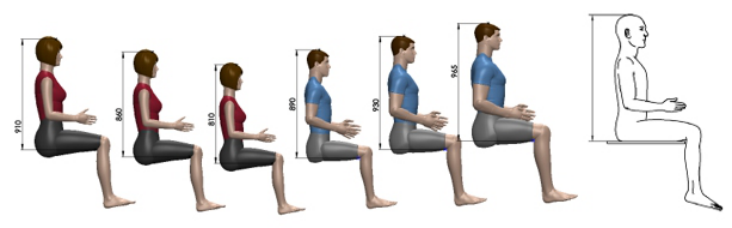
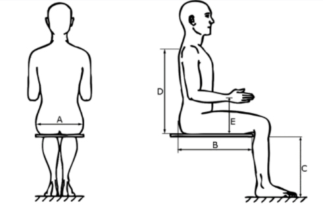
Relevant anthropometric measurements were defined based on the analysis of the product use, its interaction with user and caregiver body dimensi- ons and anthropometry simulated by the Virtual Manikin Zygote® Human Factor. In order to define Min and Max value for each relevant anthropome- tric measurement a combination of inputs from the Zygote® Human Factor and DIN 44302–2 (2020) was used (Figure 1).
The web application, namely the Product Parametric Design Tool, was built using.Net Framework 4.7.2. The server-side language used to implement the prototype is C# and no Relational Database was required to store the working data.
SolidWorks® was used to create the 3D model of the wheelchair and draft all the technical drawings necessary for the production line. The Soli- dWorks® Design Table tool, which uses Microsoft Excel spreadsheet, was exploited to create a multiple configuration assembly of the wheelchair with multiple configuration components and create a product platform.
Interaction with Microsoft Excel files was achieved using the library “microsoft.office.interop.excel”.
Instructions for measurements acquisition provided to the user in the webpage, were derived from ISO 7250–1 (2017).
The validation of the Product Parametric Design Tool has been performed applying the System Usability Scale (SUS), a standardized usability test used to evaluate the user friendliness of a system/product.
The SUS test has been designed to assess the reliability and quality of the Product Parametric Design Tool in order to identify necessary mitigation actions to be implemented to enable the user to perform the required tasks quickly and error free.
Figure 1: Body seat height (torso length) comparison DIN 33402–2 & Zygote Human Factor.
Table 1 reports the 10 statements defined and used to develop the SUS test questionnaire: The SUS questionnaire was supposed to be filled by users, after comple- ting the product configuration procedure based on their anthropometric data, providing a numerical score to each question on a scale from 1 (strongly disagree) to 5 (strongly agree).
The scores collected from each user have been used to extrapolate a nume- rical value representative of the individual SUS score using the following formula: #
("X
Individual SUS =
Odd questions scores
−5
"
#)
+
25 − X
(Even questions scores)
∗2.5
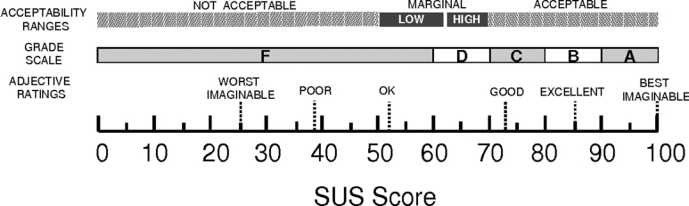
The SUS score for the Product Parametric Design Tool has been calcu- lated as the arithmetic mean of the Individual SUS values and compared to an overall assessment of the system’s reliability and usability reported in Figure 2.
Table 1. SUS test statements.
Table available in the original PDF paper.
Code Statements S1 I think that I would like to use this system frequently S2 I found the system unnecessarily complex S3 I thought the system was easy to use S4 I think that I would need the support of a technical person to be able to use this system S5 I found the various functions in this system were well integrated S6 I thought there was too much inconsistency in this system S7 I would imagine that most people would learn to use this system very quickly S8 I found the system very cumbersome to use S9 I felt very confident using the system S10 I needed to learn a lot of things before I could get going with this system
Figure 2: System reliability and usability assessment scale.
User Driven Custom Design - The Solution to Simplify Customisation 59
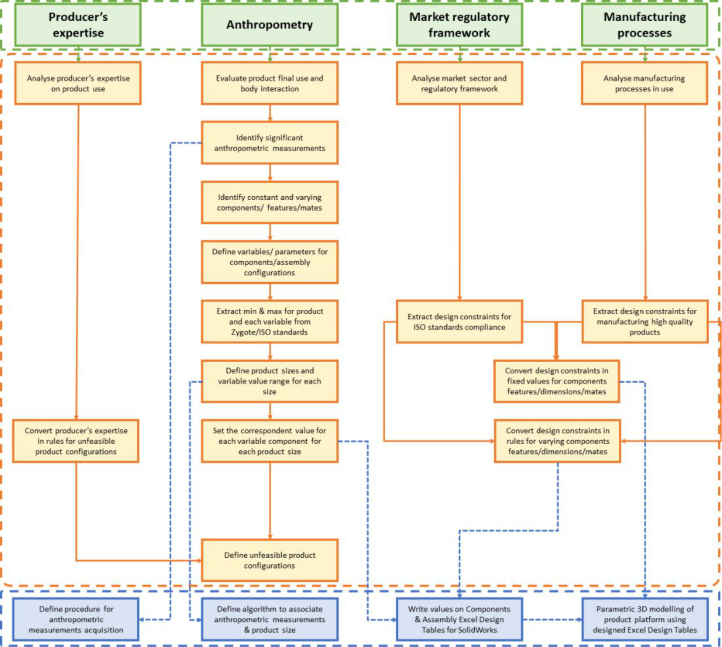
PRODUCT PARAMETRIC DESIGN METHODOLOGY The methodology has been designed in three stages: the first, where the pro- duct and its interaction with the end-user is analysed and relevant measure- ments for customization are extracted; the second, where further constraints are derived from relevant technical standards and manufacturing processes; the third, where such measurements and constraints are translated in product design specifications to create the product platform (Figure 3).
In cases where product variability cannot be managed only through anth- ropometric, standards and manufacturing constraints, the methodology allows to introduce further restrictions based on producer’s expertise on the product use. For example, if the product can be equipped with several accessories but the selection of the best accessory for the customized product cannot be left to the customer because it could lead to unproducible or not ergonomics configurations, a rule to lock in the choice must be implemented. An analysis of the possible product configurations acceptable for the designed product platform are necessary and an exclusion rule for ineligible solutions for each configuration must be defined. Such rules typically add constraints at assembly level which can be inserted into the Excel Design Tables defined for the 3D model of the product platform.
All the stages of the methodology have been developed to allow the design of a standardized product platform that can be altered and customized by the end user within given adaptation limits.
PRODUCT PARAMETRIC DESIGN TOOL The Product Parametric Design Tool has been developed to:
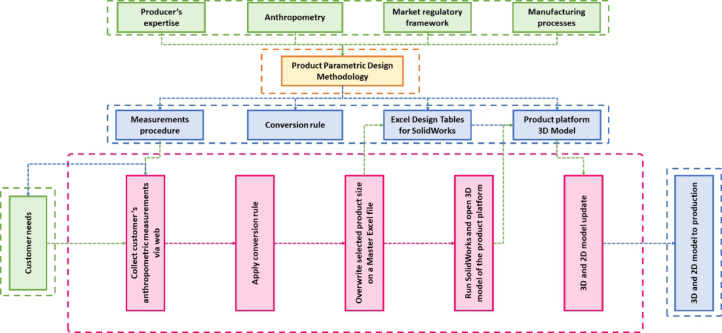
1. Collect, through a dedicated webpage, the relevant anthropometric mea- surements, providing suggestions for a correct measurement acquisition (Figure 4). 2. Apply, remotely, the defined rule to associate collected anthropometric measurements to the relevant product size. 3. Write, locally, the selected size of the product in a Master Excel file, whose content will automatically update the information reported in the Excel Design Tables designed during the application of the Methodology and saved locally. 4. Run SolidWorks locally and open the product platform file, which is auto- matically reconfigured according to data reported in the Master Excel file and update all the 2D drawings for production. 5. Save, locally, in a dedicated folder all the 3D and 2D files and related Excel Design Tables.
Figure 4 reports a schematic representation of the tool working steps, which are represented in red. In green all the inputs, in orange the metho- dology, in blue the outputs.
Figure 4: Product parametric design tool workflow.
RESULTS
The solution has been developed and applied to a medical use case (i.e. the production of a wheelchair) and validated and integrated in the KYKLOS 4.0 project main platform.
User Driven Custom Design - The Solution to Simplify Customisation 61
The application of the Product Parametric Design Methodology allowed to identify: the list of significant anthropometric measurements of the patient (parameters) and set acquisition instructions; the list of product compo- nents that are affected by changing in patient body size; the list of product components that do not change with patient dimensions (Figure 5).
The expertise of the producer has been implemented to identify a limited number of product variability and to define the rule to select one size rather than another based on user inputs.
The aim was to provide a coherent user experience for wheelchair ordering and customisation, so the user could easily provide their measurements, select the wheelchair frame and mandatory parts, optional accessories and custo- mize additional elements such as the cushion and footrest. Further Technical Components, other than the Product Parametric Design Tool, were develo- ped in order to guarantee the final workflow. The methodology has been implemented into a “Recommendation Engine”and integrated with a “Users’ Behaviour Model”, where patient’s information, such as anthropometry and behaviour, were used to better define best fitting products and accessories.
In order to test if the methodology applied to the medical use case reached the goal of correctly defining the product size starting from body measures inputs, six Virtual Manikins, one per each relevant percentile, have been used.
The selected manikins had the following sizes1 in cm (Table 2):
Figure 5: Anthropometric measurements to drive customisation of product compo- nents.
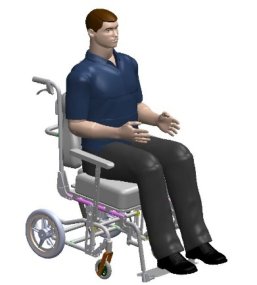
Once available, the manikin has been inserted in the Wheelchair assembly in SolidWorks, in the size defined by the Product Parametric Design Tool starting from the manikin dimensions and posed seated on the Wheelchair (Figure 6).
The measurements inserted in the Product Parametric Design Tool to select the wheelchair size have been checked on the manikin and the presence of interference points between the manikin and the wheelchair was verified (Table 3).
All the virtual tests performed shown a positive match between body size and product size, thus validating the methodology and the developed demo tool and the rules applied in it.
1Being the manikins developed for not disabled people, these 3D virtual tests have been conducted con- sidering the left and right parts of the body symmetrical, thus the values used for the right and left sides respectively of B, C and E body measures are identical among them and are those reported in the table.
Table 2. Personalized manikins’ sizes for 3D virtual tests.
Table available in the original PDF paper.
Sex Percentile A B C D E Female 5
33.3 44.0 41.0 54.0 18.5 Female 50
37.5 45.0 44.2 59.0 23.0 Female 95
39.2 52.1 46.6 63.0 27.5 Male 5
35.3 45.2 41.4 57.0 21.0 Male 50
37.0 49.0 46.3 62.5 24.0 Male 95
40.5 52.2 51.2 67.0 28.5
Figure 6: 3D virtual test – Zygote manikin, male 95◦percentile on a wheelchair size M1.Table 3. Correspondence between selected manikins and wheelchair sizes.
Table available in the original PDF paper.
Sex Percentile Wheelchair size Female 5
XS1 Female 50
S Female 95
M Male 5
XS1 Male 50
M Male 95
M1
The validation of the developed Product Parametric Design Tool has been performed also thanks to a usability test, conducted on a population of 30 users (15 men and 15 women of different ages) who simulated the configura- tion of the product according to their anthropometric characteristics. Users were asked to complete the SUS questionnaire reported in Table 1 after com- pleting the product configuration procedure based on their anthropometric data.
The Product Parametric Design Tool obtained a quite high and satisfactory SUS score of 89.65 over 100, almost an excellent rating in the assessment scale used and shown in Figure 2.
The methodology, in addition to correctly providing the desired outputs, is easy to understand, intuitive and quick, providing a positive user experience.
User Driven Custom Design - The Solution to Simplify Customisation 63
DISCUSSION AND CONCLUSION The Product Parametric Design Tool was intended to support the customer in the selection of parts and accessories to fully customise the product and, at the same time, also to support the product designer to convert customers’ requests efficiently and smoothly into personalised product specifications, thus providing a complete customer-oriented design for manufacturing with time and cost reduction.
The developed methodology can be considered part of what is called “ECO-DESIGN,” which is the design of products based on the sustainable and minimal use of resources and which enables high-quality recycling of materials at the end of the product life cycle. The use of the circular economy concept adopted in the specific case study presented is certainly relevant to the production of customised components for a wheelchair, as the produ- ction of customised components allows a reduction in the resources required to produce parts.
Moreover, since these are products that are perfectly compatible with the end user’s needs, the possibility of having returned products (when com- ponents do not meet patient’s needs) or unused products is considerably reduced, resulting in the waste of materials used.
Within this specific case-study the customisation of the wheelchair frame and accessories, based on the user’s anthropometry, allowed the reduction of unnecessary machining such as, for example, unused holes for ergonomic adaptation. It also turned out to enable a reduction on waste production of aluminium tubulars resulting in reduced processing time and harmful emissions released into the environment.
Although the solution has been applied for demonstration purposes to the personalisation of a wheelchair, it is exploitable to other products where personalisation based on anthropometric measurements is essential for maximizing patient comfort and reducing production errors and waste. The addressed medical case study highlighted some very interesting aspects concerning the replication and scale up potential in the medical domain.
The methodology based on anthropometry to define product requirements can also be applied very effectively to a variety of other products. Furni- ture products such as chairs, desks and wardrobes can also be customized using the same approach. The authors believe that sport equipment has a high potential for such application. The automation of this process and the direct relationship with the user’s dimensions could open potential markets currently reserved only to very expensive bicycle frames.
ACKNOWLEDGMENT
The authors would like to acknowledge all KYKLOS 4.0 Consortium, especially ProMedicare.
REFERENCES
B. Joseph Pine II (1993). Mass Customisation: The New Frontier in Business Competition. Boston: Harvard Business School Press.
Burton, Michael, et al. (2010) “Systematic design customization of sport wheelchairs using the Taguchi method”. Procedia Engineering 2.2. pp. 2659–2665. DIN 33402-2, 2020 Edition, December 2020 - Ergonomics - Human body dimensi-
ons - Part 2: Values. EU Project n. 872570 “KYKLOS 4.0 - An Advanced Circular and Agile Manufacturing Ecosystem based on rapid reconfigurable manufacturing process and individualized consumer preferences” (H2020-DT-2018-2020 - Digitising and transforming European industry and services: digital innovation hubs and plat- forms). Imbesi, S., Corzani, M., Lopane, G., Mincolelli, G., Chiari, L. (2022), “User-Centered
Design Methodologies for the Prototype Development of a Smart Harness and Related System to Provide Haptic Cues to Persons with Parkinson’s Disease”. Sensors 22, 8095. ISO 7250-1, 2017 Edition, August 2017 - Basic human body measurements for technological design — Part 1: Body measurement definitions and landmarks. Kuhl, J., Ding, A., Ngo, N. T., Braschkat, A., Fiehler, J., Krause, D. (2021).
“Design of Personalized Devices—The Tradeoff between Individual Value and Personalization Workload”. Applied Science 11, no. 1:241. Kuhl, J., Sankowski, O., & Krause, D. (2020). “Investigation on methods and characteristics in medical device development”. Proceedings of the Design Society: DESIGN Conference, 1. pp. 1969–1978. Perego, P, Sironi, R. (2022) Full-stack User-Centered Approach for Wearable techno-
logy design”. International Journal of Design & Technology, Vol. 25, no. 1. Rennpferdt, C., Krause, D. (2020). “Towards a frameworks for the design of varietyoriented product-service systems”. Proceedings of the Design Society: DESIGN Conference, 1. pp. 1345–1354. Santos, A. V. F., Silveira, Z. C. (2020). “AT-d8sign: methodology to support develo-
pment of assistive devices focused on user-centered design and 3D technologies”. J Braz. Soc. Mech. Sci. Eng. 42. pp. 260. Simpson, T. W. et al. (2014), “Advances in Product Family and Product Platform Design”, Methods & Applications, Springer. Usma-Alvarez, C. C., Fuss, F. K., and Subic, A. 2014). “User-Centered Design Custo-
mization of Rugby Wheelchairs Based on the Taguchi Method.” ASME. J. Mech. 136(4).
LISTED IN THE AHFE DIGITAL BOOKSTORE CATALOGUE
Explore the complete digital volume
Human Factors and Systems Interaction
Read this individual research paper free through the original publisher, or explore the full digital proceedings book.
ISBN 978-1-958651-60-5
Explore this ISBN in the AHFE Bookstore ↗Listed in the July 2026 bookstore catalogue; search by ISBN to confirm current availability · Digital book purchase optional