Sarah De_Cristofaro, Luca Rizzi, Dario Cardone, Lisa Berti, Ubaldo Spina (2024). Smart Relax Armchair - a solution for active and safe ageing at home. In: Human Factors in Aging and Special Needs. AHFE Open Access, vol. 133, pp. 80–90. https://doi.org/10.54941/ahfe1004896
The fact that people are living longer is a social and economic challenge for developed countries in the 21st century. An ageing society leads to an increase in the number of people living with multiple chronic conditions, facing the loss of independence and autonomy in daily activities and suffering social isolation caused by the pandemic or by the necessity of long-term care at home. The increasing incidence of sedentarism as well as prolonged immobility caused by long-stay settings (care home) is also a growing health concern. Indeed, spending too much time sitting daily could increase the incidence of postural changes and pressure ulcer formation, further reducing the physical, social, and emotional well-being of older adults.These problems are countable as significant contributors among many threats to elderly health and well-being leading to morbidity, disability, and premature death. In this view, Ambient Assisted Living solutions to monitor house routines of elderly patients and offer simple and healthy exercises daily are essential.This paper reports the results of the research activity conducted by the authors in collaboration with a well-known Italian sofa and armchair producer and health experts to develop an innovative solution for promoting active and safe ageing at home using a Smart Relax Armchair. The goal of the study was to introduce new smart functions to a Relax Armchair to help maintain a correct posture as well as to reduce the formation of bedsores by inducing frequent repositioning.To reach the goal, firstly the authors conducted a benchmarking analysis to identify the smart functions dedicated to health and wellbeing purposes already available on the market in the home furniture sector. A user-centred design methodology has been implemented to identify the Smart Relax Armchair functionalities, by involving industry experts, researchers in active ageing, biomedical engineers, and potential users since the early design stage. A dedicated design thinking tool has been used for users’ needs identification and translation into metrics (i.e. technical features). The Quality Function Deployment (QFD) method and tool have been used to rank such metrics and drive the design of the final product to meet users’ needs at best.3D virtual manikins, technical standards, ergonomic manuals, and the know-how of biomedical engineers and experts in Functional Recovery and Rehabilitation have been used to identify postural misbehaviour in daily life and potential intervention areas on a commercial Relax Armchair. Several active and passive solutions have been identified and tested to help maintain the correct posture and reduce the formation of bedsores. A sensorised mat has been used to assess changes in pressure distribution with respect to different layers of cushioning materials and to help select the specific pressure relief mattresses for bedsore prevention to be integrated into the final design.At the same time, an innovative protocol (anti-decubitus function) has been developed and implemented via ARDUINO to automatically induce a repositioning of the Smart Relax Armchair and thus changing the pressure distribution on the body, if the APP detects prolonged sitting.The protocol of the anti-decubitus function has been validated on a preliminary prototype thanks to a sensorised mat which demonstrated the effectiveness on pressure distribution variation, thus allowing the patenting of the idea.In order to promote active ageing at home, a set of simple rehabilitation exercises to be performed with the help of the Smart Relax Armchair has been designed and implemented in the APP specifically developed to control the product via a Smartphone or a vocal assistant.A final prototype including all the selected and developed solutions has been produced and a clinical trial will be conducted in the next months for the final validation of the product.The solutions developed and implemented on the Smart Relax Armchair have the potential to be applied to any model of Armchair or Sofa by the producer, thus changing the conventional paradigm of expensive products for active ageing only available for residential care facilities which cannot be afforded by those willing to age in place.
The fact that people are living longer is a social and economic challenge for developed countries in the 21st century. An ageing society leads to an increase in the number of people living with multiple chronic conditions, facing the loss of independence and autonomy. Among the many threats to the health and well-being of older people, home isolation and consequently home acci- dents are a significant cause and a major contributor to morbidity, disability, and premature death (EuroSafe, 2024).
Smart Relax Armchair - A Solution for Active and Safe Ageing at Home 81
One third of people over the age of 65 who live in the community fall each year and this proportion increases to 50% of those aged 80 years and older. Every year, about 36.000 fatal fall-related injuries are reported in EU- countries and an estimated number of 3.8 million older people are treated in an hospital after a fall and then at home (Directorate-General for Economic and Financial Affairs, 2021).
The increasing incidence of sedentarism as well as prolonged immobility caused by long-stay setting (care home) is also a growing health concern. Indeed, spending too much time sitting daily could increase the incidence of postural changes and pressure ulcer formation, further reducing physical, social and emotional well-being of older adults (National Institute of Aging - NIH, 2020) (Collins, 2002).
Such data underline the need to make the home a more comfortable and safer place for elderly, using not only medical devices but also smart furni- ture capable to improve people’s lifestyle by simplifying daily activities and promoting independence, thus reducing psychophysical stress, and avoiding the onset of possible depressive states.
In this view, a lot of research has been conducted to develop and intro- duce Ambient Assisted Living solutions to monitor house routines of elderly patients (Sokullu, 2020) (Borelli et al., 2019) (Danielsen et al., 2016). In addition, robotic technologies have been widely exploited as tools to support mobility capacities, such as strength, balance and range of motion (Broadbent et al., 2009) (Robinson et al., 2014), or companions to assist older adults in functional and social activities (Bevilacqua et al., 2023). A comprehensive analysis of ICT research and development is provided in (De Angeli et al., 2020). On the market, IoT products can be already found, mostly with surveillance (IP cams, etc.) or home environmental comfort purposes (air- conditioning, smart lights, curtains and/or windows, etc.) or aimed at simplifying the use or interactions with the so-called white goods (washing machine, dishwashing, etc.).
Few works can be found in literature focusing on the implementation of IoT in furniture such as armchairs, sofa, beds and/or wardrobes, to promote correct postures and avoid bedsores occurrence, while most of them focus on the development of wearables for posture monitoring (Sardini, 2015) (Borelli et al., 2019), rather than solutions to actively interrupt incorrect unhealthy behaviour.
Looking at the market, specific products have been developed for facilitat- ing healthy ageing in residential care facilities (Collins, 2002) which cannot be afforded by whom willing to age in place.
Armchairs for elderly, also known as Relax Armchairs, can certainly be a very useful aid for promoting well-being in case of mobility issues, thanks to the possibility to integrate technological solutions to help users assume a variety of positions while reducing their physical efforts (Sanatex, 2024) (Relax Drive, 2024) (Sofarm, 2024).
This paper reports the results of the research activity conducted by the authors, in collaboration with a renowned Italian furniture producer to develop an innovative solution for promoting active and safe ageing at home using a Relax Armchair equipped with smart functions to maintain a correct
posture as well as to reduce the formation of bedsores by inducing frequent repositioning.
MATERIALS AND METHODS
The Relax Armchair model selected for the implementation of the results is composed by a frame made of conventional materials (wood, fabrics, foams) and a metallic recliner system. The Relax Armchair can reach two different positions, namely the “rest position” (completely horizontal with raised feet) and the “raised position” (seat raised and tilted forward to help to get up).
A user-centred design methodology has been implemented to identify the Smart Relax Armchair functionalities, by involving industry experts, researchers in active ageing, biomedical engineers, and potential users since the early design stage. A dedicated design thinking tool, based on an excel file, has been used for users’ needs identification and translation into metrics (i.e. technical features).
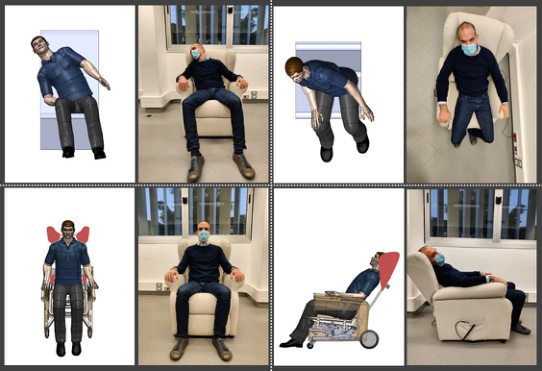
The Quality Function Deployment (QFD) method and tool have been used to rank such metrics and drive the design of the final product to meet users’ needs at best. Since the goal was to develop a smart relax armchair able to be certified as medical devices, the analysis of relevant technical standards has been essential to deduce mechanical and usability constraints (IEC 60601- 1-11, 2020) (IEC 60601-1-2, 2021) (IEC 60601-1-6, 2020) (IEC 60601-1-8, 2020) (IEC 60601-1-9, 2020) (IEC 62366-1, 2020) (IEC TR 62366-2, 2016). The expertise of researchers from the Physical Medicine and Rehabilitation Unit of the Rizzoli Orthopaedic Institute (IRCCS) has been used to identify postural misbehaviour in daily life, which have been simulated in a 3D envi- ronment using the Virtual Manikin Zygote® Human Factor (Zygote Media Group, Inc., 2024) and a 3D model of the selected armchair to identify possi- ble intervention areas for active and passive solution for postural corrections (Figure 1).
Figure 1: Evaluation and simulation of postural misbehaviour and potential corrections.
Smart Relax Armchair - A Solution for Active and Safe Ageing at Home 83
A wireless sensorised mat (BodiTrak2 Lite (BodiTrak, 2024)) has been used to assess the efficacy in terms of pressure reduction/variation introduced by the developed passive and active solutions with respect to selected postural positions.
Unity engine has been used to develop a customized APP for the man- agement of the innovative functionalities of the Smart Relax Armchair (i.e. Wi-Fi recliner, healthy routine, active ageing routine), which have been implemented in the final prototype using Arduino®.
THE SMART RELAX ARMCHAIR: A COMBINATION OF ACTIVE AND PASSIVE SOLUTIONS Fifty-five user needs have been identified, all belonging to the following classes: Aesthetic; Technical-functional; Manufacturing and cost; Safety.
The application of the QFD method allowed to rank the metrics in relation to the corresponding needs in order of priority and identify all the specifica- tions that had to be included in the final design of the Smart Relax Armchair to meet user requirements. Table 1 reports per each of the selected user’s need the corresponding requirement for the product design detailing the metrics where necessary.
Table 1. User’s needs ranking and metrics.
Table available in the original PDF paper.
No. User’s Need Description Rank Metric 5 Pinch points free 5 Protective carters 30 Low technological design 4 Embedded IoT technology 4 Full lay down position 4 Zero-gravity recliner 3 Semi-recumbent position 3 Automated recliner 22 Feedback on armchair status 3 Speakers/buzzers 47 Rest position 3 Headrest 50 Anti-decubitus properties 3 Aerated and soft materials 51 Active anti-decubitus systems 3 Automatic movements of the recliner 2 Support while seating/standing up 2 Elevating armchair 16 Portable controller 2 Smartphone and joystick 17 Removable controller 2 BLE & RJ11 plug 18 Redundant postures commands 2 Simultaneous use of smartphone and joystick 23 Safety stop 2 Reachable emergency stop 48 Comfortable and safe when sleeping 2 Actuated Backrest 6 Internal door compliance 2 Max with 75 mm
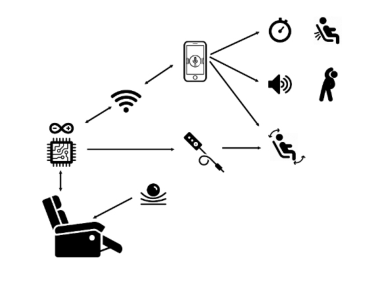
Starting from user’s requirements, the author decided to develop differ- ent levels of solutions to be implemented in the final prototype of the Smart Relax Armchair, introducing the innovative features further described below (Figure 2).
Passive Solution for Bedsores Avoidance The authors investigated and tested several materials for seat and backrest padding to modulate the softness thus minimizing local pressures on the skin (main cause of bedsores formation) and distributing user’s weight over large surfaces. The author’s idea was to combine memory foams in the padding and a surface layer of mineral gel, specifically designed for pressure distri- bution. The study of optimal stratification was carried out through specific ergonomic studies, and it has been validated through measurements car- ried out with a pressure monitoring mattress used in the orthopaedic sector (BodiTrak, 2024).
Figure 2: Smart relax armchair functionalities.
Active Solution for Posture Correction and Bedsore Avoidance – The Healthy Routine The evaluation of postural misbehaviour conducted by the authors helped to notice that people sitting for a long time on an armchair, usually tend to slide forward thus changing the posture of their back, spine and especially pelvis.
To help people maintain a correct posture when sitting, the Authors designed an automatic posture support programme which pushes the users, through external stimuli, to independently change their posture thus correct- ing the position of their body segments.
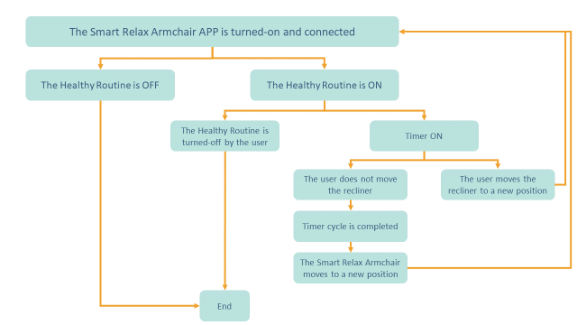
Basically, when the Smart Relax Armchair is turned-on and the Healthy Routine (Figure 3) is activated on the dedicated APP via smartphone or a vocal assistant, if the user remains seated for a very long time the system can detect if no changes has been made by the user through the reclining system in a specific amount of time. Once detected, firstly the APP alerts the user with acoustic feedback, then ARDUINO actuates the reclining system auto- matically, thus inducing a slight change on the backrest and footrest position notwithstanding the posture assumed by the user on the armchair.
The user is, now, forced to straighten the back, rotate the pelvis, and improve the lumbar support to reach a comfortable position.
Such Routine does not require large movements of the armchair, since only few degrees of changes on the backrest and footrest are enough for the user to perceive the position assumed and therefore improve it autonomously.
Smart Relax Armchair - A Solution for Active and Safe Ageing at Home 85
Furthermore, this routine can be also useful to help people with reduced movement capabilities which spend many hours sitting at home or in assisted living facilities such as elderly but not exclusively. These subjects are often subjected to bedsores due to the local and continuous pressure on the skin, which does not allow correct ventilation of the area itself as well as blood circulation.
To solve this problem, the main commercial products known to the state of the art try to relieve local pressures in a cyclical manner by inflating and deflating special cushions to alternate the support areas, thus resulting in an expensive product which is perceived by the user as an invasive medical device and not a furniture. In the Smart Relax Armchair the automatic changes on the backrest and footrest, after a specific amount of time of no movements, help to relieve and alternate local pressures in particular on thighs, back and lumbar area, while maintaining the cost low and the design of a regular Relax Armchair.
In practice, when the Healthy Routine is on, it is possible to alternate and vary the posture over time and reduce the time spent in certain positions where the pressure on specific sensitive areas can be critical for bedsores formation.
Obviously, the use of breathable materials and padding capable of dis- tributing pressure already explained in the Passive Solution for bedsores avoidance will facilitate the overall anti-decubitus effect obtained in the Smar Relax Armchair.
Figure 3: Flow chart of the healthy routine.
Interactive Solution for Active and Safe Ageing at Home – The Active Ageing Routine To promote active ageing at home, a set of simple fitness exercises to be performed with the help of the Smart Relax Armchair has been designed and implemented in the APP.
The expertise of researchers from the Physical Medicine and Rehabilitation Unit of the Rizzoli Orthopaedic Institute (IRCCS) allowed to design a set of
four different exercises to help the user stay healthy, but safely, at home to be performed using the armchair itself as an exercise tool:
1) Ankles’ flexion-extensions with feet higher than the hips to preserve the strength of the calf muscles, prevent ankle joint stiffness, increase the metabolic activity, and contribute to thrombus avoidance. 2) Core strengthening though isometric contraction, with the user semi- seated on a reclined armchair to reduce back pain and facilitate standing and walking resume. 3) Hands with fists forward extension in alternate way, staying seated to strengthen the upper limbs and avoid the occurrence of flexed posture while increasing the metabolic activity. 4) Assisted rising and seating at different speed to strengthen quadriceps and glutes, promote coordination and balance while facilitating standing and walking resume and increasing the metabolic activity.
Based on the repetition of the exercises defined by the experts of the Phys- ical Medicine and Rehabilitation Unit of the Rizzoli Orthopaedic Institute (IRCCS), the Authors defined the average amount of time necessary to per- form the single exercise and converted the exercises into a routine of different armchair positioning for a specific amount of time.
To guide the user along the Active Ageing Routine, the APP provides dif- ferent level of instructions starting from a description of the exercise, up to a short animation of a character performing the exercise and a counter/timer to help counting the repetition or duration of the exercise.
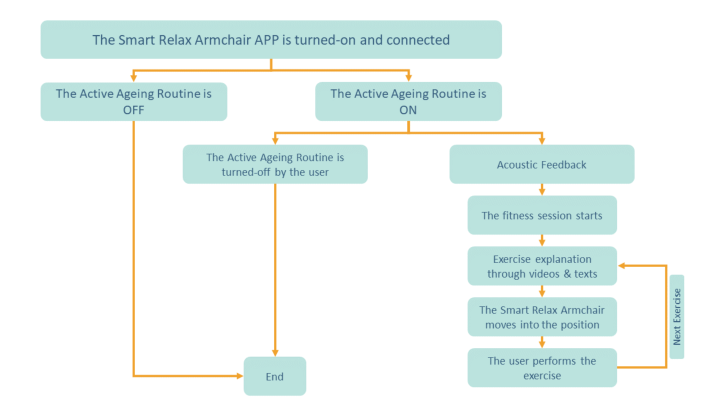
The aim is to encourage postural exercises while sitting or lying using a proprietary therapeutic protocol that has been patented (Figure 4).
Figure 4: Evaluation of postural misbehaviour and potential corrections.
Basically, when the Smart Relax Armchair is turned-on and the Active Age- ing Routine is activated on the dedicated APP via smartphone or the vocal
Smart Relax Armchair - A Solution for Active and Safe Ageing at Home 87
assistant, the user receives instructions on the set of exercises that are going to start (description and video) and an acoustic signal to indicate the start of the routine, then, after the countdown, the armchair set itself on the most appropriate position for carrying out the exercise. When the timing of the exercise is over, the user is encouraged to continue daily training.
The graphic interface of the APP has been developed to be as user-friendly as possible for non-expert users of the smartphone.
RESULTS AND DISCUSSIONS A first release of the Smart Relax Armchair has been prototyped starting from a standard relax armchair frame. A commercial reclining system with a wide range of independent movements (completely laid, reclined backrest, lifted footrest and lifted) has been used to comply with most of the requirements reported in Table 1.
ARDUINO micro has been programmed to manage the power supply and equipped with a Bluetooth module to allow Wi-Fi connection to the Smart Relax Armchair APP for smartphones.
The Healthy Routine and the Active Ageing Routine, as well as the pos- sibility to remotely control the movements of the reclining system have been compiled and uploaded in ARDUINO micro.
To define the acceptable amount of time in static position for the Healthy Routine the Authors conducted several tests on the prototype. The goal was to prevent the user from being annoyed by the routine and deactivating it, while guaranteeing the efficacy of pressure variation and posture correc- tion. A thirty-minute timer has been selected and implemented in the final prototype.
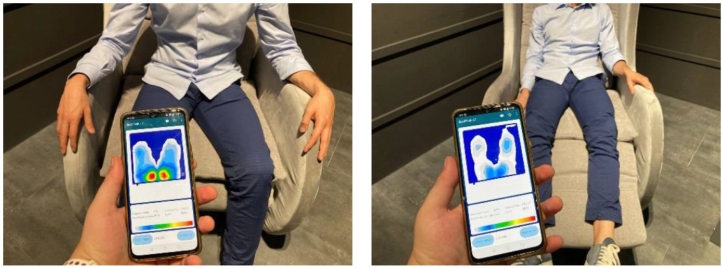
The efficacy on pressure distribution variation induced by the Healthy Routine has been validated through the integration of a sensorised mat (BodiTrak, 2024) in the seat of the Smart Relax Armchair. As shown in Figure 5, by moving the reclining system from a seated position to a semi- reclined one (slightly lowered backrest and raised footrest) a reduction of 70% in peak pressure and of 10% in pressure area has been registered.
Figure 5: Pressure distribution and peak variation in two different positions of the smart relax armchair.
To define the acceptable amount of time necessary to perform each exercise included in the Active Ageing Routine, the Authors conducted several tests on the prototype. A panel of 10 blinded users has been asked to perform each exercise, while the reclining system was moved into the right position using the wired controller. The execution time has been recorded for each exercise and the average evaluated among users. These values, increased by 5% to encourage most users to complete the fitness session on time, have been implemented in the Active Ageing Routine uploaded on the final prototype.
Further tests will be conducted in the next months to validate the clinical efficacy of the Active Ageing Routine and to assess the usability of the Smart Relax Armchair APP among elderly.
CONCLUSION
The escalating prevalence of sedentary lifestyles and prolonged immobility resulting from extended periods of sitting has emerged as a pressing health issue. Prolonged sitting not only heightens the risk of postural changes but also contributes to the formation of pressure ulcers, substantially diminishing the overall well-being of older adults.
These statistics underscore the imperative to transform homes into more comfortable and secure environments for the elderly or people with reduce mobility, employing innovative solutions such as smart furniture to enhance people’s lifestyles. In this context Relax Armchairs, can certainly be a very useful aid for promoting well-being in case of mobility issues.
The Authors exploited the potential of Relax Armchairs by embedding technological solutions on a commercial model to help users assume a correct posture while reducing their physical efforts and the occurrence of further complications due to bedsores formation. Moreover, thanks to a seamless integration of technology they reached the goal of promoting an active, but safe, ageing at home of the user which can easily perform simple workouts using the armchair itself as an exercise tool.
The solutions devised and integrated into the Smart Relax Armchair possess the capability to extend their application to any armchair or sofa model on the market. This transformative approach challenges the traditional paradigm of costly products tailored exclusively for active aging within resi- dential care facilities, making them inaccessible to individuals aspiring to age in place. The innovative features of this solution not only democratize access to advanced aging technologies but also redefine the conventional boundaries of affordability and inclusivity in the realm of aging-in-place solutions.
ACKNOWLEDGMENT
The Authors would like to thank FORM DESIGN S.r.l., whose new product development team has been crucial in the selection of commercially attractive and competitive solutions among those proposed by the Authors.
This research activity has been supported by Programma Operativo FESR 2014–2020 Obiettivo Convergenza – Regolamento Regionale Puglia n.
Smart Relax Armchair - A Solution for Active and Safe Ageing at Home 89
17/2014 – Titolo II Capo 2 - “Aiuti ai programmi integrati promossi da Medie Imprese” – PIA (Art. 26) - Codice progetto: DYXONV.
REFERENCES
Bevilacqua, R. et al., 2023. Social Robotics to Support Older People with Dementia: A Study Protocol with Paro Seal Robot in an Italian Alzheimer’s Day Center. Frontiers in Public Health, 11, p. 1141460. Borelli, E. et al., 2019. HABITAT: An IoT solution for independent elderly. Sensors
19, No. 5, pp. 26–30. Broadbent, E. et al., 2009. Retirement home staff and residents’ preferences for healthcare robots. 18th IEEE International symposium on Robot and human interactive communication (RO-MAN 2009), pp. 645–650. Collins, F., 2002. Posture and effective chairs and cushions in care homes. Nursing
and Residential Care 4, No. 1, pp. 26–30. Danielsen, A., Olofsen, H. & Bremendal, B., 2016. Increasing fall risk awareness using wearables: a fall. Journal of biomedical informatics, Volume 63, pp. 184–194. De Angeli, A., Jovanovi´c, M., Mcneill, A. & Coventry, L., 2020. Desires for active
ageing technology. nternational Journal of Human-Computer, 138, p. 1021412. Directorate-General for Economic and Financial Affairs, 2021. The 2021 Ageing Report: Economic and Budgetary Projections for the EU Member States (2019– 2070), Luxemburg: European Commission. EuroSafe, 2024. EuroSafe Homepage. [Online] Available at: https://www.eurosafe.eu.com/key-actions/older-people/aims-network. IEC 60601-1-11, 2020. Medical electrical equipment - Part 1-11: General require-
ments for basic safety and essential performance - Collateral Standard: Require- ments for medical electrical equipment and medical electrical systems used in the home healthcare envi. s.l.: IEC. IEC 60601-1-2, 2021. Medical electrical equipment - Part 1-2: General requirements for basic safety and essential performance - Collateral Standard: Electromagnetic disturbances - Requirements and tests. s.l.: IEC. IEC 60601-1-6, 2020. Medical electrical equipment - Part 1-6: General requirements
for basic safety and essential performance - Collateral standard: Usability. s.l.: IEC. IEC 60601-1-8, 2020. Medical electrical equipment - Part 1-8: General requirements for basic safety and essential performance - Collateral Standard: General require- ments, tests and guidance for alarm systems in medical electrical equipment and medical electric. s.l.: IEC. IEC 60601-1-9, 2020. Medical electrical equipment - Part 1-9: General requirements
for basic safety and essential performance - Collateral Standard: Requirements for environmentally conscious design. s.l.: IEC. IEC 62366-1, 2020. Medical devices - Part 1: Application of usability engineering to medical devices. s.l.: IEC. IEC TR 62366-2, 2016. Medical devices - Part 2: Guidance on the application of
usability engineering to medical devices. s.l.: IEC. National Institute of Aging - NIH, 2020. Maintaining mobility and preventing disability are key to living independently as we age. [Online] Available at: https://www.nia.nih.gov/news/maintaining-mobility-and-preventing-disabilit y-are-key-living-independently-we-age. Relax Drive, 2024. Poltrona per disabili GIUSTINA. [Online] Available at:
https://www.poltronaperdisabili.it/.
Robinson, H., MacDonald, B. & Broadbent, E., 2014. The role of healthcare robots for older people at home: a review.. International Journal of Social Robotics, 6(4), pp. 575–591. Sanatex, 2024. Poltrona Relax per anziani DAISY. [Online] Available at: https://www.sanatex.it/poltrone-relax/poltrone-per-anziani/poltrona-relax-ro botica-anziani/. Sardini, E. e. a., 2015. Daylong sitting posture measurement with a new wearable
system for at home body movement monitoring. s.l., IEEE. Sofarm, 2024. Dispositivo Medico. [Online] Available at: https://www.sofarm.it/po ltrone-elettriche/dispositivo-medico/. Sokullu, R. e. a., 2020. IoT supported Smart Home for the Elderly. Internet of
Things, 11.
LISTED IN THE AHFE DIGITAL BOOKSTORE CATALOGUE
Explore the complete digital volume
Human Factors in Aging and Special Needs
Read this individual research paper free through the original publisher, or explore the full digital proceedings book.
ISBN 978-1-964867-09-0
Explore this ISBN in the AHFE Bookstore ↗Listed in the July 2026 bookstore catalogue; search by ISBN to confirm current availability · Digital book purchase optional