Monica Lameiro (2023). Communication of a Theater play. An exploration from graphic design. In: Human Factors in Communication of Design. AHFE Open Access, vol. 90, pp. 103–110. https://doi.org/10.54941/ahfe1003701
Higher Institute of Education and Sciences, ISEC Lisboa; International Center for Studies and Research in Graphic Technologies and Scientific Communication, TGRAF; Faculty of Architecture, University of Lisbon, Portugal ↗
We observe how the versatility of the discipline of graphic design can incorporate its theoretical and practical knowledge of other artistic and cultural fields, such as, in this case, theatre. The interpretation of a play goes beyond the creation of scenarios or the artistic representation itself. It also requires an appropriate communication strategy to present the work in its entirety to society and capture the audience necessary for the business structure to be sustainable. This is where we focused our study area and detected a problem: how can we enhance the communication of a theatre play through design? At this point, the work is directed towards professional practice where the participating designers can interpret from their practical knowledge the characteristics and qualities of a given position to provide their graphic solution. This study focuses on exploring and comparing the practices of a selection of design professionals, specialists in this area to define which conditions and requirements should be taken into account in the briefing initially proposed in the design of this type of cultural communication as a starting point between: the creator of the play (the stage); the exhibitions of the theatre company (the performance); and the design of social dissemination (communication).
At the most basic level, Graphic Designers are professionals who commu- nicate messages through visual representations. Inform, inspire action, and connect directly with audience through beautiful graphics is one of the main goals. The practice for Cultural Design proves that this is one of the areas of Design with the greatest visual impact in contemporary cities. But, as Pei- thman & Offen (1999) refer, without an audience there could be no theatre, and without communication, for theatre, there would be no audience. How- ever, without an audience, there would be no communication Design would not exist and communication Design would not exist.
The show, due to its ephemeral and plural characteristics, disputes among peers visibility, credibility and acceptance that puts to the test the role of the designer, one of the most responsible for the media conquest of a certain piece.
When watching a theatrical performance, the audience’s main interest focuses on the story and the characters. Theatrical manifestations have
undergone significant changes over the years. Today, the trend of digital com- munication calls for designer challenges that did not exist until a few years ago. The cultural services industry is part of the defined objectives of cultural policies for promoting and preserving cultural heritage in highly competitive environments. Theatre, a mirror of society, times, and habits, is a magical, immersive experience that stirs the audience’s feelings, allowing for the dura- tion of a show to disconnect from our lives (Porter, 2015). The theatre makes us dive into a parallel reality full of artistic stimulations.
The designer working on theatre communication embraces the huge chal- lenge of working for an entertainment industry where the visual solutions represent an experience that is doubly intimate and ordinary, representing an action in a certain period and a dedicated space.
Regardless of the genres, it has to work in, commercial (featuring more popular contemporary works, with a focus on high levels of entertainment); non-profit (nonprofit, charitable, literary and educational purposes which carries on a program of performing arts for the general public) or contempo- rary (post-dramatic, where the scene is viewed as an expanded artistic field that moves away from the centrism of the text, giving way to research that goes beyond classical conventions), the designer has the mission to create visual objects that send the audience to unique experiences. This paper pre- sents some reflections on the work of designers, in the communication design area, for theater shows.
We started this study with the idea that classical approach to the desi- gner’s activity. According to Filho & de Barros (2010), this activity is as an instrument of mass production and of the organization requires the existence of a briefing and in addressing the content of a good design brief, metrics acting as early indicators of a projects success, are needed. (Petersen, Joo and Takahashi, 2015).
On the characteristics of theatre projects, according to the designer João Faria (J. Faria, personal communication, 2021), one thing is the graphic desi- gner work for a play and another thing will be the graphic work for an institution, a theatrical group, etc. because it can imply many other works
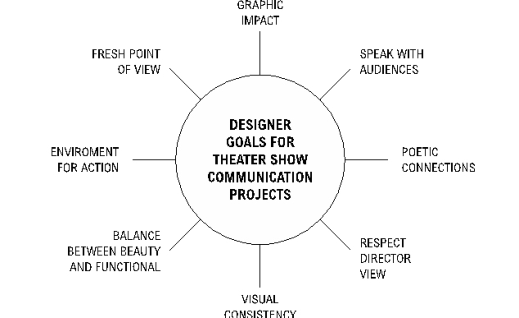
Figure 1: Designer goals (Autor, 2023).
Communication of a Theater Play an Exploration From Graphic Design 105
that not necessarily only the specificity without caring about the theatrical performance”. This idea helps us understand the dual nature of communica- tion design for theatre, where it matters to understand the difference between projects. On the one hand, we have the conception of the identity show, as a work, in an isolated, unique, and personalized way; on the other hand, the conception of identities linked to the design of a previously defined system, framed in a season campaign or company style grid, where the graphics must be standardized.
Perspectives on Theater Creative Process Designers are inspired, most of the time, by a wide variety of sources. Accor- ding to Cayatte (H. Cayatte, personal communication, 2021), there are a couple of things that can be considered during the creative process of an image for a particular show. According to the designer, there is always a “moment”, a fragment or a cinema insert (a generic name for any cinema- tographic shot intended to draw attention to the detail of the action or the scenery). The difficulty lies in finding that “moment”. A moment that should be strong from a plastic point of view must be conjugated effectively with graphic elements like typography and color. The “moment” must be the syn- thesis of the show and can come in the form of an illustration, a photograph of the play, or another. The author also mentions that sometimes a particu- lar piece can originate and result in several images, and the possibilities are infinite.
For Faria (2022) the answer is in the text and looking for things that could be vital clues to work on graphically and make the compositions. For this designer, the relationship with the context is extremely important in the cre- ative process. Seeing the shows in the rehearsal room, the montages, and the staging’s in the room, when they were still very raw and undressed, are much more natural, than when they’re in their final form on stage.
Faria considers there is a different nature in Theater Design Projects com- pared to other graphic work projects. The richness of the contents, the proper work object, and the request and demand made to the designer promote a different approach, and, there is a demand at all levels.
For Bundi (S. Bundi, personal communication, 2021), about 90% of all plays and operas are in the broadest sense about love, murder and manslau- ghter. There is a great risk that clichés will be used (heart, sword, pistol, etc.). Now the point is to visualize the specific of the piece – what kind of love, murder etc.
More important than a briefing is the designer overview to collect infor- mations that can be used guide decision-making on his design process.
A design briefing is an essential document that outlines the purpose, scope, and objectives of a theater design project. Used to provide important infor- mation to the designer when creating a play, it should include information that allows the designer to have basic elements to start the project. It must contain data about the essence of the story that will be performed, such as references to the time in which it takes place, what the action/plot is, the characters’ characteristics and the story’s central message. Alongside these
106 Lameiro
elements, the briefing should include more operational data, and a list of the theatre’s tasks/needs to make the show known.
The briefing is also used to inform designers about the project require- ments, provide clarity on the expectations (from director view and desired outcome), and help guide the design process and timing. The design briefing should also include information such as the project’s purpose of communi- cation (target audience, budget, number of communication object to design, the media to be used for dissemination, performing career).
In briefing sessions, the several participants (designer, director, artistic dire- ction or producer) should have a clear understanding of the project and be prepared to ask questions and provide constant input. The meeting should also include a discussion of any resources or materials that may be needed to complete the project that the designer should be aware of.
On the specificity of these projects, according to Faria (J. faria, personal communication, 2021), the peculiarity of the process of working for theatre reinforces its character as a specialty. According to this designer, it’s hard to find anything like it.
The designer must be aware that, even following the director’s guidelines, there are no preconceived ideas of the image that will represent the show. He must be able to conduct his creative process in a constant search for references to create innovative proposals and not fall into the repetition of proven for- mulas or standardized methods of visual resolutions already seen in previous shows.
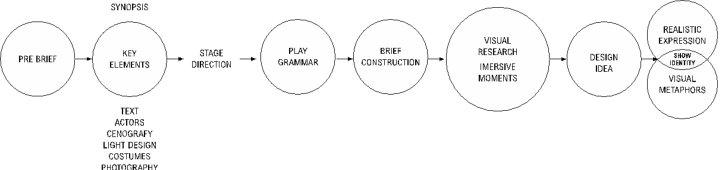
Figure 2: Theatrical process scheme (Autor, 2023).
Interdisciplinary Approach The design comes to life precisely by embracing disciplines other than our own (Design Observer, 2023), embracing its discipline of multidisciplinary knowledge. The design of a theatre show is an essential communication tool that relies on several disciplines to be successful.
More and more, it seems like theatre artists are taking an interdiscipli- nary approach to their craft, which yields a more textured artistic vision (Howlaround, 2023). According to Hovik (2019), interdisciplinarity can be understood as integrating knowledge and methods from different disciplines to develop common approaches to artmaking.
How does the designer construct these theater identities? Is it an isolated and intimate task or an action that depends on others?
Communication of a Theater Play an Exploration From Graphic Design 107
Design plays a significant role in the communication of a play, allowing the audience to connect with the story and engage in the experience. By creating a visual environment (mood), the audience is allowed to communicate with the play, providing them with clues about the context, meanings, and intenti- ons. This bridge with the perspective of the space can make all the difference in the experience of watching a play. To achieve these goals, communication also relies on the contributions of the other artistic areas: scenography, light design, costumes, props, and music. All the elements work in constructing and linking the show’s concept. The communication pieces created from this response to the concept help to emphasize the play’s central message and rein- force all the nuances present in the story. Often the visual resources used in the identity of the space rely on the use (realistic or conceptual) of key scenic elements that help to emphasize the central moments of the story, increasing the connection to the content of the work.
Theory Meets Practice The knowledge of this project typology has two components: the theoretical and the practical. To understand a theme, we must understand the theoretical concepts in depth and then apply them in practice, product design and develo- pment. The same is valid for theatre communication. But do all creations for theatre follow this metric? Or does the concern lie in making appealing gra- phic pieces in response to tight requests and deadlines? Like graphic projects of another nature, theatre design also suffers from issues related to creative blockades and the difficulty designers have in describing their processes to apply these guidelines to future projects.
According to Ramalho, L & Rebelo, A. (AGI, 2010) the process is intense, variable and involves numerous aspects determining the outcome.
Many other issues arise that go beyond the image of the final product that we see on the street, in the form of a poster or on social networks (in the form of a banner). The processes, generally seen as a private thing, are intense and have very particular nuances where we would even say there is a permanent state of work in progress. When the creative process for the image of a play (identity) begins, if the designer works recurrently for that theatre, ensuring all its communication (annual or seasonal), this process starts when building the image of the previous show is still ongoing. In this model, the designer must change the language permanently and have very effective time management.
The concept is understood as the construction of reality through com- plex ideas, with aesthetic and, in some cases, political objectives. On the other hand, language can be generated from a particular need in relation to a style, structure, form of representation, staging, aesthetics, etc.; these are mixed together to develop a coherent system of communication. Finally, objectives are closely linked to aesthetic and technical needs. They are the strategy to elaborate a language and apply it in the creation of a scenic work or phenomenon.
With the demand to achieve design pieces that communicate with the spe- ctator, it is also up to the designer to give him challenges to create an image.
108 Lameiro
For this, the designer must gather as much information as possible from the theatre (director, production) so that they can not only define the identity of the play but also give continuity to its unfolding in the period before, during and after the show’s run, in all the communication supports predefined for the play’s publicity campaign. What can never be forgotten is the commi- tment to content—working the text and creating a plastic concept around it.
Many Minds, One Vision One of the marvelous things about theatre is that is a collaborative art form (Porter, 2015). The director and the communication designer of a play work together to create the visual experience for the spectator.
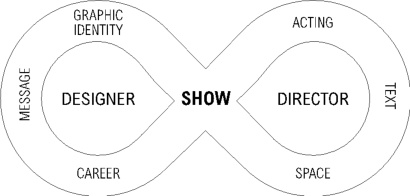
While some designers rely on their creative teams to develop the show’s communication, others solve individually all the tasks that this project encompasses. At the epicenter of the whole creative process, we find two people: the artistic director (or director) and the designer. Both work in co-creation until they reach satisfactory results to find the image of the show.
When people collaborate, their communication and coordination acts go beyond linguistic signals and involve the use of material artefact, locations, and physical spaces (Clark, 2005). According to Porter (2015) designers are also part of the director’s creative process. The director’s ideas are consoli- dated during the creative process as the designer materializes them. But how does this partnership work? Is this a process of co-creation?
The designer’s role can take many forms, depending on the principal arti- stic director’s idea or the type of show. Some theatres seek and defend unique identities for their shows, following an authorial line piece by piece (uni- que design without following defined styles per season) thus allowing their designers a more plastic work to create a singular visual grammar that exclu- sively corresponds to the essence of the text and the director’s vision, having as main goal the creation of graphic objects with impact, that seduce the audience, that subliminally transmit the concept of the show.
To ensure that designers work allows audience members to engage with the inner reality of a play, e que persegue uma linguagem comum entre a ideia do encenador e a sua, existem um conjunto de tarefas essenciais no processo criativo destas identidades. The director creates the artistic direction for the play, while the communication designer creates visual elements to support
Figure 3: Co-creation design process (Autor, 2023).
Communication of a Theater Play an Exploration From Graphic Design 109
the narrative of the play. Sometimes, the communication designer may also help the director create some visual elements for the stage.
The designer must work closely with the creator to ensure that the visual identity created is an extension of the narrative of the piece and that it reflects the cultural, historical and social references used.
If the designer doesn’t understand the grammar of the play he will not be able to animate it graphically. Understanding the grammar of the play may help the designer create a more accurate and compelling animation. Accor- ding to Faria (J. Faria, personal communication, 2021), the creative process is largely based on proximity to the work. He shared that when he dedicated himself to theatre projects, the big productions were accompanied from day one, the presence at rehearsals, which he always liked a lot, and the readings at the table, the first readings, listening to the text without the need to be isolated or to read it alone, started the process.
Bundi (S. Bundi, personal communication, 2021) describes that designer must study the topic in detail and obtain the necessary information regarding the staging. After that, however, he becomes a lone fighter who takes his task seriously.
This idea is in line with the idea of Engeström (2001), which explains that the source of creativity is not inside a person’s head but emerges in the interaction between a person’s thinking and their socio-cultural context. It is interesting to see how each designer sees these types of projects. For some it doesn’t matter how they create, but the result. For Jorge Silva (J. Silva, perso- nal communication, 2021) if we can bring the best of both worlds together, a contemporary language that can communicate with a reasonable chunk of the community and creativity, we have the right date.
CONCLUSION
Our study showed us that the projects of communication design associated with culture, namely theatre, have their very own characteristics that give them a unique identity and for which there is a set of associated tasks. It let us know that there are two project modalities, some related to pre-established and non-personalized show identities (systemic) and others in which the desi- gner must create an authorial piece by piece. We learned that to guarantee a cohesive visual identity throughout the entire career of a show or season, taking this characteristic as an own identity, and managing to make the play reach more audiences, are some of the biggest challenges for designers and theatre companies. The interviews and readings carried out helped us under- stand the conditions and requirements to be taken into account in the brief initially proposed in the design of a theatre show considering that in nowa- days the communication of shows assumes new contours that also have to do with the need to communicate more and better.
ACKNOWLEDGMENT
The author would like to acknowledge to Higher Institute of Education and Sciences, ISEC Lisboa; International Center for Studies and Research
110 Lameiro
in Graphic Technologies and Scientific Communication, TGRAF Faculty of Architecture - University of Lisbon and all Designers and Directors for their contribution to this study.
REFERENCES
AGI. Exhibition catalogue “Process is the project. O processo é o projecto”. AGI.
Porto, 2010. Bundi, S. (2021, December). Personal Interview. Cayatte, H. (2021, December). Personal Interview. Clark, HH (2005). Coordinating with each other in a material world. Discourse Soc 7: 507–525. Designer Observer. (2023). Retrivied from https://twenty.designobserver.com/mission/. Engeström, Y. (2001). Expansive learning at work: toward an activity theoretical
reconceptualization. J Educ Work 14(1):133–156. Faria, J. (2021, December). Personal Interview. Filho, E. & de Barros, A. (2010). Going beyond “briefing”: a product design approach to the life cycle. https://dx.doi.org/10.4322/pmd.2012.016 Howlround. Retrivied in 2023. Available: https://howlround.com/using-interdiscipl
inary-theatre-approach. Hovik, L. (2019). Becoming small: Concepts and methods of interdisciplinary practice in theatre for early years, Youth Theatre Journal. Routledge, 33(1), pp. 37–51. doi: 10.1080/08929092.2019.1580647. Peithman, S., & Offen, N. (1999). The Stage Directions Guide to Publicity. National
BOOK NETWORK. Petersen, Soren & Joo, Jaewoo & Takahashi, Shelley. (2015). INSPIRATIONAL DESIGN BRIEFING PERFORMANCE. In: Proceedings of the 20th International Conference on Engineering Design (ICED15), Milan, Italy, 27.-30.07.2015. Porter, L. (2015). Unmasking Theatre Design: A Designer’s Guide to Finding
Inspiration and Cultivating Creativity. Focal Press. Silva, J. (2021, December). Personal Interview.
LISTED IN THE AHFE DIGITAL BOOKSTORE CATALOGUE
Explore the complete digital volume
Human Factors in Communication of Design
Read this individual research paper free through the original publisher, or explore the full digital proceedings book.
ISBN 978-1-958651-66-7
Explore this ISBN in the AHFE Bookstore ↗Listed in the July 2026 bookstore catalogue; search by ISBN to confirm current availability · Digital book purchase optional