Yuanyuan Xia (2023). Live without time: The generation of media time and time anxiety, as well as the solutions. In: Human Factors in Communication of Design. AHFE Open Access, vol. 90, pp. 11–20. https://doi.org/10.54941/ahfe1003691
This paper first researches the changes in contemporary media time, finding that media time would lead to social acceleration and deliver a more negative impact on contemporary people, thus exacerbating their time anxiety. Secondly, based on the characteristics of the natural reality of circadian rhythms, this paper explores the ways to treat and alleviate people's time anxiety through modern media by using the means of visual communication. Thirdly, this paper explores the significance of relieving time anxiety, purposed to give physical and mental relief to more users who are living in the contemporary accelerated state.
“Different societies cultivate different concepts of time.” (David, 2003) Just as human beings rely on natural time as the way of cognition of time in an agricultural society, and use clock time to divide time in industrial society. Then, in today’s information society, communication media has been shaping people’s new concept of time, that is, “media time”. With the development of the current media, this new social time system has been subtly shaping people’s new concept of time, who unknowingly speed up their pace of life and work, and feel that free time is becoming more and more scarce. Why does media time cause these social problems? What means should people take to solve this problem?
LIVE WITH TIME: THE RELATIONSHIP BETWEEN MEDIA TIME, SOCIAL ACCELERATION AND TIME ANXIETY Media Time
Before the concept of “media time” was born, there were some similar terms describing the preconditions and characteristics of media time. Jogn Urry once coined the concept of “immediate time,” and “it is said that to some extent, hourly time is being replaced by what is known as’ immedi- ate time”(John, 2003). Zygmunt Bauman proposed the concept of “software time”, “Once people can rely on the speed of electronic signals to span the distance of space, time is no longer a ‘detour to get something’, the ‘near
instant’ of ‘software time’ heralds the ‘space depreciation (Zygmunt, 2002)”’. Thomas Googale put forward another new concept of “computer time”, saying that “computer time” does not just refer to a tool, but marks a new time orientation, and the speed of the computer is 1 billion per second, far beyond the upper limit of human perception. Never before has speed been beyond the range of human consciousness.” These concepts became the star- ting point of the birth of media time, overturning the natural time and clock time of the previous eras (Thomas, 2000).
Bian Donglei and Zhang Xiying (2006) believed that the naming of “media time”, on the premise of recognizing the decisive role of techno- logy in transforming time, on the one hand attributed the technology shaping time (mainly communication technologies, including computers, the Internet, mobile phones, radio and television, etc.) to the media,and on the other hand, began to study the role of media in the process of transforming time from the perspective of media content. The new concept of time is the result of the joint action of media technology and mass media content, so it is named “media time” rather than simply “technology time” (Bian & Zhang, 2006).
Different from time studies and media studies, media time theory has more complex implications. It includes not only the study of ontology, but also the study of non-ontology objects— It examines not only media time itself, but also insight into human thought and perception. The theory of media time is defined as a structural model of social organization in today’s rapidly developing information society, which is overturning the previous linear and unidirectional time measurement form. Along with the contemporary media, the theory of media time on the one hand conforms to the specific era, and on the other hand reconstructs the appearance of the real society. It takes different time points as the basis of existence, manifesting the communication behaviour with time attribute, and jointly influencing and constructing the social organization form with the media space. So, how does media time specifically influence the form of social organization?
Relationship Between Time and Society: Modern Time System Determines the Acceleration of Society Lian Shuixing and Deng Dan analysed the complex relationship between media, time and acceleration of society and its “social pathology”, arguing that the acceleration of society created a counter-enlightenment “lie” of modernity. Why are people so busy? Faced with this historical problem, people have already fallen into a trap of modernity. Immanuel Kant (2006) has long argued in his writing “Immanuel Kant: What is Enlightenment?” that enlightenment is man’s release from his self-incurred tutelage. Tutelage is man’s inability to make use of his understanding without direction from another. Self-incurred is this tutelage when its cause lies not in lack of reason but in lack of resolution and courage to use it without direction from another.
Therefore, “have the courage to use your own understanding”is the motto of the Enlightenment Movement, which aims to hope that people can be liberated by the brilliance of reason. However, the overall development of modernization has led people to the road of “counter-enlightenment”. The
Live Without Time —— The Generation of Media Time and Time Anxiety 13
original intention of modernity is to give people autonomy and freedom, but now people have been domesticated as “individuals” with “commonness” by the time norms of modern society (Lian & Deng, 2020). This subtle new tota- litarianism is embedding people’s daily actions in and making them serving the modern time-frame. Social time system means that “time is a specific social system, in which the division of time units is endowed with practical significance, such as people’s commuting time, and this standard system will form a reference frame of action to affect people’s actions (Zheng, 2018)”. The birth of clock time in the past means that human society has entered a highly standardized and institutionalized process, and capitalism is just relying on this standardized time system to accelerate its development.
Lewis Munford (2009) once said that the key machine of the industrial age was not the steam engine, but the clock. Timed labor in industrial society makes workers feel unprecedented urgency. All timing tools accurately mea- sure the working time of workers, thus achieving maximum production goals in the shortest time. It can be seen that the clock time system in the industrial age has changed people’s original perception of time, breeding an indepen- dent social time system divorced from nature and the body itself. This kind of time system accurately measures, standardizes and controls people’s routine practices, working methods and living habits. It not only accelerates the deve- lopment of modernization from the production and consumption behavior, but also invades people’s spiritual level and goes deep into people’s hearts.
The Dilemma Caused by the Acceleration of Society: Time Anxiety Afraid of falling behind social development, people keep accelerating the pace of life and work. Many people feel like they have a growing to-do list, longer work hours, and less free time. Today’s words such as “rat race”, as well as work systems such as “996” and “007” all reflect the current situation that everyone is disciplined and controlled by the external time system, and individuals feel lost and powerless for their lack of time and time anxiety. In this process, the gradually expanding consumption desire has become a new product of the acceleration of society. Herbert Marcuse (2006) pointed out that many needs are imposed by interest groups through mass media introductions, namely “false needs”. As a result, people are busy with endless to-do items and desires, and even form a “busy culture”. Meanwhile, the personal traits of time-saving and punctuality have long been regarded as virtues valued by everyone, proving that the ability to follow time systems accurately and efficiently has become an everyday moral norm.
In the book Alienation and Acceleration, Rosa (2014) pointed out that the norm of temporality in the accelerated context of modern society is the colle- ctive norm under the new totalitarianism. Different from the totalitarianism under the traditional political authority, this new totalitarianism infiltrates the social structure subtly and is taken for granted as the existence form of social norms that makes modernization no longer a light force to liberate people, but a silent oppression to discipline people.
In today’s digital age, the technology of time control has become a social media technology, changing people’s living conditions and increasing the
14 Xia
“time density” of individual life. Efficient work atmosphere and tight pace of life have become the crux of modern depression and anxiety. While com- plaining about the lack of time, people are caught up in the social rush at high speed. Living under this paradox, the individual has gone to a “new alienation” (Lian & Deng, 2020).
Rosa (2014) believed that only by realizing the “resonance” between indi- viduals and the world can they resist the acceleration of society. Han Bingzhe (2017) said that only by reflecting on life can one experience the “fragrant time”. So, how can people improve their relationship with time by perceiving time and contemplating life?
LIVE WITHOUT TIME: THE IMPROVEMENT OF THE RELATIONSHIP BETWEEN PEOPLE AND TIME Get Rid of Media Time
“Our sense of body is the basis of the sense of the passage of time.” — —Wittmann Although we cannot deny and abandon the concept of time passing, we may be able to get rid of the obsession with time. After all, when we talk about people being ruled by time, we mean “clock time”, which is entirely a human invention (Scott and Smith, 2012).
I first investigated the experiences of others’ lives without the clock system before I try it myself. I found that many people (including many celebri- ties) have experienced this kind of life. From the recorded experience on the internet, I refined many keywords and found many similarities, which are consistent with the reason that sometimes it’s healthy to break free from “clock time” in the previous chapter.
Neil Stanley, an expert researching stress and snoozing for three decades says, “I think if we don’t care what the clock time is, and wake up with the sun, eat when we feel hungry, work when we are most productive, and go to bed when we are sleepy, our life will be much better (Scott and Smith, 2012). So, what we can do is keeping away from the auto-pilot dictated by clock time and stepping into our reality of just being rather than constantly “doing” because of the clock (James, 2020).
Circadian Rhythm: The Authentic Time System of Nature We are all astonishingly time-poor. Time pressure forces us to walk faster and drive faster, which leads to performance degradation, aggravates long- term stress, workplace stress, and further causes poor food choices, and makes us vulnerable to related health problems (Sandhana, 2020). For exam- ple, shift workers’ insistence on clock time leads to an interruption of their natural sleep cycle, which may cause mental and physical health problems. (Sandhana, 2020). Data from a study analyzing sleep habits showed that in the past ten years, although people went to bed a little later, they still got up at the same time, which caused them to lose about 40 minutes of sleep. The reduced time spent outdoors may also explain why their circadian rhythm becomes so late (Kalb, 2013).
Live Without Time —— The Generation of Media Time and Time Anxiety 15
“By focusing on the regularity and technology associated with the work- place, it makes us indifferent to the world and connects us to the model of capitalist growth economics, which is a celebration of work, not well-being,” says Gange (2019).
Circadian rhythms are physiological, psychological, and behavioral changes within a 24-hour cycle, and are the most common biological clock rhythms in the biological world. The biological clock is a natu- ral phenomenon directly related to life. Biological clocks are naturally present in all kinds of living organisms. It refers to the inherent rhyth- micity of life activities, which is manifested as periodic changes in life activities.
Even if we are in a cave where we can not have any clues about the external time, our body will follow a cycle of about 24 hours (Gregoire, 2014). Just as our time zone keeps our time consistent across the globe, everyone’s body has a system that can help control physiological time (Kalidindi, 2019). Our internal clock regulates many parts that are important to health, such as the sleep-wake cycle, and regulates our body physiology in many ways from our liver function to the immune system (Kalidindi, 2019).
EXPLORATION OF VISUAL COMMUNICATION TO ALLEVIATE TIME ANXIETY Research Question
The clock and calendar are just tools invented by humans to measure time. While most people are following the rules of the clock and calendar, they are also being consciously or unconsciously forced to be ruled by this restricted system. But, have they ever wondered what they are doing this for? Therefore, based on my starting point, I initially formed this question: How to set people to rethink and then improve their relationship with TIME?
Through exploring and experimenting with all the potential solutions to this problem, I developed the Research Question into this more precise one: How can time be designed as a framework to rethink and improve the relationship that people have with time?
Brand Visual Communication Practice This research uses branding to challenge our existing relationship to the time system, to help the audience promote a more intuitive, free, and fri- endly appreciation of the present moment. The brand (OFFTEN) subverts the existing time system in the domestic environment through visual com- munication, allowing the audience to pay attention to the natural rhythm of their own body when using furniture in the domestic space, and get rid of the shackles of the clock system, thereby alleviating the symptoms of time anxiety.
OFFTEN sounds like “often” and looks like “off time”, which means this brand can help people be often off time by using the furniture they often use. Also, OFF can mean “to leave” or “to turn off,” while OFTEN can
16 Xia
Figure 1: OFFTEN brand logo.
mean “routine” or “habit”, but the combination of the two contributes to the meaning of “derailing from the routine time system”. (1) Brand Structure
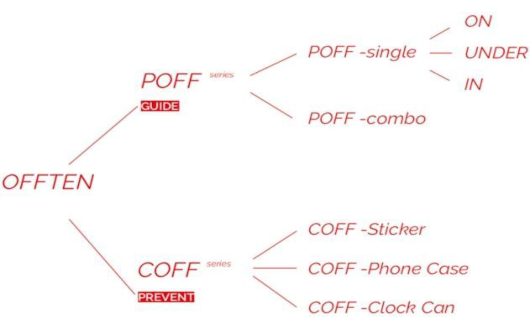
Figure 2: Brand structure.
Using improper methods to abandon clocks may cause negative emotions. Therefore, I set the functions of the products as Prevent + Guide — not only to appropriately prevent people from seeing the time system but also guide them to focus on some correct and effective things during using the products to prevent backfire. Finally, I divided OFFTEN’s products into POFF series and COFF series. (2) Products POFF is the main product of OFFTEN to fresh up customers’ furniture. POFF is a colorful inflatable duvet device that can wrap furniture, which strength- ens the adaptability of the piece of furniture to the user’s body shape and enlarges its comfortable features like a bed, aiming to make it easier for users to forget the existence of the time system when using it. POFF has 6 colors to choose from, which brings fresh blood to the domestic space, allowing users to find a sense of novelty and strangeness in the familiar environment.
Live Without Time —— The Generation of Media Time and Time Anxiety 17
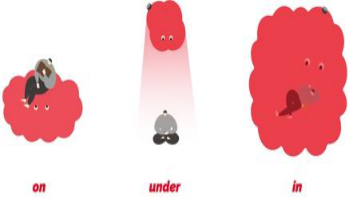
Figure 3: A rendering of POFF.Figure 4: 3 types of POFFs.
POFF represents a visualization of all the time people use the piece of fur- niture. It is here, people can sit on it, stand under it, and even walk in it. Its existence will allow users to subvert the way they look at the time during the use.
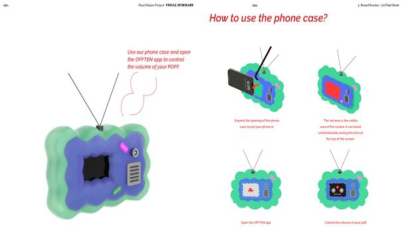
Figure 5: The phone case in the COFF series.
The COFF series is a derivative of the POFF series. It provides several tools to curtain off costumers’ clock time and calendar time, helping them avoid accidentally seeing the clock time and ruining the entire experience when using the POFF, as well as aiming to adjust user’s relationship to time, rather than being passively controlled by the clock. The COFF series currently contains three products, namely stickers, the phone case and the clock can, which can cover clocks or calendars in different situations. (3) Touchpoints——the Product Mannual
18 Xia
Figure 6: The product manual.
All the above products will be made into a product manual, which is the most essential touchpoint of this brand. The reason why I chose a book instead of a website to introduce products is that the Internet will remind people of the existence of clock time in various ways. Therefore, I chose the relatively primitive way - a book, to introduce products and provide services. Also, people’s normal rhythm can be slowed down in this way.
SIGNIFICANCE At the Level of Theoretical Research
At present, domestic and foreign studies on media time, social acceleration, time anxiety, and time view are still relatively limited, fragmented, and sin- gle, that is, they are limited to the ontology theory of media time theory, the harmful consequences of media time, research on the relationship between media time and social acceleration, the relationship between media time and people’s time view, the relationship between social acceleration and time anxi- ety, the factors that affect people’s time view, etc. However, there is still little research on the treatment and solution of time anxiety, the way to alleviate time anxiety by influencing people’s perception of time, the discussion and use of positive aspects of media time, and the discovery of opportunities in the context of media time and research that uses it to solve current problems.
Generally speaking, in this research field, there are currently more studies focusing on the ontology of WHAT and WHY, and less induction and analy- sis of specific people (WHO) and scenarios (WHEN & WHERE). There is almost zero research on HOW to solve the current time anxiety problem and alleviate the current situation of social acceleration. The author believes that the existing research is an indispensable cornerstone, it is the discovery of the problem and the exploration of the essence, and the exploration of the solution after the problem is discovered will be an inevitable direction and a major opportunity for this research field in the future. Therefore, this study will be instructive in the research of solutions to related social problems such as time anxiety and social acceleration.
Live Without Time —— The Generation of Media Time and Time Anxiety 19
At the Level of the Communication Industry Research on communication methods in the media time environment will become an important boost to promote the practice of all media. In the current environment, means of communication aimed at improving people’s concept of time and social problems, induction of the influencing factors of the audience’s information behavior and its time view, research summaries on the group characteristics and psychological behavior of the audience in the process of receiving the information will provide a reference for expanding art therapy and formulating effective and feasible industrial development strategies.
At the Sociocultural Level Sociological research points out that there is an interaction between the natu- ral attributes of media technology, the social attributes of user groups, and specific social structures. People’s use of media technology will shape the corresponding information behavior, which will gradually form a part of people’s living conditions within a certain period, which must also be an inte- gral part of social culture. This study takes the improvement of people’s time concept through communication means as the starting point while allevia- ting the audience’s time anxiety, it also improves the audience’s media culture in contemporary society, and builds good stability of the media community under the environment of media time.
CONCLUSION
The progress of science and technology accelerates the development of advanced media technology and gradually forms media time, which affe- cts people’s new view of time imperceptibly and promotes the acceleration of society. At the same time, the acceleration of society also reshapes peo- ple’s view of time and their standard of living. Advanced media technology embodies centuries of human wisdom, which should be a weapon to promote human freedom and liberation, but now it creates a tighter “cage”by forming a new time system. The author believes that the key point for addressing social issues in the context of contemporary media time is to make effective use of contemporary media communication means to break the shackles of the time system, to let people regard time as a friend, shape people’s rela- xed, optimistic and sincere time view and attitude towards life, and create a healthy media community and cultural identity space.
ACKNOWLEDGEMENT
Throughout the writing of this paper, I have received a great deal of support and assistance.
I would first like to thank my tutor, Paul Smith, for inspiring my interest in the field of people’s relationship with time during my master’s study at University of the Arts London.
In addition, I would also like to thank my parents for their wise advice and sympathetic ear, who are always by my side.
20 Xia
REFERENCES
Bauman, Z. (2002) in J. Ouyang (tran.) Liquid modernity. Shanghai: Shanghai Sanlian Bookstore, p. 185. Bian, D. and Zhang, X. (2006) “A Study on the Origin, Formation and Characteri-
stics of the Concept of Time Shaped by Communication Media,” Journalism and Communication Studies [Preprint]. ChulHan, B. and Xu, J. (2017) in X. Bao (tran.) The taste of time. Chongqing: Chongqing University Press, p. 61. Goodale, T. (2000) in S. Chen (tran.) The sociology of Leisure. Yunnan: Yunnan
People’s Publishing House, p. 148. Gregoire, C., (2014) How Clocks Could Be Harming Your Health, Happiness And Productivity. [online] Huffpost.com. Available at: \LY1\textless{}https://www.hu ffpost.com/entry/clock-time_n_5948802\LY1\textgreater{} [Accessed 23 October 2022]. Gustafsson J., 2017. Single case studies vs. multiple case studies: a comparative study
(Thesis). Halmstad, Sweden: Halmstad University. Harvey, D. (2003) J. Yan (tran.) Postmodernism. Beijing: The Commercial Press.
p. 242. James, A., (2020) No Clock For A Day - Stepping Out Of Time. [online] Pocket Mindfulness. Available at: <https://www.pocketmindfulness. com/stepping-out- of-time/> [Accessed 23 October 2022]. Kalb C, (2013) Your Alarm Clock May Be Hazardous to Your Health. [online] smi-
thsonianmag. Available at: < https://www.smithsonianmag.com/science-nature/ your-alarm-clock-may-be-hazardous-to-your-health-164620290/> [Accessed 23 October 2022]. Kalidindi, A., (2019) Yes, Daylight Saving Is Bad For Your Health. Here’s The Science. [online] ScienceAlert. Available at: < https://www.sciencealert.com/need- more-convincing-daylight-savings-is-bad-for-us-here-s-a-summary-of-the-scien ce> [Accessed 23 October 2022]. Kant, I. (2005) in Z. He (tran.) Perpetual peace and other essays on politics, history,
and morals. Beijing: The Commercial Press. p. 23. Lian, S. and Deng, D. (2020) “Translator’s introduction: Modernity and time,” modern communication, 287(6). Marcuse, H. (2006) J. Liu (tran.) One-dimensional man. Shanghai: Shanghai
Translation Publishing House. p. 6. McLuhan, M. (2011) D. He (tran.) in Understanding media. Nanjing: Yilin Press, p. 161. Mumford, L. (2009) in Y. Chen (tran.) Technics and civilization. Beijing: China
Architecture & Building Press, p. 15. Rosa, H. (2014) Alienation and acceleration: Towards a critical theory of latemodern temporality. Malmö: NSU Press. Rosa, H., (2013) Social Acceleration: A New Theory of Modernity. Jonathan Trejo-
Mathys. Columbia University Press. Sandhana, L., (2020) How To Escape The Tyranny Of The Clock. [online] Bbc.com. Available at: <https://www.bbc.com/future/ article/20200306-how-to- live-without-time> [Accessed 23 October 2021]. Scott, J. and Smith, B., (2012) Punch The Clock. [online] Men’s Health. Available
at: <https://www.menshealth.com/health/a19533293/ punch-clock/> [Accessed 23 October 2022]. Urry, J. (2003) “Sociology of Time and Space,” Social Theory Guide, 2, p. 522. Zheng, Z. (2018) “Temporalization of Temporal Forms: Changes in Social Temporal Forms and Their Contemporary Status,” Learn and Explore [Preprint]. 1, p. 21.
LISTED IN THE AHFE DIGITAL BOOKSTORE CATALOGUE
Explore the complete digital volume
Human Factors in Communication of Design
Read this individual research paper free through the original publisher, or explore the full digital proceedings book.
ISBN 978-1-958651-66-7
Explore this ISBN in the AHFE Bookstore ↗Listed in the July 2026 bookstore catalogue; search by ISBN to confirm current availability · Digital book purchase optional