Yue Jiang, Tingtao She, Tak Cheong Lee, Jingwen Li, Li Yang, Zhaorui Li, Yujia Tang (2023). Experience Media Model: A Method to Facilitate the Consistent Bottom-up Innovation in Community Co-creation. In: Human Factors in Communication of Design. AHFE Open Access, vol. 90, pp. 1–10. https://doi.org/10.54941/ahfe1003690
Co-creation is becoming a more common and essential method to deal with complex systematic problems in the community, a critical issue in social innovation. However, due to the perishability of co-creation, it is challenging to consistently facilitate the bottom-up innovation of participators. Perishability means that the co-creation results cannot be well saved and cannot have sustainable impacts on participators, such as emotional links, social interactions, and real-time talks. Towards this end, we introduce the theory of communication study into the social innovation area. According to the Malezek Mass Communication System Model and the Verkehr Theory, we deconstruct a co-creation event as a social information system and regard the traditional design touchpoints as the media touchpoints which can affect the communication process among participators during the co-creation. By combining the co-creation logic (named the Execution Co-creation Layer) from service design with the communication logic (named the Media Co-creation Layer) from the social media area, we aim to construct a new model named the Experience Media Model (EMM) to optimize the problem. EMM is a top model to help the community co-creation organizers systematically comp the information flow and adjust, delete, or create some media touchpoints to get better and consistent bottom-up innovation results after the co-creation. In addition, EMM was evaluated, verified, and iterated by applying it in a practical community co-creation project named NICE2035 Art Co-Mural, No.169 Fuxin Road, Yangpu District, Shanghai, China, where more than 200 residents were involved offline, and more than 100,000 people were involved online. Moreover, we conducted interviews, comments reviews, and media data analysis to get further feedback and insights from participators. In conclusion, we argue that the EMM can be a method to facilitate consistent bottom-up innovation in community co-creation, and we hope that this article has a specific enlightening value for later researchers.
The project process in the social innovation area often requires participation and collaboration between government, business, and the non-profit world
(Soule, Malhotra, and Clavier, 2017). The social innovation process is mainly influenced by four factors which are the expectation (Berman, 1997; Pestoff, 2013), the effort expectancy (Venkatesh et al., 2003), the ability of resource- linking (Lowndes, Pratchett, and Stoker, 2001; Edelenbos, 2005) and the representativeness of the participator’s views (V. J. J. M. Bekkers, 2004).
Co-creation is one of the essential methods when conducting a project in social innovation, which refers to any act of collective creativity that can be collaborated by two or more people (Sanders and Stappers, 2008). Generally, researchers frequently conduct the co-creation method in a social innova- tion project to facilitate the innovation process better than the traditional design method. However, it always has difficulty consistently facilitating peo- ple’s innovation, producing positive influence for them, and optimizing the perishability of co-creation (Xiangyang and Xi, 2018) in social innovation. Perishability means that the co-creation results cannot be well saved, such as emotional links, interactions, and talks (Papanek and R. Buckminster, 1972; Zeithaml, Parasuraman and Berry, 1985; Davila, Epstein and Shelton, 2006; Meroni and Sangiorgi, 2011; Xin and Cao, 2018; Xin and Wang, 2018; Jiang, 2021). The reason for perishability may be that the co-creation method essentially lacks the function of promoting efficient, in-depth, and consistent communication with expanded groups (Xiong, 2019).
The classic book The Tipping Point: How Little Things Can Make a Big Difference by Malcolm Gladwell indicates the Three Rules of Epidemics: the Law of the Few, the Stickiness Factor, and the Power of Context in the social media area (Gladwell, 2000).
If leading in the communication logic in social media are to the co-creation process, will the essential lack of a co-creation method be optimized to a certain extent?
First released in 2007 by Antony Mayfield, social media was defined as a group of new kinds of online media which share most or all of the follo- wing characteristics: participation, openness, conversation, community, and connectedness (Thomas D. Mayfield III, 2011). Furthermore, no matter how technology develops, the most prominent characteristic of social media is still empowering everyone to create and disseminate relationship-based content, which seems explicitly refer to the lack mentioned above.
A study on similar concepts was also conducted to define the new “Experience Media” concept. For instance, Pilotta’s studies focused on the simultaneous media experience, which pointed out that if one wants to solve the consumer’s media experience through multitasking, he/she needs to incorporate the experience of simultaneous media foreground/background relationships into the media planning and distribution portfolio (Pilotta and Schultz, 2005), which support the hypothesis from another perspective.
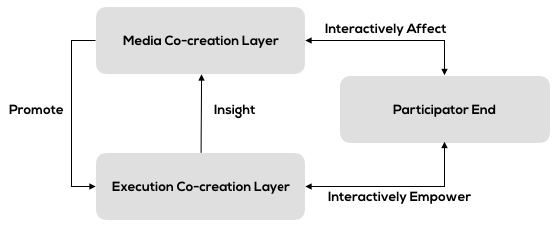
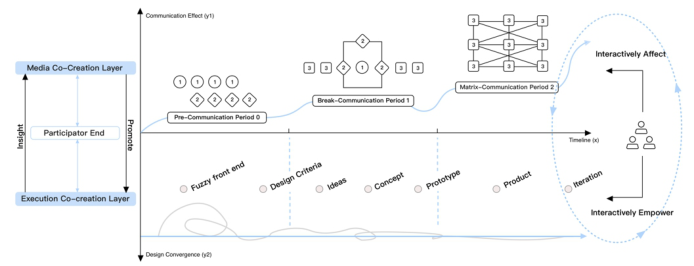
Thus, by combining the co-creation logic (as the Execution Co-creation Layer) of service design with the communication logic (as the Media Co- creation Layer) of the social media area, we established a new model named Experience Media Model (EMM), see in Fig. 1.
Experience Media Model can be structured as the Media Co-creation Layer and the Execution Co-creation Layer. The regulation of communication on the Media Co-creation Layer can be integrated with the co-creation routine
Experience Media Model: A Method to Facilitate the Consistent Bottom-Up Innovation 3
Figure 1: Experience media model hypothesis.
on the Execution Co-creation Layer, with different stages corresponding to each other, respectively (which will be detailed in Chapter 4).
Cooperated with En Masse, we conducted a co-creation project named NICE2035 Art Co-Mural in Shanghai to further test, verify, and iterate the Experience Media Model.
PRACTICAL PROJECT OF NICE2035 ART MURAL WALL
Background
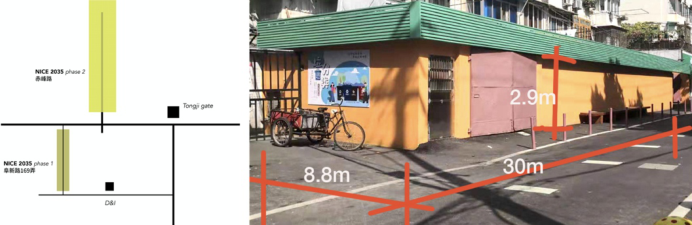
Based on the initial structure of the EXPERIENCE MEDIA MODEL, we conducted a co-creation project named NICE2035 Art Co-Mural, located at No.169 Alley, Fuxin Road, Shanghai, China. Here stands an abandoned public wall around 30 meters (Fig. 2). During the project, we had in-depth cooperation with En Masse (one of the world’s top artist collaboration teams) and D&I (College of Design and Innovation, Tongji University).
Pre-Research In the preparatory stage of the co-creation project, we conducted a pre- interview with a series of stakeholders, mainly including community resi- dents, the street department, En Masse, and D&I. Problems of this pre- interview were collected in Table 1 about the best way to renew the aban- doned public wall was the Art Co-Mural.
Figure 2: Location and size of the abandoned wall in NICE2035 block.Table 1. Collection of pre-interview with stakeholders.
Table available in the original PDF paper.
Stakeholder Evaluation Keywords Community Resident Residents opinions; Joint efforts Community innovation ignoring the residents’ opinions is meaningless. We hope to make it more exciting and creative through joint efforts.
Representative
Street Department
We hope the event will make the wall a representative community landscape.
Communication; Inspiration
En Masse We expect more communications with local people to inspire us to create.
Ideal community
D&I The residents are the most qualified and capable of creating their ideal community.
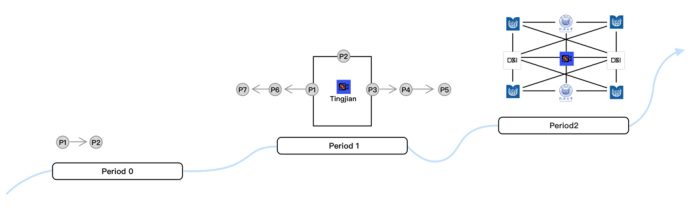
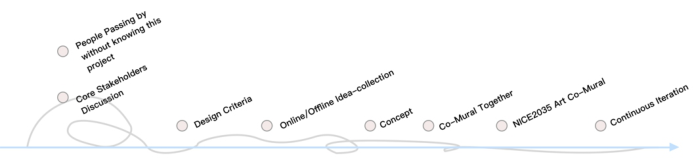
Strategic Planning of Experience Media NICE2035 Art Co-Mural project was launched from October 27, 2019, to November 3, 2019. Based on the Experience Media Model, the whole execution process is shown in Fig. 3.
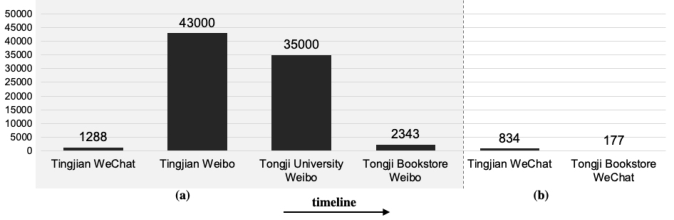
On the Media Co-creation Layer, online social media platforms such as WeChat Public Account, Weibo, etc., were organized systematically into three periods for idea-collection, crowdsourcing, and communication as follows (Runxi Zeng, Chenxi Wang, and Qiang Chen, 2014): (1) Period 0, Organizers and Participators spread information about NICE2035 Art Co-Mural that could attract a small group to join offline NICE2035 painting. (2) Period 1, the Official WeChat and Weibo platform of TINGJ Studio, was used to integrate information, photos, and articles. All these elements were sent to the online audience, leading to a period of both intended sharing and natural sharing, of which the pageviews exceeded 43,000. (3) Period 2, this stage’s strategy would help get exposure times. Cooperated with a series of official social media platforms of Pan-Tongji University
Figure 3: Media co-creation process of NICE2035 art co-mural project.
Experience Media Model: A Method to Facilitate the Consistent Bottom-Up Innovation 5
Circle (Weibo and WeChat Public Account of Tongji Univ., Tongji D&I, Tongji Bookstore, etc.), the Experience Media Matrix was established. The online promotion attracted more than 100,000 pageviews, and some ideas were developed online and integrated into the mural design. Statistics of all tweets were recorded in Fig.4. Many of the readers even came to join the Art Co-Mural.
On the Execution Co-creation Layer, it is also vital to invite the main stakeholders in multilevel, including government, college, project managers, designers, artists, community residents, interested individuals, students, and online audiences to participate in the wall painting. Therefore, the most strai- ghtforward colors, black and white, were used, and the overall constituent elements are tightly related to the most ordinary life of Shanghai residents.
Seven stages (shown in Fig. 5.) on the Execution Co-creation Layer were conducted. With an initial pattern provided to trigger imagination, the mural was gradually finished with the participation of both residents and designers on-site in three days (Fig. 7). During the one-week experiment, 221 residents participated in the wall painting, and 96 participated in our post-promotional video shooting activity (Fig. 6 (b)).
Feedback and Critical Insights In these three days, NICE2035 Art Co-Mural, based on the Experience Media Model, encouraged participators to freely express their imagination and their voice of the future community and attracted more than 200 participators and more than 100,000 pageviews, which brought us a bunch of feedback and critical insights (shown in Table 2).
Figure 4: Two articles reading statistics on various platforms. The first article was for a promotional project recorded in the (a) area. The second article summarized the project recorded in the (b) area.Figure 5: Execution co-creation process of NICE2035 art co-mural project.Figure 6: (a) The abandoned public wall in white, (b) co-creation with residents.Figure 7: Final presentation of NICE2035 art co-mural.Table 2. Feedback and evaluation of the art mural by stakeholders and critical insights.
Table available in the original PDF paper.
Stakeholder Feedback and evaluation Critical Insights Connected Community Resident
It is incredible to keep my creations on the wall as part of the community, which makes me feel that the community environment is more connected.
Social media
Street Department
The Co-Mural made the creation more open, and the dissemination and recording of the event on social media also made the event more valuable.
Co-creation
En Masse The residents’ participation in the co-creation made the final work more exciting and meaningful.
Social innovation
D&I The mural co-creation is a successful and practical case of social innovation and community co-creation.
This Art Co-Mural was far more than a black-and-white wallpaper or an ordinary display. Instead, it was about how to find a way to facilitate the bottom-up innovation of local community participators consistently, and it created a beautiful “visible/invisible” platform to share, learn, and play within the community.
Feedback and insights from this project verified the preliminary feasibility of the Experience Media Model and promoted it to iteration.
Experience Media Model: A Method to Facilitate the Consistent Bottom-Up Innovation 7
MECHANISM OF EXPERIENCE MEDIA MODEL Based on insights from NICE2035 ART Co-Mural, the detailed mechanism and iteration of the Experience Media Model were formed, as shown in Fig. 8.
The Experience Media Model is structured as two layers connected with the participator end, which can be explained as follows: (1) Media Co-creation layer: According to the timeline (x) and the commu- nicating effect (y1), there are three stages, including Pre-Communication Period 0, Break-Communication Period 1, and Matrix Communica- tion Period 2, corresponding to the three communication methodologies shown in Fig. 9. Numbers in each stage represent different kinds of social media. With time, the overall communicating effect increases and fluctuates in a small range. It indicates the mechanism of consistently facilitating the bottom-up innovation of participators, and online social media platforms (matrix) provide the dynamic interaction for desi- gners and participators, helping them to learn, share, and co-creation. From the overall perspective, Media Co-creation Layer can promote the Continuity and Togetherness of the Execution Co-creation Layer. (2) Execution Co-creation Layer: According to the timeline (x) and the design convergence (y2). The dots represent the seven co-creation stages corresponding to the three media co-creation stages above, respectively: a) Fuzzy front end and the first half of the Design Criteria correspond to the first media co-creation stage, which represents the natural sha- ring mainly upon the private flow of the preliminary participators can gradually structure the chaotic process in the early stage of design; b) the second stage of Media Co-creation Layer includes the second half of Design Criteria, Ideas, Concept, and the first half of Prototype. The seven-stage co-creation line starts to converge and can make substantial progress. c) Product and Iteration belong to the third media co-creation stage. The product at this stage has already been relatively completed and accepted by the crowd. Thus, it is necessary to use matrix media to spread it. From the overall perspective, Execution Co-creation Layer provides the possibility and methodology for Media Co-creation Layer to gain in-depth insight into the event and participators.
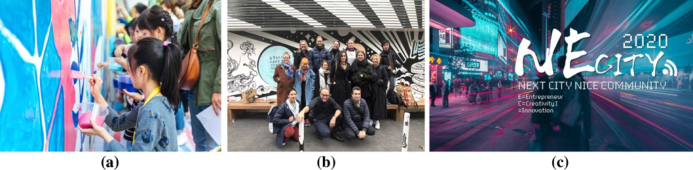
Figure 8: Mechanism of experience media model.Figure 9: (a) Tongji 2019 open street festival (D&I Tongji 2019), (b) Tongji x Kolding 2019 collaborative workshop (SIIDI Tongji 2019), (c) NICE city 2020 short video contest (SIIDI Tongji 2020).
(3) Participator End: it represents the participators in a co-creation project and owns the function of connecting the two layers above, and the two layers have an interactive connection between the Participators Layer.
The Experience Media Model indicates the mechanism to consistently facilitate the bottom-up innovation of local community participators and optimize the perishability of co-creation. It can make the creation more diverse, and the broad communication channels of the media are used to give the design a more comprehensive range of communication space.
DISCUSSION
This study proposed the Experience Media Model combining the co-creation and communication logic to optimize the innovation continuity and peri- shability when conducting co-creation. Moreover, the mechanism of this model was tested, verified, and iterated by being applied in a practical project NICE2035 Art Co-Mural.
This model has the function of re-integrating social resources, gaining insi- ghts into user needs in a highly efficient way, and providing new broader channels for innovation of users and designers. Furthermore, the practical experience of the NICE2035 Art Co-Mural project accumulated lessons to some extent for the future social innovation projects surrounding Tongji University, such as Tongji 2019 Open Street Festival (Fig. 9(a)), Tongji x Kolding 2019 Collaborative Workshop (Fig. 9(b)), NICE City 2020 Short Video Contest (Fig. 9(c)).
However, in conclusion, it has some disadvantages that instruct the future works as follows: (1) The mechanism of the Experience Media Model was tested and verified in a community co-creation project, but in different types of projects, such as enterprise innovation, medical service design, and technology- driven innovation, the feasibility of the model may be affected. At the same time, even in one project, many variables may affect the robu- stness of the model, such as the number of participators, project size, and project duration. Therefore, in further study, a series of control groups should be set to execute co-creation projects with different attri- butes and to explore the combination degree of the Media Co-creation Layer and the Execution Co-creation Layer.
Experience Media Model: A Method to Facilitate the Consistent Bottom-Up Innovation 9
(2) The research on the Media Co-creation Layer in this model was mainly based on the “new media matrix” theory. However, with the broad spread of 5G, there will be more and more advanced and multi- dimensional media communication modes. Further research should also consider the suitability of future new media communication modes. (3) In this project, the effect of participators in the “very early stage/ strategic stage” was partly neglected for specific reasons. How to systematically attract multi-layer core stakeholders with specific attri- butes into the “very early stage/ strategic stage” via the communication methodology should also be one of the future works.
ACKNOWLEDGMENT
The authors would like to acknowledge Prof. Richard Hsu and Prof. Yun- sheng Su for the launch and direction of the project NICE2035 Art Mural Wall.
REFERENCES
Berman, E. M. (1997) ‘Dealing with Cynical Citizens’, Public Administration Review, 57(2), p. 105. Available at: https://doi.org/10.2307/977058. Davila, T., Epstein, M. J. and Shelton, R. D. (2006) Making innovation work: how
to manage it, measure it, and profit from it. Upper Saddle River, N. J: Wharton School Pub. Edelenbos, J. (2005) ‘Institutional Implications of Interactive Governance: Insights from Dutch Practice’, Governance, 18(1), pp. 111–134. Available at: https://doi. org/10.1111/j.1468-0491.2004.00268.x. Gladwell, M. (2000) The tipping point: how little things can make a big difference.
1st ed. Boston: Little, Brown. Jiang, Y. (2021) Research on Service System Design for the Media-based Platform of Medical Co-design. Master. Tongji University. Lowndes, V., Pratchett, L. and Stoker, G. (2001) ‘Trends In Public Participation: Part
1 - Local Government Perspectives’, Public Administration, 79(1), pp. 205–222. Available at: https://doi.org/10.1111/1467-9299.00253. Meroni, A. and Sangiorgi, D. (2011) Design for Services. 1st Edition. Farnham, the UK: Gower Publishing Limited (Design for Social Responsibility Series). Available at: https://doi.org/10.4324/9781315576657. Papanek, V. and R. Buckminster, F. (1972) DESIGN FOR THE REAL WORLD.
London: Thames and Hudson. Pestoff, V. (2013) New Public Governance, the Third Sector, and Co-Production. 1st edn. Routledge. Available at: https://doi.org/10.4324/9780203152294. Pilotta, J. J. and Schultz, D. (2005) ‘Simultaneous Media Experience and Synesthesia’,
Journal of Advertising Research, 45(01), p. 19. Available at: https://doi.org/10. 1017/S0021849905050087. Runxi Zeng, Chenxi Wang and Qiang Chen (2014) ‘Comparative Study on Transmission Phase and Model of Internet Public Opinion’, JOURNAL OF INTEL- LIGENCE, pp. 119–124. Available at: https://doi.org/10.3969/j.issn.1002-1965. 2014.05.021. Sanders, E. B.-N. and Stappers, P. J. (2008) ‘Co-creation and the new landsca-
pes of design’, CoDesign, 4(1), pp. 5–18. Available at: https://doi.org/10.1080/ 15710880701875068.
Soule, Malhotra and Clavier (2017) Defining Social Innovation | Stanford Graduate School of Business. Available at: https://www.gsb.stanford.edu/faculty-research/ centers-initiatives/csi/defining-social-innovation (Accessed: February 2 2020). Thomas D. Mayfield III (2011) ‘A Commander’s Strategy for Social Media’, NDU
Press, January, pp. 79–83. V. J. J. M. Bekkers (2004) ‘Virtual policy communities and responsive governance: Redesigning online debates’, Information Polity, 9(3, 4), pp. 193–203. Available at: https://doi.org/10.3233/IP-2004-0053. Venkatesh et al. (2003) ‘User Acceptance of Information Technology: Toward a Uni-
fied View’, MIS Quarterly, 27(3), p. 425. Available at: https://doi.org/10.2307/ 30036540. Xiangyang, X. and Xi, W. (2018) ‘Co-Creation and Uncertainties of Experiences in Service Design’, ZHUANGSHI, pp. 74–76. Available at: https://doi.org/DOI: 10.16272/j.cnki.cn11-1392/j.2018.04.014. Xin X. and Cao J. (2018) ‘Positioning Service Design’, Packaging Enginee- ring, 39(18), pp. 43–49. Available at: https://doi.org/10.19554/j.cnki.1001-3563. 2018.18.011. Xin, X. and Wang, X. (2018) ‘Co-creation in Service Design and Uncertainty in
Service Experience’, Zhuang Shi, (04), pp. 74–76. Xiong, D. (2019) ‘Service Co-creation: Co-creation in Service Design and Its Mechanism’, ZHUANGSHI, pp. 116–119. Available at: https://doi.org/DOI:10.16272/ j.cnki.cn11-1392/j.2019.10.028. Zeithaml, V. A., Parasuraman, A. and Berry, L. L. (1985) ‘Problems and Strategies in
Services Marketing’, Journal of Marketing, 49(2), pp. 33–46. Available at: https: //doi.org/10.1177/002224298504900203.
LISTED IN THE AHFE DIGITAL BOOKSTORE CATALOGUE
Explore the complete digital volume
Human Factors in Communication of Design
Read this individual research paper free through the original publisher, or explore the full digital proceedings book.
ISBN 978-1-958651-66-7
Explore this ISBN in the AHFE Bookstore ↗Listed in the July 2026 bookstore catalogue; search by ISBN to confirm current availability · Digital book purchase optional