Weiming Liu, Ying Zhao, Guoer Wang, Li Yang (2023). Exploration of AI aided design path for graphic designers. In: Ergonomics In Design. AHFE Open Access, vol. 77, pp. 288–296. https://doi.org/10.54941/ahfe1003386
At present, the field of artificial intelligence is developing rapidly, and breakthrough achievements have been made in design. Artificial intelligence design shows the characteristics of humanization, diversity, convenience and high efficiency. Through questionnaire interviews and quantitative analysis, this paper first collects current graphic Designers' opinions on AI participation in design, then conducts quantitative analysis to find out the problems and pain points that graphic designers encounter in the environment of AI participation in design. Then it discusses the principles of AI design and the relationship between AI and human in design activities. A set of AI-aided design model is constructed to improve the current level of collaboration between graphic designers and AI paintings.
Science magazine in the United States selected major scientific discoveries, developments and trends in the past year among the top 10 scientific bre- akthroughs in 2022. Artificial Intelligence Generated Content, along with NFT and VR/AR, constitutes the three major infrastructures of the meta uni- verse and Web3.0. At present, artificial intelligence GC has also become the largest trend in the field of artificial intelligence, which means that artificial intelligence has gradually penetrated into the unique field of human “artistic expression”. According to a report by Gartner, a research institute, 20% of the content is expected to be created by Generative Artificial Intelligence by 2023. Until 2025, Generative AI will create 10% of all data already produced, but at present it is less than 1%. (World Internet Conference) The purpose of this study is to help graphic designers explore a way that can complement AI design, make use of the advantages of AI to make up for human defe- cts, build a set of AI-aided design model, set up AI-assisted graphic designer completion strategy, and make AI design serve human beings.
Analysis of Current Common Artificial Intelligence Design Processes At present, AI design software with high search frequency mainly inclu- des: Chuangkit, canvas, Alibaba Luban, Yiqixiu, free logo design, looka.
Exploration of AI Aided Design Path for Graphic Designers 289
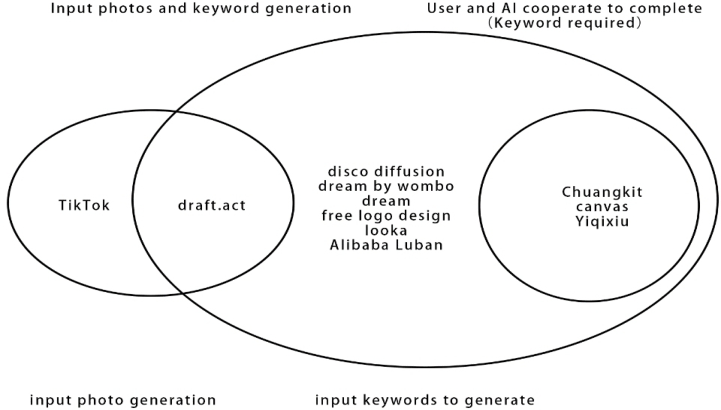
AI painting applications with high search frequency mainly include: Tiktok, draft.act, disco diffusion, dream by wombo, dream. Among them, those who input keywords to generate illustrations or design drafts include: disco dif- fusion, dream by wombo, dream, Alibaba Luban, free logo design, looka. Those who can use the material library for intelligent design according to user needs include: Chuangkit, canvas, Yiqixiu (Figure 1).
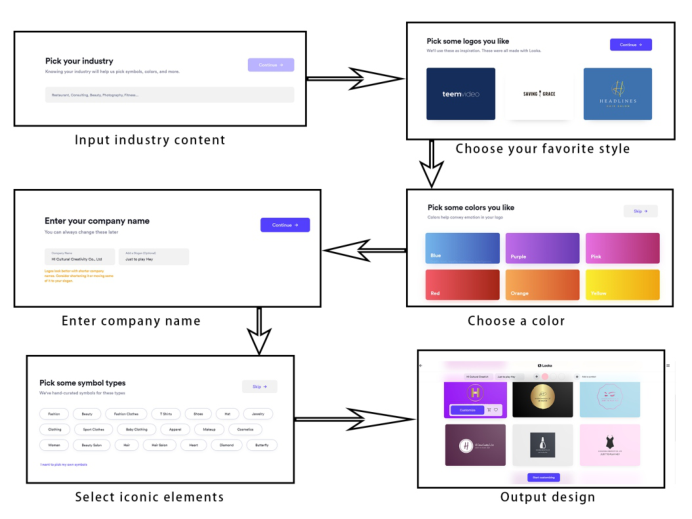
The following figure (Figure 2) shows the process of generating a logo using artificial intelligence from the looka website, which represents the current common process of online AI generation and design.
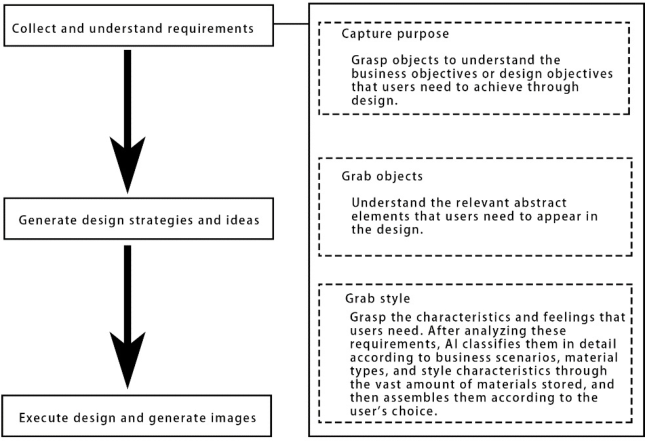
Step 1: Enter the product content, and AI will select the relevant content style to present to the user; Step 2: Choose your favorite style; Step 3: Select the main color; Step 4: Enter the company name; Step 5: Select the desired iconic elements in the logo; Step 6: Output Design. It can be seen that the current common AI design applications mainly include the following steps: first collect and understand the requirements, then generate design strategies and ideas, and finally execute the design and generate images (Figure 3).
(1) When using AI for design, it first analyzes the user’s input semantics, carries out semantic analysis, intelligent word segmentation, entity recogni- tion and semantic association, and then establishes the following information capture for user input:
1. Purpose capture: understand the business objectives or design objectives that users need to achieve through design; 2. Object capture: understand the relevant abstract elements that users need to appear in the design;
Figure 1: Classification of current AI design/painting applications.Figure 2: Artificial intelligence design process taking looka as an example.Figure 3: Artificial intelligence design process taking looka as an example.
3. Style capture: capture the characteristics and feelings of users. After the analysis of these requirements, AI classifies them according to busi- ness scenarios, material types, and style characteristics through the vast amount of materials stored, and then assembles them according to the user’s choice.
Exploration of AI Aided Design Path for Graphic Designers 291
(2) Then there is the design strategy and creative link. The design stra- tegy is a subjective model established by the design experts, which extracts and analyzes the knowledge map and converts it into clear call instructions. After the judgment of the business level and the design level is completed in the strategy link, the design elements are called. Take the commodity poster as an example. After the strategic judgment, it is concluded that the poster needs to have the impact of commodities. Then the artificial intelligence will call out a large number of commodity images, and then get the content of the commodity through semantic analysis, and get the specific commodity through feature analysis, and then corresponding to the poster design. This is the final creative link.
(3) Finally, design generation. Under the guidance of the strategy in the second step, AI gives instructions to each part of the module to complete the generation of the whole design, and detects and optimizes it, fine-tuning the inappropriate parts, and finally completes the creation.
Investigation and Research on AI Aided Design by Users This research is mainly carried out by means of interviews. Through online interviews, we have carried out investigation and interview research on two major categories of graphic designer profession and non-graphic designer profession.
The main research content of this interview is divided into the following three parts:
1. Whether the AI design will be used in the actual work; 2. What problems have you encountered when using artificial intelligence to paint or design; 3. Whether non-graphic designers can meet their psychological expectations when using them.
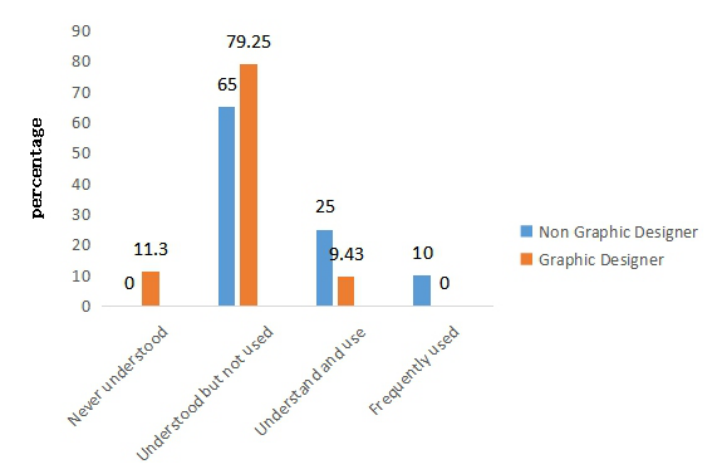
According to the interview results, for people who are not graphic desi- gners, 11.32% said they have never heard of it, 79.25% said they understand but have not used it, and only 9.43% said they understand and have used it; However, for people in the direction of graphic design, the reach of AI design has reached full coverage, but still 65% of them said they understand but have not used it, only 35% said they understand and use it, and 10% said they often use it. This phenomenon indicates that artificial intelligence design has been recognized by most people, but most of them have not used it. The- refore, it is a trend to correctly guide the use of artificial intelligence design (Figure 4).
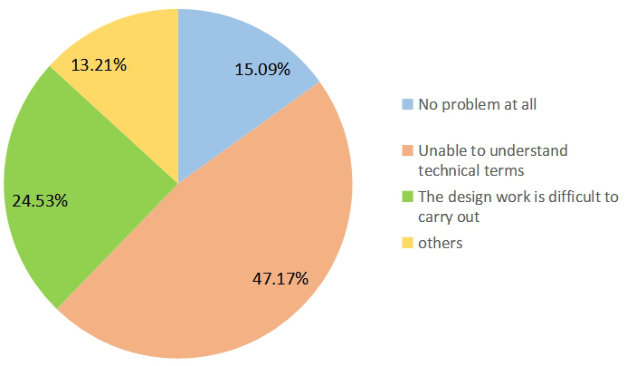
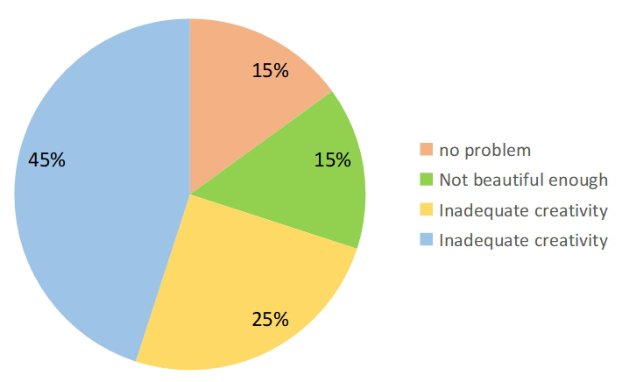
For non-graphic designers, the biggest problem they face is that they can’t understand the professional terms, accounting for 47.17%, followed by the design work is difficult to carry out, accounting for 24.53%, 15.09% said that there is no problem at all, and 13.21% chose other people (Figure 2). But for graphic designers, the biggest problem they face is that AI design cannot meet the demand, accounting for 45%. The second is that the content of AI design is not creative enough, accounting for 25%, the selection of content
Figure 4: User’s understanding of AI design (from interview survey).
is not beautiful enough, accounting for 15%, and the proportion of people who think AI design is completely OK accounts for 15% (Figure 5, Figure 6).
Based on the above interviews and surveys, it can be concluded that the main reasons why non graphic designers do not use AI for drawing are the difficulty in understanding terminology and carrying out design. However, for graphic designers, it is difficult for AI to meet multiple needs and cre- ativity. Therefore, AI assisted design urgently needs a perfect path to help designers carry out better design.
Figure 5: Analysis of the disadvantages of AI design used by non-graphic designers.
Exploration of AI Aided Design Path for Graphic Designers 293
Figure 6: Analysis of the disadvantages of AI design used by graphic designers.
Through interviews and surveys, it was found that most of the purpose of using AI to design or paint by non-graphic designers was simple photo typesetting, and most of the AI design products used were Photo beautifica- tion application on the market, such as the poster making function in Meitu Xiuxiu and butter camera, or the use of creative playing methods in Xingtu, TikTok, Meitu Xiu Xiu and WeChat applets to generate AI paintings. Most of them said that AI design is very interesting and suitable for non-design professionals.
The interview with graphic designers found that the main purpose of graphic designers to use AI to create for the crowd is to complete course assignments and design logos, and they did not use AI design in their work. There are also a large number of graphic designers who believe that machines can still not completely replace human beings, and that the inability to design pictures based on accurate descriptions and the creativity of machines can not replace human beings. However, there are also some who believe that the use of AI for auxiliary design can be more flexible and convenient, but also hope that AI design can be easier to use. When faced with the question of “cho- osing to use AI to assist in design creation”, most of the answers are quick and convenient to use for drawing. In addition, AI can be used for divergent thinking. However, some designers believe that AI design is too rigid to meet the design requirements. Specific analysis is shown in Table 1.
To sum up, for non-professional people, AI design can meet their daily needs to a certain extent, but once it rises to the professional field, AI design can not completely replace human design at present, but can help designers to divergent thinking, provide inspiration sources and make design more flexible and convenient.
Therefore, through investigation and research, designers need a new AI aided design model to help designers improve their work efficiency, and AI also needs a more complete strategy to design.
Table 1. Purpose and defects of user’s use of AI design.
Table available in the original PDF paper.
Service defect
The main purpose of using AI painting/design
Whether to use in work
Graphic Designer
Inability to accurately read requirements and lack of creativity
Get inspiration, complete school work and design logo
Use as design reference(For example, canvas, Alibaba Luban)
Non-Graphic Designer
Used by a small number of people(For example, Yiqixiu)
Use Photo beautification application to generate cartoon images, make simple posters online, typeset photos, personal invitations, etc
Use Photo beautification application to generate cartoon images, make simple posters online, typeset photos, personal invitations, etc
AI Aided Path Model for Graphic Designers The rapid development of artificial intelligence has involved the unique cre- ative field of human beings, but there are still various defects, which can not completely replace human designers. Based on the above analysis, a path model for AI aided design is proposed. By using the advantages of artifi- cial intelligence, it provides new ideas for human designers, improves design efficiency and creative inspiration for human designers, and reduces meanin- gless repetitive work. By using the advantages of AI design to help graphic designers get a lot of inspiration and analyze more quickly, it can reduce many complicated work and help graphic designers complete their work more efficiently.
The innovation of this path model is to improve the current problem of “unable to accurately read the demand”, and use the most common AI expert system (Min Fan, Wenxuan Zhang, Hong Li. 2022) inference engine to train this model. After a certain number of reasoning, remember the user’s likes and records in the material library, so that it can be extracted and used in the next similar demand. Solve the problem that most designers are troubled by the difficulty of using AI in their work.
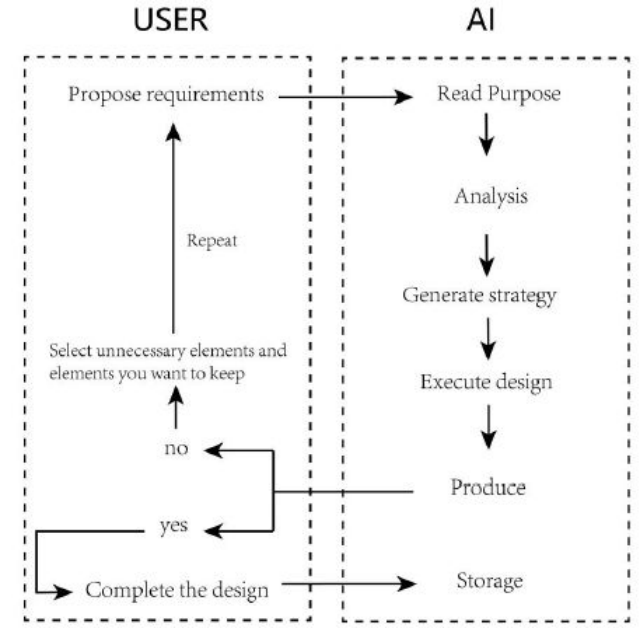
The solution is as follows: the designer first puts forward the demand, which is read by AI. After AI captures the purpose and demand, it generates the monthly design strategy creativity through the analysis of massive materi- als, and finally implements the design and outputs. At this time, the designer selects the optimal design, and AI records the preference, and generates a new design or stores it for next use (Figure 7).
This diagram first follows the basic process of AI design. The designer pro- poses requirements, and AI reads and analyzes them. After analyzing a large amount of materials, AI generates a preliminary design strategy and outputs it. Unlike the AI design process currently seen, after this output, designers can retain the elements they need on the image and eliminate the unneces- sary elements. Finally, the result is conveyed back to the first step, and a new design is generated until the user is satisfied. Through this training process, designers can step by step achieve their inner ideas, and can alleviate many
Exploration of AI Aided Design Path for Graphic Designers 295
Figure 7: AI aided path model for graphic designers.
repetitive and inefficient tasks. Through the use of AI aided design, design work can be completed more efficiently.
CONCLUSION
Through collecting the opinions and opinions of current graphic designers on AI participation in design and conducting quantitative analysis, find out the problems and defects encountered by current graphic designers in the environment of AI participation in design, and after discussing the principles of AI design, build a set of AI aided design model. By taking advantage of the advantages of AI computing speed and massive database, Establish the strategy of AI assisting graphic designers to complete the design, and improve the current level of collaborative work between graphic designers and AI painting.
REFERENCES
Min Fan, Wenxuan Zhang, Hong Li (2022). 基于人工智能的期刊专家审稿系统编辑 策略的优化研究. Research on the Optimization of Editing Strategy of Periodical Expert Review System Based on Artificial Intelligence. 2022, 40(06): 95–98.
Wenfeng Wang, Rong Zhang (2022). 智能技术在交互式绘画设计中的应用及 其创作机制研究. Research on the application of intelligent technology in inte- ractive painting design and its creative mechanism. 2022, 43(S1): 89–95. DOI: 10.19554/j.cnki.1001–3563.2022. S1.017 Yan, Han, Zhang, Haijun; Liu, Linlin; Zhou, Dongliang; Xu, Xiaofei; Zhang, Zhao;
Yan, Shuicheng. (2022). Toward Intelligent Design: An AI-based Fashion Designer Using Generative Adversarial Networks Aided by Sketch and Rendering Genera- tors. ISSN:1520–9210, E-ISSN:19410077. DOI: 10.1109/TMM.2022.3146010. Leiser, Alexander, Schlippe, Tim. (2022). AI in Art: Simulating the Human Painting ProcessLeiser. Lecture Notes of the Institute for Computer Sciences, Social- Informatics and Telecommunications Engineering, LNICST, Volume 422 LNICST, Pages 295-308, 2022. ISSN: 1867–8211. E-ISSN:1867822X. DOI: 10.1007/978- 3-030-95531-1_20. Sola, Mar, Guljajeva, Varvara. (2022). Dream Painter: Exploring creative possi-
bilities of AI-aided speech-to-image synthesis in the interactive art context. E- ISSN:25776193. DOI: 10.1145/3533386. Chang, Rong, Song, Xinmiao, Liu, Huiwen. (2022). [1] Between Shanshui and Landscape: An AI Aesthetics Study Connecting Chinese and Western Paintings. ISBN- 13:9783031063909. ISSN: 1865–0929. E-ISSN:18650937. DOI: 10.1007/978-3- 031-06391-6_24.
LISTED IN THE AHFE DIGITAL BOOKSTORE CATALOGUE
Explore the complete digital volume
Ergonomics In Design
Read this individual research paper free through the original publisher, or explore the full digital proceedings book.
ISBN 978-1-958651-53-7
Explore this ISBN in the AHFE Bookstore ↗Listed in the July 2026 bookstore catalogue; search by ISBN to confirm current availability · Digital book purchase optional