Zhu Qingyu, Ying Zhao, Hao Yang, Yiyang Zhang (2022). Persuasive interaction design based on The behavior of Car-sharing users in Beijing. In: Ergonomics In Design. AHFE Open Access, vol. 47, pp. 706–716. https://doi.org/10.54941/ahfe1002001
With the advent of the era of sharing economy, in order to alleviate traffic congestion, environmental pollution and other increasingly serious urban traffic problems, car-sharing emerged at the historic moment. However, with the rapid development of car-sharing, some problems in the process of users' use are gradually exposed, mainly manifested in the damage of the car body caused by users' non-standard operation, among which the high rate of loss of personal property of users has also caused a certain impact on user experience. This paper investigates user behavior cognition through questionnaires and other forms, studies persuasive interaction design based on user behavior of car-sharing, and attempts to improve user behavior problems in car-sharing by means of behavioral persuasion, i.e. on-board HUD reminder system, which is of certain significance to balance user experience and product value.
In the context of sharing economy, shared electric vehicles have become a new operation mode in the development of new energy vehicles (Wang gaohong. 2017). This motorized travel mode between public transport and private motor vehicle is conducive to reducing carbon emissions, increasing the use efficiency of motor vehicles, and alleviating the “difficult travel” and “time-consuming” problems in large and medium-sized cities (Li Zhiping et al. 2017). However, in the process of users’ use, for example, car body damage caused by users’ non-standard operation, deteriorating inte- rior environment, disorderly parking, and even traffic accidents lead to poor user experience and reduced user retention rate. In view of the pro- blems caused by user behaviors, the author tries to integrate the persu- asive design concept into the interaction design of car-sharing to control and cultivate good user behaviors. Improve user experience and resou- rce waste. Therefore, this paper explores persuasive interaction based on user behavior of car-sharing, and attempts to use behavioral persu- asion to improve user behavior problems in the car-sharing industry in Beijing.
Persuasive Interaction Design Based on the Behavior of Car-Sharing Users in Beijing 707
THE PRINCIPLE AND HISTORY OF PERSUASION TECHNIQUES AND AUGMENTED REALITY TECHNOLOGY
1. Persuasive design model: Persuasion technology refers to an interactive computing system that changes or influences user behavior through cer- tain persuasion methods. The theory proposed by Professor BJ Fogg, an experimental psychologist from Stanford University, based on the inter- disciplinary knowledge of psychology and computer science (Fogg BJ. 2002). The most important theoretical model in persuasive design is Fogg behavior model. The Persuasion Technology Laboratory of Stan- ford University led by Professor BJ Fogg proposed a model to analyze user behavior -- Fogg Behavior Model (FBM), which plays a very impor- tant role in the analysis and design of persuasion technology. Persuasive design currently has the theory of Captology, and the research focuses on how to use computers for interactive technical persuasion. Then there is Icek Ajzen’s theory of planned behavior and psychologist Robert Cial- dini’s “law of influence.” And three strategies of persuasive design in Internet product design proposed by Stephen Wendel.
Persuasive design is widely used in car-sharing.: Limited Interaction Design for car-sharing users proposed by Zhao Ying (Zhao Ying. 2021). Research on the design of shared electric vehicle Service based on behavioral persuasion proposed by Lin Dan (Lin Dan. 2019). Deng Rong intuitively shows the appli- cation method of persuasive design in sports and health APP (Deng Rong. 2017). In the current form of the Internet, persuasion technology is everyw- here. Any website, an APP and other Internet products can find the trace of persuasion design, and its application in various fields will subtly change and influence the user’s behavior (Zhou Yang. 2017).
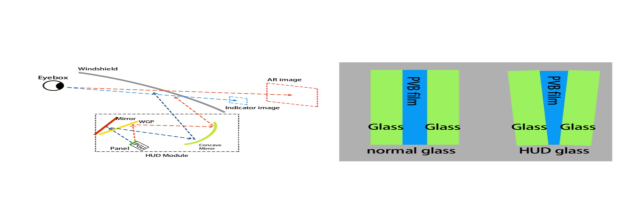
2. Augmented reality -- HUD technology: At present, most of the research on augmented reality in vehicle-mounted human-computer interaction system is carried out around the combination of AUGMENTED REA- LITY and HUD (head-up Display). General Motors was one of the first to use HUD head-up displays in its Olds Mobile Cutlass Supreme in 1988. Since then, HUD systems have gradually appeared in sports cars and sedans, and developed from the original single-color projection of dri- ving information to the direction of digitalization (Chen Yanxuan et al. 2018). HUD technology uses the principle of optical reflection to pro- ject important and relevant information onto a piece of glass. This piece of glass is located at the front of the cockpit, and text and images are projected on a coated lens (refractive lens) and balanced back into the pilot’s eyes (Cao Zengchen et al. 2010). Today, as an information filter, the HUD projects selected, directly relevant driving-related information in full color onto the windshield so that the driver can access the informa- tion in comfort without taking his eyes off the road. HUD contributes to accident-free driving as part of the HMI (Huang Erdian. 2016). Figure 1 shows the HUD fundamentals and dedicated glass contrast.
Figure 1: Basic principles of HUD and SPECIAL glass for HUD.Table 1. The questionnaire outline.
Table available in the original PDF paper.
Basic information age, gender occupation, driving years Travel Information Have you aver used a shared car to commute The total number of times you commuted using a shared car The average length of your commute per shared car The distance you commute by car sharing single trip) Shared car brands you have used (multiple choices) Behavioral cognitive condition
What do you think are the factors that affect the daily commuting use of shared cars? (multiple choices) Why do you choose a shared car for your daily commute (multiple choices) Have you ever lost something while using a shared car Have you recovered your lost items If you lose an item in a shared car, it is Do you think it is easy to lose personal belongings in car sharing Do you think that if an item is lost in a shared car, the probability of successful recovery is Do you think it is easy to recover the lost items in the shared car If you have never lost items in the shared car, what do you think is the reason (multiple choices) Do you think there is time in your daily life to find lost items in your shared car
USER BEHAVIOR SURVEY AND KEY PROJECT ANALYSIS User demand analysis is the focus of interaction design, so user behavior analysis is the focus of persuasive interaction design. Therefore, this stage is to investigate the user’s behavior. The questionnaire is mainly divided into three parts, as shown in Table 1: The first part is the basic information of users, studying the characteristics of target users. The second part is the study of users’ travel situation. The third part is the study of users’ behavioral cogni- tion to find which factors can influence users’ behaviors and the degree of these factors. Then, through field investigation, the behaviors of users when using car-sharing are deeply studied.
Persuasive Interaction Design Based on the Behavior of Car-Sharing Users in Beijing 709
Table 2. Basic information of users.
Table available in the original PDF paper.
Name Option Frequency Percentage (%) Cumulative Percentage (%)
30 31.91 52.13
Gender Male 53 56.38 56.38 Female 41 43.62 100 Age 18–20 1 1.06 1.06 21–25 40 4.55 43.61 26–30 50 53.19 96.81 31–40 2 2.13 98.94 over 40 1 1.06 100 Occupation Students 19 20.21 20.21 IT technology enterprises
43 45.74 100
Freelancer 2 2.13 54.26 Teachers, scientific research, medical staff, state organs
54 57.45 58.51
Driving years 3000km rookie 1 1.06 1.06 10,000 km–20,000 km ordinary
39 41.49 100
50,000 km–310,000 km ordinary Total 94 100 100
Table 3. Customer use situation.
Table available in the original PDF paper.
Name Option Frequency Percentage (%) Cumulative Percentage (%)
Yes 94 100 100
Hav you ever used a shared car to commute?
Your average number of commutes per month using a shared car
3-4 times 61 64.89 64.89 5-6 times 31 32.98 97.87 7 times in half 2 2.13 100 The average length of your commute per shared car
Within 1 hour 26 27.66 27.66 1-3 hours 66 27.66 27.66 3-8 hours 2 2.13 100 The distance you commute by car sharing (single trip)
5-10 km 29 30.85 30.85 10-15 km 48 51.06 81.91 15-20 km 16 17.02 98.94 20-30 km 1 1.06 100 Total 94 100 100
In the questionnaire part, the survey users were in Beijing area, and ele- ctronic questionnaire was made by Using Wenjuanxing. A total of 103 users filled in the questionnaire, and 94 valid questionnaires were finally collected, with the questionnaire efficiency of 91.3%. Firstly, the basic information and travel situation of users are shown in Table 2 and Table 3. Among the
Table 4. The user think factors affecting car-sharing commute daily use.
Table available in the original PDF paper.
Name Option Frequency Percentage (%) Cumulative Percentage (%)
Vehicle use problem Not 33 35.11 35.11 choose 61 64.89 100 Vehicle safety issues Not 26 27.66 27.66 choose 68 72.34 100 Cost amount Not 30 31.91 31.91 choose 64 68.09 100 Personal property security issues
Not 20 21.28 21.28 choose 74 78.72 100 Others (please specify) Not 94 100 100 Total 94 100 100
Table 5. The user’s perception of the lost item.
Table available in the original PDF paper.
Name Option Frequency Percentage (%) Cumulative Percentage (%)
Do you think it is easy to lose personal belongings in car sharing
No way 8 8.51 8.51 Less likely 48 51.06 59.57 general 1 1.06 60.64 More likely to 36 38.3 98.94 Can completely 1 106 100
Not completely 6 6.38 6.38 Note 27 28.72 35.11 general 13 13.83 48.94 Relatively easy to 45 47.87 96.81 often 3 3.19 100 Do you think that if an item is lost in a shared car, the probability of successful recovery is Do you think it is easy to recover the lost items in the shared car easily 3 3.19 3.19 Should be able to 18 19.15 22.34 general 16 17.02 39.36 More difficult 51 54.26 93.62 Not completely 6 6.38 100 Total 94 100 100
94 questionnaires, it can be seen that the target users are younger in age distribution. The occupation category has the largest number of professional workers, followed by full-time students. In terms of the actual driving stage, the total number of novice users accounts for 58.51%. Most of the users are not only relatively young, but also have relatively little actual driving experi- ence. Users of these two kinds of occupations have higher education level, or the quality of these two kinds of users is higher, and the probability of success of behavior persuasion is greater 5. In the survey of users using shared cars to commute, 70.21% of users use cars for 1 to 3 hours, while 51.06% of users commute 10 to 15 kilometers. These survey data show that most users
Persuasive Interaction Design Based on the Behavior of Car-Sharing Users in Beijing 711
Table 6. Cause of user Loss.
Table available in the original PDF paper.
Name Option Frequency Percentage (%) Cumulative Percentage (%) There are obvious hints in the car
Not 9 9.57 9.57 choose 85 90. 43 100
Not 25 26.6 26.6 choose 69 73.4 100 High safety awareness Not 32 34. 04 34. 04 choose 62 65.96 100 Understand the safety specifications in detail before use Remind by others Not 86 91.49 91.49 choose 8 8.51 100 Total 94 100 100
Name Option Frequency Percentage (%) Cumulative Percentage (%)
no 6 6.38 6.38 There should be no 48 51.06 57.45 general 3 3.19 60.64 Should be able no 37 39.36 100
Do you think there is time in your daily life to find lost items in your car shared vehicle Total 94 100 100
who commute by car-sharing in Beijing have shorter and longer commuting distances and compact user behaviors.
In the cognitive stage of users, the factors affecting the daily commuting use of car-sharing and the use of car-sharing are studied and analyzed. First of all, the results in Table 4 show that users think that personal property security issues have a great impact on daily commuting using car-sharing, accounting for 78.72%. Table 5 studies users’ views on a series of phenomena such as the loss of personal property in the use of car-sharing. 47.87% of the users think it is easy to lose personal belongings in the use of car-sharing, and 54.26% and 51.06% of the two questions about whether the users think it is difficult to find the lost belongings. Table 6 is a further study of the above part. 73.4% of the users think that if there is an obvious reminder in the car, they will not lose their items in the car, and 51.06% of the users think that they have no time to find the lost items. This part shows that most users believe that the obvious prompt in the car can effectively ensure that they do not lose items in the car, and they have no free time to find the lost items in the car-sharing.
At the stage of the questionnaire survey, it is found that most of the car-sharing commuters in Beijing are concerned about the loss of personal property during the use of vehicles, and most of them think it is necessary to add reminder signs in vehicles. Therefore, it continues to measure and record the visual focus of users when using vehicles by observing their behaviors in the field. According to their actual driving experience, the respondents of this behavior survey were divided into two groups of veteran drivers and two
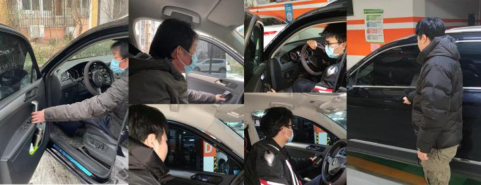
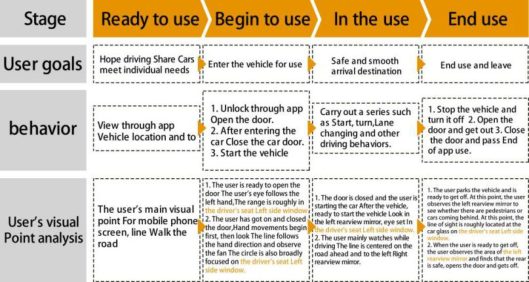
Figure 2: User behavior observation process.Figure 3: User behavior observation records.
novice drivers, and the survey place was Beijing. The process and results of user behavior observation are shown in Figure 2 and Figure 3 respectively.
Based on the above observation results of user behavior, the survey found that although each user observed the position in different ways such as sequ- ence and time, the position in the car with the most focus of their eyes except the road in front of them was the car glass on the left of the driver’s seat. The specific behavior of users will be different due to the driving behavior of users. Therefore, in the follow-up behavior persuasion design, it is neces- sary to achieve an adjustable and effective persuasion design that varies from person to person.
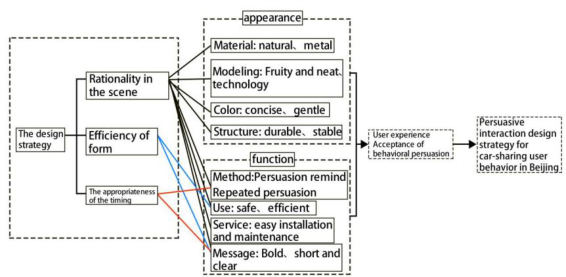
PERSUASIVE INTERACTION DESIGN STRATEGY BASED ON THE BEHAVIOR OF CAR-SHARING USERS IN BEIJING In this stage, the rationality, efficiency and appropriateness of behavio- ral persuasion design in the interior space of car-sharing in Beijing will be analyzed by combining the theory of behavioral persuasion technology and HUD technology, as shown in Figure 4. The appearance and function of specific design forms will be formulated from the direction and method of behavioral persuasion. At the behavioral level, users are advised and reminded.
Persuasive Interaction Design Based on the Behavior of Car-Sharing Users in Beijing 713
Figure 4: User behavior flow.
1. Rationality of behavioral persuasion scenarios: For intelligent vehicles, the high level of intelligent interconnection may to some extent make drivers lack situational safety awareness and reduce the usabiliy of the system (Hao Yang et al. 2021). To give the user an immersive and calm driving experience, avoid disturbing the user’s driving behavior (Lin Dan. 2019). At the same time, if the content complexity of persuasion infor- mation is high, the information presented to the user will bring a high cognitive load in the process of information (Zhou Jian et al. 2019), which will distract the user’s attention while driving and reduce the user’s car safety. The overall appearance of the persuasion equipment should conform to the feelings brought to users in existing shared cars. The use of white, light blue these light colors, first of all, give people a sense of calm, clean feeling (Xu Fei. 2015). And gray, as a kind of intermediate tone, is highly accepted, while sending out a cold wind, showing a uni- que sense of advanced. However, if gray is simply used, users will have a “static” feeling after staring for a long time, without excitement. There- fore, some delicate color blocks or patterns should be combined, which will produce a new style (Wang Ying. 2019). Therefore, the overall appe- arance of the persuasion equipment should be light gray combined with natural wood, and the main persuasion information should be blue and white.
2. Efficiency of behavioral persuasion: The high efficiency of persuasion means to help users to spend less time and accomplish the target behavior more conveniently. In order to improve the user’s ability, the design can be carried out from the dimensions of behavior decomposition and simpli- fication, simplification and easy operation, visualization, state feedback and suggestions (Lin Dan. 2019). So for Beijing area car-sharing commu- ter user behavior persuasion design specific form as well as the design position is particularly important, only the vision points through visual information to strengthen the user for the protection of the personal items at the same time to strengthen the memory, get advice information users in a short period of time, at the same time allows users in a certain time
to remember the information. The overall structure in the shared veh- icle should be durable and stable, easy to install and maintain to save costs. In order to meet the needs of users and maximize the matching with the interior environment of shared cars, thus enhancing the effect of user behavior persuasion and the sustainability of the use of persuasion equipment. 3. Appropriate timing of behavioral persuasion: From the perspective of enhancing the effectiveness of trigger factors, in the whole process of sha- ring, only by choosing the right time, the right place and the right way to persuade users’ behaviors can the purpose of behavior persuasion be achieved under the condition that motivation and ability are satisfied. Information should be conveyed when users first contact, so that they can quickly form cognition and impression (Lin Dan. 2019). In order to strengthen the cognition and memory of behavioral persuasion informa- tion, repeated persuasion information can be conveyed in the process of use and at the appropriate time after completion. So the emergence of behavior persuasion information point is based on user behavior analy- sis phase, of the vehicle location other than the user the road ahead is the driver a car on the left side of the glass, persuasion information in time with the same phase user observe the location at the same time, in every vehicle ignition, stall the engine and open the door closed the driver on the left side of the window position.
DESIGN SCHEME OF ON-BOARD HUD REMINDER SYSTEM FOR SHARED CARS In this stage, according to the research on the persuasive interaction design strategy of car-sharing users in Beijing in the previous stage, the material and use mode of the behavioral persuasion design are formulated. First of all, the position of the main equipment is located in the left front window frame, and the projection position is the left window. The appearance of the equipment is made of aluminum metal and wood shell, which can ensure the stability and durability of the equipment, and bring users a clean and advanced look and feel. In terms of specific persuasion, the device will open HUD projection to remind users every time the vehicle starts, flameouts and doors open and close, and persuade users with short and clear blue reminder words.
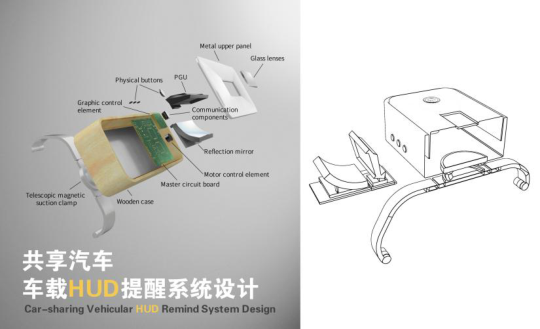
The main appearance of the on-board HUD reminder system of shared cars is shown in Figure 5. Metal and wood shells are the main components, including graphic control unit and reflective mirrors. In connection mode, the vehicle install the equipment by a telescopic magnetic fixation clip made of metal. This connection mode can meet the needs of different shared vehicles, with low follow-up cost and no hard connection with the body. In case of any failure, it can be put into use only by removing the faulty equipment and directly replacing the new equipment.
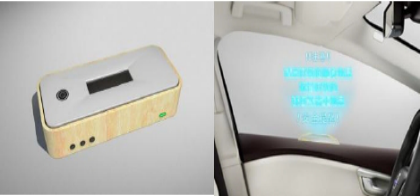
The green light at the lower left corner of the device is steady on, indica- ting that the device is in normal working state. The overall reminder font is blue, which is more suitable for the working environment in the car. It will not instantly burden the driver’s eyes, but also with eye-catching and clear
Persuasive Interaction Design Based on the Behavior of Car-Sharing Users in Beijing 715
Figure 5: Renderings and section wireframes.Figure 6: Actual operation renderings.
feeling to remind the user to take care of their belongings. The alert content is “Attention! Please take good care of your personal property. According to Figure 6, the reminder function of the on-board HUD reminder system for users of shared cars can be intuitively felt, so that users can strengthen the safety awareness of keeping their belongings.
CONCLUSION
Behavioral persuasion theory can persuade users of car-sharing in Beijing to misbehave in daily use of car-sharing, reduce users’ irregular operation and avoid waste of social resources, which is of positive significance to the deve- lopment of car-sharing industry in Beijing. Behavior persuasion theory with HUD technology and applied to share in Beijing auto persuasive in intera- ction design, according to the current sharing in Beijing car users reflects the problem of lost things, design the emphasis from the source, to alert users to improve their safety awareness, at the same time for the user to create a safe, stable transport environment, Reduce the problems users encounter when using car-sharing. So as to improve the user experience, so that Beijing area car-sharing healthy and sustainable development.
ACKNOWLEDGMENT
This research was funded by Beijing Urban Governance Research Pro- ject, grant number 21CSZL09; and Scientific Research Program of Beijing Education Commission, grant number KM202010009003.
REFERENCES
Cao Zengchen, Dai Lei. HUD Technology for Automotive Applications and Development at Home and abroad [J]. China Building Materials Technology, 2010. Chen Yanxuan, Xu Juanfang. Research on Application of Augmented Reality in
Vehicle Design [J]. Design, 2021. Deng Rong. The application of persuasive design in sports health APP [J]. Packaging Engineering, 2017. Fogg BJ. Persuasive Technology: Using Computers to Change What We Think and
Do [M]. United States of America: Morgan Kaufmann, 2002.15. Hao Yang, Jitao Zhang, Yueran Wang and Ruoyu Jia. Exploring relationships between design features and system usability of intelligent car human–machine interface. Robotics and Autonomous Systems, 2021, 143, 103829. Huang Erdian. Research on application of Augmented Reality technology in Auto-
motive Interior [J]. Design, 2016. Lin Dan. Research on The Design of Shared Electric Vehicle Service Based on Behavior Persuasion [D]. Jiangnan University. 2019 (12). Li Zhiping, Yin Zhaowei. Sharing economy promotes sustainable development of
urban transportation [J]. City, 2017(09). Wang gaohong. Research on current situation and development trend of electric vehicle technology [J]. Power grid and clean energy, 2017, 33(11). Wang Ying. Research on Interior Design of Intelligent Driverless Vehicle [D].
Changchun University of Technology. 2019. Xu Fei. Research on visual fatigue phenomenon in Visual Communication Design [D]. Beijing Institute of Fashion Technology. 2015 (04) Zhao Ying. Research on Limited Interaction Design for B2C Shared Car User
Behavior [D]. Guangdong University of Technology, 2021. Zhou Jian, Zheng Jiajia. Research on interface Design of complex Information System based on Design thinking [J]. Industrial Design. 2019 (07). Zhou Yang. Research on chronic disease health management strategy based on
Read this individual research paper free through the original publisher, or explore the full digital proceedings book.
ISBN 978-1-958651-23-0
Explore this ISBN in the AHFE Bookstore ↗Listed in the July 2026 bookstore catalogue; search by ISBN to confirm current availability · Digital book purchase optional