Yue Li, Ying Zhao, Jing Mei, Li Yang (2023). Design strategy of digital outdoor study manual based on children's learning behavior guidance. In: Ergonomics In Design. AHFE Open Access, vol. 77, pp. 394–402. https://doi.org/10.54941/ahfe1003397
In the era of continuous and profound integration of digital technology and daily learning life, a large number of children's digital learning products have emerged and been used by children. In the field of outdoor study and learning activities, the study manual is an important carrier to supplement the content of activities to assist children in learning, but the traditional paper manual design is not in-depth enough to study the needs of the target subject and its design method cannot meet the needs of the times, and cannot bring children experiential learning in the study and learning activities. In study and learning activities, digitalization guides children's behavior and immerses them in study and learning activities, which can stimulate their interest in learning and improve learning efficiency. For this reason, this paper explores the design of digital outdoor study manual for children's learning behavior guidance. Based on the theoretical perspective of behaviorism psychology, this paper analyzes the learning behavior psychology of children in study activities, summarizes the characteristics of their learning behavior, and designs the flow chart of children's learning methods and observation behavior process in study activities in combination with the relevant theories of behavioral design. Through the questionnaire data, we analyzed the influencing factors of children's willingness to use the digital outdoor study manual. Finally, we tried to build the design strategy of the digital outdoor study manual that actively guides children's learning behavior. Provide reference for the design of children's digital outdoor study manual, assist the implementation of outdoor study activities, and make contributions to the development of digital education.
With the continuous improvement of national cultural needs, people pay more attention to children’s participation in outdoor study activities, and outdoor study activities begin to flourish. Outdoor study and learning activi- ties provided by social organizations have developed rapidly in China, which makes outdoor study and learning gradually enter children’s life and lear- ning. Outdoor study is an organized, purposeful and planned outdoor visiting experiential learning activity (Jiang, 2019). In the study activities, the outdoor study manual is an important carrier to supplement the content of activities
Design Strategy of Digital Outdoor Study Manual 395
to assist children in learning, and is the key factor to successfully carry out the study activities of experiential learning. However, the design of the traditional paper study manual is insufficient, and it cannot bring children experien- tial learning in study activities. Therefore, from the perspective of children’s needs, combined with the relevant theories of behaviorism psychology and behavioral design, this paper analyzes and summarizes children’s learning methods and behavior processes in study activities, and uses digital techno- logy to make up for the shortcomings of traditional paper manual design to propose optimization plans, and tries to build a design strategy of digital outdoor study manual that actively guides children’s learning behavior.
OVERVIEW OF DIGITAL OUTDOOR STUDY MANUAL AND CHILDREN’S LEARNING BEHAVIOR GUIDANCE Overview of Digital Outdoor Study Manual
The continuous development of digital augmented reality technology has expanded China’s emerging consumer groups, and promoted the combina- tion of AR technology and traditional paper media, gradually revealing the benefits of integration (Wang and Hu, 2016). The digital outdoor study manual is a combination of AR technology and the paper manual of out- door study activities. The content of the traditional paper study manual design is presented as follows: the form is single, with the characteristics of “test paper”, which cannot stimulate children’s interest in learning; Ignoring children’s needs and abilities, children’s observation and learning are more passive; The manual is limited in length, fails to help children observe the learning objects more comprehensively, and fails to guide children to conduct experiential observation and learning, which hinders the implementation of outdoor study activities. With the combination of digital AR technology and paper manuals, children can clearly and intuitively see the external characteri- stics and internal structure of the learning objects by scanning the information on the paper manuals through mobile phones or other electronic devices and presenting the activity contents in a three-dimensional way, so as to stimulate children’s interest in learning; The combination of virtuality and reality, rich in forms, allows children to interact in real time, improving children’s explo- ratory learning experience; In addition, the carrying capacity of the content is expanded to effectively assist children in outdoor exploration and learning. With the continuous improvement of digital technology and the diversified development of study activities, in the design of digital outdoor study manual in the future, more attention should be paid to understanding the chara- cteristics of children’s learning behavior. Through the integration of digital technology, children should be actively guided in learning behavior to meet the needs of children to explore experiential learning in outdoor study.
Overview of Children’s Learning Behavior Guidance Behavior guidance is to guide the target subject to make behavior or change his own way and consciousness unconsciously to achieve the preset goal
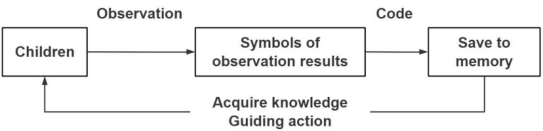
(Lin,Chen and Zhang, 2021). Learning behavior guidance design is to acti- vely guide the learning behavior of the target subject through design. The study of behavior guidance is mainly in the fields of behaviorism psychology and behavior design. Behavioral psychology developed again in the 1970s, producing the social learning theory represented by Albert Bandura, and putting forward the widely used learning method in observational learning (Zhang, 2003), that is, learners first use observation to obtain the symbols of demonstration activities, then code in the form of semantics, then store them in the memory, and finally, guide future actions.
Through field study, in outdoor study activities, children learn by obse- rving and exploring the surrounding environment and listening to the tea- cher’s explanation. According to Albert Bandura’s theory of social learning, combined with the situation of children in outdoor study activities, it is concluded that children in study activities, by generating the behavior of obse- rvation learning objects, convert their observation results into symbols, and code and store them in their own memory, So as to provide guidance in future theoretical practice or when observing and learning again (see Figure 1). It can be said that observation plays a key role in the whole learning process of children. Without the generation of observation behavior, the learning process cannot be completed.
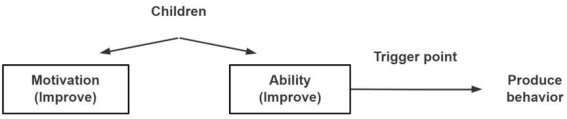
People’s research on the psychology of target subjects has gradually deve- loped from understanding human behavior to guiding human behavior, thus forming behavioral design. Professor B.J. Fogg, one of the founders of beh- avioral design, proposed the Fogg Behavior Model (FBM) to understand human behavior (Zhang and Zhou, 2018). The model shows that a person can produce a certain behavior only when he/she meets the three factors of motivation, ability and trigger point. According to the FBM theory, combi- ned with the situation of children in outdoor study activities, the observation behavior process of children in study activities is obtained. Children need to have observation motivation, observation ability and trigger points to stimu- late their interest in observation at the same time to produce the observation behavior process (see Figure 2). If you want children to have positive and
Figure 1: Children’s learning style (self-drawn by the author).Figure 2: Children’s observation behavior process (self-drawn by the author).
Design Strategy of Digital Outdoor Study Manual 397
effective learning behaviors, in the process of observing behaviors, you need to focus on three aspects: improving observation motivation, improving chil- dren’s own observation ability and effectively stimulating the trigger points of observation interest, and guide or change children’s observation behaviors or attitudes through the design of study manuals.
INFLUENCING FACTORS OF WILLINGNESS TO USE In order to explore the influencing factors of children’s willingness to use the digital outdoor study manual, reference the previous maturity scale, use the Likert 5 subscale, develop the evaluation scale and distribute the question- naire (see Table 1). The object of this study is a group of children. Parents assisted the children to fill in the questionnaire, and used the online questi- onnaire to collect data. A total of 198 questionnaires were collected. After eliminating the invalid questionnaires, 167 valid questionnaires were finally obtained, with an effective recovery rate of about 84.0%, which is in line with the predetermined sample size.
Reliability and Validity Analysis Reliability is an indicator to test the accuracy of the measurement results of the scale in the questionnaire(Cheng et al. 2021). Reliability test is conducted by calculating the value of Cronbach’s Alpha coefficient. The results show that the Cronbach’s Alpha coefficient of the scale as a whole is 0.961, greater than 0.9, which indicates that the reliability quality of the study data is high and can be used for further analysis. Validity is an indicator of the energy efficiency of each item. Through data analysis, the KMO is 0.945, and the significance is 0.000. The design method of each observation variable in the study is derived from the mature scale that has been verified by predecessors, so it can be considered that the questionnaire has good validity (see Table 2).
Multivariate Linear Regression Analysis The data were analyzed by multivariate linear regression. The independent variables were: performance expectancy, effort expectancy, social influen, perceived trust, perceived usefulness, perceived ease of use, perceived ple- asure, and self-efficacy; Dependent variable: willingness to use. According to the calculation results (see Table 3). The eight variables can explain 72.3% of the change degree of the dependent variable, and the model fit is 72.3%>50%. Its linear regression model is significant, F = 51.541, P<0.05, indicating that at least one of the eight independent variables can signifi- cantly affect the dependent variable. Among the eight independent variables, the Sig.<0.05 of the five independent variables of performance expectancy, perceived usefulness, perceived ease of use, perceived pleasure and self- efficacy showed that it could significantly affect the dependent variables; The influence coefficients of the five independent variables are all greater than 0, indicating a significant positive impact on the dependent variable; There is no multicollinearity between the two independent variables, and the VIF is less than 5, which indicates that the calculation result is accurate and reliable; The regression equation between the independent variable and the dependent variable is: willingness to use = 0.068 + 0.144 ×performance
Table 1. Questionnaire on influencing factors of children’s willingness to use digital outdoor study manual (the table made by the author).
Table available in the original PDF paper.
Dimension Subject Source literature Performance Expectancy Modified from (Wu and Wu, 2019; Venkatesh et al., 2003) Using the digital study manual can help me gain more knowledge in my study activities. Using the digital study manual can enhance my skills in using new technologies and equipment. Using the digital study manual will help to improve the efficiency of my observation and learning.
Effort Expectancy
Modified from (Wu and Wu, 2019; Venkatesh et al., 2003)
I hope that the digital study manual is simple and easy to operate. I hope it doesn’t take much time and energy to learn how to use the digital study manual. I am well aware of the function of the digital study manual and use it selectively.
Social Influen There are teachers and classmates around me who have used digital study manuals. If my classmates and teachers recommend using the digital study manual, I will also use it. The publicity and promotion of study activities can promote my use of digital study manuals.
Modified from (Madigan et al., 2016; Panagiotopoulos and Dimitrako- poulos, 2018) Perceived trust
I believe that the digital study manual can be a good helper for me to learn knowledge. I believe that the digital study manual will be continuously improved and upgraded. I trust the safety of using digital study manuals.
Modified from (Panagiotopou- los and Dimitrakopou- los, 2018) Perceived usefulness
I think the digital handbook will improve my learning efficiency. I think the digital study manual will help me to observe and learn.
Modified from (Panagiotopou- los and Dimitrakopou- los, 2018) Perceived ease of use
Modified from (Wu et al., 2019)
I think it’s easy to learn the digital study manual. My interaction with the digital study manual is clear and easy to understand. I think it will be very simple to use the digital study manual for learning.
Perceived pleasure
Modified from (Venkatesh et al., 2012)
I feel relaxed and happy in the process of using the digital study manual. I can use the digital study manual to bring me more fun. Using the digital study manual can make me feel satisfied.
Modified from (Ramayah and Aafaqi, 2004)
Self - efficacy I am confident to make good use of the functions of the digital study manual. I can skillfully use the digital study manual. I solve my study problems independently by using the digital study manual, which makes me feel very fulfilled.
Willingness to use
Modified from (Venkatesh et al., 2003)
I am willing to learn how to use the digital study manual. I am willing to try to use the digital study manual. I would recommend the use of digital study manuals to others. I will use more digital study manuals in the future.
expectancy + 0.171 × perceived usefulness + 0.189 × perceived ease of use × 0.195 × perceived pleasure + 0.325 × self-efficacy. That is, the higher children’s performance expectancy, perceived usefulness, perceived ease of use, perceived pleasure and self-efficacy, the higher children’s willingness to use.
Design Strategy of Digital Outdoor Study Manual 399
Table 2. Test results of reliability and validity (the table made by the author).
Table available in the original PDF paper.
Dimension Cronbach’s Alpha Number of terms Performance Expectancy 0.787 3 Effort Expectancy 0.709 3 Social Influen 0.715 3 Perceived trust 0.814 3 Perceived usefulness 0.838 2 Perceived ease of use 0.831 3 Perceived pleasure 0.882 3 Self - efficacy 0.851 3 Willingness to use 0.914 4 Entirety 0.961 27 KMO 0.945 Significance 0.000
Table 3. Multivariate linear regression analysis results (the table made by the author).
The above results show that children’s performance performance expe- ctancy, perceived usefulness, perceived ease of use, perceived pleasure and self-efficacy need to be improved if they want to improve their willingness to use the digital outdoor study manual. It means that for the design of digital outdoor study manuals, children need to feel that digital outdoor study manu- als are more effective than traditional paper manuals; More useful in use; It is easier to use in the process of use; More pleasant in use; Be more confident in the use process, so as to improve children’s willingness to use the digital outdoor study manual, and better assist children’s observation and learning in study activities.
Design Strategy of Digital Outdoor Study Manual to Guide Children’s Learning Behavior There are three main reasons why children need digital outdoor study manu- als to guide children’s learning behavior in outdoor study activities: children’s
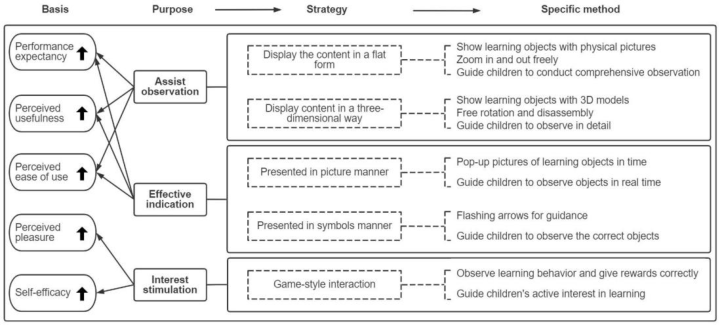
visual area is limited (Zhang, 2020), and the observation of learning objects is not easy or comprehensive due to their own factors and environmental factors during the activities, and the design of the manual needs to help children bet- ter observe learning objects; Children can’t capture the object of the teacher in time or accurately, and the manual design needs to show the object of the tea- cher to children in time; Children are not focused enough (Shan and Cheng, 2016) and are easily affected by the surrounding environment. The design of the manual needs to stimulate children’s interest in learning. Through the above three aspects of digital manual design, children’s willingness to use the manual can be improved, and at the same time, children’s observation beh- avior can be positively guided, so that children can have positive learning behavior, and children can obtain effective and experiential learning in out- door study activities. To this end, the corresponding design strategies will be proposed through the above three aspects (see Figure 3).
This design strategy is based on five aspects of improving children’s per- formance expectancy, perceived usefulness, perceived ease of use, perceived pleasure and self-efficacy, so as to improve children’s willingness to use the manual, that is, the manual design achieves effective auxiliary observation and effective indication, so that children feel that the digital outdoor study manual is more effective, useful and easy to use than the traditional paper manual, thus improving performance expectancy, Perceived usefulness and perceived ease of use; The manual is designed to achieve effective interest sti- mulation, make children happier and more confident in the use process, and then improve their sense of perceived pleasure and self-efficacy.
Objective to assist observation, effective indication and interest stimula- tion. The first is to assist children in observation, scan paper manuals through mobile phones and other electronic products, adopt the design method of flat display content and three-dimensional display content, so that children can observe the physical picture or 3D model presented by digital AR technology, and zoom in, zoom out or rotate in the electronic device as needed, so as to make up for the situation that children can not see the learning object in out- door study activities, Guide children to actively observe learning behavior;
Figure 3: Design strategy of digital outdoor study manual (self-drawn by the author).
Design Strategy of Digital Outdoor Study Manual 401
The second is to effectively prompt children to observe, present in the form of pictures and symbols manner, and timely pop up the picture of the learning object or flashing arrows and other symbols through digital AR technology to remind children of the learning object they need to observe at present, and guide real-time and accurate observation objects; The third is to stimu- late children’s interest in learning, using game-style interaction, and digital AR technology to present interactive small games. Whenever children’s obse- rvation and learning behavior is correct, awards, such as virtual trophies, will be issued in time to guide children to observe and learn more actively, improve children’s learning efficiency, and promote the effective development of outdoor study activities.
CONCLUSION
With the rapid development of outdoor study activities in which children participate, in order to meet children’s observation and learning needs in the activities, it is necessary to combine digital technology with paper manuals, so that the design of digital outdoor study manuals can effectively assist chil- dren’s learning. According to relevant theories and children’s situations in outdoor study, this paper analyzes and summarizes children’s learning style and children’s observation behavior process, and through the analysis of que- stionnaire data, obtains the influencing factors of children’s willingness to use the digital outdoor study manual, and finally develops the design strategy of the digital outdoor study manual, which aims to help children gain better experiential learning in the process of outdoor study. The design strategy proposed in this paper needs to be improved through design practice. In the follow-up study, it will be put into practice for in-depth study and analysis.
REFERENCES
Cheng, Y. X. Zhang, X. Y. Wang, Z. X. Song, X. P. and Yang, Z. G. (2021). Construction and Empirical Research of an Influence Model for the Users’ Intention to Use the Self-Service of University Library. Research on Library Science (23), pp. 58–71. Fornell C, Larcker D F. (1981). Structural Equation Models with Unobservable
Variables and Measurement Error: Algebra and Statistics. Journal of Marketing Research (JMR)18 (1). pp. 39–50. I. Panagiotopoulos and G. Dimitrakopoulos. (2018). “An empirical investigation on consumers’ intentions towards autonomous driving,” Transportation Research Part C: Emerging Tech-nologies, vol. 95, pp. 773–784. J. Wu, H. Liao, J.-W. Wang, and T. Chen. (2019). “The role of environmen-
tal concern in the public acceptance of autonomous electric vehicles: a survey from China,” Transportation Research Part F: Traffic Psychology and Behaviour, vol. 60, pp. 37–46. Jiang, Y. X. (2019). Study on the Dilemma and Countermeasures of the Implementation of Research Travel in Primary and Middle Schools. Northeast Normal University. Lin, N. Chen, L. S. Zhang, J. W. (2021). Research on the application of behavior
guidance in children’s product design. Design. 34(16). pp. 17–19.
R. Madigan, T. Louw, M. Dziennus et al. (2016). “Acceptance of automated road transport systems (ARTS): an adaptation of the UTAUT model,” Transportation Research Procedia, vol. 14, pp. 2217–2226. Ramayah T, Aafaqi B. (2004). Role of Self–Efficacy in E–Library Usage Among
Students of a Public University in Malaysia. Malaysian Journal of Library and Information Science. 9(1). pp. 39–57. Shan, K. L. Cheng, Y. S. (2016). On the Thinking of Children’s Behavioral Psychology on Building Design. The Guide of Science & Education. (28). pp. 145–146. V. Venkatesh, J. Y. Thong, and X. Xu. (2012). “Consumer acceptance and use of
information technology: extending the unified theory of acceptance and use of technology,” MIS Quarterly, vol. 36, no. 1, pp. 157–178. Venkatesh V, Morris M, Davis G, et al. (2003). User Acceptance of Information Technology: Toward a Unified View. MIS Quarterly. 27(3). pp. 425–478. Wang, X. L. Hu, Y. K. (2016). A new form of children’s book design under the care
of AR technology. Publishing Research (05). pp. 48–50. Wu, C. G. Wu, P. Y. (2019). Investigating User Continuance Intention Toward Library Self–Service Technology. Library Hi Tech. 37(3). pp. 401–417. Zhang, H. C. (2003). Behaviorism psychology. Hangzhou: Zhejiang Education
Publishing House. Zhang, L. F. Zhou, Y. Q. (2018). Fogg behavior model in internet product design. Packaging Engineering. 39(04). pp. 159–163. Zhang, X. (2020). Research on interior space environment design based on the theory
of children’s behavior psychology. Dalian Polytechnic University.
LISTED IN THE AHFE DIGITAL BOOKSTORE CATALOGUE
Explore the complete digital volume
Ergonomics In Design
Read this individual research paper free through the original publisher, or explore the full digital proceedings book.
ISBN 978-1-958651-53-7
Explore this ISBN in the AHFE Bookstore ↗Listed in the July 2026 bookstore catalogue; search by ISBN to confirm current availability · Digital book purchase optional