Jianan Liu, Yichen Wu (2023). Digital Service Design Based on Social Welfare - Taking Pet shelter as an Example. In: Ergonomics In Design. AHFE Open Access, vol. 77, pp. 73–82. https://doi.org/10.54941/ahfe1003364
Most pet shelters are organizations established in the name of individuals or a few people out of love. PETA is a pet adoption system based on the shelter scenario, aiming to use digital means to reduce the burden of shelters in information management and dissemination, call for more people to accept pet adoption, and alleviate the social problem of stray pets to a certain extent. This study uses a mixed method of questionnaires, field observations, and semi-structured interviews to understand better shelters' real-life dilemmas and adopters' concerns. The final design results are presented through user needs summarization, design strategy refinement, and functional framework sorting.
Under the influence of the epidemic (COVID-19), data on stray pets (mainly cats and dogs) are on the rise worldwide. According to incomplete statistics, there are at least 600 million stray pets worldwide. Among them, the num- ber of stray pets in China accounts for about 50 million, which is increasing. Their sources are mainly abandonment by breeders, wild breeding, etc. Stray pets bring a series of problems to a society, ranging from small aggressive behaviors, nuisance, and impact on urban hygiene to large ecological imba- lances and epidemics. Therefore, it is urgent to alleviate the problem of stray pets (Hua, 2021; Campanilla et al. 2022).
Current means of controlling the number of stray pets include the ena- ctment of regulations, registration of pet and breeder status, additional taxes, education and guidance for breeders, promotion of spay/neuter programs, centralized collection and rescue of pets after straying; the remaining few also include harsh treatments such as euthanasia and shooting. Depending on the nature of the organizations, they can be divided into government departments, animal shelters, voluntary public interest groups, and indivi- dual breeders (Tasker, 2007). Among them, as self-initiated public welfare organizations, pet rescue shelters take up part of the social responsibility - rescuing and adopting these stray pets and helping them find adopters as much as possible. However, it is difficult to maintain the status quo effecti- vely in the long term due to the limitations of the person in charge’s own
time, energy, and financial level (Hoy-Gerlach et al. 2021). At the same time, based on the soundness of China’s legal policies and the current development of shelters, the lack of professional security and extra support makes it dif- ficult for these spontaneous private charity organizations to survive (Hua, 2021). On the one hand, rescue shelters have poor experience managing and disseminating information about supplies and pets. On the other hand, most adopters have low acceptance and trust in the adoption channel and even give up adoption midway for reasons such as expectation bias, channel reliability, pet health, and breed (Frank and Carlisle-Frank, 2008; Neidhart and Boyd, 2002; Shore, 2005; Hawes et al. 2020). PETA is a digital adoption service design based on a rescue shelter scenario. We aim to alleviate the problem of stray pets and use the digital transforma- tion of the adoption process to build a public welfare-oriented pet adoption system for pet shelters on a specific scale. This paper will be divided into five parts. The second part summarizes the relevant concepts and definitions. The third part outlines the mixed research steps of quantitative and qualitative research. The fourth part details the design scheme and the main functional overview. In the end, we highlight the study’s conclusions and its limitations.
LITERATURE REVIEW
Digital Services for Pet Adoption Service design is an approach that intersects disciplines. This interdisciplinary practice incorporates many skills from design, management, and engineering (Zeng, 2018). It is a full-link design of systems and processes, aiming to cre- ate a comprehensive experience for users (Lynn Shostack, 1982). As one of the means to improve organizational productivity and ensure overall image and service quality (Barrett et al. 2015), digital services can largely allevi- ate the problems of information management, resource allocation, and trust establishment at shelters, and can In the future, it is expected to become a breakthrough point for business model innovation in China’s pet industry.
The current digital design of pet adoption mainly focuses on the early and middle stages of the adoption process. (Wu et al. 2022) tried to opti- mize the current social assistance system for stray animals through technical means (big data, artificial intelligence, etc.). (Allison, 2019) created an app where adopters can match pets according to their preferences, with the aim of simplifying the adoption process and providing more convenience for stray animals. (Da, 2022) Adding an AI virtual pet module to a pet adoption app can allow users to assess raising risks and challenges in advance. In addition to focusing on the service experience before and at the time of ado- ption, post-adoption pet retention and the cultivation of the breeder’s sense of responsibility are equally important (Neidhart and Boyd, 2002; Hawes et al. 2020). At the same time, digital adoption services usually include the following characteristics: channels are relatively scattered and lack credibi- lity (mainly attached to small programs or mainstream social platforms for information dissemination), adopters worry about information security and pet health, etc. (Da, 2022; Campanilla et al. 2022).
Digital Service Design Based on Social Welfare - Taking Pet Shelter 75
Concepts Related to Social Welfare Social welfare generally refers to the interests and well-being that citizens can enjoy. The free contribution made by the shelter to stray pets is an essential manifestation of the continuous advancement of public welfare undertakings. These are not only about the survival of stray pets but also closely related to the development of the human world (Campanilla et al. 2022). Moreover, this kind of public welfare behavior connects people and organizations from all walks of life (including pet lovers, volunteers, pet hospitals, pet shops, etc.) to form a close network of relationships, which lays the foundation for the reliability of the adoption process. Therefore, the intervention of a third-party platform to help the digital transformation of pet shelters, on the one hand, reduces the actual burden on the person in charge of the base and expands the public welfare influence of the shelters; The spread and deepening of the concept of adoption.
METHODOLOGY
The focus of this paper is to develop a digital adoption service system based on social welfare, taking the pet shelter as an example. Before that, it is necessary to obtain user needs and feedback in this scenario. First, the que- stionnaire survey was used as the first step of the research to understand people’s views on pets. Secondly, this article uses natural observation and semi-structured interviews as the primary method to conduct in-depth under- standing with relevant professionals and determines the adoption scenarios and problems centered on pet shelters. The third step is to use the case analy- sis method to summarize and sort out the functions of some representative solutions. Finally, based on the previous research, this paper puts forward the service design strategy of pet adoption in the shelter scenario and shows the final solution and design concept in combination with the relevant tools of interaction design and service design. (As shown in Table 1) Questionnaire
In this survey, a total of 295 questionnaires were distributed through the online platform, screened according to the answering time and the identity
Table 1. Research steps.
Table available in the original PDF paper.
Phase Method Content Research Questionnaire Survey Understanding the basic situation of pet keeping Natural observation Collecting user needs of shelters and adopters Interview Case study Analyze the functions of existing adoption platforms Design Interaction design and service design tools
Propose design strategies and specific functions
76 Liu and Wu
Figure 1: Some results from the questionnaire.
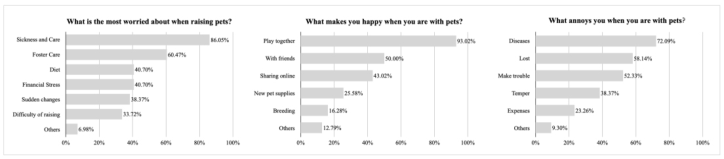
of the breeder, and finally determined that the number of valid questionnai- res was 244. The results show (as shown in Figure 1) that female breeders account for a large proportion (about 73%), mainly young people aged 18– 25 (about 81%), and the average monthly expenditure of pets is basically between 0–600 yuan (about 92%), and less than 1% are above 1,000 yuan. Sickness and nursing care (about 86%) and foster care (about 60%) are the two areas that breeders worry about the most. Disease (about 72%), loss (about 58%), and training (about 52%) are the main factors that annoy breeders. Playing with pets (about 93%), petting pets with friends (about 50%), and sharing pet content on social platforms (about 43%) are the main behaviors that make breeders happy.
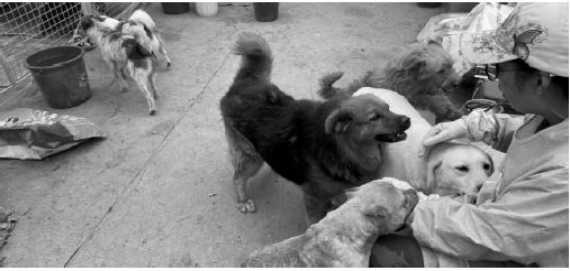
Field Trips Naturalistic observations and interviews aim to deepen understanding of user needs. We visited 8 pet institutions (including 2 shelters, 3 pet stores, and 3 pet hospitals), conducted on-site inspections and semi-structured interviews with professionals and relevant persons in charge (from personal basic infor- mation, institution operations, situation of breeder or customer, etc.), make a brief record with the consent of the interviewee in advance, and convert it into design keywords. Only some of the statements are shown in the text (as shown in Figure 2 and Table 2). It can be seen that the main reasons why users hold negative attitudes towards keeping pets or adopting pets include concerns about pet health, lack of online services, low credibility of the plat- form, and ambiguity in the adoption process. The existing problems of the shelters include inconvenient information management, troublesome regular return visits, and low success rate of adoption. According to the interviewee’s point of view, if we want to really reduce the number of stray pets and reduce the burden on rescue agencies, we need to start from the root cause (such as: the improvement of national laws, the attention of local governments, etc.). From the perspective of service design strategy, improving the quality of bre- eders, and doing a good job of disease prevention and health protection in the early stage of raising pets are important means to alleviate the problem of stray pets.
Case Analysis We conduct functional analysis on four online products related to pet ado- ption and use this as the basis for subsequent design practice. (As shown in Table 3) It is worth learning that. First, some platforms use the method
Digital Service Design Based on Social Welfare - Taking Pet Shelter 77
Figure 2: Current status of shelters.Table 2. Some oral materials and keyword extraction.
Table available in the original PDF paper.
Institution Original oral presentation Keywords Quality education for the breeders Corner Pet Store “Breeders themselves should be highly educated in order for pets to have a healthier living environment”
April Pet Clinic “Vaccinations and antibody testing are best done in the early stages” Knowledge of breeding
Good prevention and protection work Hui Jia Pet Hospital “There are many categories and brands of food, so breeders don’t know how to choose, and some products with good reputation may not be suitable for their pets” Rejection of abandonment
Daily management of pets Lapin Coco Pet Store “Since the abandonment rate is getting increasingly high, creating a vicious cycle, I want every pet to have a good home” NOVA PETS “Too many pet stores, imperfect online platform, less services” Lack of online services Pet International Animal Hospital
Concern for pet health
“Some customers abandoned their pets because the cost of disease treatment was too expensive”
Low credibility of the platform Low adoption success rate (related to the complexity and ambiguity of the adoption process) Information management
Simida shelter “in each platform we have released adoption information, but few people really come to adopt, people’s awareness of adoption or breeding awareness is not mature, which is also related to national policy” “To adopt, adopters need to sign an agreement and submit your personal information and part of the deposit, which will be refunded after a few months”
Regular return visits
Cui’s Small Home “I’m not even too sure about the pets I adopt out, and I return to each pet on a regular interval”
of step donation to convert daily behaviors into real value (pet food, etc.), allowing everyone to participate in it; second, the adoption process is rela- tively complete, the display of pet information is relatively comprehensive,
78 Liu and Wu
Table 3. Functional analysis.
Table available in the original PDF paper.
and it is easy for adopters to understand the situation quickly. At the same time, the following problems were also found: 1. The functions are mainly concentrated before and during adoption, and there are almost no functions after adoption; 2. After adoption, users are scattered, unable to form com- munity communication, and lack stickiness; 3. Lack of incentive mechanism; currently only taking pictures. Check-in is mainly used for follow-up visits to shelters; 4. Pet information display is relatively simple, with only graphic introductions; 5. Shelters cannot efficiently manage pet information and item resources.
SOLUTION Design Strategy and Concept
PETA is a real-name mobile application integrating pet adoption and pro- tection. Through design strategies such as the binding mechanism of pet identity, the growth mechanism of breeders, and the road to pet cultivation (as shown in Table 4), as well as the assistance of nose print recognition tech- nology, the reliability of the adoption system is guaranteed in an all-round
Digital Service Design Based on Social Welfare - Taking Pet Shelter 79
Table 4. Problems and corresponding design strategies.
Table available in the original PDF paper.
User Problem or Need Design Strategy Breeder Quality training and improvement Guiding users to become qualified breeders through growth mechanism. Prevention and protection
Cooperate with various brands to introduce privileged services in food, care and clothing etc. and release general knowledge on breeding from time to time. Daily management Remind the key time of vaccination, deworming, washing and care, and manage and supervise various physical indicators of pets; and record and share daily clips of pets. Few post-adoption services
Establishing a full-chain pet adoption and protection platform Low community cohesion and lack of stickiness
Establishing circles through common points such as the same breed and the same region; then motivating users to use the software through mechanisms such as points, medals and service exchange. shelter Low adoption success rate
All information and processes are transferred to online.
Adoption process is more standardized and transparent through human-pet identity binding and digital agreement; at the same time, public welfare activities are released through the platform to expand influence. Management of information and resources Set up an adoption adaptation period, identity transfer and other functions to guarantee the belonging of pets.
Worry about the possibility of pets being abandoned again
way. While helping the adopter become a qualified breeder also provides a healthy and safe growth environment for pets. At the same time, the modified design makes up for the lack of design of the existing adoption platform at the shelter and helps the digital transformation of the shelter service.
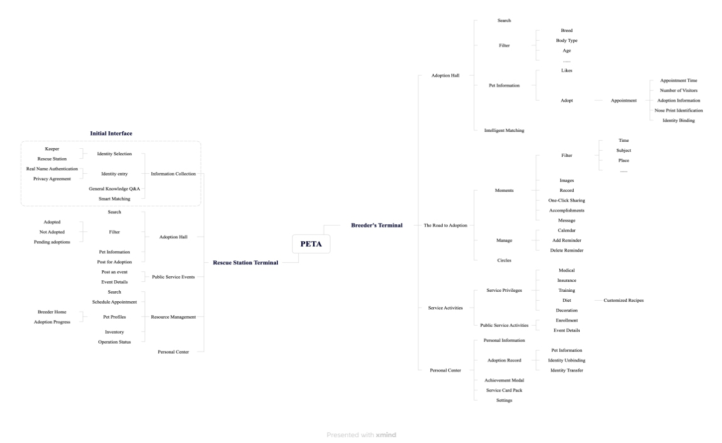
Main Function Introduction PETA is mainly divided into shelter terminal and breeder terminal(as shown in Figure 3). Before entering the application, the user needs to choose an identity to enter different interface terminals. When registering, users must complete their personal information, perform real-name authentication, and pass common sense questions and answers related to pet raising to ensure they have the essential ability to raise pets. In order to help some users who do not know what kind of pet to adopt, PETA provides an intelligent matching function. It can match the corresponding pets through the basic information, personal preferences, and needs of the adopters, reducing their
80 Liu and Wu
Figure 3: Information frame.
decision-making time. After entering the official interface, the bottom navi- gation bar is divided into four sections (Adoption Hall, Pet Raising Road, Service Activities, and Personal Center). The adoption hall is mainly respon- sible for various functional modules before and during adoption, helping users complete a series of operational tasks such as searching, viewing, con- firming, and making appointments. On the one hand, the road to raising pets is mainly responsible for recording and sharing the daily life of pets after ado- ption, which is convenient for later review and can meet other like-minded breeders; on the other hand, it is the reminder and management of critical events (such as deworming, bathing, Nursing, etc.), which is very necessary for some forgetful breeders. Service activities are divided into two sections. Service privileges refer to cooperation between shelters and businesses in the pet industry to launch commercial services or irregular benefits; public wel- fare activities mainly come from shelters (such as volunteer recruitment, love crowdfunding, material donations, etc.). The personal center includes basic information, adoption records, achievements, service card packs, and other primary content.
The shelter terminal is also divided into four major sections (adoption hall, public welfare activities, resource management, and personal center). The pri- mary function of the adoption hall is to check the adoption status and release the adoption information. Public welfare activities are mainly responsible for the release and recruitment of activities. Resource management includes pet files, appointment schedules for adopters, stock of materials in the base, operating conditions, etc. The personal center and the breeder terminal are basically the same.
Digital Service Design Based on Social Welfare - Taking Pet Shelter 81
Figure 4: Business canvas.
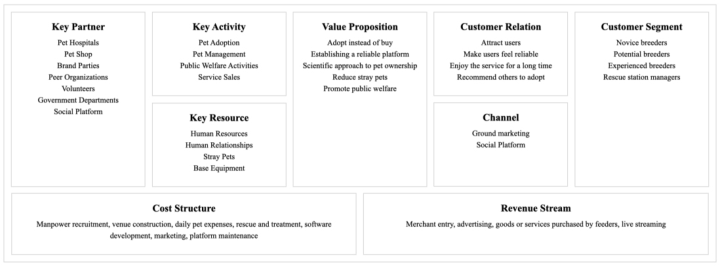
Business Model Through in-depth research and insight into the pet shelter, this paper also conceives its future development direction and business model (as shown in Figure 4). The short-term plan is to spread the concept of adoption as the guide, expand the influence of the shelter, and realize the digital tran- sformation of the adoption process (essential functions are prioritized). The long-term plan is to extend the service of shelters to pet hospitals, pet stores, and other industry scenarios, increase the breadth and depth of cooperation, promote win-win results for all parties, and alleviate the social problems of stray pets to a certain extent. During the interview, one person in charge of the shelter mentioned that because the shelter is located in a suburban area, he had thought of developing this place into a group building activity base or an outdoor activity place and launched a series of pet-related services. This one is a long-term, high-quality idea, but it still requires the joint efforts of all members of society to realize the excellent vision step by step.
CONCLUSION
The digital transformation of shelters has certain challenges related to com- plex factors such as laws, policies, and social concepts. Based on social welfare, PETA seeks digital solutions for adoption services for shelters, a small step toward alleviating the problem of stray pets. Its innovations are mainly reflected in the: first, it emphasizes the insight into the actual needs of the shelter and provides design for this, and this applies to all similar insti- tutions; second, it strengthens the focus on the needs of the breeders after adoption, and for this purpose Provide a series of guarantee services and mea- sures. On the one hand, PETA can guarantee and strengthen the reliability of the adoption system, reduce the actual burden on relief stations, expand the social influence of relief stations, and appeal to more people to accept the new concept of adoption; on the other hand, it can help public welfare undertakings with the power of design, It is an essential manifestation of the designer’s sense of social responsibility. In addition, due to the limitations of objective conditions, the project has not yet been implemented on a large
82 Liu and Wu
scale in usability testing, and only a small number of users are open to pro- totype testing, which needs to be supplemented in follow-up research. At the same time, the interaction design details of some interfaces still need to be improved.
ACKNOWLEDGEMENTS
Thanks to everyone who took part in the research, and especially thanks to pet shelters for their cooperation.
REFERENCES
Allison, H. (2019). # PawnderAdoption Creating a Public Relations Campaign to Increase Adoption Rates Among Shelters in the United States. Barrett, M. Davidson, E. Prabhu, J. and Vargo, S. L. (2015). Service innovation in the
digital age. MIS quarterly, 39(1), 135–154. Campanilla, B. S. Etcuban, J. O. Maghanoy, A. P. Nacua, P. A. P. and Galamiton, N. S.
(2022). Pet Adoption App To Free Animal Shelters. Journal of Positive School Psychology, 6(8), 5993–6006. Da, W. H. (2022). AI pet technology applied to the design research of pet adoption app. Electronic Testing (09), 115–118. Frank, J. M. and Carlisle-Frank, P. (2008). Attitudes and perceptions regarding pet
adoption. Foundation for Interdisciplinary Research and Education 1, 19. Hawes, S. M. Kerrigan, J. M. Hupe, T. and Morris, K. N. (2020). Factors informing the return of adopted dogs and cats to an animal shelter. Animals, 10(9), 1573. Hoy-Gerlach, J. Ojha, M. and Arkow, P. (2021). Social workers in animal shelters:
a strategy toward reducing occupational stress among animal shelter workers. Frontiers in Veterinary Science, 8, 734396. Hua, Z. (2021). The Study of Two Competitive Firms in the Online Pet Industry and a Business Proposal Solving Stray Pet Issue in China. In 2021 12th Interna- tional Conference on E-Education, E-Business, E-Management, and E-Learning (pp. 348–354). Lynn Shostack, G. (1982). How to design a service. European journal of Marketing,
16(1), 49–63. Neidhart, L. and Boyd, R. (2002). Companion animal adoption study. Journal of Applied Animal Welfare Science, 5(3), 175–192. Shore, E. R. (2005). Returning a recently adopted companion animal: adopters’
reasons for and reactions to the failed adoption experience. Journal of Applied Animal Welfare Science, 8(3), 187–198. Tasker, L. (2007). Stray animal control practices (Europe). WSPA and RSPCA Report,
584. Wu, L. F. Shao, M. H. Wei, S. Q. Lu, R. X. and Huang, B. D. (2022). Widespread of Stray Animals: Design a Technological Solution to Help Build a Rescue System for Stray Animals. In HCI International 2022–Late Breaking Papers: HCI for Today’s Community and Economy: 24th International Conference on Human-Computer Interaction, HCII 2022, Virtual Event, June 26–July 1, 2022, Proceedings (pp. 376–396). Cham: Springer Nature Switzerland. Zeng, D. (2018). Application of service blueprint method in the design of children’s smart photo products. https://kns.cnki.net/KCMS/detail/detail.aspx? dbname=CMFD201901&filename=1018877639.nh
LISTED IN THE AHFE DIGITAL BOOKSTORE CATALOGUE
Explore the complete digital volume
Ergonomics In Design
Read this individual research paper free through the original publisher, or explore the full digital proceedings book.
ISBN 978-1-958651-53-7
Explore this ISBN in the AHFE Bookstore ↗Listed in the July 2026 bookstore catalogue; search by ISBN to confirm current availability · Digital book purchase optional