Claas Digmayer, Nina Rußkamp, Eva-Maria Jakobs (2023). The Customer Experience of Energy Services. In: Human Factors in Software and Systems Engineering. AHFE Open Access, vol. 94, pp. 145–155. https://doi.org/10.54941/ahfe1003780
Climate protection and the limited availability of conventional energy sources have led to efforts to facilitate a transition to renewable sources. This trend also changes the way in which electricity is consumed and distributed: Recently, end-users have taken an increasingly active role in the electrical power system that enables a collective form of energy self-consumption and sharing - so-called ‘energy communities’ [1]. In these communities, energy is generated with solar or wind technologies and distributed between members using local grids and community battery storages.The diffusion of energy communities on a large scale could provide advantages such as increasing customers’ electricity savings, electricity suppliers' sales, and grid operators' revenues due to reduced grid tariffs for inner-community electricity transfer [2]. A barrier to a large-scale rollout is the fact that energy often remains invisible to most citizens and is merely perceived in terms of ‘energy services’ ("[…] functions performed using energy which are means to obtain or facilitate desired end services or states" [3]). This focus on energy services can give rise to a wide range of information needs but also to different attitudes in the evaluation of energy communities from the perspective of potential customers. Therefore, it is necessary to analyze whether companies address such requirements in order to establish a positive customer experience.In this study, the topic is operationalized through three research questions:Communication from the company's point of view: How are energy communities advertised by companies that support customers in implementing them? Information needs from the customer's perspective: What do potential customers want to know about energy communities?The questions are examined in a comparative analysis based on text mining methods. For this purpose, data were collected from two types of sources: Comments from social media addressing energy communities and promotional in which companies communicate energy communities to potential customers. Both data sets were analyzed with regard to the research questions.The results show a mismatch between what customers want to know about energy communities and what companies communicate about such forms of energy production and distribution. In particular, risks perceived by potential customers (such as concerns about the equitable distribution of energy) are hardly addressed. By resolving such mismatches, the diffusion of energy communities could be accelerated. The results are discussed in terms of possible measures to enhance the customer experience.References[1] Iazzolino, G./Sorrentino, N./Menniti, D./Pinnarelli, A./De Carolis, M./ Mendicino, L. (2022). Energy communities and key features emerged from business models review.Energy Policy, 165. https://doi.org/10.1016/j.enpol.2022.112929.[2] Fina, B./Monsberger, C./Auer, H. (2022). A framework to estimate the large-scale impacts of energy community roll-out. Heliyon, 8 (7). https://doi.org/10.1016/j.heliyon.2022.e09905.[3] Fell, M. J. (2017). Energy services: A conceptual review. Energy Research & Social Science, 27, 129–140. https://doi.org/10.1016/j.erss.2017.02.010
Climate protection and the limited availability of conventional energy sou- rces have led to efforts in facilitating a transition to renewable sources. This trend also changes the way in which electricity is consumed and distributed: Recently, end-users have taken an increasingly active role in the electrical power system that enables a collective form of energy self-consumption and sharing - so called ‘energy communities’ (Iazzolino et al., 2022). In these com- munities, energy is generated with solar or wind technologies and distributed between members using local grids and community battery-storages.
The diffusion of energy communities on a large scale could provide advan- tages such as increasing customers’ electricity savings, electricity suppliers’ sales, and grid operators’ revenues due to reduced grid tariffs for inner- community electricity transfer (Fina et al., 2022). A barrier to a large-scale rollout is the fact that energy often remains invisible to most citizens and is merely perceived in terms of ‘energy services’ (“[…] functions performed using energy which are means to obtain or facilitate desired end services or states” (Fell, 2017)). This focus on energy services can give rise to a wide range of information needs but also to different attitudes in the evaluation of energy communities from the perspective of potential customers. Therefore,
it is necessary to analyze whether companies address such requirements in order to establish a positive customer experience.
In this study, the topic is operationalized through three research questions:
Communication from the company’s point of view: Which stages and related information needs are addressed in articles and promotional materials?
Information needs from the customer’s perspective: What do potential customers want to know about energy communities?
The questions are examined in a comparative analysis based on text mining methods. For this purpose, data were collected from to types of sources: Com- ments from social media addressing energy communities and promotional in which companies communicate energy communities to potential customers. Both data sets were analyzed with regard to the research questions.
DEVELOPING THEORETICAL BACKGROUND In the following, the theoretical background relevant for this study is sum- marized. In particular, insights on customer experience and on energy communities are described.
Customer Experience Customer experience (CX) refers to the overall impression a customer has with a company and its products or services. Kokins et al. (2021) summa- rize definitions of CX that are usually used in the literature – according to them, innovations developed with CX in mind aim to create and improve the customer-value proposition of the customer journey by focusing on the touchpoints of direct and indirect interaction between the customer and orga- nization. As the meaning of value is subject to the personal perception of customers, co-creation aspects and customer-journey focused thinking are of relevance for companies that seek to promote CX. The concept of CX connects three core aspects (Keyser et al., 2020):
Touchpoints: the individual contacts between a company and customers across the customer journey that serve purposes such as information gathering, payment, or usage,
Contexts: the ‘conditional state that determines the resources a person can directly and indirectly draw on at some point in time’ which embeds the interaction of customers with a company, and
Qualities: a set of distinctive attributes that reflect the nature of customer reactions to interactions with a company.
The touchpoints (online and offline) are examined at each individual stage necessary for a customer to arrive at a purchase decision – often referred to as ‘customer journey’ (Neslin, 2022). Recent studies emphasize the importance of sustainable products and services for CX; e.g., the customer’s personal values and beliefs with regard to achieving a more responsible and sustainable way of living in a circular economy (Guyader et al., 2022). Another way for citizens to improve their carbon footprint is the sustainable production and
The Customer Experience of Energy Services 147
use of energy – especially in collaboration with others in so-called energy communities.
Energy Communities The transition to sustainable energy production, self-sufficient energy systems, equitable energy distribution, and responsible energy consumption is imperative due to the numerous issues associated with conventional energy use and its impact on community well-being. In this context, energy infra- structure can be considered as “common goods” (Wolsink, 2018), offering a range of benefits that extend to the economy, society, and environment. These benefits include: affordable energy costs, new business opportunities in various sectors such as mobility and ICT, job creation in local communi- ties, increased social inclusivity across socioeconomic backgrounds, a sense of community, and reduced carbon emissions through the use of environ- mentally friendly technologies and lifestyles (Mihailova et al., 2022). The promotion of this transition requires efforts from both local authorities and residents, as outlined below.
Regarding top-down approaches, local authorities must establish a regula- tory framework that provides legal certainty while remaining flexible enough to not stifle technical advancements. Strategies for reducing CO2 in the buil- ding sector may include enforcing standards and policies, conducting impact assessments, adopting low-carbon technology, and limiting energy consum- ption. Instead of solely relying on prohibitions, motivators and incentives can also influence residents’ behavior. For example, in Norway, commercial and industrial customers are charged based on their highest monthly power demand, encouraging them to reduce their consumption for efficient grid utilization (Maldet et al., 2022). The municipality can also initiate measu- res such as legal or financial allowances, and business partners and fina- ncial stakeholders can provide support through R&D, product co-creation, risk-pooling, and investments (Mihailova et al., 2022).
Regarding bottom-up approaches, many successful projects initiated by residents have been reported in the literature, aimed at making communi- ties more sustainable and energy self-sufficient (Ruggiero et al., 2018). These grassroots innovations require community engagement, a shared vision of the community’s future, and aligned behavior (Ruggiero et al., 2018; Weigelt et al., 2021). Energy prosumer households not only consume, but also pro- duce and sell electricity (Kotilainen, 2019), which can be achieved through technologies like photovoltaic, battery storage, and DC microgrids. As the majority of prosumers are technically educated men (Hansen et al., 2022), measures that support and facilitate prosumer behavior in marginalized com- munities and households can contribute to social and energy justice (Ring et al., 2022).
Prosumer behavior is not limited to individual households and energy pro- sumers can form communities and sell their excess energy. Energy selling can take place through the main power grid or in micro-grids, virtual communi- ties, or peer-to-peer through technologies like blockchain (Kotilainen, 2019). Collective renewable energy prosumerism can form a social movement that
transforms the energy system (Wittmayer et al., 2022), leading to innovative energy policies and business models that enhance quality of life, create jobs, and promote sustainable communities (Ulgiati et al., 2019).
There are multiple obstacles that impede the shift towards energy-efficient communities. One of the main barriers is the lack of knowledge regarding alternative energy options and practices. According to a study by Guideh- ouse (2021), while 70% of residents are aware of low-cost energy-saving methods, such as switching to LED light bulbs, only 57% are aware of high- cost options like insulation. This figure is even lower in the commercial and industrial sectors, with 51% and 57% respectively.
There is a lack of analyses that address information needs at the various stages in the customer journey of energy communities. Do conduct such an analysis, a methodological approach based on text mining was used. The methods are described in the following.
METHODOLOGY
The investigation of information needs regarding the development of energy communities was conducted through an analysis of articles and user- generated comments posted on various internet forums, social media, and news portals. The data was collected by using Java scripts based on the Jsoup library, and stored as text files with each comment including the title, creation date, and source. The body of the data consist of 200 documents.
The first step in preparing the data involved tagging each comment for parts of speech using the spaCy library. This allowed for automated processing of the data. The next step involved annotating expressions of non-knowledge, insecurity, or uncertainty in the documents to identify know- ledge gaps and information needs. These terms include linguistic expressions that communicate non-knowledge, such as questions, modal words, word fields related to innovation, negations, and rhetorical figures (the process is described in (Digmayer, 2022)). These expressions were then used as search patterns on the tagged comments, resulting in a corpus of 3,739 matches and surrounding text.
The matches related to information needs regarding energy communities were analyzed qualitatively to identify common stages of the costumer jour- ney to energy communities and related information needs per stage that costumers usually face. The results are described in the following.
RESULTS
First, the customer journey is described as summarized in the articles of energy providers and interest groups. For each stage, the relevant informa- tion needs and touchpoints are described. Second, based on comments from social media, information needs as well as contexts and qualities are descri- bed that potential customers associate with this journey and that can be used to measure the CX.
The Customer journey from the perspective of companies and institutions: Customers go through different stages in their journey to becoming part of an
The Customer Experience of Energy Services 149
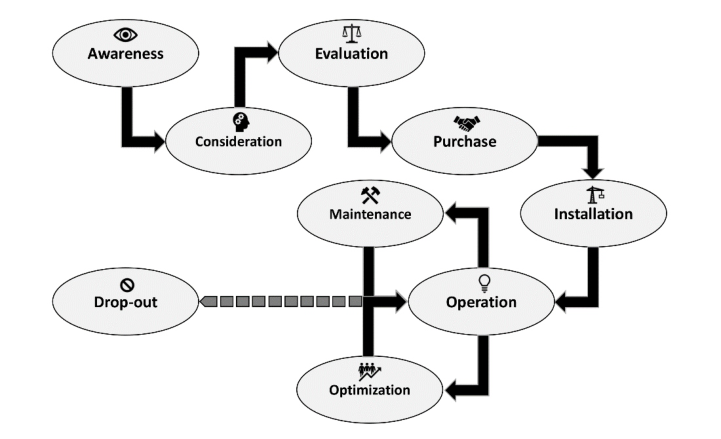
energy community. At each stage, specific information needs arise that need to be satisfied for costumers to make informed decisions. Nine stages were identified in the analysis: awareness, consideration, evaluation, purchase, installation, operation, maintenance, optimization, drop-out. Information needs and related touchpoints are summarized in the following for each stage. A visual representation of the customer journey is shown in Figure 1.
Awareness: In the awareness stage, customers are just learning about the concept of energy communities and the benefits they offer (such as a diversifi- cation of energy sources, energy security and autarky, a reduced dependence on energy imports, lower emissions and clean energy). They need basic infor- mation about what energy communities are, how they work, and how they can help save money on their energy bills. They also need to know the dif- ferent types of energy communities, the various providers available, and existing communities in the vicinity (alternatively information about possibi- lities to invest in energy communities, e.g., via online crowdfunding). Raising awareness can be achieved both online (e.g., with social media campaigns) and offline (e.g., via word of mouth).
Consideration: In the consideration stage, customers are interested in lear- ning more about the type of energy community they are considering. They require information about the specific community they are interested in, such as the size of the community, the types of energy sources used, concreate num- bers regarding the costs (e.g., grid charges, levies, surcharges and taxes) and cost savings, the terms and conditions of joining (including distribution and billing methods, e.g., using P2P approaches), as well as restrictions (e.g., the maximum distance between buildings for a physical energy community to be efficient). They also need to know about the customer service and support offered by the provider. In addition, they require in-depth knowledge about
Figure 1: Costumer journey of energy communities.
the functioning and necessity of the various technologies (such as heat pumps, PV, battery storages, and micro grids). Finally, customers require informa- tion on regulatory frameworks and energy policies (such as the Renewable Energy Directive II). The costumer experience in energy communities starts with the initial engagement. This can involve outreach programs, educational events, and other initiatives that help to raise awareness about the benefits of participating in an energy community. In addition, various documents that cover these information needs can be found online. However, some of these are rather vague and may not answer all individual questions of customers. For this purpose, contact information of experts and consultants is available online.
Evaluation: In the evaluation stage, customers are trying to decide whe- ther to join an energy community. To arrive at an informed decision, they need to compare the knowledge acquired in the previous stages with their own context: Available offerings need to be compared to the own investment strategy (especially with regard to the return on investment), available techni- cal configurations need to be compared to the local requirements and assets. In the analysis, online materials supporting these tasks (e.g., guidelines and examples) were lacking. Therefore, Information needs are more likely to be clarified in person with company representatives or members of existing energy communities.
Purchase: In the purchase stage, customers are ready to make a decision and join the energy community. They need to know the bundles of techno- logies available (such as PV, battery storage, and DC microgrids) and how these are integrated in the community infrastructure, the process for signing up (including any forms to be filled out and related permitting procedures) and any payments they need to make. They also need to know about the customer service and support available once they have joined the community.
Installation: In the installation stage, customers need to know about the process for installing the energy community systems, including any necessary permits, any upgrades that need to be made to their homes, and the timeline for installation. They also need to know about any warranties or guarantees offered by the provider, as well as the process for dealing with any issues that may arise during installation. As in the previous stage, most of these infor- mation needs are to be addressed in person by experts and can be supported with materials available online.
Operation: After the necessary technology has been installed and put into operation, the customer is a member of the energy community. In this stage, there is a need to stay informed about the services related to the production, consumption, storage, and sale of renewable energy. One of the key aspe- cts of the customer experience in energy communities is the level of control that consumers have over their energy usage. This can include access to real- time energy data, the ability to set usage goals, and the ability to track their progress over time. The main touchpoints in this case are digital: Some com- panies offer online platforms and apps for forecasting, control, monitoring, management, and billing. Customers can also participate in community ini- tiatives and events, such as energy-saving challenges, which help to promote
The Customer Experience of Energy Services 151
sustainable energy practices. Another important aspect of the customer expe- rience in energy communities is the level of support that customers receive. This can include access to experts in energy efficiency, regular communica- tion and updates, and a range of resources to help customers make the most of their energy community experience.
Maintenance: In the maintenance stage, customers need to know about the ongoing maintenance and upkeep of the energy community systems. They need to know about the responsibilities of the provider, as well as any respon- sibilities that fall to the customers themselves (such as hiring maintenance personnel experienced with the particular technological configuration). They also need to know about any ongoing costs associated with maintaining the systems, as well as the process for reporting any issues that may arise. This stage shares its touchpoints with the purchase and installation phase.
Optimization: In the optimization stage, customers need to know about ways they can optimize the ways they produce (e.g., by making the distri- bution of energy more efficient by using direct-current) or consume energy (e.g., by optimizing their use of energy services) in the community and in this way get the most benefits from their membership. They also need to know about any incentives or rewards offered by the provider for reducing their energy consumption, as well as any educational resources or worksh- ops available to help them understand energy usage and optimization. Such information needs include possibilities to participate in efficient trading of small amounts of energy in local, regional, and national electricity markets and provide system services in balancing energy markets. By satisfying such needs, consumers in the energy community can be turned into producers. In addition, policy-makers should seek to gather experiences and recommenda- tions from members of energy communities. As such information needs are very context-specific, the touchpoints in this stage predominantly consist of face-to-face interactions.
Drop-out: In the event that customers decide to leave the energy commu- nity, they need to know about the process for doing so, including any fees that may be associated with leaving (e.g., for cancelling tenant-electricity contra- cts). They also need to know about the impact of dropping out on their energy bills, and whether there are any penalties for leaving the community early.
The costumer journey from the perspective of costumers: The results differences between the information needs of customers and what energy companies actually communicate about the process of becoming part of an energy community: Users mostly discuss the middle and late phases of the customer journey (operation, optimization, drop-out), while the presenta- tion of information needs by company and institution mainly focuses on the early phases (awareness, consideration, evaluation).While companies and institutions focus on advantages and technical aspects in their presentation of energy communities, users often want to be informed about how to limit risks that emerge in energy communities and how to relate general information to concrete contexts and problems.
Potential risks are a topic of high relevance for users; these include poten- tial impacts of solar and wind power construction, the reliability of and dependence on renewables, conflicts within a community as well as privacy
concerns in case usage data is shared within a community. In particular, it is feared that the integration of renewables could lower the value of houses if the technologies do not work as expected. In terms of energy self-sufficiency, it is doubted that renewables can meet the energy needs of a community. Espe- cially in the winter time with few sunny days, the effectiveness of the concept is questioned. On the one hand, there is the question of whether the supply via the general grid is guaranteed in such bottlenecks, and on the other hand, whether the capacity of the grid is sufficient to feed in the electricity produced when the community is highly active. In both cases, the possibility of outages is expected in the event of a negative result. Also of concern are potential con- flicts within a community. According to users, these can arise, for example, if there are differences of opinion between members regarding the technolo- gies to be used. But problems are also anticipated if parts of the community want to change providers. There is a considerable need for information regar- ding best practices on how to resolve issues with other community members. Finally, with regard to privacy issues, it is pointed out that, in principle, detai- led usage data about consumers could be collected via technologies such as smart meters and made available to companies and other community mem- bers. The associated loss of privacy and possible exploits are being perceived as a problem of acceptance.
Customers who are interested in joining an energy community have a number of questions that they need answers to, such as how the commu- nity works, the costs involved, the benefits they can expect, and the impact they can have on the environment. However, they want these general aspe- cts to be related to specific application situations. The focus here is not on energy or energy technologies, but on energy services, i.e., concrete applica- tions that are facilitated or made possible in the first place by interconnected energy generation. Examples given here are the extent to which the local expansion of energy communities accelerates the spread of electric vehicles (and charging points) and benefits the local street lighting network. Despite such concrete information needs, energy companies often focus on commu- nicating technical details and information about the products and services they offer, rather than addressing the needs and concerns of customers. This lack of clear and concise information can make it difficult for customers to fully understand what becoming part of an energy community entails, and discourage them from participating. Additionally, many energy companies use jargon and technical terms that are not easily understood by the average person. This further complicates the process of becoming part of an energy community, as customers may not understand the benefits or requirements of the different options available to them.
As a way to resolve such ambiguities, face-to-face touchpoints are essen- tially preferred over digital. In particular, local discussion groups are sought in which knowledge is shared and experiences passed on. Experienced com- munity members in particular are seen as experts who can provide better information on local requirements than company representatives or digital information services.
The Customer Experience of Energy Services 153
DISCUSSION
The results of the study suggest that there is a mismatch between the informa- tion needs of customers and what energy companies actually communicate about the process of becoming part of an energy community (focus on dif- ferent phases of the customer journey) as well as diverging preferences for touchpoints (e.g., digital and fact-to-face), differences on contextualizing information (e.g., general and local contexts), and diverging perceptions of qualities (e.g., focus on benefits and risks, technical aspects and energy services).
To overcome this mismatch, energy companies need to prioritize clear and accessible communication about the process of becoming part and being an active member of an energy community. Such efforts should combine digital support with local contacts that help to contextualize information for local requirements. In this way, co-creation between prosumers and companies is achieved that could further be used to develop adequate regulatory framew- orks and policies, especially with regard to underutilized technologies such as DC in local distribution grids. In addition, the aspect of sustainability is often referred to in the articles but not explained in detail. In this way, articles are less suitable for attracting environmentally conscious interested parties as customers for an energy community. This aspect should be taken into account in the communicative presentation. In addition, users expect risks to be addressed, known cases of these risks to be mentioned, and potential solutions to be discussed. By understanding these information needs, energy community providers can better serve their customers and help them make informed decisions at each stage of the journey. By providing clear and com- prehensive information, providers can build trust with their customers and help them feel confident in their decision to join an energy community. Such efforts should always be guided by what aspects of evaluation in local con- texts may have the effect of promoting acceptance (Jakobs, 2019) of energy communities and CX at the same time. This requires not only an analysis of locally perceived qualities and context properties as evaluation criteria, but also an investigation of touchpoint preferences.
CONCLUSION
In conclusion, the results suggest a mismatch between the information needs of customers and the information provided by energy companies regarding energy communities. Customers are more concerned about potential risks, privacy issues, and concrete applications of energy services, while companies focus on technical details and product offerings. This lack of clear and concise information can make it difficult for customers to fully understand the bene- fits and requirements of becoming part of an energy community, potentially discouraging them from participating. However, face-to-face touchpoints, such as local discussion groups, are preferred by customers for sharing know- ledge and experiences. Therefore, companies should prioritize addressing the information needs and concerns of customers and providing clear and concise information in a way that is easily understood. This will promote a posi- tive customer experience and facilitate the transition to sustainable energy
production, self-sufficient energy systems, equitable energy distribution, and responsible energy consumption.
ACKNOWLEDGMENT
Funded by the Federal Ministry of Education and Research (BMBF, FKZ 03SF0592), Flexible Electrical Networks (FEN) Research Campus.
REFERENCES
Digmayer C (2022) Automated Economic Welfare for Everyone? Examining Barriers to Adopting Robo-Advisors from the Perspective of Explainable Artificial Intelligence. Journal of Interdisciplinary Economics: 026010792211301. Fell MJ (2017) Energy services: A conceptual review. Energy Research & Social
Science 27: 129–140. Fina B, Monsberger C and Auer H (2022) A framework to estimate the large-scale impacts of energy community roll-out. Heliyon 8(7): e09905. Guidehouse (2021) Michigan Energy Waste Reduction Statewide Poten- tial Study: Statewide Potential Study (2021-2040). Available at: https: //www.michigan.gov/mpsc/-/media/Project/Websites/mpsc/workgroups/ewr-s tudy/mi_ewr_statewide_potential_study_final_draft_report.pdf. Guyader H, Ponsignon F, Salignac F, et al. (2022) Beyond a mediocre customer expe-
rience in the circular economy: The satisfaction of contributing to the ecological transition. Journal of Cleaner Production 378: 134495. Hansen AR, Jacobsen MH and Gram-Hanssen K (2022) Characterizing the Danish energy prosumer: Who buys solar PV systems and why do they buy them? Ecological Economics 193: 107333. Iazzolino G, Sorrentino N, Menniti D, et al. (2022) Energy communities and key
features emerged from business models review. Energy Policy 165: 112929. Jakobs E-M (2019) Technikakzeptanz und -kommunikation – ein vielschichtiges Konstrukt. In: Fraune C, Knodt M, Gölz S and Langer K (eds) Akzeptanz und politische Partizipation in der Energietransformation: Wiesbaden: Springer Fachmedien Wiesbaden, pp. 301–321. Keyser A de, Verleye K, Lemon KN, et al. (2020) Moving the Customer Expe-
rience Field Forward: Introducing the Touchpoints, Context, Qualities (TCQ) Nomenclature. Journal of Service Research 23(4): 433–455. Kokins G, Straujuma A and Lapi¸na I (2021) The Role of Consumer and Customer Journeys in Customer Experience Driven and Open Innovation. Journal of Open Innovation: Technology, Market, and Complexity 7(3): 185. Kotilainen K (2019) Energy Prosumers’ Role in the Sustainable Energy System. In:
Leal Filho W, Azul AM, Brandli L, Özuyar PG and Wall T (eds) Affordable and Clean Energy: Cham: Springer Publishing, pp. 1–14. Maldet M, Revheim FH, Schwabeneder D, et al. (2022) Trends in local electricity market design: Regulatory barriers and the role of grid tariffs. Journal of Cleaner Production 358: 131805. Mihailova D, Schubert I, Burger P, et al. (2022) Exploring modes of sustainable value
co-creation in renewable energy communities. Journal of Cleaner Production 330: 129917. Neslin SA (2022) The omnichannel continuum: Integrating online and offline channels along the customer journey. Journal of Retailing 98(1): 111–132.
The Customer Experience of Energy Services 155
Ring M, Wilson E, Ruwanpura KN, et al. (2022) Just energy transitions? Energy policy and the adoption of clean energy technology by households in Sweden. Energy Research & Social Science 91: 102727. Ruggiero S, Martiskainen M and Onkila T (2018) Understanding the scaling-up of
community energy niches through strategic niche management theory: Insights from Finland. Journal of Cleaner Production 170: 581–590. Ulgiati S, Casazza M, Kordas O, et al. (2019) Energy technologies and perspectives for human and environmental wellbeing. Energy 183: 1–3. Weigelt C, Lu S and Verhaal JC (2021) Blinded by the sun: The role of prosumers
as niche actors in incumbent firms’ adoption of solar power during sustainability transitions. Research Policy 50(9): 104253. Wittmayer JM, Campos I, Avelino F, et al. (2022) Thinking, doing, organising: Prefiguring just and sustainable energy systems via collective prosumer ecosystems in Europe. Energy Research & Social Science 86: 102425. Wolsink M (2018) Social acceptance revisited: gaps, questionable trends, and an
auspicious perspective. Energy Research & Social Science 46: 287–295.
LISTED IN THE AHFE DIGITAL BOOKSTORE CATALOGUE
Explore the complete digital volume
Human Factors in Software and Systems Engineering
Read this individual research paper free through the original publisher, or explore the full digital proceedings book.
ISBN 978-1-958651-70-4
Explore this ISBN in the AHFE Bookstore ↗Listed in the July 2026 bookstore catalogue; search by ISBN to confirm current availability · Digital book purchase optional