Jingming Ma, Peng Ji (2023). Topological Shape Differences in High-speed Trains from a Human Perspective. In: Human Factors in Transportation. AHFE Open Access, vol. 95, pp. 261–269. https://doi.org/10.54941/ahfe1003811
The shape of high-speed trains is a combination of engineering and design, taking into account both performance requirements and aesthetic form. With the increase of operating speed, the shape design and aerodynamic research need to be synergistically unified. Different topological shapes have large differences in air resistance and aerodynamic noise, so trains in different regions have their own characteristics in terms of shape. By analyzing the evolution of the shape spectrum of high-speed trains in each platform in the world, we extract the genes of high-speed train aerodynamic performance shape, and analyze the regional characteristics and the influence of human factors on train shape to help the brand construction of high-speed trains in different regions.
As the speed of high-speed train is gradually increasing, the appearance that affects the aerodynamic performance of trains has become an important rese- arch object for the appearance design of high-speed train. When the speed of the train exceeds 300 kilometers per hour, air resistance accounts for more than 85% of the total resistance(Tian, 2006). Reducing the aerodynamic resistance is an important means of energy conservation and consumption reduction for high-speed trains, and the aerodynamic resistance of high-speed train is highly related to its appearance, especially the locomotive shape. The research on the aerodynamics of high-speed trains aims to improve the aerodynamic performance of trains, such as aerodynamic resistance, aerody- namic lift, air pressure distribution on train surface, transverse force, crossing pressure wave and aerodynamic noise, and the measures to improve the aerodynamic performance are finally incorporated into locomotive shape design of high-speed trains(Tian, 2007).
Improving train speed is the main goal of high-speed train design. However, for the general public, the speed and the technology behind it are abstract and vague, but the visible and perceivable image is the key to distinguish one from another. People’s first impression of appearance determines their expectation on the technology, security or other services. High-speed trains have different and distinctive train images in terms of topological shape, mold line, and
design aesthetics due to their differences in technology and regional culture, and these images have also become one of the cultural symbols of the country.
STATISTICS AND INDUCTION OF WORLD HIGH-SPEED TRAIN MODELS World High-Speed Train Model Statistics
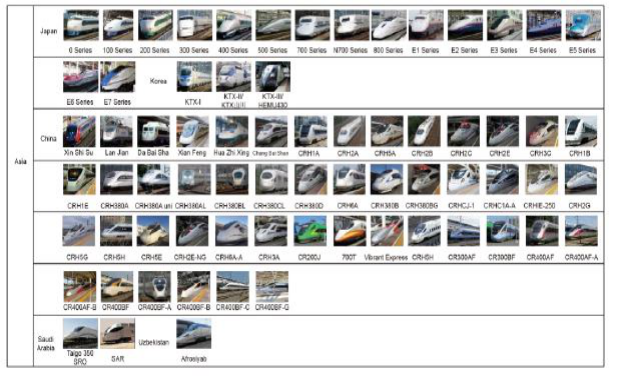
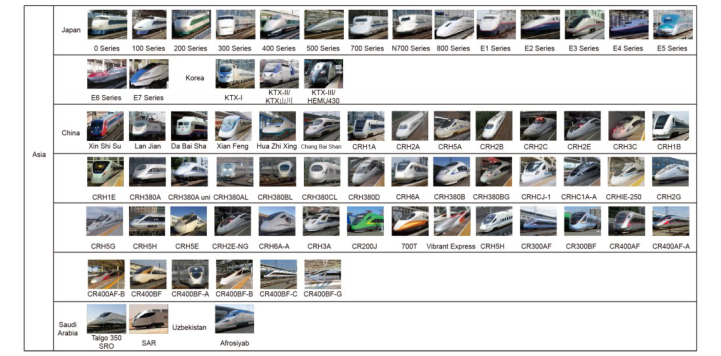
Evolution of high-speed trains in Asia. Five countries in Asia now use high-speed trains with 72 types (Figure 1). Japan’s Shinkansen began its operation in 1964 and now has formed a supporting high-speed railway tech- nology system. China is the world’s largest market for high-speed trains and a new producer of high-speed train technology. At present, the total mileage of China’s high-speed railway is 25,000km, forming “CRH” Series, “CRH380” Series and “Fuxing” Series. South Korea has introduced French TGV-R tech- nology for its high-speed trains. In 2004, KTX Series trains were put into use. Uzbekistan and Saudi Arabia have introduced technology from Spain, with a total of 3 operating types.
Evolution of high-speed trains in Europe. The study of high-speed train in Europe started at the same time as that in Japan. France conducted real train test at a speed of 200km/h in 1969, and high-speed trains were put into operation in Britain, Germany, Italy, Spain, Sweden, etc (Figure 2).
France is the first to research and develop high-speed trains, which fea- ture concentrated power and articulated bogies (Wu, 2007). In 1987, TGV was officially put into operation, keeping a record of the highest wheel-rail train speed of 574.8km/h so far, with a total of 9 operating types. The deve- lopment of high-speed trains in Germany started late because of national division. In 1989, ICE trains were officially put into use, laying emphasis on comfort and functional completeness. ICE3 is changed from centralized power to decentralized power (Du et al. 2015). Combined with the national
Figure 1: Model statistics of Asian high speed train.
Topological Shape Differences in High-Speed Trains From a Human Perspective 263
Figure 2: Model statistics of high speed trains in Europe.
conditions to develop variable gauge trains, AVE in Spain began its opera- tion in 1992, with a total of 7 operating types. Italy began its high-speed railway project in the 1970s, with a total of 12 operating types. Under the influence of national power, Italy has developed Pendolino tilting train plat- form for train speed increase of existing lines, with a total of 12 operating types. The British-developed InterCity Series trains were put into operation in 1976. In the later period, because of funds and policies, Britain stopped train self-research and introduced platform types, such as TGV, Bombardier and Shinkansen, with a total of 16 operating types. Many other European coun- tries also operate high-speed trains, but they have not yet formed mature technical platform or not established dedicated high-speed railway system.
Evolution of high-speed trains in other regions. There is an existing XPT train imported from Britain in Australia, which was put into operation in 1982 (Tian, 2020). Acela Express type of TGV and SCB-40 type of SIEMENS were introduced to the United States, which were officially put into operation in 2000 and 2018 respectively. There are 3 types in Oceania and America. At present, no high-speed trains have been put into use in Africa (Figure 3).
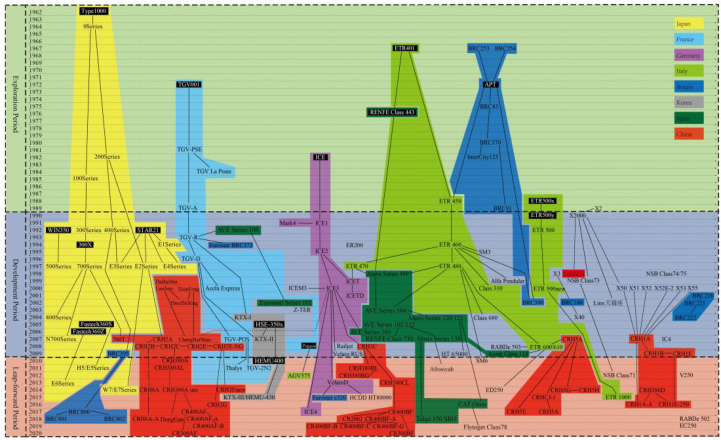
Shape Evolution Relationship of Main Platforms In light of the development of worldwide high-speed trains, in this paper, it is divided into three stages in chronological order, namely, exploration period, development period and leap-forward period (Figure 4).
The exploration stage is from the 1970s to the 1990s. The speed was 220-245km/h. A few countries began to research and develop high-speed trains and put them into operation, but because of the lack of systematic technical indicators, they failed to form a systematic technical platform and
Figure 3: Model statistics of high speed trains in other regions.
Figure available in the original PDF paper.
264 Ma and Ji
Figure 4: Model evolution relationship of main technical platforms.
trains were not popularized. Shinkansen platform first used elliptical diver- sion layer to reduce air resistance and form bullet-shaped appearance, while TGV and BRC platforms developed high-speed trains from wedge-shaped appearance.
The development stage is from the end of the 20th century to the begin- ning of the 21st century. The speed was 245-300km/h. The development environment of major high-speed trains in the world was basically formed, and major high-speed train types began to be put into use. During this period, high-speed train types were put into operation in eight countries, up from 12 in the exploration stage to 64. Eight major technical platforms for high-speed trains were initially formed. Shinkansen platform adopted the wedge feature in response to the change of crossing pressure with the idea of “diversion”. Wedge shape was the main focus, and new aerodyna- mic problems emerged as it entered the 300km/h phase later. To reduce the tunnel effect, each platform developed rounded wedge, ellipsoid and spindle based on the wedge characteristics, which can enhance the effective stream- lined length of the concave type while coping with the bionic duck-billed type with short line spacing in Japan and the short streamlined length in Spain.
The leap-forward stage is after the 2010s. The speed is 300-360km/h. Each platform does in-depth research on the basis of the 300km/h type of the development period. Higher operating speed brings more stringent techni- cal indicators and R&D barriers. Meanwhile, affected by global economic environment and increasingly clear R&D objectives of new trains among countries, the number of new types put into operation in each country in the new era has decreased remarkably, and the R&D platform presents a trend of cooperation and integration.
Topological Shape Differences in High-Speed Trains From a Human Perspective 265
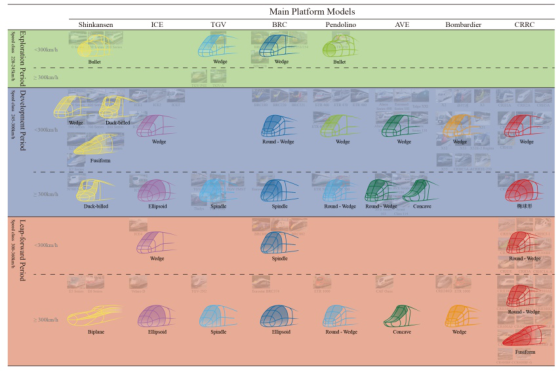
Analysis of Elements of Train Shape Design in Each Development Stage In pace with the development of high-speed train and the continuous breakth- rough of the maximum speed, taking into account of the development period and speed grade comprehensively, in the exploration period, at 220-245km/h speed grade, bullet-shape type is the main focus, concentrating in the front and middle section of the train, that is, the appearance of trains is impro- ved at the nose part of the head; In the development period, at 245-300km/h speed grade, different from the changes in the appearance of the front and middle sections of the exploration period, optimization is more focused on the middle and rear sections. Due to the increase of streamlined length, nose part is elongated, appearing wedge, duck-billed shape and other appeara- nces; In the leap-forward period, at 300-320km/h speed grade, the middle and rear sections of the locomotive are closer to Paraboloid line, and double- wing appearance appears. With the continuous improvement of the speed
Figure 5: Speed level and shape topology evolution of main technical platforms.Figure 6: Analysis of train head shape.
266 Ma and Ji
grade, the section change rate of the type tends to be closer to the optimal section change rate to enhance the aerodynamic performance of the train (Figure 5).
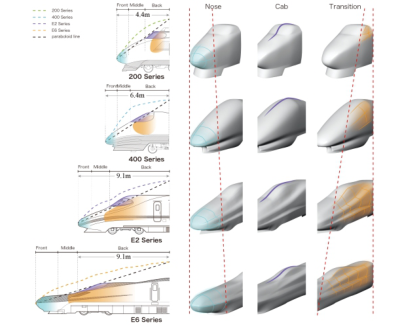
With the upgrade of speed grade, the overall shape of global train has developed from bullet to wedge, duck bill, ellipsoid and spindle, and then to double wings. The same is true for types of the same series. For example, wedge-shaped 400 Series and duck-billed E2 Series are derived from bullet- shaped 200 Series, and then double-wing E6 Series with long streamlined length is developed (Li et al. 2022) (Figure 6).
INFLUENCE OF HUMAN FACTORS ON TRAIN STYLING The styling design of high-speed train should not only satisfy the basic mech- anical dimension requirements, but also have certain external spiritual style. The locomotive styling is the key to the appearance of high-speed trains, and the basic element for high-speed trains to form a brand series. Different regi- onal environment and climate give birth to different national cultures and aesthetic concepts, which are reflected in the appearance of high-speed trains.
Japanese High-Speed Train Design Japan, the birthplace of high-speed trains, opened the world’s first high-speed railway in 1964. However, because of the historical limitations of early con- struction, the sectional area of the tunnel in Japan is basically less than 64m2, and the smaller sectional area of the tunnel causes a larger blockage ratio. At the same time, because of Japan’s small territory, many high-speed railw- ays pass through the city center, and the huge noise generated by high-speed trains exerts a direct influence on people’s lives. Therefore, high-speed trains in Japan encounters aerodynamic problems earlier, making it one of the first countries to study aerodynamic problems.
The Japanese characters and the styling styles of cultural products embo- died in the shape of Shinkansen high-speed train are influenced by national cultural genes to a great extent. The modeling design of Japan’s high-speed trains not only absorbs the sophisticated technology of foreign high-speed trains, but also integrates distinctive traditional cultural characteristics of the nation. Yamato nation advocates the natural style of dhyana, which is embodied in the bionic form in the styling design of high-speed trains.
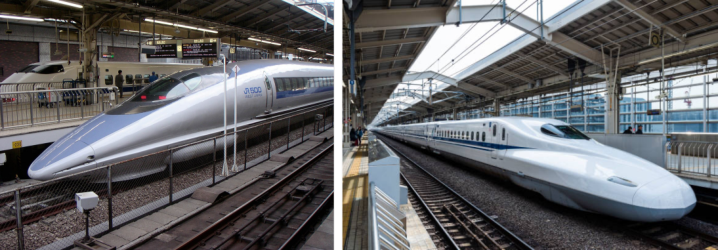
For example, the overall locomotive styling of Shinkansen 500 Series comes from the mouth of the kingfisher because the kingfisher produces very little spray when it catches fish in the water. According to this, bullet-shape locomotive is rebuilt. Practice has proved that the speed of this kind of train is 10% higher than that of the original design, while the power consum- ption is reduced by 15%, and the noise is remarkably reduced. The overall locomotive styling of Shinkansen N700 Series comes from the duck’s bill, which is steady and stout; The train body is streamlined to ensure speed and a sense of strength; The shape characteristics of the duck’s eyes are applied to the cab window by bionic design; The headlight design imitates the duck’s nose, which is concise and strongly functional(Zeng and Dai, 2017) (Figure 7).
Topological Shape Differences in High-Speed Trains From a Human Perspective 267
Figure 7: Shinkansen 500 series and Shinkansen N700 series.
Throughout all trains in Japan, it can be found that the contour line on the side of the train is long, which is in the diving oblique shape, implying a sharp and fast visual effect; In addition, the shape turning line connects the ups and downs and changes of the surface, creating a train shape with rich aesthetic feeling and light figure.
German High-Speed Train Design As for the ICE series trains in Germany, locomotives of ICE1 and ICE2 are mainly square, with a bit of roundness. ICE3 styling comes from the shape of water droplets. For ICE3 and its subsequent series, the locomotive has evo- lved into a long oval shape, which is rounder and plumper, and can improve the train speed at the same time. German high-speed train has clear lines and pursues geometric aesthetics (Zhi and Xu, 2014). The front of the locomo- tive is flat and gradually tilted into bluntness, and the center of gravity of the train sinks through linear trend, showing stable, regular and solid visual effect, and embodying the German national cultural characteristics of rigor, rationality and orderliness.
French High-Speed Train Design The wedge-shaped locomotive of TGV is the result of technical requirements and shape innovation, and the curved surface full of tension gathers strength. The proportion, scale and details of its styling have been carefully refined and verified by repeated aerodynamics experiments, making it contain accu- rate mathematical relations and embody orderly aesthetics. AGV Series of high-speed trains are the representatives of fashion and personality, and their styling features are impressive. As the visual center of the whole, the loco- motive can best reflect its local and logo features. The main tone of the distinct and strong structural line is very dynamic, which is the embodi- ment of the vitality of AGV(Yu, 2017). This series of designs mirror French diversified geographical environment, aesthetic differences and the diversi- fied integration of culture, highlighting the enthusiasm and romance of the French nation.
268 Ma and Ji
China High-Speed Train Design China’s high-speed railways are typically built in the wild and at least 50m away from residential areas. When entering cities, high-speed trains reduce their running speed to reduce noise, so domestic high-speed trains take running speed as the main goal, rather than having strict noise reduction requirements like Japan. Because of the late start, China’s high-speed trains are developed from a wide range of technology platforms. Although the technology has developed rapidly, due to the influence of different design concepts, the design theory of appearance styling is relatively backward. Train types are numerous but cluttered, and the appearance design of the train is somewhat out of line with the construction of its own product series.
Chinese people preach the golden mean. The formation of this concept is reflected in the lack of personality in the styling of China’s high-speed trains. Like CRH380 Series, the styling is regular, round and smooth, with- out large curvature or hard feature lines, and the locomotive is steady and simple. There is less overall change, and the style is unified and harmoni- ous, but hardly impressive. The styling and coating of China’s high-speed trains is expert in drawing inspiration from Chinese traditional elements and excellent national culture, forming a branding train styling, which is different from other countries, creating a brand culture of high-speed trains with China characteristics, forming “Chinese symbols”and “intelligent manufacturing in China”, and indirectly disseminating Chinese culture.
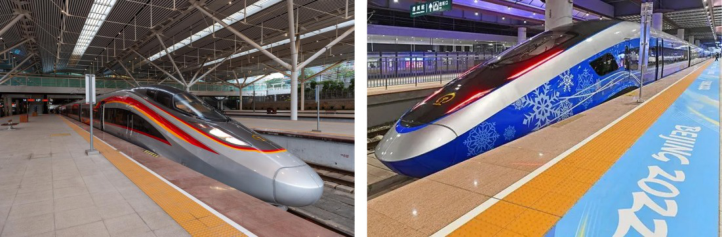
Locomotives of CR400BF-C of “Longfeng Chengxiang”, a new smart high-speed train and “Ruixue Yingchun”, a new smart Fuxing high-speed train serving the Beijing 2022 Winter Olympics, adopt the principles of bionics and aerodynamics, bionic to the falcon and swordfish. Streamlined locomotive has clear edges and smooth surface transition, which can effe- ctively reduce air diversion (Figure 8). The aerodynamic resistance of the whole train is 7.4% lower than that of the Fuxing CR400BF high-speed train, which can save energy by 10%, further improving its environmental- protection attribute. In addition, the appearance of the train adopts the totem elements of dragon and phoenix in traditional culture, and the red and yellow stripes dancing up and down, indicting “dragon and phoenix soar between heaven and earth.” With the theme of “prosperity brought by the dragon and
Figure 8: “Longfeng Chengxiang” and “Ruixue Yingchun”.
Topological Shape Differences in High-Speed Trains From a Human Perspective 269
phoenix”, it implies the mission of China’s high-speed train to benefit man- kind and good wishes of the country’s prosperity and people’s happiness and well-being.
CONCLUSION
The change and development of the times also exert an influence on the function and culture of high-speed trains. High-speed trains in each era have their own significance and mission.
By sorting out the speed grade and topological evolution in shape of the main technical platforms of high-speed train in the world, it can be found that the topological shape of high-speed trains has been continuously improved as the study of aerodynamics deepens. It’s also found that the topological shape of high-speed trains in each country is closely related to the national characters and regional and environmental features of the country. Through the differences in the styling and color of high-speed trains, we can see the different observations and cognitions of things, and the different emotional attachments to a same thing between different nations. At the same time, it can promote the construction of brand culture. Create the trains that are in line with national styles.
ACKNOWLEDGEMENT
The authors would like to acknowledge the financial support from the Natural Science Foundation of Hunan Province (Grant number 2022JJ40064).
REFERENCES
Du, H., Li, W. P. & LIU, H. Y. (2015). Siemens Ag’s Elaborate High-speed Train Velarod for Deutsche Bahn. Foreign Rolling Stock, (1), pp. 25–30. Li, Y., Yang, L., Ji, P., & Liu, L. J. (2022). Research on Collaborative Design of
Shinkansen Train Head Shape. Packaging Engineering, 43(22), pp. 57–64. Tian, H. Q. (2006). Advances in the Study of Train Aerodynamics in China. Journal of Traffic and Transportation Engineering, 6(1), pp. 1–9. Tian, H. Q. (2007). Train Aerodynamics. 1st ed. Beijing: China Railway Publishing
House, pp. 1–9. Tian, R. (2020). Development of High-speed Trains in the World. Foreign Diesel Locomotive, (4), pp. 1–6. Wu, G. D. & Li, B. B. (2007). Development History and Technical Characteristics of
TGV. Foreign Rolling Stock, 4(1), pp. 1–4. Yu, Y. B. (2017). Reflection of Cognitive Differences in Modeling of High-Speed Train. Modern Communication, (10), pp. 183–184. Zeng, Y., & Dai, R. (2017). Comparative Study on Brand Culture from the
Perspective of High-speed Train Appearance Design. Design, 39(5), pp. 83–94. Zhi, J. Y., & Xu, B. C. (2014). A Research on Cultural Connotations of High-Speed Train’s Shape Design. Collections, 3.
LISTED IN THE AHFE DIGITAL BOOKSTORE CATALOGUE
Explore the complete digital volume
Human Factors in Transportation
Read this individual research paper free through the original publisher, or explore the full digital proceedings book.
ISBN 978-1-958651-71-1
Explore this ISBN in the AHFE Bookstore ↗Listed in the July 2026 bookstore catalogue; search by ISBN to confirm current availability · Digital book purchase optional