Yifei Wang (2023). The Design Thinking Practice of Future Urban Public Transport Service under the Thinking of Double Diamond Model. In: Human Factors in Transportation. AHFE Open Access, vol. 95, pp. 500–510. https://doi.org/10.54941/ahfe1003835
In the post-epidemic and digital era, with the rapid development of autopilot technology and transformation processes of society, the project aims to study the service design strategy and specific scheme of the transport system in complex urban public environments for the future. Based on the divergent convergence and iterative characteristics of the double diamond model, the collaborative design of community residents and professional design based on research methods and design tools were connected to carry out design practice and envision future scenarios intertwined with physical and digital in the autopilot system. In this paper, the whole process of transport in the urban scene was investigated, the key pain points of users and corresponding design opportunities were sorted out, and the service system framework of future transport in urban settings in the future era was proposed. The key touch points of transport services for residents in urban scenes were explored to form integrated design interventions of convenient, considerate, constructive, and inclusive products and systems. The innovative solution with strong integration in this project is conducive to better grasping the product and service forms of transport at the grassroots level and improving users' positive feelings, sense of participation, and experience in the autopilot system in their daily life, thus improving the quality and availability of public transport services which have a positive impact on the efficiency and sustainability of urban areas.
URGENT NEED FOR THE ADOPTION OF A NEW PARADIGM FOR SUSTAINABLE TRANSPORTATION AND DEVELOPMENT Urban Public Transport Service and Status Quo of Paradigm
Urban public transport services are a crucial component of urban transpor- tation systems that provide safe, reliable, efficient, and affordable transpor- tation options to facilitate the movement of people, goods, and services within urban areas. The importance of urban public transport services in promoting sustainable urban development has been widely acknowledged by scholars and policymakers, especially in the context of rapid urbanization and associated challenges in managing vehicular traffic and environmental impacts. Studies have highlighted the role of public transport in reducing
The Design Thinking Practice of Future Urban Public Transport Service 501
traffic congestion, air pollution, and carbon emissions, while also promo- ting social equity and economic benefits (Newman and Kenworthy, 2015; Glaeser et al. 2008; Holmgren et al. 2019; Litman, 2019). Nevertheless, many urban areas struggle to provide affordable and efficient public transport servi- ces, emphasizing the need for investing in public transport infrastructure to improve urban life and enhance economic opportunities.
SERVICE DESIGN HELPS AUTOMATED DRIVING-BASED TRANSPORTATION Service Design Double Diamond Model
Service design is a human-centered design approach that focuses on the cre- ation of effective and efficient services, which incorporates elements of UX design, design thinking, and business strategy. The concept was put forward by G. Lynn Shostak in the field of management in the 1980s. In 2011, Marc Stickhorn and others put forward the concept of “service design thinking”, forming a systematic and effective system. The Double Diamond model is a framework for the service design process first introduced by the UK Design Council in 2005. The model consists of four stages: Discover, Define, Deve- lop, and Deliver, which has become a widely used tool for practitioners with the benefits of improving customer satisfaction, and loyalty, as well as enhancing user experience and retention.
Usability Analysis of the Double Diamond Model Service design is a valuable approach to creating innovative and effective services, including in the context of urban public transportation (Kim and Park, 2017; Bitner et al. 2008; Polaine et al. 2013; Sangiorgi and Prendiville, 2017; Foss et al. 2018). The intelligent automation service system using AI and autonomous driving technology presents an opportunity for improving public transport, and service design can guide and optimize user participa- tion through tangible and intangible design. Effective collaboration among government, transportation service providers, urban planners, and commu- nity members is crucial for developing reliable, efficient, and equitable public transportation systems. The four stages of service design involve conducting user research and case studies, considering user attributes and pain points, ideating solutions from multiple perspectives, and implementing solutions with scenarios while establishing user trust.
A DESCRIPTION OF THE PROCESS FOR THE SERVICE DESIGN Discover Phase
The group employs a mixed-methods approach to analyze urban public transportation from multiple perspectives, using both existing literature and first-hand investigations (see Figure 1). They conduct user research and case studies to understand the current situation and prospects of automated public transportation. The group collects data through questionnaire interviews and
502 Wang
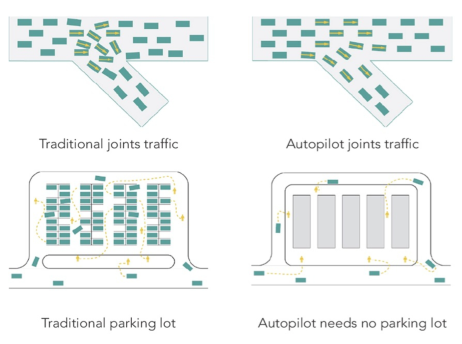
Figure 1: Autopilot transportation enhances total efficiency and saves public expendi- ture at the system level.
observations of local workers, ordinary citizens, and tourists to identify dif- ferent groups’ understanding and pain points. Field research in Copenhagen was conducted, and 106 valid questionnaires were collected with 54.72% of respondents aged 15–35 living in and around Copenhagen. Results show that most citizens prefer walking and cycling, and few use public transpor- tation due to accessibility issues. Respondents lacked systematic knowledge of automated driving, and 60% noted public transportation shortcomings. The challenge is to design a product that satisfies human-level needs while providing an autopilot transportation system for a prosperous future.
At the same time, a case study of existing Autopilot transportation systems for public transportation was made (see Table 1). A total of 9 cases were sele- cted from developed countries (USA, UK, Germany, Denmark, Japan, South Korea, and Singapore) and developing countries (Russia and India).
The implementation and regulations of autonomous public transporta- tion systems vary by country, but their potential benefits, such as increased efficiency, reduced emissions, and improved mobility, have garnered signifi- cant interest from governments and companies worldwide. The next stage of functional exploration will analyze the needs of the public and tourists in the city as the service subjects.
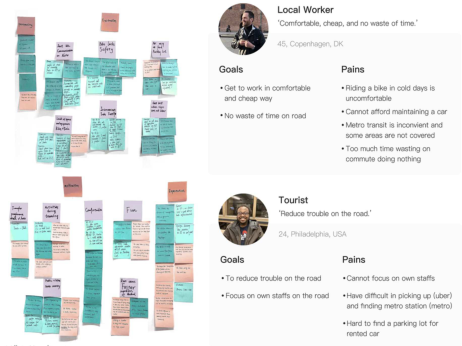
Define Phase The research team engaged in user-centered design by reflecting on user roles and attributes to identify core values and understand user needs. Target users were invited to participate in in-depth interviews to discuss their tran- sportation pain points and needs. The affinity graph method was utilized to summarize common needs into four categories: personality, frustration, motivation, and expectations. Two groups of users were identified: local wor- kers/citizens and tourists. Prioritized needs differed between the groups, with workers valuing price, comfort, and efficiency, and tourists valuing conveni- ence, leisure, and accessibility of travel information. Both groups emphasized
The Design Thinking Practice of Future Urban Public Transport Service 503
Table 1. Analysis of autopilot transportation systems in other countries.
Table available in the original PDF paper.
Transportation type
Company Typical case Policy and initiative
United States
Bus, shuttle, train
Guidelines for the testing and deployment
Waymo, Uber, Tesla, EasyMile, Local Motors
Waymo autonomous ride-hailing services pilot program (2020)
United Kindom
Bus, shuttle Stagecoach, Transport Systems
AI-controlled shuttle project (2021)
Support and funding for development; code of practice for testing Germany Bus, shuttle Mercedes-Benz, Audi
Future Bus project (2016)
National strategy and legal framework for development Denmark Bus, train Autonomous Mobility, Sensible4
Aalborg Autonome Buses project (2018)
National expanding plan and program Japan Bus, shuttle, taxi
The e-Palette project (2018)
Toyota, Honda, Yamaha, DeNA, Isuzu, NEC
Investment and Strategic Innovation Promotion Program (SIP) South Korea
Bus, shuttle, taxi
Legal framework and roadmap
Hyundai, Samsung, KT Corporation, LG
K-City testing facility project (2018)
Singapore Bus, shuttle, taxi
ST Engineering The Sentosa Island autonomous shuttle service pilot project (2019)
Expanding plan and roadmap
Yandex.Taxi ride-hailing service project (2020)
Expanding plan and regulatory framework; launched the Autonomous Vehicle Initiative Russia Bus, taxi Yandex, Kamaz, Cognitive Technologies, Hyundai India Bus, shuttle, metro Policy framework and the Smart Cities Mission
Tata Motors, Ashok Leyland, Mahindra & Mahindra
The Delhi Metro Rail Corporation (DMRC) project (2022)
convenience and systematization while rejecting cumbersome and inefficient transportation forms (see Figure 2).
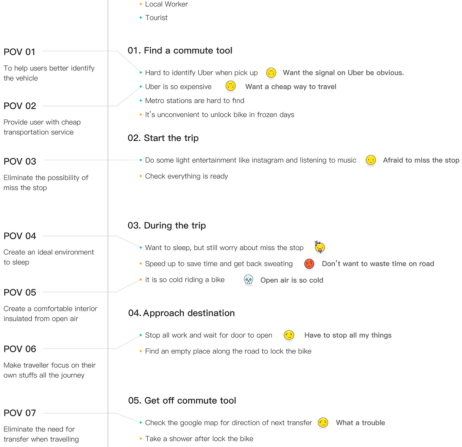
Develop Phase The journey map depicts the content and support system of the pre, during, and post-service. The diagram outlines stakeholders and their interaction relationships. The user experience process is divided into three stages: pre- service (finding means and reaching starting point), service (trip start, travel
504 Wang
Figure 2: Personas and affinity map of interviewees.
process, approaching destination), and post-service (arriving at the desti- nation, ending the trip). The user’s emotional peaks, negative emotions, and needs for convenience, service comfort, and information traceability are identified to clarify service pain points, user flow, and human-machine- background interaction (see Figure 3).
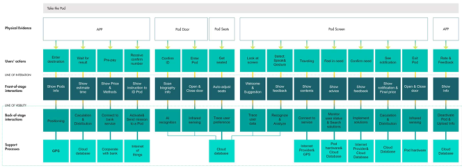
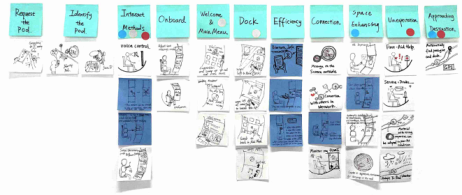
The service blueprint analyses service processes, emotional changes, and touchpoints with scenarios to find opportunities. In the pre-service stage, users feel negative due to a lack of understanding of travel information. The focus is on online information retrieval, and the App can organize relevant information. During the service, users want a convenient and comfortable travel experience, focusing on their own needs with minimal disturbances.
Figure 3: As it journey map.
The Design Thinking Practice of Future Urban Public Transport Service 505
The focus is on the systematization and humanization of user interaction with autonomous mobility products. In the post-service stage, users want to stay connected and informed about the destination through online connection and feedback (see Figure 4).
A service design system is proposed using intelligent autonomous travel products, information interaction platforms, and traffic service systems to address major pain points, which consider the needs of users and reflect inclusiveness and universality. The system includes an app and inbuilt inte- raction port, communities, and a personalized big data platform. Service operators organize and iterate service content, contact service providers, and cooperate with agencies to improve user participation and promote public transportation.
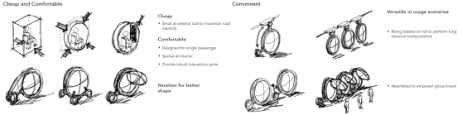
Hardware Product Design To fulfil users’ needs for a comfortable, cheap, and convenient transportation service, the design needs to create a minuscule space as an individual tran- sport solution and make it versatile to all kinds of scenes such as single/multi passengers, long-distance transportation, and integrated assembly attributes (see Figure 5).
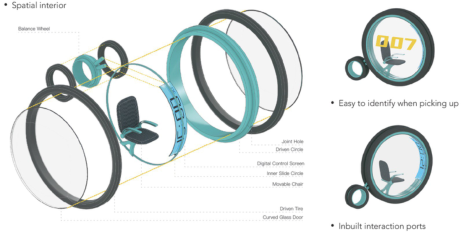
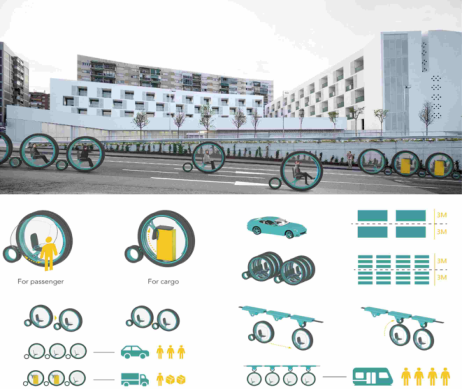
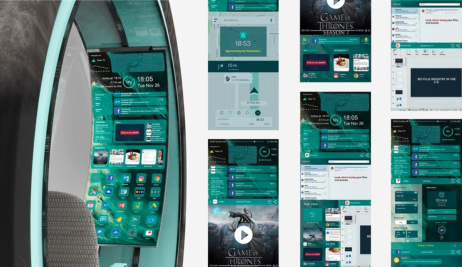
The creation for single passengers has an inbuilt interaction port and exterior digital display for easy identification (see Figure 6). Versatile pods are designed for multiple usage scenarios, eliminating the need for more parking space and transfer between transportation, as well as being assem- bled for group travel or freight and loaded onto the rail for long-distance transportation (see Figure 7).
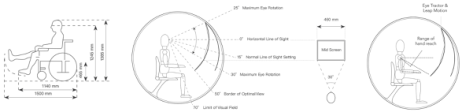
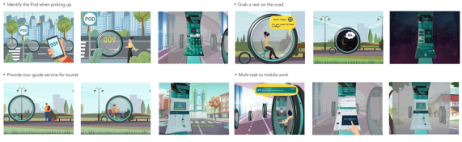
Interaction Design at the Product Level Four most common activities extracted from storyboards within pods: getting services, mobile work, entertainment, and resting (see Figure 8). Ergono- mic factors were considered such as space size, screen layout for attention
Figure 4: Service blueprints.Figure 5: Autopilot transportation product ideation sketch.
506 Wang
Figure 6: Pod design for a single passenger.Figure 7: Versatile pods that are economical and convenient in multiple usage scenarios.Figure 8: Storyboard of common transportation activities.
allocation, movement boundaries, and optimal screen viewing angles (see Figure 9).
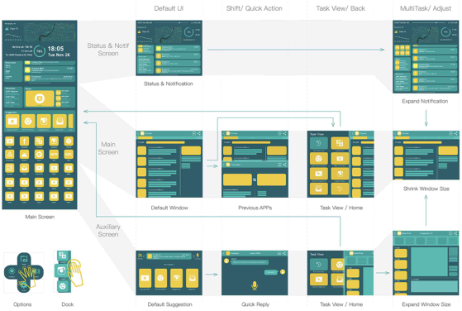
Interaction Design at the Software Level To address ergonomic concerns, the screen was divided into three parts. As shown in the wireframe and user flow (see Figure 10), the status and notifi- cation area are located above the optimal viewing area, while the auxiliary
The Design Thinking Practice of Future Urban Public Transport Service 507
Figure 9: Decision on the optimal area for viewing.Figure 10: Wireframe and user flow.
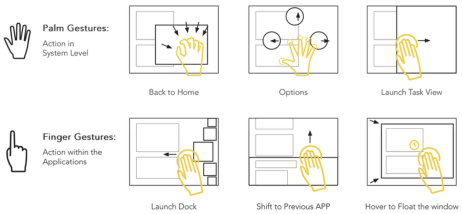
actions and suggestion area is within reach of hand for efficient interactions. Non-touch gesture control was designed, including palm and finger gestures (see Figure 11), and incorporates VR/AR technologies to create immersion.
Deliver Phase A 1:1-size prototype with MDF boards and printed sliders were built. 15 participants (8 female, 7 male) aged between 23 and 42 were recruited accor- ding to personas. Three tasks were designed to cover the main workflow of the interaction system ( see Figure 12). During the 15-minute interview, par- ticipants were asked about their concerns and preferences for interface and feature.
Figure 11: Non-touch gesture control language design for inbuilt interaction port screen.
508 Wang
Figure 12: User test and 1:1 scale prototype of inbuilt interaction port screen.
Figure available in the original PDF paper.
1. Main screen: ask about the present status of the journey and launch an app. 2. Quick actions and dock: resume watching the video left last time and reply to a message on social media opened from the dock with a quick reply. 3. Multi-task and adjust window size: open the email and PowerPoint at the same time to finish the assignment. At last, pin the browser to the dock.
Analysis of the data through observation and interviews with 15 partici- pants revealed that the participants were able to comprehend the product’s purpose without explicit instructions. However, they suggested areas of improvement, such as the irrational layout and confusion caused by multi- ple apps. Although the participants expressed satisfaction with the product’s comprehensive design, some interaction aspects were found to be confusing and challenging without guidance. To address these issues, the researchers proposed optimizing the UI interface, adding user prompts, and enhancing the prompt interaction mode with multi-modal channels and additional infor- mation. The service design scheme and usage scenarios were displayed (see Figures 13 and 14). The urban autonomous transportation service system
Figure 13: Usage scenarios and address pain points.Figure 14: App design and function display.
The Design Thinking Practice of Future Urban Public Transport Service 509
design of residential communities, traffic information, and service opera- tors were connected to improve user participation and promote the value orientation of public transportation.
CONCLUSION
This paper utilized the double-diamond model to develop an autonomous tra- vel scheme for future transportation. Pain points were identified, and smart autonomous mobility products and apps were designed. The study highlights the significance of considering human needs at both the system and individual scale to create promising solutions that meet the middle point. The research proposed the service system framework and explored the key touchpoints of sustainable transport services, resulting in integrated design interventions that improve users’ positive feelings, sense of participation, and experience. The model requires iterative testing and improvement and can serve as a refe- rence for future research to explore trends and methods for urban public transportation products and services.
REFERENCES
Bitner, M. J., Ostrom, A. L., & Morgan, F. N. (2008). Service blueprinting: A practical technique for service innovation. California Management Review, 50(3), 66–94. Foss, L., Jorgensen, M., & Kastberg, P. (2018). Service design and public service deli-
very: Towards a customer-centric approach. Public Management Review, 20(6), 817–836. Glaeser, E. L., Kahn, M. E., & Rappaport, J. (2008). Why do the poor live in cities?
The role of public transportation. Journal of Urban Economics, 63(1), 1–24. Holmgren, J., Liu, Y., & Mekonnen, M. M. (2019). Sustainability assessment of public transportation: A critical review. Sustainability, 11(8), 2366. Kim, W. G., & Park, J. Y. (2017). An empirical investigation of the roles of service
quality, perceived value, and customer satisfaction in the relationship between service climate and customer loyalty: An Asian hotel context. Journal of Travel & Tourism Marketing, 34(7), 933–946. Lim, W. H., & Tan, K. K. (2020). Autonomous vehicles and their impact on public transportation systems: A Singapore perspective. Transportation Research Part D: Transport and Environment, 78, 102221. Litman, T. (2019). Evaluating public transit benefits and costs. Victoria Transport
Policy Institute. Newman, P., & Kenworthy, J. (2015). The end of automobile dependence: How cities are moving beyond car-based planning. Island Press. Polaine, A., Løvlie, L., & Reason, B. (2013). Service design: From insight to
implementation. Rosenfeld Media. Sangiorgi, D., & Prendiville, A. (2017). Designing for service: Key issues and new directions. Bloomsbury Publishing. Shostack, G. Lynn. “Designing services that deliver.” Harvard business review 62.1
(1984): 133–139. Smith, B. (2019). Autonomous Vehicles in Public Transportation: Impacts and Implications for Policy. Mineta Transportation Institute. Stickdorn, Marc, et al. This is service design thinking: Basics, tools, cases. BIS
Publishers, 2012.
510 Wang
UK Design Council. “The Double Diamond.” Design Council, 2005. Available at: https://www.designcouncil.org.uk/news-opinion/design-process-what-double -diamond World Economic Forum. (2019). Autonomous and urban mobility: A blueprint for
policy-makers. Zhong, R. Y., Huang, G. Q., & Lan, S. (2019). An overview of autonomous vehicles in public transportation. Transportation Research Part C: Emerging Technologies, 103, 1–17.
LISTED IN THE AHFE DIGITAL BOOKSTORE CATALOGUE
Explore the complete digital volume
Human Factors in Transportation
Read this individual research paper free through the original publisher, or explore the full digital proceedings book.
ISBN 978-1-958651-71-1
Explore this ISBN in the AHFE Bookstore ↗Listed in the July 2026 bookstore catalogue; search by ISBN to confirm current availability · Digital book purchase optional