Alexandra Calle, Patricia Margarita Ortega Chasi, Andrea Argudo-Vásconez, Martha Cobos, Omar Alvarado (2023). Exploring the Role of Visual Attention in Aggressive Behavior: Evidence from Eye-Tracking Measurements. In: Neuroergonomics and Cognitive Engineering. AHFE Open Access, vol. 102, pp. 239–247. https://doi.org/10.54941/ahfe1003024
This study explores the relationship between eye-tracking measurements (fixation count and duration) and aggressive traits. The research involved 60 female and male participants between 12 and 17 years. The standardized questionnaire used to measure aggressive traits was CAPI-A to assess premeditated and impulsive aggression. The sample was divided into two groups based on aggressive traits' presence (n=30) or absence (n=30). The participants were exposed to a validated subset of the OASIS affective images as visual stimuli, using the Gazepoint GP3 device to capture eye-tracking information. The study found that participants with aggressive traits had higher fixation durations and fixation counts on negative stimuli than non-aggressive participants. These findings suggest that aggressiveness may be related to selective attention towards negative stimuli, which may impede a person's ability to perceive positive stimuli in their environment. This study provides insight into potential underlying mechanisms contributing to aggressive behavior in adolescents.
Aggression is a complex and pervasive issue in society; aggressive beha- vior is characterized by violent acts that can manifest in various ways, such as using physical, verbal or emotional violence projected towards another individual whose objective is to cause harm (Anderson, 2002). The pheno- menon of aggressive behavior has been a subject of study in psychology and related fields for decades. While there is a substantial body of research on the factors that contribute to aggressive behavior, the role of visual atten- tion in this phenomenon remains relatively unexplored. Recent advances in eye-tracking technology have provided new opportunities to examine the
relationship between visual attention and aggression (Andrade-Castro et al., 2020; Gomez-Ochoa et al., 2020; Argudo-Vásconez et al., 2021). Several studies suggest that visual attention and eye tracking may be signi- ficant in studying aggression. Adolescents with higher levels of aggression tend to fix their gaze on more violent areas of video games (Bushman, 2009). Other findings suggest that people with a higher rate of aggression tend to direct their attention to violent stimuli, which in turn causes them to have a greater sensitivity towards violence (Bartholow, 2005). The study by González (2019) found that the participants with the highest index of aggres- siveness had a greater fixation towards the facial expressions of anger, disgust and fear. Similar results were found in the study by Bours (2018).
Lavel et al. (2018) hypothesized that aggressive adolescents pay more attention to signals of hostility and threat in people’s behavior. Their results show that aggressive adolescents paid more attention to social scenarios with hostile cues, particularly to scenarios in which the actor had a congruent emotional response, corroborating social information processing theory and the traditional bottom-up processing hypothesis that aggressive behavior is related to increased attention to hostile cues.
These studies demonstrate the fundamental role of visual tracking in the study and investigation of aggression. Visual attention patterns produced by eye movement can be used to make inferences about attentional patterns and cognitive processing. Consequently, visual tracking makes it possible to analyze visual fixation and duration of fixation on positive and negative ima- ges to analyze the emotional response of participants with different levels of aggressiveness.
In this paper, we aim to investigate the extent to which visual atten- tion plays a role in aggressive behavior using eye-tracking measurements. Specifically, we will explore the following research question: To what extent do individuals who engage in aggressive behavior exhibit distinct patterns of visual attention compared to those who do not engage in aggressive beh- avior? By examining this question, we hope to shed light on the complex interplay between visual attention and aggressive behavior and contribute to our understanding of this important issue.
METHODOLOGY
The purpose of this study is to determine whether there is a discernible pattern of fixation time and fixation count in adolescents with aggressive behaviors, as compared to those who do not exhibit such behaviors. The sample consisted of 60 female and male participants aged 12-17. The study is non-experimental, quantitative, comparative and descriptive in nature. The data was collected through direct means, using a non-probabilistic convenience sampling method.
All participants completed the Standardized Intentional and Impulsive Aggression Questionnaire (CAPI-A), which was chosen as the measure of aggression. The results of this questionnaire were then validated through an interview conducted with the parents of the participants. The sample was divided into two groups, one consisting of participants who exhibited
Exploring the Role of Visual Attention in Aggressive Behavior 241
Equation reproduced from the original PDF.
Visual tracking techniques and the Gazepoint GP3 device were used to capture information on visual fixation time and fixation count between aggressive and non-aggressive individuals. The Gazepoint GP3 device has a high-resolution infrared camera with an image processing system. It pro- vides two types of sampling frequency (60Hz and 150Hz), with a viewing angle of 0.5-1 and five to nine calibration points. The software used for data analysis was Gazepoint Analysis. This software allows for obtaining parame- ters such as fixation time, heat maps, saccadic movements, and pupil dilation (Gazepoint, 2021).
During the experiment, participants were presented with 16 images that were selected from the Open Affective Standardized Image OASIS set of affe- ctive images. The images were divided into two categories, positive valence (n = 8) and negative valence (n = 8). The subset of images used in the experi- ment had been previously validated in the cultural context of the participants by Andrade Castro (2020), ensuring their appropriateness for use in the study. The OASIS set of affective images was developed by Kurdi, Lozano, and Banaji (2016) and is a widely used resource for researchers studying emotio- nal responses in participants. By using validated images appropriate for the cultural context of the participants, this study aimed to accurately measure emotional responses to specific stimuli.
To minimize any potential biases, the order and location (left or right) of the images with positive and negative valences were randomized on the screen. Each slide presented two images, one with a positive valence and one with a negative valence. The presentation time for each slide was 3 seconds, and there was a 2-second fixation-cross slide after each visual stimulus. The purpose of the fixation-cross slide was to help refocus the participants’ gaze after each slide presentation.
This study utilized two variables to assess eye movements during informa- tion processing. The first variable, duration of fixation, refers to the length of time that the eyes remain still and focused on a particular stimulus. Fixation duration can range from 60 milliseconds upwards. The second variable, fixa- tion count, measures the total number of times that the participant fixated on a specific area of interest. Together, these variables provide insight into the cognitive processes involved in visual attention and perception during information processing.
The statistical analysis performed in this study included an assessment of normality through the use of the Kolmogorov-Smirnov test to determine the distribution of the data. Following this, a descriptive analysis was condu- cted to summarize the scores obtained during the experiment. Measures such as the mean, median, standard deviation, and percentiles were computed to provide a comprehensive overview of the data. This approach allowed for a thorough evaluation of the statistical properties of the data and facilitated the interpretation of the results. These measures helped to understand the scores’ distribution better and identify any patterns or trends that might exist.
The study aimed to investigate whether there were any differences in atten- tional processes between individuals who exhibit aggressive behavior and
those who do not. To evaluate this hypothesis, a hypothesis test was con- ducted to determine whether individuals in the aggressive group paid more attention to negative images compared to those in the non-aggressive group. Specifically, a Mann-Whitney test was used to determine differences between the two groups with regard to fixation duration and fixation count variables for both positive and negative stimuli. The null hypothesis was established as the assumption that no significant difference existed between the fixation duration and fixation count variables of the two groups.
While this methodology has certain limitations, such as the potential for bias in the non-probabilistic sampling method, it provides a useful framework for exploring the presence of aggressive traits in this specific population.
RESULTS
The present study examined the relationship between aggressiveness and the visual response to stimuli with positive and negative valence, using eye-tracking technology in two study groups. The results show signifi- cant differences in visual tracking between the groups of aggressive and non-aggressive individuals.
The normality of the fixation duration and fixation count variables for positive and negative stimuli was assessed using the Kolmogorov-Smirnov test. The results showed that none of the variables followed a normal distribution (see Table 1).
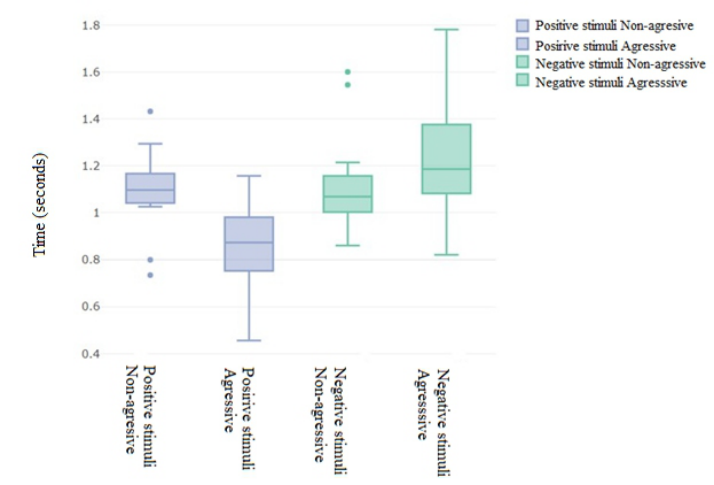
Figure 1 illustrates the results showing that the non-aggressive adole- scent group exhibited a longer fixation time towards positive stimuli than their aggressive counterparts. Conversely, the aggressive adolescent group demonstrated a longer fixation time towards negative stimuli than the non-aggressive group. These findings suggest that there may be significant differences in attentional processes between aggressive and non-aggressive individuals, particularly with regard to emotional stimuli.
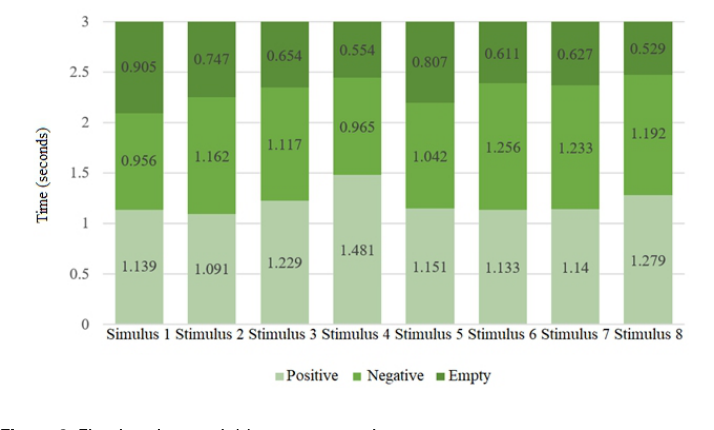
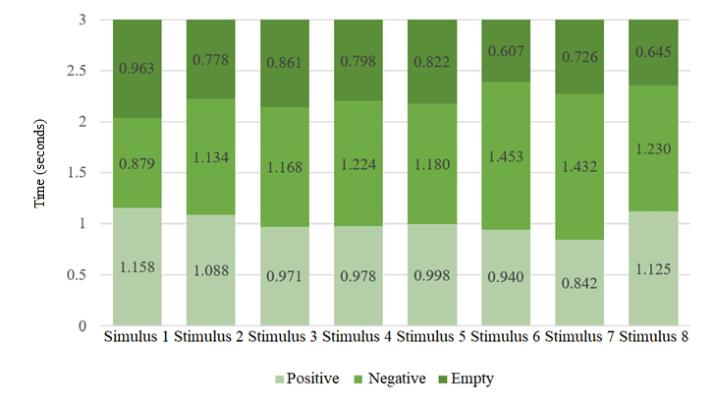
The findings on fixation patterns in both the aggressive and non-aggressive adolescent groups reveal that the non-aggressive participants exhibited a significantly higher fixation time of positive stimuli than negative stimuli. In contrast, the aggressive participants demonstrated a considerably higher fixation time on negative stimuli than on positive stimuli (refer to Figure 2 and Figure 3). These observations suggest that aggressive and non-aggressive individuals may react differently to emotional stimuli.
Table 1. Results of Kolmogorov-Smirnov tests for normality of fixation time and fixations data for positive and negative stimuli.
Table available in the original PDF paper.
Variable D value p-value Fixation time (positive) 0.061 5.395e-09*** Fixation time (negative) 0.036 0.00587* Fixation time (positive) 0.096 < 2.2e-16*** Fixation time (negative) 0.103 < 2.2e-16***
Note. ***p <.001, *p <.05.
Exploring the Role of Visual Attention in Aggressive Behavior 243
Figure 1: Boxplot fixation duration variable for aggressive vs non-aggressive groups.Figure 2: Fixation time variable non-aggressive group.
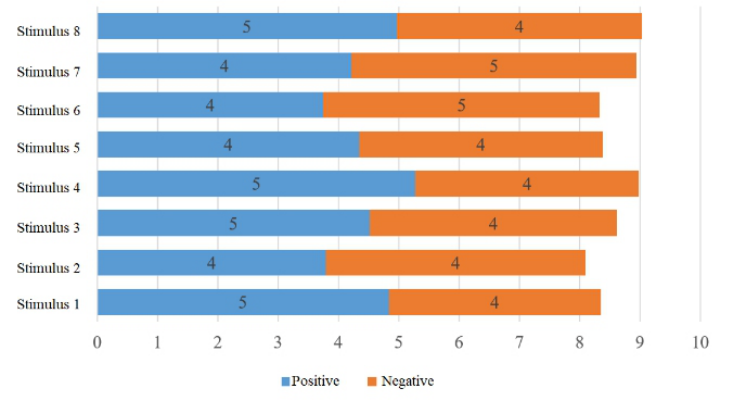
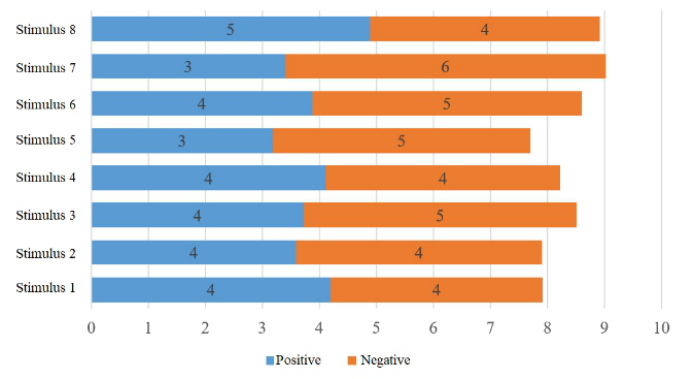
According to the results obtained it was found that the non-aggressive ado- lescent group exhibited an average of up to 9 fixations on both the positive and negative stimuli, with a slight predominance of fixations on positive sti- muli (one more than negative stimuli). Conversely, the aggressive adolescent group demonstrated an average of up to 9 fixations on positive and negative stimuli, with a notable predominance of fixations on negative stimuli (three more than positive stimuli), as illustrated in Figure 4.
Figure 3: Fixation time variable aggressive group.Figure 4: Non-aggressive fixation count on positive and negative stimuli.
In contrast to their aggressive peers, non-aggressive adolescents tend to exhibit a greater propensity towards positive stimuli, as evidenced by their predominant fixation on such stimuli. In contrast, aggressive adolescents exhibit a preponderance for negative fixation, whereby their attention is predominantly focused on negative stimuli (Figure 5).
The U Mann-Whitney test’s statistical analysis examines and compares fixation duration and fixation count for positive and negative stimuli between the aggressive and non-aggressive groups. The findings indicate significant disparities between the two groups across all variables, as presented in Table 2.
Exploring the Role of Visual Attention in Aggressive Behavior 245
Figure 5: Aggressive fixation count on positive and negative stimuli.Table 2. Results of U Mann-Whitney tests for differences between aggressive and non-aggressive groups in fixation duration and fixation count for positive and negative stimuli.
The visual tracking data analyzed establish that aggressive adolescents are generally more sensitive to negatively valanced stimuli, unlike non-aggressive adolescents who present a general tendency towards positive stimuli.
CONCLUSION
This study explored the relationship between eye-tracking measurements and aggressive traits in adolescents. The results showed that adolescents with aggressive traits displayed a higher fixation count and duration on negative stimuli than non-aggressive individuals.
The observed differences in fixation duration and fixation count, wherein aggressive adolescents displayed a greater fixation on negative stimuli and non-aggressive adolescents exhibited a propensity for positive stimuli, highli- ght the sensitivity of aggressive individuals to negatively valanced stimuli. These findings are consistent with Skinner’s (1953) definition of behavi- oral attention and support Arias’ (2013) suggestion that environmental factors can influence the attentional patterns of adolescents with aggressive behaviors.
These results indicate that aggressive behavior may be linked to selective attention towards negative stimuli, which could hinder an individual’s ability to perceive positive stimuli in their environment. These findings highlight the importance of eye tracking in studying aggressiveness and provide insights into the potential underlying mechanisms that contribute to aggressive beha- vior in adolescents. This study contributes to the growing literature on visual attention and aggressive behavior, underscoring the need for further research. Eye tracking could be a valuable tool in future research studies on aggressive behavior, aiding in developing targeted interventions to reduce aggression in adolescents.
REFERENCES
Anderson, C. y. (2002). Los efectos de la violencia mediatica en lasociedad. Ciencia. Andrade Castro, K. (2020). Validación de imágenes afectivas de los sets IAPS y OASIS en adolescentes. Validación de imágenes afectivas delos sets IAPS y OASIS en adolescentes. Cuenca, Azuay, Ecuador: UDA. Andrade-Castro, K., Alvarado-Cando, O., Ortega-Chasi, P., Cobos-Cali, M. (2020).
An Eye Tracking System to Perform the Wechsler Intelligence Children-Fifth Edition (WISC-V) Test: A Case Study. In: Ahram, T., Falcão, C. (eds) Advances in Usability and User Experience. AHFE 2019. Advances in Intelligent Systems and Computing, vol. 972. Springer, Cham. https://doi.org/10.1007/978-3-030-19135- 1_84. Argudo-Vázcones, A., Alvarado-Cando, O., Caldero, O., Buele, F., Ortega-Chasi, P. y Cobos-Cali, M. (2021). Measure of the Attentional Bias in Children Using Eye Tracking During a Psychological Test. In: Ahram, T. Z., Falcão, C. S. (eds) Advances in Usability, User Experience, Wearable and Assistive Technology. AHFE 2021. Lecture Notesin Networks and Systems, vol. 275. Springer, Cham. https://doi.org/10.1007/978-3-030-80091-8_96. Arias, W. (2013). Agresión y violencia en la adolescencia: La importancia de la
familia. Revista psicologíca de UNIFE, 23–34. Bartholow, B. A. (2005). Atención selectiva a estímulos violentos prototípicos versus no prototípicos: evidencia de potenciales cerebrales relacionados con eventos. Revista de Psicología Anormal. Bours, C. B. (2018). Emocional face recognition in male adolescents with autism spe-
ctrum disorder or disruptive behavior disorder: An eye tracking study. European child & adolescent psychistry, 1143–1157. Bushman, B. y. (2009). Consideraciones metodologicas y teoricas en elestudios de la agresion mediante el uso de videojuegos violentos. Revista de Psicología Anormal. Gazepoint. (2021) “Gazepoint GP3 eye tracker.”. Obtenido de Gazepoint: https:
//www.gazept.com/product/gp3hd/. Gómez-Ochoa, N. G., Ortega-Chasi, P., Alvarado-Cando, O., Cobos-Cali, M., Artega-Sarmiento, S. (2020). Eye Tracking in the Diagnosis of Aggressive Behaviors and Emotions: A Systematic Review of the Literature. In: Ahram, T. (eds) Advances in Human Factors in Wearable Technologies and Game Design. AHFE 2019. Advances in Intelligent Systems and Computing, vol. 973. Springer, Cham. https://doi.org/10.1007/978-3-030-20476-1_13. Kurdi, B., Lozano, S., & Banaji, M. (2016). Introducing the Open Affective
Standardized Image Set (OASIS). Behavior Research Methods, 457–470. Lavel, C., Griffey, M., Ping, L., Kirk, W., Menno, V., Horn, P., & Pedapati, E. y.
(2018). Eye gaze patterns associated with aggresive. Psychiatr.
Exploring the Role of Visual Attention in Aggressive Behavior 247
Niño-González, J. C.-C.-M. (2019). Publicidad in-game (IGA): un análisis exploratorio de patrones de personalidad y de respuesta biométrica mediante expresión facial, GSR y eye-tracking. Prisma Social Revista de Ciencias Sociales, 7. Skinner. (1953). Science and human behavior. Macmillan.
LISTED IN THE AHFE DIGITAL BOOKSTORE CATALOGUE
Explore the complete digital volume
Neuroergonomics and Cognitive Engineering
Read this individual research paper free through the original publisher, or explore the full digital proceedings book.
ISBN 978-1-958651-78-0
Explore this ISBN in the AHFE Bookstore ↗Listed in the July 2026 bookstore catalogue; search by ISBN to confirm current availability · Digital book purchase optional