2 Neurosciencies Group, Universidad del Azuay, Cuenca-Ecuador ↗
3 Neurosciencies Group, Universidad del Azuay, Cuenca-Ecuador; School of Computer Science, Universidad del Azuay, Cuenca-Ecuador ↗
4 Neurosciencies Group, Universidad del Azuay, Cuenca-Ecuador; School of Psychology, Universidad del Azuay, Cuenca-Ecuador ↗
5 Neurosciencies Group, Universidad del Azuay, Cuenca-Ecuador; Centro de Investigación de Ingeniería Electrónica, Universidad del Azuay Cuenca-Ecuador ↗
Aggressiveness is an emotional state associated with physical or verbal violence or destruction towards others or oneself. Aggressive behaviors in adolescents are a frequent reason of consultation in mental health care services because it generates negative consequences in the life of the person and their environment, in addition, it increases the probability of school dropout, psychiatric disorders and substance abuse. The study contemplates the presentation of images with positive valence and images with negative valence of the set IAPS to 60 adolescents who were previously evaluated with CAPI-A test, divided into 30 adolescents with aggression and 30 without aggression. The results were analyzed through an eye tracker and indicate the existence of bias in the visual attention of aggressive adolescents towards negative stimuli, while that non-aggressive adolescents tend to focus on positive stimuli.
Aggressiveness refers to any intentional action performed to provoke harm towards others or oneself, aggressive behavior can be verbal or physical, and the aggressor attacks hopping that the victim is harmed in some way (Arsenio, 2004; Li et al., 2010; Ramírez et al., 2020). Adolescence is a biopsychosocial development phase considered one of the most important stages of life because in this phase of the life cycle occurs physical, psychological, and social change, this transition changes the relationships of adolescents with other people in the family, social and school environment (Glock et al., 2008; Musitu et al., 2012). The environ- ment family passes to second place and adolescents are mostly influenced by the social environment, they behave violently within the group to obtain respect and popularity among themselves, increasing the probability that these aggressive behaviors continue, from this age everyone wants to imi- tate the most powerful of the group, even if he is a negative leader (López, 2013), it increases the probability of having others violent behaviors in the
future, school dropout, psychiatric disorders and substance abuse (Estévez y Jiménez, 2015).
Aggression is the result of a complex interplay of various neurochemical substances and other factors that may be: environmental, neuroanatomical, hormonal, and genetic, specific structures such as the frontal lobe, hippocam- pus, amygdala, and thalamus are involved in the regulation and control of decision making, behavior, and aggressive behavior (Rubio, 2009; Calero e Ibañez, 2020; Ortega y Alcazar, 2016). In adolescents, environmental factors induce aggressive behavior, but, mostly the biological factor, such as serotonin, norepinephrine, and dopamine neurotransmitters, influence these aggressive responses (Arias, 2013).
Identifying new modalities for the early detection of aggressive behavi- ors will help prevent them in the future (Lin et al., 2016). Visual tracking technology known as eye tracking is responsible for obtaining and analy- zing the eye movements of a person toward a certain scene or image, also allows us to perform inferences about our attention patterns and cognitive processing, recording what the subject observes, the time interval of his obse- rvation, visual trajectory and pupil dilation to presented stimuli (Isaacowitz et al., 2015; Duchowski, 2017).
The eye tracking methodology has identified that aggressive adolescents put more attention to signals of hostility and threat in other people’s behavior and that gaze fixation time in hostile signals can predict aggressive behavior (Lin et al., 2016; Lauel et al., 2018). Adolescents with autism spectrum disor- der see less to the eyes in emotional images of fear, anger, joy, and neutrals, also, they take significantly more time to fix their gaze, while adolescents with oppositional defiant disorder display faster initial gaze fixation compa- red to others (Bours et al., 2018). Adolescents with disorder conduct display significant hypo-activation in the right anterior insula during emotional face processing and spend significantly less time in the eye region (Menks et al., 2021), in addition, display deficiencies in emotion recognition and a reduced tendency to fix their gaze in the region face when they see expressions of fear and sadness, males recognize emotions worse than women and display a redu- ced tendency a fix their eyes (Key et al., 2018; Alvarado-Cando et al., 2019; Andrade-Castro et al., 2020; Gomez-Ochoa et al., 2020; Argudo-Vásconez et al., 2021).
Aggressive tendencies predict violent, suicidal, or self-injurious behaviors, while that eye movement allows for obtaining objective information (Bercea, 2011; Duchowski, 2017). For this reason, this research aimed to identify the presence or absence of a pattern of fixation in adolescents with aggressive behaviors compared with adolescents without aggressive behaviors.
METHODOLOGY
A non-experimental quantitative, comparative, and descriptive study was performed with a sample of n = 60 adolescents (age range = 12-17 years), to whom, the CAPI-A aggressiveness test (Andreau, 2010) was previously applied, dividing them into n = 30 adolescents with aggression and n = 30 adolescents without the aggression of the school “Mario Rizzini” in Cuenca- Ecuador (Table 1).
Fixation Analysis of Affective Picture Processing in Aggressive Adolescent 63
Table 1. Distribution of the study sample.
Table available in the original PDF paper.
Sample Aggressive Non-aggressive Total
12 years 4 2 6 13 years 3 6 9 14 years 5 7 12 15 years 6 4 10 16 years 3 4 7 17 years 9 7 16 Total 30 30 60
Software Implementation For data management, the Gazepoint Analysis software was used to obten- tion eye tracking parameters and digitize stimuli (Gazepoint, 2021).
Procedure Sixteen images from IAPS set previously validated in Cuenca-Ecuador (Andrade, 2020; Gómez, 2020) were used, divided into 8 images with a positive valence or pleasant and 8 images with a negative valence or unple- asant, images that presented violence and explicit sexuality were omitted. The random digitization of the IAPS set images was performed with the for- mula =random() to determine the order and location of images, within each slide, a positive and negative image located on the right or left side were pla- ced interspersed, then, each image was uploaded to the Gazepoint Analysis software. To record eye movements GP3 eye tracker was used, it contains a high-resolution infrared camera with an image processing system (Gaze- point, 2021), the same one that was calibrated according to each participant. Between each of the slides was an image called “Fixation Cross”, this image serves to focus the gaze after each visual stimulus. The sample time for each slide was 3 seconds and 2 seconds for the fixation cross.
Results
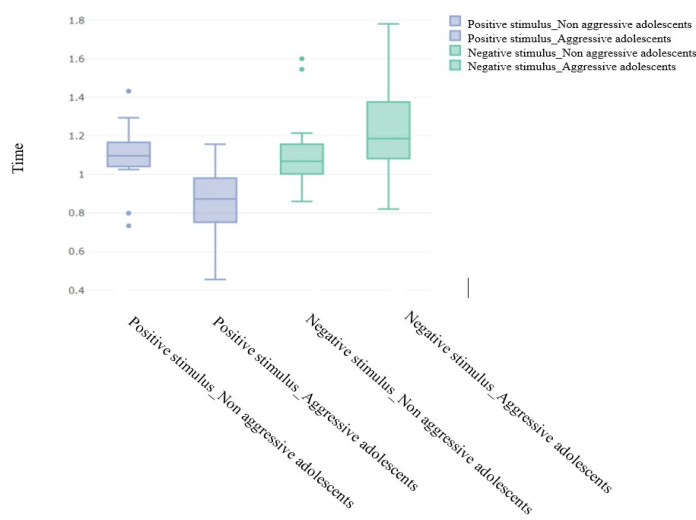
A comparative analysis was performed between the groups of aggressive and non-aggressive adolescents using the box-and-whiskers diagram, it was obse- rved that the group of non-aggressive adolescents have a higher prevalence for positive stimuli than aggressive adolescents, and in comparison, when comparing negative stimuli, aggressive adolescents have a higher prevalence than non-aggressive adolescents (Figure 1).
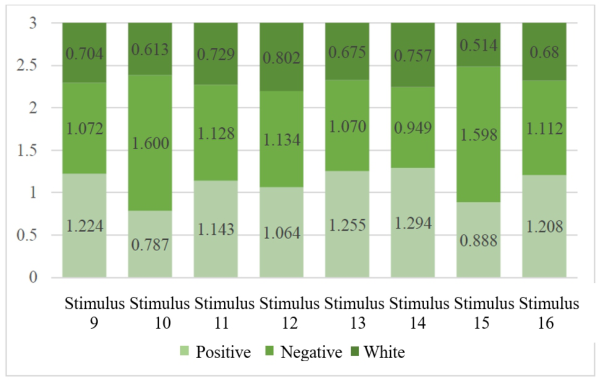
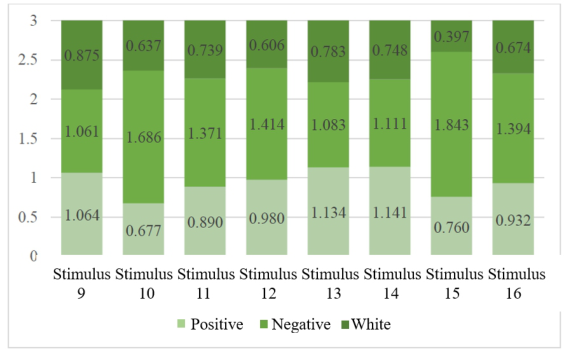
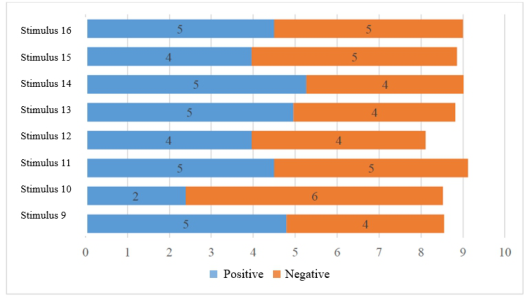
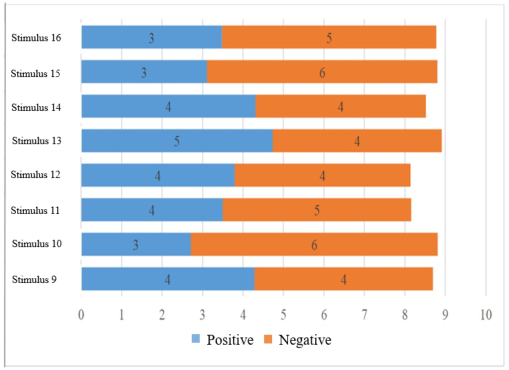
The measurements of time (Figures 2 and 3) and the number of fixati- ons (Figures 4 and 5) indicate differences in the attention between the two groups. Aggressive adolescents focused faster on images with negative sti- muli, and they saw more times and for more time these images, contrasting with non-aggressive adolescents, in whom, attention was more dispersed, they had fewer images with negative stimuli and focused more on images with positive stimuli.
Figure 1: Comparative analysis between aggressive and non-aggressive adolescents.Figure 2: Results of time of non-aggressive adolescents.
A comparative analysis of time and fixations to positive and negative sti- muli was performed between aggressive and non-aggressive women and men through the means and standard deviations of the estimates obtained in the 16 images of the IPAS set. In the group of non-aggressive adolescents, comparing the time and fixa- tions in positive stimuli, men obtained a higher prevalence than women, and
Fixation Analysis of Affective Picture Processing in Aggressive Adolescent 65
Figure 3: Results of time of aggressive adolescents.Figure 4: Number of fixations of non-aggressive adolescents.
about the time in negative and fixations negatives, women obtained a higher prevalence than men (Tables 2 and 3).
In the group of aggressive adolescents, comparing the time and fixations in positive stimuli, men obtained a higher prevalence than women, about the time in negative stimuli, women obtained a higher prevalence than men
Table 2. Comparison of non-aggressive men/women. Variable time and fixations to positive stimuli.
Table available in the original PDF paper.
Positive stimuli, non-aggressive Time Fixations
M SD M SD Men 0.818 0.190 3.344 0.780 Women 0.815 0.262 3.132 1.003
Figure 5: Number of fixations of aggressive adolescents.
and in the fixations in negative stimuli, men obtained higher prevalence that women (Tables 4 and 5).
Table 3. Comparison of non-aggressive men/women. Variable time and fixations to negative stimuli.
Table available in the original PDF paper.
Negative stimuli, non-aggressive Time Fixations
M SD M SD Men 1.245 0.289 4.521 0.852 Women 1.384 0.327 4.694 0.849
Table 4. Comparison of aggressive men/women. Variable time and fixation to positive stimuli.
Table available in the original PDF paper.
Positive stimuli, aggressive Time Fixations
M SD M SD Men 1.117 0.196 4.429 1.009 Women 0.992 0.217 3.750 0.862
Table 5. Comparison of aggressive men/women. Variable time and fixation to negative stimuli.
Table available in the original PDF paper.
Negative stimuli of IAPS set_adolescents aggressive Time Fixations
M SD M SD Men 1.130 0.243 4.402 0.965 Women 1.179 0.309 4.149 1.027
Fixation Analysis of Affective Picture Processing in Aggressive Adolescent 67
CONCLUSION
The data obtained in this research indicate the existence of a bias in visual attention between non-aggressive and aggressive adolescents. Aggressive ado- lescents are more sensitive to negative valence stimuli, they focus faster and see more time these stimuli, this result matches with Arias (2013), who indica- tes that adolescents with aggressive behaviors tend to focus more on negative events due to the environment by which they are influenced, while that the attention of the non-aggressive adolescents are more dispersed, they see fewer images with negative stimuli and focus more on images with positive stimuli.
Women with aggressive behaviors tend to observe more time and obtain a greater number of fixations in negative stimuli in comparison to aggressive men, this result agrees with some studies about emotion processing that refer that men tend to process emotional stimuli in terms of their implications for the required action and are somewhat indifferent to the negative emotions, while that women tend to put more attention to the feelings provoked by stimuli (Wager et al., 2003 Gardener et al., 2013; Kong et al., 2014; Lungu et al., 2015).
The results of this research add to the evidence that selective visual atten- tion when associated with hostile emotions can predict aggressive or violent behaviors.
REFERENCES
Alvarado-Cando, O., Belén Jara, G., Barzallo, P., Torres-Salamea, H. (2019). A Software Based on Eye Gaze to Evaluate Mathematics in Children with Cerebral Palsy in Inclusive Education. In: Ahram, T., Falcão, C. (eds) Advances in Usability, User Experience and Assistive Technology. AHFE 2018. Advances in Intelligent Systems and Computing, vol. 794. Springer, Cham. https://doi.org/10.1007/978- 3-319-94947-5_89 Andrade, K. (2020). Validación de imágenes afectivas de los sets IAPS y OASIS en
adolescentes. (Tesis de maestría). Universidad del Azuay, Cuenca, Ecuador. Andrade-Castro, K., Alvarado-Cando, O., Ortega-Chasi, P., Cobos-Cali, M. (2020).
An Eye Tracking System to Perform the Wechsler Intelligence Children-Fifth Edi- tion (WISC-V) Test: A Case Study. In: Ahram, T., Falcão, C. (eds) Advances in Usability and User Experience. AHFE 2019. Advances in Intelligent Systems and Computing, vol 972. Springer, Cham. https://doi.org/10.1007/978-3-030-19135- 1_84 Andreu, J. (2010). CAPI-A cuestionario de agresividad premeditada e impulsiva en adolescentes. Madrid: TEA Ediciones. Argudo-Vázcones, A., Alvarado-Cando, O., Caldero, O., Buele, F., Ortega-Chasi,
P. y Cobos-Cali, M. (2021). The measure of the Attentional Bias in Children Using Eye Tracking During a Psychological Test. In: Ahram, T. Z., Falcão, C. S. (eds) Advances in Usability, User Experience, Wearable and Assistive Technology. AHFE 2021. Lecture Notes in Networks and Systems, vol 275. Springer, Cham. https://doi.org/10.1007/978-3-030-80091-8_96 Arias, W. (2013). Agresión y violencia en la adolescencia: La importancia de la familia. Revista psicológica de UNIFE, 21(1), 23–34. Bercea, M. (2011). Anatomy of methodologies for measuring consumer behavior
in neuromarketing research. University of Ia¸si, Romania. Romanian National Authority.
Bertsch, K., Krauch, M., Stopfer, K., Haeussler, K., Herpertz, S. C., & Gamer, M.
(2017). Interpersonal threat sensitivity in borderline personality disorder: an eye- tracking study. Journal of personality disorders, 31(5), 647–670. 101. Bours, C., Bakker-Huvenaars, M., Tramper, J., Bielczyk, N., Scheepers, F., Nijhof, K & Buitelaar, J. (2018). Emotional face recognition in male adolescents with autism spectrum disorder or disruptive behavior disorder: An eye-tracking study. European child & adolescent psychiatry, 27(9), 1143–1157. Calero, P., e Ibáñez, J. (2020). Neuropsicología de las conductas agresivas: apor-
taciones a la criminología. Revista Iberoamericana de Neuropsicología, 3(2), 171–183. Duchowski, A. (2017). Eye tracking methodology. Theory and practice. Springer, vol.
Second edition, p. 335. Estévez, E., y Jiménez, T. (2015). Conducta agresiva y ajuste personal y escolar en una muestra de estudiantes adolescentes españoles. Universidad Psychologica, 14 (1), 111–124. Gardener, E., Carr, A., MacGregor, A., y Felmingham, K. (2013). Diferencias sexuales
y regulación emocional: un estudio potencial relacionado con eventos. PloS uno, 8 (10), e73475. Gazepoint. (2021). “Gazepoint GP3 eye tracker.” https://www.gazept.com/product /gp3hd/. Glock, C., Wuthnow, R., Piliavin, J., & Spencer, M. (2008). Adolescent Evolution.
Fifth Edition. New – York: Harper & Row. Gómez, N. (2020). Validación de imágenes afectivas de los sets IAPS y OASIS en niños y niñas. (Tesis de maestría). Universidad del Azuay, Cuenca, Ecuador. Gómez-Ochoa, N. G., Ortega-Chasi, P., Alvarado-Cando, O., Cobos-Cali, M.,
Artega-Sarmiento, S. (2020). Eye Tracking in the Diagnosis of Aggressive Beh- aviors and Emotions: A Systematic Review of the Literature. In: Ahram, T. (eds) Advances in Human Factors in Wearable Technologies and Game Design. AHFE 2019. Advances in Intelligent Systems and Computing, vol 973. Springer, Cham. https://doi.org/10.1007/978-3-030-20476-1_13. Isaacowitz, D., Livingstone, K., Harris, J., & Marcotte, S. (2015). Mobile “Eye Tracking” Reveals Little Evidence for Age Differences in Attentional Selection for Mood Regulation. Emotion, 15(2), 151–161. Key, N., Graf, E., Adams, W., & Fairchild, G. (2018). Facial emotion recognition
and eye movement behavior in conduct disorder. Journal of Child Psychology and Psychiatry, 59(3), 247–257. Kong, F., Zhen, Z., Li, J., Huang, L., Wang, X., Song, Y., & Liu, J. (2014). Sex-related neuroanatomical basis of emotion regulation ability. PloS one, 9(5), e97071. Lauel, C., Griffey, M., Ping-I, L., Kirk, W., Menno, V., Horn, P., Pedapati, E &
Barzman, D. (2018). Eye gaze patterns associated with aggresive. Psychiatr Q. https://doi.org/10.1007/s11126-018-9573-8. Lin, P., Hsieh, C., Juan, C., Hossanin, M., Erickson, C. & Lee, Y. (2016). Predicting Aggressive Tendencies by Visual Attention Bias Associated with Hostile Emotions. PLoS ONE, 11(2). López, L. 2013. Las manifestaciones del acoso escolar Cómo acosan los alumnos y
alumnas? Revista Iberoamericana de Educación; Vol. 62, N
1, 1–13. Lungu, O., Potvin, S., Tikàsz, A. y Mendrek, A. (2015). Diferencias sexuales en la conectividad fronto-límbica efectiva durante el procesamiento de emociones negativas. Psiconeuroendocrinología, 62, 180–188. Menks, W., Fehlbaum, L., Borbás, R., Sterzer, P., Stadler, C. y Raschle, N. (2021). Eye
gaze patterns and functional brain responses during emotional face processing in adolescents with conduct disorder, NeurImage: Clinical, 29, 102519.
Fixation Analysis of Affective Picture Processing in Aggressive Adolescent 69
Musitu, G., Palmero, F., y Cordero, N. (2012). Violencia, victimización y cyberbullying en adolescentes escolarizados/as. Sevilla: PabloD Olavide. Ortega, J., y Alcázar, M. (2016). Neurobiología de la agresión y la violencia. Anuario
de psicología jurídica, 26(1), 60–69. Rubio, E. (2009). La agresividad vista desde la neurología. Revista electrónica de psicología. Wager, T., Phan, K., Liberzon, I., & Taylor, S. (2003). Valence, gender, and laterali-
zation of functional brain anatomy in emotion: a meta-analysis of findings from neuroimaging. Neuroimage. 19, 513–531.
LISTED IN THE AHFE DIGITAL BOOKSTORE CATALOGUE
Explore the complete digital volume
Physical Ergonomics and Human Factors
Read this individual research paper free through the original publisher, or explore the full digital proceedings book.
ISBN 978-1-958651-79-7
Explore this ISBN in the AHFE Bookstore ↗Listed in the July 2026 bookstore catalogue; search by ISBN to confirm current availability · Digital book purchase optional