Manuel Gomez, Samuel Montalvo, Daniel Conde, Gabriel Ibarra-Mejia (2023). Differences in Circulating Cortisol Levels After Completing Hand Ergometer Exercise with and Without Graded Compression Arm Sleeves. In: Physical Ergonomics and Human Factors. AHFE Open Access, vol. 103, pp. 144–149. https://doi.org/10.54941/ahfe1003954
Cortisol has many physiological effects on the human body and its concentration increases in an intensity-dependent manner. The prolonged physical stress increases total cortisol concentration. Anecdotal data suggests that using graded compression sleeves forearm alleviates pain in the upper and lower limbs. The physiological mechanisms underlying these benefits are not fully understood. This study aimed to assess the effects of wearing graded compression (13-18 mmHg) sleeves on circulating cortisol after completing a physical activity with three different intensities. The study included six participants between 18 and 25 years old without a known history of injuries in the upper limbs. The proper sleeve size was fitted to the participants following the manufacturer’s instructions (On-Site Therapy, Tallahassee,FL.), and anthropometric measurements were taken. All the participants randomly completed a cycle hand ergometer exercise at 60 RPM at 25 W., 50 W., and 75 W for a maximum of 10 minutes with and without forearm sleeves. All the participants rested for at least 72 hours before the next exercise session to avoid muscular fatigue. Venous blood samples were drawn before and after completing each session to compare the effects of wearing graded compression sleeves on the circulating cortisol concentration. Cortisol concentrations were analyzed by enzyme link immunosorbent assay (ELISA). A Linear mixed-effects model was used for analysis. Participants wearing the compression sleeves showed a significant decrease in cortisol concentration at 50 W only. This study shows the potential benefits of wearing compression sleeves while performing activities involving the upper limbs. Even though our results show a decrease in cortisol concentration at 50 W., a larger sample size would be needed to dictate a significant difference in the physiological response associated with the use of graded compression sleeves.
The effects of elevated circulating cortisol levels are well documented. Eleva- ted basal and circulating cortisol levels are associated with higher body mass index (BMI), greater waist-to-hip ratio (Fraser et al., 1999), and increased
Differences in Circulating Cortisol Levels After Completing Hand Ergometer Exercise 145
insulin resistance (Faggiano et al., 2003; Tauchmanov´a et al., 2002). Corti- sol is the primary stress hormone in humans. It targets central and peripheral nervous system processes (Lupien et al., 2007). Cortisol secretion is vital for maintaining homeostasis in the body (McEwen, 2000; Tsigos and Chrou- sos, 2002). It follows a circadian rhythm with a peak rise after waking up and declining throughout the day (Weitzman et al., 1971). However, when the body releases cortisol outside the circadian rhythm, the increased expres- sion is associated with physiological and psychological stress (Herman et al., 2005). Increases in circulating cortisol levels are intensity-dependent. Physical activity performed at 60% (moderate intensity) and 80% (high intensity) of the maximal oxygen consumption (VO2 max) produces a significantly higher concentration of circulating cortisol (Hill et al., 2008). Anecdotal data describes the benefits of using graded compression sleeves in the forearm to alleviate pain in the upper and lower limbs (Doan et al., 2003). How- ever, the physiological mechanisms underlying the benefits of using graded compression sleeves are not fully understood.
This study aimed to assess the effects of wearing graded full-arm com- pression sleeves (13-18 mmHg) on circulating cortisol concentration after completing physical activity bouts with three different intensities. It was hypothesized that wearing compression sleeves would result in a lower concentration of circulating cortisol when compared to not wearing the sleeves under similar exercise intensity.
METHODS
The study included six male participants from the University of Texas at El Paso between 18 and 25 years old without a known history of injuries in the upper limbs, blood pressure below 120/80 mmHg, BMI below 25 kg/m2, and not currently taking anti-inflammatory or pain medication. All the partici- pants were asked to abstain from performing additional strenuous physical activity during their participation in the study.
During their first visit to the laboratory, participants were fitted for the proper sleeve size according to the manufacturer’s instructions (On-Site The- rapy, Tallahassee, FL.). All the participants used full-arm sleeves that have graded compression only in the forearm. Afterward, anthropometric and baseline measurements such as weight, height, BMI, and blood pressure were collected. Additionally, a 10 cc blood sample was collected from the mid-cubital vein of their non-dominant arm. The blood samples were imme- diately centrifuged at 1,500 x g for 10 minutes and the serum was analyzed to determine basal circulating cortisol levels using a cortisol enzyme-linked immunosorbent assay (ELISA) kit (Enzo Life Sciences, Farmingdale, NY.).
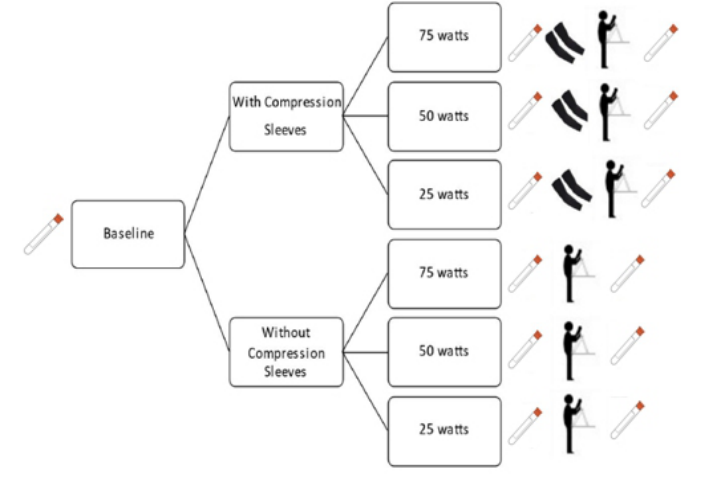
After all baseline data were collected, the participants returned to the lab on different days to complete six bouts of physical activity in a random order, with and without sleeves at 25 W, 50 W, and 75 W, as shown in Figure 1. The physical activity required the participants to complete a simulated work ses- sion in a pedal hand ergometer (Angio, Lode, Groningen, Netherlands). Each stage required a cadence of 60 RPM for 10 minutes or until failures. A 10 cc
Figure 1: Experimental design. After baseline data were obtained, participants per- formed a total of six arm-ergometer exercises (three wearing sleeves and three not wearing sleeves) randomly.
venous blood sample was drawn before and after completing each session to compare the effects of wearing graded compression sleeves on the circula- ting cortisol concentration as previously described. All the participants rested for at least 72 hours before the next exercise session to avoid the delayed onset of muscle soreness (OMS). A Linear mixed-effects model was utilized for analysis, in which cortisol concentration was the dependent variable, the condition was a fixed factor, and the subjects were considered the random factor. Significance was set priori at an alpha level of 0.05.
RESULTS
The participants were 23.66±1.24 years old, with a height of 1.71±0.04 meters, weight of 63.73±5.21 kg, body mass index of 21.59±1.73, systolic blood pressure of 107.83±10.80, and diastolic blood pressure of 71.5±3.68. The use of compression sleeves showed a decrease in cortisol concentration at 50 W.
DISCUSSION
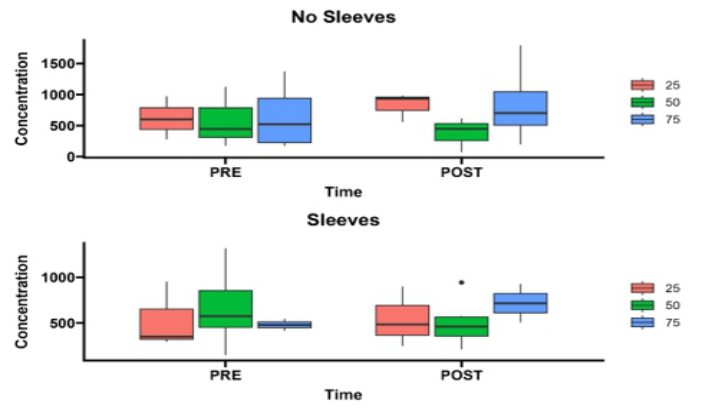
This study aimed at identifying the changes in circulating cortisol levels in a group of participants after completing a series of repetitive cycles of arm cranking under three levels of muscular exertion and either wearing a full- arm graded compression sleeve or not. Our results revealed an increase in the concentration of cortisol compared to baseline levels. The concentration of cortisol wearing the graded compression sleeves or not, did not yield a significant difference at 25W and 75W of power output, as shown in Figure 2.
Differences in Circulating Cortisol Levels After Completing Hand Ergometer Exercise 147
Figure 2: Boxplot with individual data points between normalized cortisol levels to baseline among conditions.
However, a small effect size with a significant lower expression of circulating cortisol when participants completed the task at 50w of power output and wearing the full-arm sleeves. Therefore, we infer that wearing the sleeves during the sub-maximal power output exercise had a small effect on lowering the expression of cortisol.
Physical activity has the potential to cause a stress response. Cortisol is a biomarker for stress monitoring, but its biological and therapeutic impor- tance is still debated due to the intricacy of cortisol production processes, circadian cycles, and environmental influences including mood and food (Pearlmutter et al., 2020). The effects on the expression of cortisol have been studied previously. In 2002, Jacks et al. in 2002, and Hill et al. in 2008, iden- tified the changes in saliva cortisol concentration in response to exercise at three different intensity levels, supporting the hypothesis that cortisol levels are mainly expressed only during high intensity exercise (Hill et al., 2008; Jacks et al., 2002). The stress caused by the maximal arm power output exe- rcise may have contributed to the variation in cortisol secretion levels among study participants during the bouts without wearing the graded compression sleeves.
The use of compression garments (CG) has been linked to faster recovery after exercise-induced muscle damage. Lower body and lower limb com- pression garments have grown in popularity as a recovery tool both during and after exercise, and it has been widely studied in sport performance and endurance. For example, compression garments were found to reduce fatigue- induced strength loss, and reduced fatigue-induced strength loss (N´egyesi et al., 2021). However, even though arm and forearm compression garments are also a common intervention used in sports to improve performance and recovery, there is not enough evidence to show that wearing arm/forearm compression clothing during intense exercise actually improves performance.
Some evidence suggests that forearm compression can help improve muscle tissue oxygenation. However, in a study with rock climbers, it did not enhance hand grip strength and endurance, performance parameters, physiological responses, or perceptual measures.
Our study is not without limitations. Even though our results show a decre- ase in cortisol concentration at 50 W., a larger sample size is needed in order to dictate a significant difference in the physiological response are associated with the use of graded compression sleeves. All participants failed to com- plete ten minutes or work-output at 75W. Therefore, we infer that the length of time performing at 75W was sufficient to elicit the expression of cortisol, but not enough to identify a potential difference with or without wearing the full-arm sleeves. However, we do provide additional biochemical data from human participants that support the potential effect of compressive garments on muscular fatigue and recovery that requires further investigation.
CONCLUSION
Our results suggest that wearing the full arm sleeves would be associated with a lower expression of cortisol but only during strenuous and repetitive muscu- lar work. This study shows the potential benefits of wearing compression sleeves while performing activities involving the upper limbs by reducing cor- tisol concentration. However, we do not recommend that monitoring saliva cortisol levels are used as the sole biomarker indicating physical activity indu- ced stress, since it is mainly associated with strenuous physical exercise. Other variables must be also considered, such as body composition, sex, and fat intake to name a few. As well as determining the proper intensity on which, the compression sleeves maximize their function.
REFERENCES
Doan B, Kwon Y-H, Newton R, Shim J, Popper E, Rogers R, Bolt L, Robertson M and Kramer W. Evaluation of a lower-body compression garment. Journal of sports sciences. 2003;21: 601–610. Faggiano A, Pivonello R, Spiezia S, De Martino MC, Filippella M, Di Somma C,
Lombardi G and Colao A. Cardiovascular risk factors and common carotid artery caliber and stiffness in patients with Cushing’s disease during active dis- ease and 1 year after disease remission. The Journal of Clinical Endocrinology & Metabolism. 2003;88: 2527–2533. Fraser R, Ingram MC, Anderson NH, Morrison C, Davies E and Connell JM. Cortisol effects on body mass, blood pressure, and cholesterol in the general population. Hypertension. 1999;33: 1364–1368. Herman JP, Ostrander MM, Mueller NK and Figueiredo H. Limbic system mecha-
nisms of stress regulation: hypothalamo-pituitary-adrenocortical axis. Progress in Neuro-Psychopharmacology and Biological Psychiatry. 2005;29: 1201–1213. Hill E, Zack E, Battaglini C, Viru M, Viru A and Hackney A. Exercise and circulating cortisol levels: the intensity threshold effect. Journal of endocrinological investigation. 2008;31: 587–591. Hill EE, Zack E, Battaglini C, Viru M, Viru A and Hackney AC. Exercise and circu-
Differences in Circulating Cortisol Levels After Completing Hand Ergometer Exercise 149
Jacks DE, Sowash J, Anning J, McGloughlin T and Andres F. Effect of exercise at three exercise intensities on salivary cortisol. J Strength Cond Res. 2002;16: 286–9. Lupien SJ, Maheu F, Tu M, Fiocco A and Schramek TE. The effects of stress and stress
hormones on human cognition: Implications for the field of brain and cognition. Brain and cognition. 2007;65: 209–237. McEwen BS. The neurobiology of stress: from serendipity to clinical relevance. Brain research. 2000;886: 172–189. Négyesi J, Zhang LY, Jin RN, Hortobágyi T and Nagatomi R. A below-knee com-
pression garment reduces fatigue-induced strength loss but not knee joint position sense errors. Eur J Appl Physiol. 2021; 121: 219–229. Pearlmutter P, DeRose G, Samson C, Linehan N, Cen Y, Begdache L, Won D and Koh A. Sweat and saliva cortisol response to stress and nutrition factors. Sci Rep. 2020;10:19050. Tauchmanovà L, Rossi R, Biondi B, Pulcrano M, Nuzzo V, Palmieri E-A, Fazio S and
Lombardi G. Patients with subclinical Cushing’s syndrome due to adrenal ade- noma have increased cardiovascular risk. The Journal of Clinical Endocrinology & Metabolism. 2002;87: 4872–4878. Tsigos C and Chrousos GP. Hypothalamic–pituitary–adrenal axis, neuroendocrine factors and stress. Journal of psychosomatic research. 2002;53: 865–871. Weitzman ED, Fukushima D, Nogeire C, Roffwarg H, Gallagher TF and Hellman L.
Twenty-four hour pattern of the episodic secretion of cortisol in normal subjects. The Journal of Clinical Endocrinology & Metabolism. 1971;33: 14–22.
LISTED IN THE AHFE DIGITAL BOOKSTORE CATALOGUE
Explore the complete digital volume
Physical Ergonomics and Human Factors
Read this individual research paper free through the original publisher, or explore the full digital proceedings book.
ISBN 978-1-958651-79-7
Explore this ISBN in the AHFE Bookstore ↗Listed in the July 2026 bookstore catalogue; search by ISBN to confirm current availability · Digital book purchase optional