Francisco Duarte, Raoni Rocha, Francisco Lima, Maria Luiza Fernandes, Luciano Garotti (2023). Safety Culture Assessment and the transformation of practices. In: Safety Management and Human Factors. AHFE Open Access, vol. 105, pp. 31–41. https://doi.org/10.54941/ahfe1003067
1 Production Engineering Program – Federal University of Rio de Janeiro – PEP/COPPE/UFRJ, Technology Center G209 - 21941–972 - Rio de Janeiro, Brazil ↗
2 Production Engineering Department – Federal University of Ouro Preto, Brazil ↗
3 Production Engineering Department – Federal University of Minas Gerais, Brazil ↗
This article presents preliminary results of the Human and Organizational Factors of Industrial Safety project under development in the Brazilian oil and gas industry since the late 2020s. It is a project carried out in 17 production units including offshore production platforms with different times production, refinery, thermoelectric, drilling rigs and different types of vessels.More specifically, this article presents the safety culture assessment methodology and proposals for transforming practices built through a participatory process.The focus will be on the pilot project developed on an offshore platform, considered as a pilot project.Approaches to safety culture assessment may have many limits if supported exclusively by quantitative methods. Based on that, a research team developed a quantitative-qualitative approach to assess the maturity of the safety culture. To that end, the team sought to develop and test a method consisting of an initial ethnographic phase, based on ergonomic work analysis (Guérin et al., 1997). This ethnographic phase was followed by 4 other distinct phases: definition of homogeneous groups; production of customized questionnaires; quantitative evaluation; and qualitative assessment. The results show the emergence of trends, from pre-defined themes in the safety culture to specific levels of maturity for each of the homogeneous groups. At the same time, it was possible to perceive that the maturity level of the groups is defined from the daily work practices developed by each one of them. Although the definitions surrounding Safety Culture are in line with regard to the sharing of practices and values, Antonsen (2009, p. 184) reminds us that every organization is composed of subgroups, each with “multiple sets of ‘individual and group values, attitudes, perceptions, competencies and patterns of behavior’, and that these may be more or less incompatible”. Thus, “several different sub-cultures will emerge from, or form around, functional groups, hierarchical levels and organizational roles” (Cooper, 2000, p. 113). A safety culture must, then, be thought of based on the sharing of practices and values at the boundaries of these subgroups, and not necessarily throughout the organization, where it would be very difficult to find a homogeneous culture.In our pilot project, proposals for transforming safety practices emerged in the qualitative phase. A debate process with different homogeneous groups (different hierarchical levels and contracted companies) allowed for a broad discussion about the main following topics: Blaming, Pertinence of the Rules, Priority in security, Bureaucracy in security and Return on Experience.The actions currently under way focus on: (i) the development of accident/incident analysis methodologies focused on root causes; (ii) the restructuring of tools such as daily safety meetings, behavioral audits, among others; (iii) in communication with the workforce and the development of an organizational device to return experience (expanding active listening) and (iv) the training of proximity managers based on real cases.References•Antonsen, S. 2009a. Safety culture and the issue of power. Safety Science, 47, 183–191. https://doi.org/10.1016/j.ssci.2008.02.004•Cooper, D.; 2000. Towards a model of safety culture. Safety Science, n. 36, p 111-136.•Guérin F, Laville A, Daniellou F, Duraffourg J, Kerguelen A. 1997. Comprendre le travail pour le transformer : la pratique de l’ergonomie [Understanding work to transform it: the practice of ergonomics]. Toulouse, France: Agence nationale pour l’amélioration des conditions de travail (Anact).
Several authors have presented different concepts of safety culture (Le Coze, 2022, 2019a; Gonçalves Filho and Waterson 2018, Dekker, 2019; Reason, 1998), and many approaches have been adopted in the past 20 years. As researchers have attempted to empirically understand safety culture, tensi- ons between creating norms and intervening or transforming activities have risen. This paper addresses safety culture based on the tradition of work activity ergonomics (Daniellou, 2005), that is, from an empirical perspective linked to a detailed analysis of practices and a social, technical, constructivist perspective of intervention and transformation.
Approaches to safety culture assessment may have many limits if suppor- ted exclusively by quantitative methods (Dekker, 2019; Gonçalves Filho and Waterson 2018). Based on that, our research team developed a quantitative- qualitative approach to assess the maturity of safety culture. The team sought to develop and test a method consisting of an initial ethnographic stage, based on ergonomic work analysis (Guérin et al., 1997 and 2021). This ethnographic stage was followed by four other distinct stages: definition of homogeneous groups; production of customized questionnaires; quantitative evaluation; and qualitative assessment. The results showed the emergence of trends from pre-defined topics in safety culture to specific levels of maturity for each homogeneous group. At the same time, we perceived that the matu- rity level of the groups was defined according to the daily work practices developed by each group.
Although the definitions surrounding safety culture are in line with the sha- ring of practices and values, Antonsen (2009a, p. 184) reminds us that every organization is composed of subgroups, each of them with “multiple sets of ‘individual and group values, attitudes, perceptions, competencies and pat- terns of behavior’, and that these may be more or less incompatible”. Thus, “several different sub-cultures will emerge from, or form around, functional groups, hierarchical levels and organizational roles” (Cooper, 2000, p. 113). A safety culture must, then, be thought of based on the sharing of practices and values at the boundaries of these subgroups, and not necessarily through- out the organization, where it would be very difficult to find a homogeneous culture.
REFERENCE POINTS FOR ACTION Generally, safety culture refers to safety-related practices and values shared among the members of an organization. The International Atomic Energy Agency, which assess accidents in the nuclear industry—among them, the Chernobyl disaster—, defines safety culture as “the result of individuals and groups’ beliefs, attitudes, competencies, and behavior patterns” (IAEA, 1991). Reason (1998, p. 294), in a seminal study about the topic, defi- nes safety culture as the “shared values (what is important) and beliefs (how things work) that interact with an organisation’s structures and con- trol systems to produce behavioural norms (the way we do things around here).” These references have influenced several studies, such as the works of the International Association of Oil & Gas Producers (IOGP), which argue that safety culture evaluations “are intended to uncover the underlying, often unspoken, values, beliefs, and assumptions within the organisation” (IOGP, 2010, p. 15). The classification of safety culture usually follows the categorization pro- posed by Westrum (1993) for organizational cultures, later adapted for the safety field by Hudson (1999; 2003).
Hudson (2003) elaborated on this idea and added two intermediate levels to Westrum’s classification: the reactive culture—between the pathological and bureaucratic levels—has a low anticipatory capacity and takes safety measures only after events occur; and the proactive culture—between the
Safety Culture Assessment and Transformation of Practices 33
bureaucratic and generative levels—develops different mechanisms and devi- ces to anticipate potential safety problems. The author uses the term “calcu- lative” as a synonym for “bureaucratic”. He describes five levels of safety culture maturity, which have influenced various studies on this topic (IOGP, 2010; Gonçalves Filho et al., 2011). Parker et al. (2006) detail each level based on the characteristics of concrete aspects of an organization. These aspects are classified as benchmarking, trends, and statistics; audits; investigations and analyses of incidents and accidents; reports on danger and unsafe acts; work planning; and outsou- rcing management. The authors detail each safety culture maturity level as follows: i. At the pathological level, benchmarking conforms to the requirements of the articles of incorporation and only focuses on finances and produ- ction. The organization does not have a structured audit system and only conducts verifications after serious accidents. Accident analyses are limi- ted to legal requirements and are directed at major accidents. Records of unsafe conditions are not kept, and knowledge about safety is not shared. Perceptions around safety are generally conflicting. There are no safety plans, only descriptions of fast and cheap actions. Outsourced service providers do the work with minimum effort and cost. ii. At the reactive level, benchmarking is mainly directed at the costs of accidents. Audits are only carried out when they are inevitable, e.g., in case of a serious accident. Therefore, audits are seen as punishments. Accident investigations focus on immediate causes and finding culprits. The system for reports on unsafe conditions is simple, focusing on bla- ming and immediate causes, with a low level of information exchange. Planning activities about safety is informal and based only on previous mistakes. When it comes to outsourcing, cost is the main criterion for hiring, and safety issues are only considered after accidents occur. iii. At the calculative level, benchmarking includes incidents and accidents, focusing on current problems which can be objectively measured. There is a structured system for audits, which are scheduled, recurrent, and focused on high-risk areas. Employees feel uneasy about being audi- ted and the possible lack of results of audits. Accident investigations generate a great number of data and action lists, but they are frequ- ently neglected. Reports on situations of risk follow a categorization pattern and include documentation of observations, increasing the num- ber of reports and reported data, with a reasonable level of information exchange. Work plans emphasize risk analysis and the permit-to-work system. People believe the system is appropriate, and there is little feedback for improvement. There are qualification requirements for outsourced service providers, who are responsible for completing their activities in the agreed period. iv. At the proactive level, benchmarking aims at adapting management stra- tegies to safety trends, and the results are shared with employees. There is a well-structured program for cross-audits among different areas in the organization, so leaders have an action model that is less partial
and more open to discussion. Accident analysis reports are shared with the entire company, and lessons are learned. Investigators are trained and conduct systematic follow-ups of implemented changes. Danger and unsafe action reports examine the reasons behind occurrences instead of only describing them. Efficient submission and treatment are prefer- red over data quantity. Planning is a standard practice that integrates work and safety, and its effectiveness is evaluated by supervisors and line managers. As for outsourcing management, safety is regarded as a partnership that relies on joint efforts, and the hirer company assists the hired providers with education and training. v. Finally, at the generative level, benchmarking is based on references out- side the industry and includes all organizational levels to identify areas of improvement. The audit system is thorough and systemic, with follow- up at all stages. Informal searches for unapparent issues are carried out continuously. Accident investigations aim at a deep understanding of how accidents occur, and follow-ups are systematic to monitor imple- mented changes and their maintenance. Reports on unsafe conditions are accessed by all organizational levels, and the information they con- tain is actively used in daily activities. In terms of planning, there is a widespread process of problem anticipation and process revision, with the direct participation of those responsible for its operation. Outsou- rcing management involves a collaborative effort to find solutions for risk prevention issues.
These definitions, proposed by Parker et al. (2006), can help us under- stand safety culture, as they delineate the concept of safety around what happens within an organization. Therefore, a safety culture can be establi- shed after these definitions. One might be more or less developed than the other, revealing inadequacies and necessary safety improvements.
We present below some principles, concepts and tools that were mobilized in the ongoing project: a) Integrated safety: After the development of technical reliability and management systems, which characterize the current state of safety, the deve- lopment of a safety culture involves the integration of human and organiza- tional factors. “Integrated safety” refers to the combination of “standardized safety” and “safety in action”, applying knowledge from past experiences with technical reliability, norms, and procedures to current experiences, which deal with novel risks and anticipates the deregulation of production systems (Daniellou et al., 2010). However, it is not a simple combination of concepts and its subsequent development. By acknowledging safety in action and applying feedback devices, standardized safety is likewise remodelled. One of the main changes was to disregard the opposition between confor- mity and initiative behaviour and thus grant more autonomy for operational teams to evaluate the adequacy of norms and develop safe practices in work situations.
b) Just culture: beyond blame and human error: In the current safety culture, errors are negatively perceived as deviations from safe behaviour, which in turn is seen as rigorous compliance with procedures. Therefore,
Safety Culture Assessment and Transformation of Practices 35
any deviation or error must be avoided, which is reinforced by reliability systems that are developed to prevent human error. In a proactive or genera- tive culture, errors are perceived as inevitable, and deviations from existing procedures and norms are seen as conditions for developing competencies as well as safe and efficient ways of producing and working. As someone has aptly put it: “the person who caused an accident is a proactive person who failed.” For that reason, doing nothing more than blaming the person who caused an accident inhibits proactivity. It shows a lack of understan- ding of the work situation and the circumstances of the event. Analyzing the event and the conditions that caused it, including the human factors, is neces- sary to learn from mistakes and deviations. This also affects consequence policies and behaviour treatment, as it diminishes the need for disciplinary measures—when they are truly needed, they can be enforced justly (Dekker, 2017). c) Activity-based accident analysis: Just decisions regarding workers who caused accidents or presented deviant behavior rely on deep and systematic knowledge of the circumstances of the event and the worker’s acts. Accident investigation methods adopted in a calculative safety culture aim at finding culprits and resemble criminal investigations. This hinders the understanding of how accidents occur when workers believe they are doing the right thing and have everything under control. Intentional violations are rare in profes- sional settings, and unintentional deviations must be analyzed according to the situation. They normally result from circumstances that are particular to each time and place. As for subjective or human factors, unintentional devia- tions stem from subconscious perception and cognition processes. In certain cases, they are preceded by conscious risk assessments (“calculated risks,” in professional jargon) and differ from legal concepts, such as “negligence”, “malpractice”, and “imprudence”, which are related to “professional faults” and wrongful, unintentional accidents.
d) Professionalism x Control: Control procedures originate from a nega- tive perspective about human beings. According to some theories, humans are prone to deviant behaviors (the principle of least effort) and are naturally unreliable. This would justify the need for control, followed by punishments and incentives, to ensure conformity. This perspective is harmful, because it infantilizes workers, who have been trained and have experience. A proactive and generative safety culture values professionalism and recognizes prudence as inherent to professional activities (Dekker, 2017). When experienced pro- fessionals cause accidents, analyses can serve as learning tools for everyone. However, for this to happen, the event analyses must include more than the usual explanations that focus exclusively on human factors, such as negli- gence and recklessness that come from experience, habit, or the illusion of being in control of risks.
e) Trust and autonomy: By definition, to recognize the ability of a professi- onal to conduct work that is good, efficient, and safe means to trust them and acknowledge their autonomy. These values entail an asymmetrical relation- ship because one would have to admit one’s ignorance against uncertainties that a professional is better suited to handle. Trust is built when one is not sure about how the other will behave—sometimes because both are distant
from each other—, but one knows the other will do the right thing. There- fore, the other has the autonomy to decide and act. Certainly, as noted above, any professional is prone to making mistakes. This might affect trust, but it cannot lead to a definitive conclusion, disregarding their good performance in the past. There is no other way of dealing with the uncertainty that is always present at work and the need for evaluating risks when performing tasks. Making safety inherent to work depends on the development of qua- lified professionals who act with autonomy. Without this, the accumulated experience is wasted.
f) Listening: The calculative model is predominantly descending, with pro- cedures for risk auditing, control, awareness, and information exchange. Reporting channels for inadequate conditions—material or personal—are either not often used or have formal characteristics (e.g., achieving goals) that make them ineffective. A mature safety culture requires communication with operational teams who are directly and continuously involved with ever- changing work situations. Meetings and ascending communication channels supposedly allow workers to speak up and report inadequate working con- ditions. However, they are pointless if superiors are unwilling to listen to and address their demands. For that reason, the right to refuse is ineffective in pra- ctice. A mature safety culture creates conditions for listening and addressing demands, by making existing meetings more effective or creating mechanisms such as work debate spaces (WDS) (Rocha et al., 2014).
g) Prioritization of risk control actions: The widespread belief that Bird’s Pyramid expresses a causal relationship between deviations and serious acci- dents led to an increase in deviation reports, which in turn caused problems with data treatment. As deviation reports were made compulsory and tied to goals by management systems, the number of reported deviations increased, without consideration for their relevance. Databases were updated with thou- sands of data without prioritization criteria or treatment procedures. Because of this, Daniellou (ICSI, 2021) proposed the substitution of Bird’s Pyramid for the “Safety Diamond”, which identifies and prioritizes high-risk events.
h) Organizational learning: Finally, the most essential characteristic of a mature or generative safety culture is permanent learning. In terms of safety, no state is stable or sufficiently safe. The idea of “zero accidents” might be a distant goal. Any record for the longest amount of time without accidents will inevitably be broken. Instead, the organization, after doing everything within its power, should learn from unexpected events and do more than finding culprits and expelling “bad apples”(Dekker, 2013). When it comes to human factors, rather than focusing on people, it would be more appropriate to make better use of their experience to make organizations more efficient and safe, as well as transform the material and organizational conditions that might induce errors. The concepts discussed above form the basis for this permanent learning process to be established within the company.
i) Organizational silence: Regarded as safety’s greatest enemy, organizati- onal silence describes organizations where potentially relevant field informa- tion does not find its way up the organization’s hierarchy and remains at the low levels of the organization. Such information is not processed and is the- refore disregarded by strategic decisions. The consequences are continuous
Safety Culture Assessment and Transformation of Practices 37
improvement deficits, silenced errors, an illusion of conformity, disengage- ment, and resilience weakening. Among its causes are fear of punishment and the absence of feedback mechanisms (Daniellou et al., 2010).
METHODS
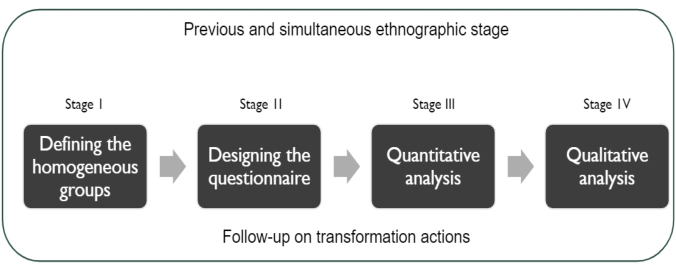
The methodology of this project is shown in Figure 1.
The ethnographic stage aimed to identify the work on board the platform by monitoring the work of different teams. This stage was carried out con- tinuously during our visits to the unit. At this stage, we wrote an ergonomic evaluation report about the working conditions at the unit following the gui- delines of the Brazilian law (NR-17) to later discuss them with the unit’s managers. Our research team has conducted similar studies since 2014. We performed the diagnosis for safety culture maturity in four stages: Stage I — Definition of homogeneous groups. Identification of the roles, hierarchy levels, and companies working on the platform. We identified seven teams or homogeneous groups: (1) managers, coordinators and supe- rvisors (2) safety technicians (SMS), (3) Outsourced supervisors / providers, (4) insourced operations and maintenance employees, (5) outsourced main- tenance professionals, (6) cargo handling professionals, and (7) hotel service professionals. The quantitative and qualitative stages were carried out with these homogeneous groups in isolation.
Stage II — Application of a customized questionnaire at the studied produ- ction unit. This Likert-scale questionnaire comprised 78 questions, grouped by the following topics: demographic and occupational variables, safety management system, safety priority, conformity behavior demands, initiative behavior development, safety training, integrity, risks, and accidents. The questionnaire was built based on studies by Daniellou et al. (2010), Anton- sen (2009b), and Duarte (2018) and it was applied during meetings with each homogeneous group. Because of the pandemic, they were conducted remo- tely. Each question was read aloud to participants. Only after all answers were given, they proceeded to the following question. There were no right or wrong answers. The objective was to understand the group’s perception of
Figure 1: Project methodology.
the topics covered. The participation level was high: the confidence level was 95%, and the margin of error was 2%. Stage III — Quantitative analysis. In this stage, we treated the data using a specific software program, through which we generated charts about the perceptions of the homogeneous groups. This stage allowed us to classify the safety culture maturity of the different groups in each unit. We assessed safety culture maturity according to the following topics: blaming, pertinence of the rules, safety bureaucracy, safety priority, and return on experience.
Stage IV — Qualitative analysis. In this stage, we discussed the results from the quantitative stage with the homogeneous groups. We confirmed whe- ther the classification of maturity from the previous stage was valid. This stage generated information that can inform future action plans for transfor- ming practices and integrating human and organizational factors to ensure industrial safety.
Based on the data collected at each stage of the project, we conducted a workshop and held meetings with leaders to develop an action plan to transform safety practices.
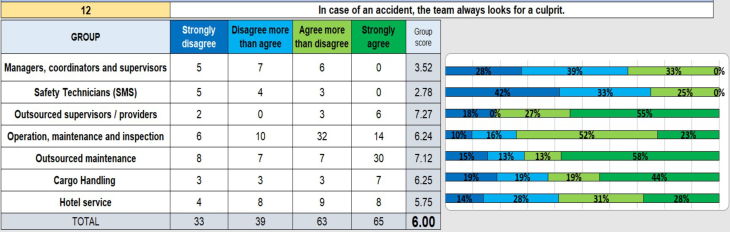
RESULTS: QUANTITATIVE AND QUALITATIVE STAGES Answers to the questionnaire were inserted into a table and then treated. We analyzed points of convergence and divergence between the perceptions of the different groups to determine the level of the safety culture in each answer. To treat the data, we used Sphinx, which generates charts with the answers of each homogeneous group, as well as an arithmetic mean on a scale of 0 to 10. Based on this mean, we established the following relation between the scale’s intervals and the possible answers: from 0 to 2 (“strongly disagree”); from 2 to 4 (“moderately disagree”); from 4 to 6 (“disagree”); from 6 to 8 (“moderately agree”); from 8 to 10 (“strongly agree”). Figure 2 shows a chart used during the meetings of the qualitative stage.
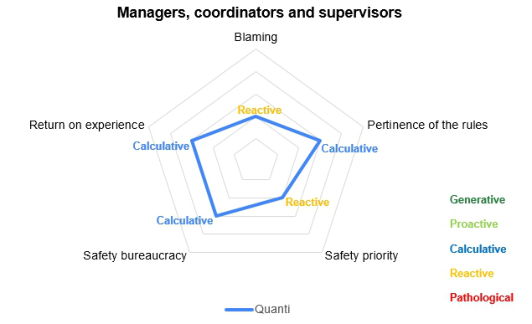
The quantitative stage allowed us to classify the level of maturity of each homogeneous group for each aspect analyzed. Figure 3 shows one example.
As Figure 3 shows, the answers to the questionnaire were used to assess the maturity of the safety culture in each homogeneous group according to the IOGP scale (pathological, reactive, calculative, proactive, and generative) on each of the five topics analyzed: blaming, return on experience, safety
Figure 2: Chart with answers related to blaming.
Safety Culture Assessment and Transformation of Practices 39
Figure 3: Quantitative diagnosis for managers, coordinators and supervisors.
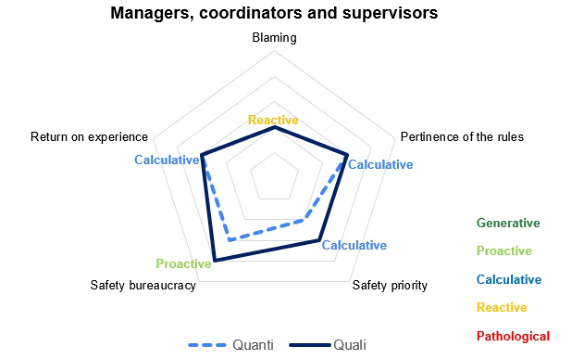
bureaucracy, safety priority, pertinence of the rules. Safety culture maturity was reassessed in the qualitative stage after cases and issues were reported. We held 18 meetings on the platform with the homogeneous groups on two different occasions. On the first occasion, a total of 69 participants discussed safety-related issues on the platform. On the second occasion, 53 did so. We plotted charts with answers that we considered representative of each homogeneous group and asked participants if they agreed with those answers. Based on the cases and discussions raised during the qualitative stage, we decided whether to alter or preserve the results from the quantitative stage, as shown in figure 4, for the group of managers, coordinators and supervisors presented above.
The homogeneous groups shared their reports in an atmosphere of trust among researchers and workers. A proactive and creative culture is built upon a diversity of perspectives. Discussing case reports during the project does not
Figure 4: Quantitative and qualitative diagnosis for managers, coordinators and supervisors.
imply we unconditionally endorse those who report them. These reports only represent partial points of view. To build a collective safety culture, they need further elaboration before being converted into action plans in the subsequent stages of the project.
FINAL CONSIDERATIONS: SUPPORT FOR THE DEVELOPMENT OF SAFETY PRACTICES This study did not assess the safety culture of a production unit. It analyzed the maturity of the safety culture of each group of people for each topic inve- stigated: blaming, return on experience, safety bureaucracy, safety priority, and pertinence of the rules. In general, we concluded that the culture of most groups is calculative with some reactive aspects (blaming and punishment). The debate conducted in the qualitative stage—particularly the practical situ- ations and cases mentioned—allowed us to identify several obstacles to the development of a proactive, generative, and just safety culture. To foster this development, actions, either specific or general, have been taken to transform typical practices of safety culture management or even pathological ones. These actions vary in nature. They can tackle the prevention of accidents and incidents or the analysis of events after they have happened. Either way, the goal is the same: to establish a process of collective and organizational learning, which is currently inhibited by the prevailing practices and values around a safety culture that is either reactive or calculative. These actions can be grouped into five broad topics:
Methodologies for accident analysis
Restructuring of safety management systems (SMS)
Organizational changes
Installation projects and renovations
Safety culture training for managers We have been working with leaders to improve, prioritize, and schedule action plans within the project’s deadline, but we also seek to establish them as programs and experiments that can last longer than the project itself. However, some findings of this study—most importantly, the existence of various similar programs and actions related to SMS—suggest that handling such a project requires two precautionary measures: (1) to transform current practices toward a more proactive and generative safety culture instead of proposing novel actions and programs; and (2) to adapt actions to the par- ticular aspects of each unit, including the different maturity levels identified in the diagnosis.
ACKNOWLEDGMENT
The authors acknowledge the support of the Foundation for Support of Research in the State of Rio de Janeiro (FAPERJ) [210.621/2019].
REFERENCES
Antonsen, S. Safety Culture and the Issue of Power. Safety Science, Volume 47, pp. 183–191, 2009a.
Safety Culture Assessment and Transformation of Practices 41
Antonsen, S. Safety Culture: Theory, Method and Improvement. Ashgate Publishing Company, 2009b. Cooper, M. D. Towards a Model of Safety Culture. Safety Science, 36, 111-136, 2000.
http://dx.doi.org/10.1016/S0925-7535(00)00035-7. Daniellou, F. (2005) The French-speaking ergonomists’ approach to work activity: cross-influences of field intervention and conceptual models, Theoretical Issues in Ergonomics Science, Taylor & Francis Vol. 6, No. 5, pp. 409–427. Daniellou, F.; Simard, M.; Boissieres, I. Human and organizational factors of
industrial safety: a state of the art., ICSI, Toulouse, France 2010. Dekker, S. Second Victim. London: CRC Press, 2013. Dekker, S. Just Culture. London: CRC Press, Third éd, 2017. Dekker, S. Foundations of safety science: a century of understanding accidents and disasters, Taylor & Francis, 2019. Duarte, F. Safety culture in the ergonomics perspective: case study in offshore
platforms, Advances in Safety Management and Human Factors, Advances in Intelligent Systems and Computing 604, Springer International Publishing, 2018. Gonçalves Filho, A. P. et al. Culture e safety management: the proposal of a model.
Gest. Prod., São Carlos, v. 18, n. 1, pp. 205–220, 2011. Gonçalves Filho, A. P and Waterson, P. Maturity models and safety culture: a critical review, Safety science v. 105, pp. 192–211, 2018. Guérin, F. et al. Compreender o trabalho para transformá-lo: a prática da ergonomia.
São Paulo: Edgard Blucher, 2001. Hudson, P. Applying the lessons of high risk industries to health care. Quality & Safety in Health Care, n. 12, pp. I7–I12, 2003. IAEA (International Nuclear Safety Advisory Group). Safety Culture: A report by the
International Nuclear Safety Advisory Group. Vienna: IAEA; 1991. (Safety Series No. 75-INSAG-4). ICSI. O essencial da prevenção de acidentes graves, fatais e tecnológicos ampliados.
Toulouse: ICSI, 2021. IOGP - International Association of Oil & Gas Producers. A guide to selecting appropriate tools to improve HSE culture. Report No. 435, International Association of Oil & Gas Producers. London, 2010. Le Coze, Jc (2022). Risques (socio) technologique, ergonomie et culture sécurité :
nouvelles perspectives. Proceedings of the 56th SELF. Vulnérabilité et risques émergents: penser et agir ensemble pour transformer durablement. Geneva, 2022. Le Coze, Jc. 2019. How safety culture can help us think. Safety Science. 118.
221–229. Parker, D. et al. A framework for understand the development of organizational safety culture. Safety Science, n. 44, pp. 551–562, 2006. Reason, J. Achieving a safe culture: theory and practice. Work & Stress, 1998,
pp. 293–306. Reason, J. Achieving a safe culture: theory and practice. Work & Stress, v. 12, n. 3, pp. 293–306, 1998. Rocha, R. et al. O retorno de experiência e o lugar dos espaços de discussão sobre o
trabalho: uma construção possível e eficaz. Trabalho & Educação, vol. 23, n. 1, pp. 1–74, 2014. Westrum, R. Cultures with requisite imagination. In: Wise, J. A.; Hopkin, V. D.; Stager, P. (Org.). Verification and validation of complex systems: human factors issues. New York: Springer-Verlag, 1993. pp. 413–427.
LISTED IN THE AHFE DIGITAL BOOKSTORE CATALOGUE
Explore the complete digital volume
Safety Management and Human Factors
Read this individual research paper free through the original publisher, or explore the full digital proceedings book.
ISBN 978-1-958651-81-0
Explore this ISBN in the AHFE Bookstore ↗Listed in the July 2026 bookstore catalogue; search by ISBN to confirm current availability · Digital book purchase optional