Ssu Min Chang, Johan Chang (2023). Categorizing Empathy Traits. In: Training, Education, and Learning Sciences. AHFE Open Access, vol. 109, pp. 245–253. https://doi.org/10.54941/ahfe1003958
During the university stage, students can be exposed to non-major skills and knowledge in a safe learning environment and experience interdisciplinary teamwork. However, interpersonal relationships, internal team attitudes, and other factors can hinder knowledge sharing and learning experiences. Empathy can help teams handle crises in such situations. Empathy, as a personal trait, is often studied by categorizing individuals into "high-level" and "low-level" types. In recent years, some scholars have defined empathy types based on four dimensions: empathic concern (EC), personal distress (PD), fantasy (FN), and perspective taking (PT). However, the classification of empathy traits using this multi-dimensional structure still remains somewhat unclear. This study is part of a series of research on empathy in design education, and in this paper, we aim to explore the classification of empathy traits as a reference for teaching practices. A total of 31 participants were recruited for a 10-day interdisciplinary design workshop. The Interpersonal Reactivity Index (IRI) was used to measure empathy, and correlation and cluster analyses were conducted based on the dimensions of EC, PD, FN, and PT. The research findings revealed PD was negatively correlated PT, and FN was positively correlated with PT. In addition, PD, FN, and PT can serve as clustering indicators for empathy trait types. Based on these indicators, the participants were divided into three groups: the Anxious-Fantasy Type (highest scores in PD and FN; significantly low scores in PT), the Apathetic-Self Type (significantly low scores in three dimensions), and the Rational-Cognitive Type (highest scores in PT and FN; significantly low scores in PD). This study proposes a new classification of empathy traits, which will be further explored in future research related to design education.
In recent years, due to the increasing complexity of social, economic, and technological challenges, which often involve larger and more diverse teams collaborating to define problems and propose solutions, interdisci- plinary teams have become the norm (Pontis & van der Waarde, 2020). As a result, design thinking has been widely applied in various fields and at different educational levels (Pande & Bharathi, 2020), with more
universities incorporating design thinking into their curricula. This allows students to gain exposure to non-disciplinary skills and knowledge in a safe learning environment, and experience interdisciplinary teamwork (Koh et al., 2015).
However, due to the differences in professional terminology and vocabu- lary among interdisciplinary team members, cognitive gaps can easily arise (Monteiro & Keating, 2009). Moreover, most individuals tend to take their own field’s norms and values for granted, disregarding the fact that oth- ers may not share the same knowledge and perspectives. These underlying positions can hinder cross-domain collaboration (Edmondson & Harvey, 2018) and may lead to communication difficulties, interpersonal relationsh- ips, internal team attitudes, and ultimately impede knowledge sharing (Fiore et al., 2015).
When an organization faces crisis situations, expressing empathy towards its stakeholders is helpful for crisis communication (Schoofs et al., 2020). The trait of empathy influences a leader’s management and crisis handling abilities. High levels of empathy enable leaders to quickly identify warning signals and acquire more crisis-related information, but it may also lead to overreacting (König et al., 2020).
Empathy holds significant importance in social behavior (Lamm et al., 2019) and consists of four representative dimensions known as response tendencies in interpersonal interactions. These dimensions include empathic concern, personal distress, fantasy, and perspective-taking (Davis, 1980). Empathy, as a personal trait, has been widely studied by summing up the scores of these four dimensions to categorize individuals into “high- level empathy” and “low-level empathy” groups (Melchers et al., 2015; Xiao et al., 2021). Some researchers explore the personality traits asso- ciated with individuals who score high on specific dimensions (Fultz & Bernieri, 2022). Additionally, there have been attempts to define diffe- rent types of traits based on the multidimensional composition of empa- thy, such as other oriented (high EC, PT, FN, low PD), low empathy (low scores on all four dimensions), cognitive empathic (high PT, other three dimensions below average), and self-oriented empathic (high sco- res on all four dimensions) (Otterbacher et al., 2017). The differentiation and study of different types of empathy are crucial aspects of empathy research.
However, the study by Otterbacher et al. (2017) pointed out that when using a multidimensional structure to differentiate types of empathy, the choice of the number of clusters in k-means clustering analysis is relatively ambiguous. The researchers ultimately selected four categories as long as it did not significantly reduce variance. This indicates that the definition of empathy types based on a multidimensional structure is somewhat vague. Therefore, this study makes the following assumption: “The dimensions of perspective-taking, empathic concern, personal distress, and fantasy can serve as classification factors for empathy traits and can be used to categorize students into different types.”
A New Approach to Categorizing Empathy Traits 247
METHODS
Experimental Setting and Procedure A cross-disciplinary design workshop was conducted as the research setting, involving four different fields (Industrial Design, Commercial Design, Furni- ture Carpentry, and Woodworking Design). On the first day of the workshop, the purpose and procedures of the study were explained, and the Interperso- nal Reactivity Index (IRI) questionnaire was distributed to invite volunteers for participation. Since the IRI questionnaire is a self-report measure, to avoid influencing response validity, individual scores were not made public, and only participants had access to their own score information. Subsequent sta- tistical analyses were performed, including descriptive statistics, correlation analysis, and cluster analysis.
Participants All workshop participants completed the IRI questionnaire, totalling 31 indi- viduals. Among them, 10 were male, accounting for 32.3% of the sample. The mean age was 21.45, with a standard deviation of 3.15.
Measures The Interpersonal Reactivity Index (IRI) (Davis, 1980, 1983) is a widely used tool for assessing empathy worldwide and is suitable for self-report question- naires in normal populations. It measures different dimensions of empathy and consists of four dimensions: empathic concern, personal distress, fan- tasy, and perspective taking. The IRI has been translated into various languages and adapted for different populations or slightly modified ver- sions. In accordance with cultural and language requirements, this study used the Traditional Chinese version revised by Wong (1986). It includes 32 items, with 8 items for each dimension. Among them, 11 items are reverse-scored (items 6, 7, 10, 15, 17, 18, 19, 20, 25, 26, and 29), and a 5-point Likert scale was used for rating (ranging from 1 to 5, indicating “strongly disagree,” “disagree,” “neutral,” “agree,” and “strongly agree,” respectively).
RESULTS
Descriptive Statistics A total of 31 valid samples were collected. The mean score for Empathic Concern was 3.66, with a standard deviation of 0.44. The mean score for Personal Distress was 3.27, with a standard deviation of 0.54. The mean score for Fantasy was 3.68, with a standard deviation of 0.68. The mean score for Perspective Taking was 3.66, with a standard deviation of 0.53. There was a negative correlation between Personal Distress and Perspective Taking, while Fantasy showed a positive correlation with Per- spective Taking. The results of the correlation analysis are presented in Table 1.
248 Chang and Chang
Table 1. Correlation analysis of the four dimensions.
Table available in the original PDF paper.
Empathic Concern
Personal Distress
Fantasy Perspective Taking Empathic Concern Pearson Correlation Sig. (2-tailed) Personal Distress Pearson Correlation .120 Sig. (2-tailed) .527 Fantasy Pearson Correlation .227 .162 Sig. (2-tailed) .228 .392 Perspective Taking Pearson Correlation .255 -.381* .378* Sig. (2-tailed) .173 .038 .040
Note. **p <.01 (2-tailed), *p <.05 (2-tailed)
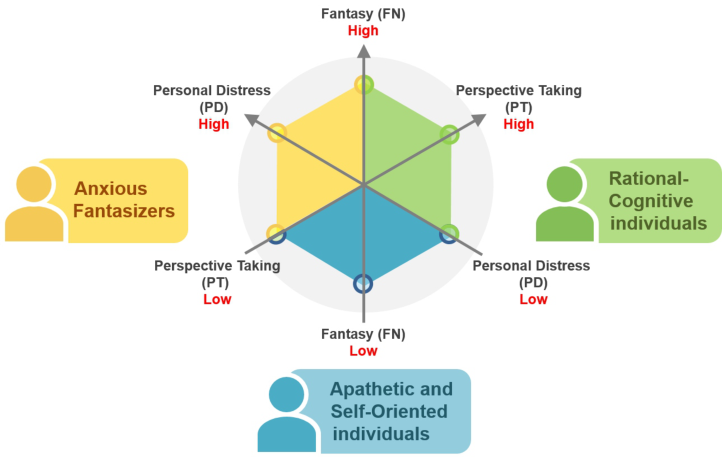
Cluster Analysis Hierarchical cluster analysis was performed using Ward’s method and squa- red Euclidean distance as the measurement interval. The optimal number of clusters determined in the first stage was three. In the second stage, K-means clustering analysis was conducted with three clusters, and the final cluster centres are presented in Table 2. In the analysis of variance, the score for Empathic Concern was not significant, indicating that it did not significantly affect cluster grouping. However, Personal Distress, Fantasy and Perspe- ctive Taking can serve as clustering indicators for different types of empathy traits. The results of the analysis of variance are presented in Table 3. This study proposes three types of empathy traits, described as follows, with the number of observations in each cluster shown in Table 4. Furthermore, using the scores of “Personal Distress, Fantasy, and Perspective Taking”, we created graphical representations of the three dimensions to illustrate the characteristics of different clusters (Figure 1).
(1) Cluster 1: This cluster has high scores in Personal Distress and Fantasy, but a low score in Perspective Taking. This cluster is named “Anxious Fantasizers” in this study. (2) Cluster 2: This cluster has low scores in Personal Distress, Fantasy, and Perspective Taking. This cluster is named “Apathetic and Self-Oriented individuals” in this study. (3) Cluster 3: This cluster has high scores in Fantasy and Perspective Taking, but a low score in Personal Distress. This cluster is named “Rational- Cognitive individuals “ in this study.
Table 2. Final cluster centres of the empathy traits.
Table available in the original PDF paper.
Cluster
1 2 3
Empathic Concern 3.75 3.41 3.72 Personal Distress 3.76 3.09 2.80 Fantasy 4.05 2.75 3.84 Perspective Taking 3.48 3.32 4.08
A New Approach to Categorizing Empathy Traits 249
Table 3. Analysis of variance of the empathy traits.
Number of Cases in each Cluster Cluster 1 13.000 2 7.000 3 11.000 Valid 31.000 Missing .000
Figure 1: Three-dimensional clustering of empathy traits.
DISCUSSION
A New Classification of Empathy Types Based on the statistical results, “Personal Distress, Fantasy, and Perspective Taking” can be used as clustering indicators for different types of empa- thy traits. The participants were divided into three clusters: “the Anxious Fantasizers (highest scores in PD and FN; significantly low scores in PT), the Apathetic and Self-Oriented individuals (significantly low scores in three dimensions), and the Rational-Cognitive individuals (highest scores in PT and FN; significantly low scores in PD)”.
250 Chang and Chang
(1) Anxious Fantasizers: They are willing to immerse themselves in the events and situations of others, trying to understand their circumsta- nces. However, they tend to experience distress due to the unfortunate events or emotions of others, without necessarily seeking to understand or adopt the psychological perspectives of others. In simple terms, they may be prone to feeling anxious. Personal distress represents the nega- tive aspect of affective empathy. Individuals with high personal distress may experience pain and exhaustion in empathic interactions (Kim & Han, 2018). A longitudinal study also suggests that personal distress does not decrease with age (Konrath et al., 2011). The dimensions of personal distress and fantasy showed no correlation with the time spent engaging in prosocial behaviour (Xiao et al., 2021). Teaching interventions may be necessary to help Anxious Fantasizers alleviate their inner distress, enh- ance their ability to adopt others’ perspectives, and engage in prosocial behaviours.
(2) Apathetic and Self-Oriented individuals: They are less likely to expe- rience distress as a result of others’ unfortunate events or emotions. Both affective and cognitive understanding of others are low. They are less incli- ned to imagine or put themselves in others’ shoes to understand their emotions and perspectives. This cluster aligns with previous studies that referred to “low-level empathy” (Melchers et al., 2015; Xiao et al., 2021). Research indicates that when empathy is centered around oneself, it can lead to errors and biases when predicting another person’s mental state (Coplan, 2011). Furthermore, when individuals lack similar experiences or face unpredictable emotions, they cannot fully grasp others’ emoti- ons or think from their perspective. This is known as empathy gap in psychology (Van Boven et al., 2013). Educational interventions are nee- ded to activate the intrinsic and extrinsic motivations of Apathetic Self- Oriented individuals and promote the development of different dimensions of empathy.
(3) Rational-Cognitive individuals: This cluster shares similarities with the Other-Oriented type proposed by Otterbacher et al. (2017). They are willing to engage in perspective-taking and understand the emotions and situations of others. They can differentiate between their own emotions and others’ emotions, without projecting their own unfortunate experiences and emotions onto others. However, the other-oriented type is characteri- zed by a high emotional concern (EC) tendency, which was not used as a clustering indicator in this study. Therefore, it cannot be determined if Rational-Cognitive individuals have significantly higher Empathic Concern (EC) scores. This group also exhibits similarities to the concept of “high- level empathy” mentioned in previous studies (Melchers et al., 2015; Xiao et al., 2021). The difference lies in the fact that individuals with high-level empathy often have high personal distress (PD) scores, whereas Rational- Cognitive individuals may experience less emotional distress. Future explo- ration should focus on how to help these relatively calm individuals who are willing to engage in perspective-taking to learn social skills and promote effective collaboration among team members in cross-disciplinary learning settings.
A New Approach to Categorizing Empathy Traits 251
Why Empathic Concern Cannot Serve as a Clustering Indicator to Categorizing the Empathy Traits Empathy requires an altruistic motive to be driven (Hoffman, 1984), and the ability to recognize others’ needs relies on motivation (Carpenter et al., 2016). Empathic concern, as a dimension of empathy, is evidently important. However, in the analysis of variance in this study, the scores for empathic concern were not significant, indicating that it does not influence the cluste- ring of empathy types. There could be two possible reasons for this. First, the sample participants may have similar levels of empathic concern towards others, with no significant differences. In the future, increasing the sample size will ensure the stability of empathy type classification. Second, since the validation of this version of the assessment tool was conducted almost 40 years ago, it may require modification to align with the empathic concerns of the current Generation Z population. Future research could further validate an IRI scale (Traditional Chinese version) suitable for Generation Z.
CONCLUSION
This study proposes a new concept of empathy types, and the results suggest that “Personal Distress, Fantasy, and Perspective Taking” can serve as clu- stering indicators for different empathic traits. The participants were divided into three clusters: the Anxious Fantasizers, the Apathetic and Self-Oriented individuals, and the Rational-Cognitive individuals. The empathy traits of individuals are not solely characterized as high or low empathy, but rather by their inclination towards different dimensions of empathy. This provi- des possibilities for conducting related behavioural studies. Additionally, it is important to expand the scope of empathy through training and accumulated experiences, transcending personal traits and team limitations (McDonagh et al., 2018). Future research will further explore the design and educational implications based on the multidimensional classification of empathy traits.
ACKNOWLEDGMENT
We are very grateful to the Ministry of Education, Republic of China (Taiwan) that has provided financial support for the project, and the respon- dents for their patience in filling out the questionnaire. Finally, we are most thankful for Prof. Wong, who kindly authorized us to use IRI (Wong, 1986) for research.
REFERENCES
Carpenter, J. M., Green, M. C., & Vacharkulksemsuk, T. (2016). Beyond perspectivetaking: Mind-reading motivation. Motivation and Emotion, 40, 358–374. https: //doi.org/10.1007/s11031-016-9544-z Coplan, A. (2011). Will the real empathy please stand up? A case for a narrow conce-
ptualization. The southern journal of philosophy, 49, 40–65. https://doi.org/10. 1111/j.2041-6962.2011.00056.x
252 Chang and Chang
Davis, M. H. (1983). Measuring individual differences in empathy: Evidence for a multidimensional approach. Journal of personality and social psychology, 44(1), 113–126. https://doi.org/10.1037/0022-3514.44.1.113 Davis, M. H. (1980). A Multidimensional Approach to Individual Differences in
Empathy. JSAS Catalog of Selected Documents in Psychology, 10, 85. Edmondson, A. C., & Harvey, J. F. (2018). Cross-boundary teaming for innovation: Integrating research on teams and knowledge in organizati- ons. Human Resource Management Review, 28(4), 347-360. https://doi.org/ 10.1016/j.hrmr.2017.03.002 Fiore, S. M., Carter, D. R., & Asencio, R. (2015). Conflict, trust, and cohesion: examining affective and attitudinal factors in science teams. Team Cohesion: Advances in Psychological Theory, Methods and Practice, 17, 271–301. https: //doi.org/10.1108/S1534-085620150000017011 Fultz, A. A., & Bernieri, F. J. (2022). Observer descriptions of the empathic person: a
look at the Davis IRI and Hogan empathy scales. The Journal of Social Psychology, 162(1), 26–40. https://doi.org/10.1080/00224545.2021.1985416 Hoffman, J. A. (1984). Psychological separation of late adolescents from their parents. Journal of counseling psychology, 31(2), 170. König, A., Graf-Vlachy, L., Bundy, J., & Little, L. M. (2020). A blessing and a curse:
How CEOs’ trait empathy affects their management of organizational crises. Aca- demy of Management Review, 45(1), 130–153. https://doi.org/10.5465/amr.2017. 0387 Kim, H., & Han, S. (2018). Does personal distress enhance empathic interaction or block it? Personality and Individual Differences, 124(1), 77–83. https://doi.org/ 10.1016/j.paid.2017.12.005 Koh, J. H. L., Chai, C. S., Wong, B., & Hong, H. (2015). Design thinking and
education (pp.1–15). Springer Singapore. ISBN: 978-981-287-444-3. Konrath, S. H., O’Brien, E. H., & Hsing, C. (2011). Changes in dispositional empathy in American college students over time: A meta-analysis. Persona- lity and Social Psychology Review, 15(2), 180–198. https://doi.org/10.1177/ 1088868310377395 Lamm, C., Rütgen, M., & Wagner, I. C. (2019). Imaging empathy and prosocial
emotions. Neuroscience letters, 693, 49–53. https://doi.org/1016/j.neulet.2017. 06.054. McDonagh, D., Woodcock, A., & Iqbal, S. (2018). Experience + Experience + Experience = Empathy. Paper presented at Design for health, Sheffield, United Kingdom. Melchers, M., Li, M., Chen, Y., Zhang, W., & Montag, C. (2015). Low empathy is
associated with problematic use of the Internet: Empirical evidence from China and Germany. Asian journal of psychiatry, 17, 56–60. https://doi.org/10.1016/j. ajp.2015.06.019 Monteiro, M., & Keating, E. (2009). Managing misunderstandings: The role of language in interdisciplinary scientific collaboration. Science communication, 31(1), 6–28. https://doi.org/10.1177/1075547008330922 Otterbacher, J., Ang, C. S., Litvak, M., & Atkins, D. (2017). Show me you care:
Trait empathy, linguistic style, and mimicry on Facebook. ACM Transactions on Internet Technology (TOIT), 17(1), 1-22. https://doi.org/10.1145/2996188 Pande, M., & Bharathi, S. V. (2020). Theoretical foundations of design thinking – A constructivism learning approach to design thinking. Thinking Skills and Creativity, 36, 100637. doi: 10.1016/j.tsc.2020.100637. Pontis, S., & Van der Waarde, K. (2020). Looking for alternatives: challenging
assumptions in design education. She Ji: The Journal of Design, Economics, and Innovation, 6(2), 228–253. https://doi.org/10.1016/j.sheji.2020.05.005
A New Approach to Categorizing Empathy Traits 253
Schoofs, L., Fannes, G., & Claeys, A. S. (2022). Empathy as a main ingredient of impactful crisis communication: The perspectives of crisis communication practi- tioners. Public Relations Review, 48(1), 102150. https://doi.org/10.1016/j.pubrev .2022.102150 Van Boven, L., Loewenstein, G., Dunning, D., & Nordgren, L. F. (2013). Cha-
pter Three - Changing Places: A Dual Judgment Model of Empathy Gaps in Emotional Perspective Taking. In James M. Olson, Mark P. Zanna (Ed.), Adva- nces in Experimental Social Psychology (Vol. 48, pp. 117-171). Academic Press. https://doi.org/10.1016/B978-0-12-407188-9.00003-X Wong, K. C. (1986). Empathy: Multidimensional Measurement and Related Research. Dayang. Xiao, W., Lin, X., Li, X., Xu, X., Guo, H., Sun, B., & Jiang, H. (2021). The influ-
ence of emotion and empathy on decisions to help others. SAGE Open, 11(2), 21582440211014513. https://doi.org/10.1177/21582440211014513
LISTED IN THE AHFE DIGITAL BOOKSTORE CATALOGUE
Explore the complete digital volume
Training, Education, and Learning Sciences
Read this individual research paper free through the original publisher, or explore the full digital proceedings book.
ISBN 978-1-958651-85-8
Explore this ISBN in the AHFE Bookstore ↗Listed in the July 2026 bookstore catalogue; search by ISBN to confirm current availability · Digital book purchase optional