Yu-chen Huang, Johan Chang (2024). Exploring Hand Dexterity in Spoon Handling : Impact of Handle Cross-Section on Dynamic Tripod Grip. In: Human Factors in Design, Engineering, and Computing. AHFE Open Access, vol. 159, pp. 1232–1243. https://doi.org/10.54941/ahfe1005691
Spoons are among the fine tools frequently used by toddlers who transition from early power grips to refined dynamic tripod grips. Research on fine finger manipulations reveals that such operations are more stable when performed with relatively small finger flexion and pressure changes. Existing literature on pencil and chopstick handling shows that the cross-section of the handle affects fine manipulation, but there is limited research specifically evaluating such effects with regard to spoons. To design a spoon suitable for dynamic tripod grips and facilitate learning for toddlers with less mature manipulative skills, experiments were conducted with adults who exhibit stable dynamic tripod operations. This study synthesized spoon operation literature and movement processes to identify three specific tasks: Scooping, Cutting, Gathering. Following an analysis of commercially available products, six common cross-sectional shapes were selected. Thirty adults with normal hand function participated in the experiment, wearing flexion and pressure sensors to assess the impact of handle cross-section shapes on operational efficiency, finger stability, and finger pressure. Results indicate that hexagonal and pentagonal shapes offer the best operational efficiency. No significant differences in finger stability were observed among the six shapes, and circular shapes allowed for better performances in finger pressure. Overall, the combined evaluation suggests that circular, pentagonal, and hexagonal shapes are preferable, providing a foundation for product development in this field. The applicability of these findings to toddlers can be further validated through future experiments.
Fine motor skills play a crucial role in various aspects of development, including physical fitness, sensory processing, cognition, and social- emotional well-being. As children enter school age, approximately 30% to 60% of their time is spent engaging in fine motor activities (McHale and Cermak, 1992), highlighting their significance. Among the early fine motor tools encountered by young children, the spoon holds particular importance. With age and finger differentiation, children transition from a static tripod grasp to a dynamic tripod grasp, enabling them to scoop small amounts of liquids or easily rollable food and guide it to their
Exploring Hand Dexterity in Spoon Handling: Impact of Handle Cross-Section 1233
mouths (Kamosita, 2020). Literature on self-feeding and robotic arm studies suggests that using spoons involves not only scooping but also various subtle manipulation techniques (Yasuda et al., 2017). These fine movements enhance eating efficiency (Kamosita, 2020). Handwriting research indicates that utilizing lower finger pressure and posture variations for fine tool adjustments leads to better outcomes (Falk et al., 2011). This emphasizes the importance of fine motor control in the dynamic tripod grasp, which requires hand strength, coordination, and manipulation skills for precise and efficient operation (Kamosita, 2020). While the lack of practice in dynamic tripod manipulation may not pose immediate danger, it significantly impacts handwriting skills in school age children (Prunty et al., 2013). Research has also shown that practicing flexible finger joint manipulation before handwriting instruction can reduce the occurrence of incorrect postures, excessive force, and compensatory behaviors (Benbow, 2006). Previous studies on chopstick and pencil use have demonstrated that different handle cross-sections can influence operation efficiency and flexibility (Goonetilleke et al., 2009 ; Wu and Tsai, 2012). However, limited research has focused on handle cross section evaluation for spoons. Commercially available spoon products often prioritize effective grasping, emphasizing grip posture while neglecting manipulation techniques, potentially hindering the transition from static to dynamic grasp. This study aims to design a spoon suitable for dynamic tripod operation in preschool children. While experiments using existing spoon cross-sections are conducted, adults are chosen as participants instead of young children. This decision is based on the assumption that adults can better reflect actual operation conditions. Additionally, due to the underdeveloped dynamic tripod grasp in young children, simultaneous instrumentation and operation could lead to compensatory issues. Adult participants allow for a more accurate assessment of the impact of spoon handle cross-section on dynamic tripod operation.
Fine Motor Skill Development and Dynamic Tripod Learning Gesell’s Maturation Theory (1954) explains that fine motor skills in the hands develop from proximal (closer to the body) to distal (farther from the body), encompassing Reach, Grasp, In Hand Manipulation, and Release. Coordinated palm and finger movements, involving the Metacarpophalangeal Joints, are key for delicate finger manipulations (Wu et al., 2019; Exner, 1989). Grasping skills typically develop first, with the dynamic tripod grasp essential for activities like writing and scissor use, emerging around four and a half years old (Case-Smith and O’Brien, 2010). This development happens in two stages: initially, a static posture with assistance from the shoulder, arm, and wrist, and later, reduced upper limb and wrist movements with more finger joint activity (Bardo et al., 2018). Stable and coordinated finger movements significantly impact writing efficiency, so practicing finger joint flexibility before learning to write can reduce posture errors and excessive force (Ziviani and Wallen, 2006; Benbow, 2006).
1234 Huang and Chang
Finger Operation Measurement Research in handwriting studies suggests that lower finger pressure and subtle posture adjustments are preferable for fine control (Falk et al., 2011). Finger pressure is commonly measured using resistive thin-film pressure sensors like SEN-09673 and FSR-402, which detect pressure changes through resistance alterations (Hsu et al., 2013; Lin et al., 2017). Optical motion capture systems, though precise, are costly and require specific setups (Arauz et al., 2016; Zhu et al., 2021). Mechanical motion capture using various sensors can also detect dynamic joint movements (Nelson et al., 2000; Li et al., 2019). Flex Sensors, for example, change resistance when bent, allowing detection of finger movements (Syed, 2012). Traditional resistive instruments can be error-prone due to electromagnetic interference, but data stability can be achieved using methods like simple averaging and threshold algorithms (Liu et al., 2018). Sensors can be stabilized on fingers using gloves or braces (Syed, 2012; Wang and Yu, 2015; Liu et al., 2018). This study will use sensors on glove interfaces, with Arduino microcontrollers to detect finger movements for analysis (Syed, 2012).
Dynamic Tripod Grasp and Fine Manipulation of Spoons The mature dynamic tripod grasp allows for efficient and subtle manipulations, improving tasks like eating by enabling refined spoon usage (Kamosita, 2020). Studies show that scooping liquids like soup takes longer than scooping soft foods (tofu, pudding), solid particles (malt), or semi- solids (yogurt) due to the need for precise horizontal positioning of the spoon (Yasuda et al., 2017). When handling solid and soft foods, people rotate and tilt the spoon to cut and then scoop the food. They also scrape food along the bowl’s wall to gather it for easier scooping (Abe et al., 2013 ; Yasuda et al., 2017). This study focuses on five key actions: scooping, cutting, gathering, lifting, and a combination of cutting and scooping. Based on dining tasks, three experimental tasks are planned: lifting, gathering and scooping, and cutting and scooping.
Figure 1: Illustration of pick, cutting-scraping, and gathering-scooping tasks.
Figure available in the original PDF paper.
Analysis of Literature and Commercial Products on Spoons The transition from static to dynamic tripod grasp involves gradually introducing finer motor skills while reducing restrictive aids. Studies on pencil grip learning suggest that different handle shapes and lengths can influence grip efficiency and flexibility (Cochran and Riley, 1986; Goonetilleke et al., 2009; Wu and Tsai, 2012). Similarly, research on spoon length indicates that
Exploring Hand Dexterity in Spoon Handling: Impact of Handle Cross-Section 1235
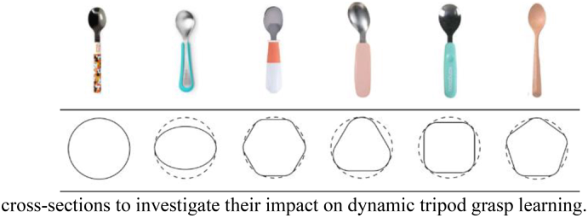
a 30mm increase is appropriate for taller individuals to facilitate support and operation (Liu et al., 2008). For digging and placing food tasks, adults generally prefer spoons with a smaller diameter (15mm) compared to 15, 25, 40mm diameters (Leiras et al., 2014). Product design, including appearance and material, can also influence user operation (McCoy, 1984). This study aims to investigate the impact of spoon handle cross-section on dynamic tripod grasp learning. Common spoon handle cross-sections at the tripod grip area were identified and classified into six categories: Circular, Oval, Triangle, Square, Pentagonal, and Hexagonal. While literature does not provide definitive guidance on the most suitable handle shape for dynamic tripod grasp learning, commercial spoons often incorporate designs intended to enhance grip for young children. However, these designs often prioritize product appearance over grip posture, potentially hindering the development of fine motor skills. Therefore, this study will conduct experimental evaluations of spoon handle cross-sections to investigate their impact on dynamic tripod grasp learning.
Figure 2: Spoon handle cross-section shapes.
METHODS
Research Sample (Independent Variables) This study analyzed commercially available products and classified six types of handle cross-sections for spoons: Circular, Oval, Triangle, Square, Pentagonal, and Hexagonal. According to the literature, the outer diameter of these spoons is 15mm, and the length is determined by adding 30mm to the average hand length of Taiwanese adults, resulting in a total length of 200mm.
Participants This study recruited 30 participants who are adults with normal hand functionality and meet the criteria of the 50th percentile of the human database, with an average hand length of 112.60±6.9mm. All participants completed the experiment. The valid sample consists of 16 males and 14 females, with a mean age of 24.80 years (SD = 1.32).
1236 Huang and Chang
Dependent Variable and Measuring Tools This study employed a repeated-measures within-subjects design to investigate the impact of spoon handle cross-section on dynamic tripod grasp learning. Three primary data sets were collected: task efficiency, finger stability, and finger pressure.
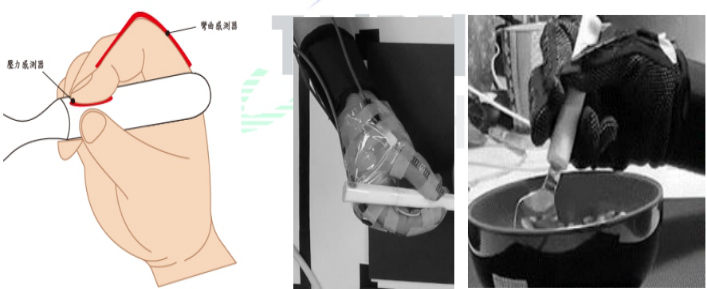
(1) Task Efficiency: Task efficiency was assessed by measuring the time required to perform the pick, gather-scoop, and cut-scrape tasks, recorded from the spoon’s contact with the food particles until placing the food in the simulated mouth opening. (2) Finger Stability: Finger stability was evaluated using Flex Sensor SpectraSymbol 4.5 and an Arduino hardware platform. The sensor measured the flexion angles of the thumb, index finger, and middle finger at the proximal and distal interphalangeal joints (PIP and DIP). Smaller flexion angles were indicative of greater stability. (3) Finger Pressure: Finger pressure was assessed using resistive thin-film pressure sensors (SEN-09673) and an Arduino hardware platform. The sensors recorded the normal force applied to the tool by the smaller finger pads of the thumb, index finger, and middle finger’s distal radial side.
Figure 3: Spoon handle cross-section shapes.
Task Environment Setup This study sets up the task environment with a working area of (420x297mm) and a height of 750mm. The placement point is positioned at a height of 220mm in front, and an adjustable height chair is provided. Participants are required to adjust the chair to a suitable height before testing. The task content is defined based on the literature as follows:
(1) Pick Task: Participants are required to scoop three red beans (diameter: 80mm) from the bowl at a time, repeating this action three times, and place them at the designated point directly in front of them. (2) Cutting Task: Participants are tasked with cutting a piece measuring (100x20mm) into three pieces, repeating this action three times, and
Exploring Hand Dexterity in Spoon Handling: Impact of Handle Cross-Section 1237
placing the resulting pieces at the designated point directly in front of them. (3) Gathering Task: Participants scoop four red beans from a plate (diameter: 130mm), moving them to the edge, repeating this action three times, and placing the scooped beans at a designated point directly in front of them.
After obtaining informed consent from participants, this study randomly assigns six different spoon shapes for experiments. Since daily dining actions often involve three tasks simultaneously, the study will calculate the efficiency of each task separately and cumulatively. This approach aims to comprehensively assess the impact of spoon shape on operational efficiency.
RESULTS
As the study utilized a repeated-measures within-subjects design, a test for homogeneity of variance was conducted to ensure consistency in the variability of the data across the repeated measures. The results of this test are summarized in Table 1.
Table 1. Mauchly’s test of sphericity for six spoon handle cross-sections.
According to the results of Mauchly’s sphericity test shown in the table, only in the finger pressure measurements for cutting (p = 0.225 > 0.05) and scooping (p = 0.395 > 0.05) did the data pass the Mauchly’s sphericity test, indicating homogeneity of variance and suitability for ANOVA analysis. However, for the remaining items, Mauchly’s sphericity test was not passed. Therefore, Friedman test (Nonparametric test) ANOVA and Wilcoxon signed rank test will be used for analysis.
Impact of Spoon Handle Cross-Section Shape on Operation The study analyzed the six cross-sections based on operation efficiency, finger stability, and finger pressure, as shown in Tables 2 and 3.
1238 Huang and Chang
Table 2. Friedman test and Wilcoxon signed rank test results for six types.
Table 3. ANOVA variance analysis and post-hoc comparisons for six types.
Table available in the original PDF paper.
Dependent Variable SS Df MS F p ηp2 Post-Hoc(LSD) finger pressure Cutting 51390.82 5 10278.16 6.53 .000 .18 Circle > Triangle, Square, Pentagon, Hexagon, Oval** Hexagon > Square** 228136.3 145 1573.35 Gathering 20925.52 5 4185.10 3.80 .003 .11 Circle > Oval, Triangle, Pentagon, Hexagon * Square>Triangle * 159486.5 145 1099.90
Operational Efficiency In terms of pick efficiency, the hexagonal handle resulted in significantly shorter operation times compared to the circular (P=.00), elliptical (P=.04), and rectangular (P=.03) handles. The pentagonal handle also showed significantly shorter operation times compared to the circular (P=.00), elliptical (P=.04), and rectangular (P=.00) handles. There were no significant differences between the triangular handle and the hexagonal (P=.08), rectangular (P=.81), elliptical (P=.53), and circular (P=.06) handles, but the triangular handle had significantly longer operation times compared to the pentagonal handle (P=.00). There were also no significant differences between the elliptical and rectangular handles (P=.30), but both handles had significantly shorter operation times compared to the circular handle. In terms of pick task operation efficiency, the hexagonal and pentagonal handles exhibited the highest efficiency among all handles, significantly outperforming the circular, elliptical, and rectangular handles. In the cutting-scraping task, the circular handle had significantly longer operation times compared to the triangular (P=.00), pentagonal (P=.00), hexagonal
Exploring Hand Dexterity in Spoon Handling: Impact of Handle Cross-Section 1239
(P=.00), and elliptical (P=.04) handles. The hexagonal handle, on the other hand, had significantly shorter operation times compared to the elliptical (P=.01), rectangular (P=.03), triangular (P=.00), and circular (P=.18) handles. There were no significant differences between the pentagonal and elliptical or rectangular handles. The triangular handle had longer operation times compared to the pentagonal (P=.00) and hexagonal (P=.00) handles, but no significant difference with the elliptical handle. The pentagonal and hexagonal handles did not show any significant difference in operation times. In terms of cutting-scraping task operation efficiency, the hexagonal and triangular handles exhibited the highest efficiency, significantly outperforming the circular, elliptical, and rectangular handles. The pentagonal handle’s operation efficiency did not differ significantly from that of the elliptical and rectangular handles. In the gathering-scooping task, the hexagonal and pentagonal handles did not show any significant difference (P=.95), and both outperformed the circular (P=.00), elliptical (P=.00), and rectangular (P=.00) handles. The pentagonal handle also did not differ significantly from the triangular handle (P=.08), but outperformed the circular (P=.00), elliptical (P=.01), and rectangular (P=.00) handles. The triangular handle, on the other hand, showed no significant difference with the elliptical handle (P=.10) but outperformed the circular (P=.00) and rectangular (P=.02) handles. The elliptical and rectangular handles did not show any significant difference (P=.29), but both outperformed the circular handle (P=.00). The circular handle, in turn, outperformed the rectangular handle (P=.00). Therefore, in terms of gathering-scooping efficiency, the hexagonal and pentagonal handles were significantly better than the elliptical, rectangular, and circular handles, followed by the triangular handle. The circular handle was found to be significantly more difficult to use in this task. Overall, the hexagonal and pentagonal handles did not show any significant difference (P=.11), but both significantly outperformed the rectangular (P=.02), triangular (P=.01), elliptical (P=.01), and circular (P=.00) handles. The pentagonal handle also significantly outperformed the rectangular (P=.03), triangular (P=.01), elliptical (P=.01), and circular (P=.00) handles. The rectangular and triangular handles did not show any significant difference (P=.94) and neither did the rectangular and elliptical handles (P=.53), but both handles significantly outperformed the circular handle (P=.00). The elliptical and triangular handles also did not show any significant difference (P=.55), but both handles outperformed the circular handle (P=.00). In summary, the hexagonal and pentagonal handles exhibited higher operation efficiency compared to all other spoons, with the hexagonal handle demonstrating the highest overall efficiency. The elliptical and triangular handles had intermediate operation efficiency between the hexagonal and circular handles, with the circular handle having the lowest operation efficiency.
Finger Stablize In the Pick task, the rectangular handle did not show any significant difference with the hexagonal (P=.34) or pentagonal (P=.89) handles,
1240 Huang and Chang
but significantly outperformed the triangular (P=.01), elliptical (P=.04), and circular (P=.01) handles. The pentagonal handle also did not differ significantly from the hexagonal (P=.89) or elliptical (P=.12) handles in terms of stability, but significantly outperformed the triangular (P=.04) and circular (P=.03) handles. The hexagonal handle did not show any significant difference with the triangular (P=.14) or elliptical (P=.09) handles, but significantly outperformed the circular handle (P=.04). The elliptical and triangular handles did not show any significant difference (P=.86), and neither did the triangular and circular handles (P=.46). In the cutting-scraping task, only the pentagonal (P=.04) and elliptical (P=.03) handles significantly outperformed the hexagonal handle, with no significant difference between the pentagonal and elliptical handles (P=.13). In the gathering-scooping task, there were no significant differences among the six cross-sectional shapes.Overall, there were no significant differences in finger stability among the six cross-sectional shapes. However, when considering the tasks individually, rectangular, pentagonal, and hexagonal handles demonstrated better finger stability in the pick task, with pentagonal and hexagonal handles showing slightly better stability compared to rectangular handles. In the cutting-scraping task, pentagonal and elliptical handles were the better choices, while the remaining four handles did not show any significant differences.
Finger Pressure In the pick task, the circular handle exhibited similar performance to the elliptical (P=.052) and hexagonal (P=.10) handles, but less pressure compared to the triangular (P=.04), rectangular (P=.00), and pentagonal (P=.00) handles. No significant differences were observed among the remaining handles (P>.05). For the gathering-scooping task, the circular and rectangular handles had comparable performance (P=.05) but exerted less pressure than the other handles (P=.00). The rectangular handle showed similar performance to some handles but less pressure compared to the triangular handle (P=.02). In the cutting-scraping task, the circular handle exerted less pressure than most handles (P=.00). The hexagonal handle showed similar performance to some handles but less pressure than the rectangular handle (P=.00). The triangular, elliptical, and rectangular handles did not significantly differ (P>.05). Overall, the circular handle exhibited the lowest pressure, followed by the triangular and hexagonal handles.Overall, the circular handle showed significantly better finger pressure performance compared to other handle shapes (P<0.05), while the remaining handle shapes (elliptical, triangular, rectangular, pentagonal, and hexagonal) did not differ significantly from each other (P>0.05).
CONCLUSION
The conclusion drawn from organizing and analyzing the experimental results is as follows:
Exploring Hand Dexterity in Spoon Handling: Impact of Handle Cross-Section 1241
(1) Hexagonal and pentagonal shapes are the most efficient. Finger stability shows no significant difference among spoon types for adults. Circular spoons exert the least finger pressure.This finding is consistent with related literature on pen grip (Goonetilleke et al., 2009) and spoon manipulation (Huang and Chang, 2022), where subjective evaluations align. The circular cross-section applies less pressure on the fingers due to its larger curvature, leading to greater satisfaction. In summary, this study suggests that circular, pentagonal, and hexagonal cross-sectional spoons are best suited for dynamic tripod grasp operations, considering their efficiency, finger stability, and pressure. (2) The scope of this study is limited to the Taiwan region. However, literature suggests that fine motor skills may vary depending on factors such as geographical location(Chui et al., 2007), experience (Kamosita, 2020), and physiological differences. Therefore, data collected from other regions or countries may differ. (3) As this study assesses the mature dynamic tripod grasp, primarily observed in adults, its relevance to children is uncertain. Future experiments could confirm the applicability of these findings to young children.
ACKNOWLEDGMENT
This study was supported by the Ministry of Science and Technology (MOST) grant MOST 108-2221-E-027-015-MY2. The researchers extend their heartfelt thanks to the 30 participants for their valuable contributions to the study.
REFERENCES
Arauz, P., Sisto, S. A., and Kao, I. (2016). Experimental study of the optimal angle for arthrodesis of fingers based on kinematic analysis with tip-pinch manipulation. Journal of biomechanics, 49(16), 4009–4015. Available at: https://doi.org/10. 1016/j.jbiomech.2016.10.047. Abe, S., Hayashi, Y., Maeda, Y., and Akimoto, S. (2013). The Impact of the
Compatibility between the Inner Edge of the Dish and the Spoon on the Eating Efficiency of the Elderly. Journal of Community Welfare Development, 15(3), A13-A20. Available at: https://doi.org/10.18975/jais.15.3_A13. Benbow, M. (2006). Chapter 15 - Principles and Practices of Teaching Handwriting, Hand Function in the Child: Foundations for Remediation, 319–342. Bardo, A., Vigouroux, L., Kivell, T. L., and Pouydebat, E. (2018). The impact of
hand proportions on tool grip abilities in humans, great apes and fossil hominins: A biomechanical analysis using musculoskeletal simulation. Journal of Human Evolution, 125, 106–121. Available at: https://doi.org/10.1016/j.jhevol.2018.10. 001. Cochran, D. J., and Riley, M. W. (1986). The effects of handle shape and size on exerted forces. Hum Factors, 28(3), 253–265. Available at: https://doi.org/10. 1177/001872088602800302. Falk, T. H., Tam, C., Schellnus, H., and Chau, T. (2011). On the development of a
computer-based handwriting assessment tool to objectively quantify handwriting proficiency in children. Computer Methods and Programs in Biomedicine, 104(3), e102–e111. Available at: https://doi.org/10.1016/j.cmpb.2010.12.010.
1242 Huang and Chang
Goonetilleke, R. S., Hoffmann, E. R., and Luximon, A. (2009). Effects of pen design on drawing and writing performance. Applied Ergonomics, 40(2), 292–301. Available at: https://doi.org/10.1016/j.apergo.2008.04.015. Hsu, H.-M., Lin, Y.-C., Lin, W., Jr., Lin, C.-J., Chao, Y.-L., and Kuo, L.-C. (2013).
Quantification of handwriting performance: Development of a force acquisition pen for measuring hand-grip and pen tip forces. Measurement, 46(1), 506–513. Available at: https://doi.org/10.1016/j.measurement.2012.08.008. Huang, Y. C., and Chang, J. H. (2022). Impacts of the Cross-Sectional Shape of Spoon Handles on Subjective Satisfaction during Dynamic Tripod Manipulation. The 2022 International Conference on Taiwan Institute of Kansei and Taiwan Association of Digital Media Designe, Taiwan. Kamosita Kenichi (2020). Step-by-Step Illustrated Sensory Integration Life Training
Techniques: Enhancing Fine Motor Skills for Children through Games. Taipei City: New Parents. ISBN: 9789865752859. Leiras, C., Cotter, K., Thompson, T., Ward, A., and Beasley, J. (2014). Quantifying the Pressure and Force Applied by the Hand When Utilizing Adapted Spoons During Self Feeding. Journal of Hand Therapy, 27(3), e4. Li, H., Li, H., Lou, X., Meng, F., and Zhu, L. (2019). Soft optical fiber curvature
sensor for finger joint angle proprioception. Optik, 179, 298–304. Available at: https://doi.org/10.1016/j.ijleo.2018.10.187. Lin, Y.-C., Chao, Y.-L., Wu, S.-K., Lin, H.-H., Hsu, C.-H., Hsu, H.-M., and Kuo, L.-C. (2017). Comprehension of handwriting development: Pen-grip kinetics in handwriting tasks and its relation to fine motor skills among school-age children. Australian Occupational Therapy Journal, 64(5), 369–380. Available at: https://doi.org/10.1111/1440-1630.12393. Liu, T. S., Gao, X. Q., Yu, Y. L., and Xiong, J. H. (2018). Design of Robot Gesture
Control System Using Bend Sensor. Journal of Single-Chip Microcomputer and Embedded System Applications, 18(9), 39–41. McHale, K., and Cermak, S. A. (1992). Fine Motor Activities in Elementary School: Preliminary Findings and Provisional Implications for Children With Fine Motor Problems. American Journal of Occupational Therapy, 46(10), 898–903. Nelson, J. E., Treaster, D. E., and Marras, W. S. (2000). Finger motion, wrist
motion and tendon travel as a function of keyboard angles. Clinical biomechanics (Bristol, Avon), 15(7), 489–498. Available at: https://doi.org/10.1016/s0268- 0033(00)00011-5. Prunty, M., Barnett, A., Wilmut, K., and Plumb, M. (2013). Handwriting speed in children with Developmental Coordination Disorder: Are they really slower? Research in developmental disabilities, 34, 2927–2936. Syed, A. (2012). Flex Sensor Based Robotic Arm Controller Using Micro Controller.
Journal of Software Engineering and Applications, 05, 364–366. Available at: https://doi.org/10.4236/jsea.2012.55042. Wu, D. W., and Chen, Y. R. (2019). Skill Comes with Practice. Taipei City: Genesis.
ISBN: 9789869021838. Wu, Shui-Pei, and Tsai, Wu-Huang. (2012). “The Influence of Chopstick Handle Cross-sectional Shape and Holding Method on Dining Performance.” Journal of Work and Leisure, Vol. 3, Issue 1, pp. 1–10. Available at: https://doi.org/10.6848/JWL.201203_3(1).0001. Wang, Q., and Yu, C. (2015). Research on virtual hand control system based on wireless data glove
Equipment Department, Hangzhou First People’s Hospital, 12(12), 35–37.
Exploring Hand Dexterity in Spoon Handling: Impact of Handle Cross-Section 1243
Yasuda, T., Fukiwake, M., Shimokasa, K., and Mine, Y. (2017). Investigation of Food Characteristics Modulating Spoon Motions in Skilled Spoon Users: Proposal of a Control Target for the Active Self-feeding Spoon. Advanced Biomedical Engineering, 6, 110–121. Zhu, Y., Lu, W., Gan, W., and Hou, W. (2021). A contactless method to measure
real-time finger motion using depth-based pose estimation. Computers in Biology and Medicine, 131, 104282. Available at: https://doi.org/10.1016/j.compbiomed .2021.104282.
LISTED IN THE AHFE DIGITAL BOOKSTORE CATALOGUE
Explore the complete digital volume
Human Factors in Design, Engineering, and Computing
Read this individual research paper free through the original publisher, or explore the full digital proceedings book.
ISBN 978-1-964867-35-9
Explore this ISBN in the AHFE Bookstore ↗Listed in the July 2026 bookstore catalogue; search by ISBN to confirm current availability · Digital book purchase optional